The Wire · live GRID-REF 37°47′N 122°25′W
DISPATCH 03/26 · 23 Aug 2026
BattlePolicy
Startup to front line. Strategy to consequence.
Lexicon · Russia

Sukhoi S-70 Okhotnik-B

Russia's heavy stealth flying-wing combat drone, built as a Su-57 "loyal wingman." Its defining moment was a humiliation: in October 2024 a Russian fighter shot down its own out-of-control Okhotnik over Ukraine — handing Kyiv the wreckage, Western chips inside and all.
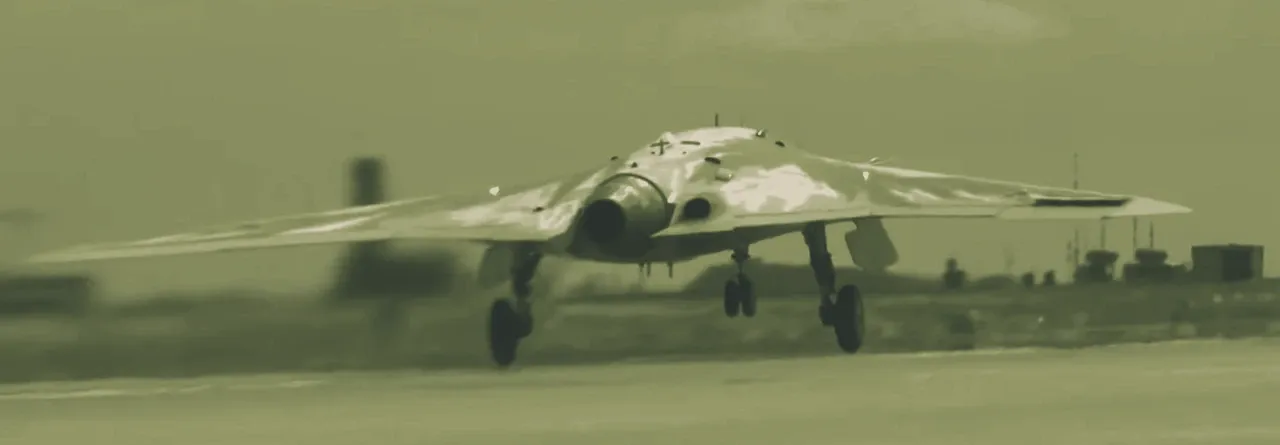
Sukhoi S-70 Okhotnik-B
FIG.01 · Russia Image — The Sukhoi S-70 Okhotnik-B stealth combat drone. Russian MoD / Mil.ru, CC BY 4.0, via Wikimedia Commons.
Russia's heavy, jet-powered, tailless flying-wing stealth combat drone — fighter-sized, with internal weapons bays — built as a "loyal wingman" for the Su-57. Its concept is the same manned-unmanned teaming everyone is chasing; its reality is a program defined by a self-inflicted humiliation, when a Russian fighter shot down its own Okhotnik over Ukraine and handed Kyiv the wreckage.

Overview

The S-70 Okhotnik-B (Охотник, "Hunter") is a heavy stealth uncrewed combat aircraft (UCAV) — a tailless flying wing in the ~20-tonne class with internal weapons bays, one of the largest combat drones of its type. Developed by Sukhoi (with MiG, under United Aircraft Corporation/Rostec) and derived from the cancelled Mikoyan Skat using Su-57 technology, it is conceived as a Su-57 "loyal wingman": flying into contested airspace ahead of the crewed jet to scout, designate targets and deliver internally-carried munitions. It is Russia's entry in the collaborative-combat-aircraft race, and the counterpart to America's Fury and Valkyrie, China's GJ-11 and Russia's own simpler Orion. The essential caveat up front: for all its ambition, the Okhotnik remains a handful of prototypes that is not in serial production, and its advertised stealth and AI autonomy have been publicly undercut — most damningly by the loss of one over Ukraine.

Development

The Okhotnik program traces to 2011-2012, and the first prototype made its maiden flight on 3 August 2019 — a short hop of about 20 minutes, against an advertised 24-hour endurance. It is built at the Novosibirsk aircraft plant (NAPO/Chkalov), and in 2019 Russia demonstrated more than 30 minutes of autonomous teaming between an Okhotnik and a Su-57. Serial production has slipped repeatedly — promised for 2023, then 2024, then 2025 — and as of mid-2026 there is no open-source confirmation of serial production or delivery to the Russian Aerospace Forces, with roughly four prototypes believed to exist.

Design & capabilities

The Okhotnik is a large flying wing of composites and radar-absorbent material, roughly 14 m long with a ~19-20 m wingspan and an MTOW around 25 tonnes. Crucially, the flown prototypes use a single AL-31F engine with a non-stealthy round exhaust nozzle — a flat, low-observable nozzle and a more powerful AL-41F-derivative are only planned — so the airframe's actual stealth is well short of the marketing. It carries weapons in two internal bays (a payload variously reported at ~2,000-2,800 kg; the one confirmed weapon recovered was a UMPB D-30SN glide bomb), and is meant to cruise around 1,000 km/h with a claimed ~6,000 km range (combat radius cited at 3,000-4,000 km). Its control is via datalink with immature autonomy — the advanced AI Russia advertises has not been publicly demonstrated, and a datalink failure is exactly what doomed the one that was lost. (Honest flags: length, wingspan and payload figures conflict across sources; range is a claimed figure; and a "Mach 1.4" speed claim is an outlier to be ignored.)

Variants

No production variants exist — only prototypes, which have themselves differed (e.g. the round-nozzle early aircraft versus the planned flat-nozzle, more-stealthy configuration). Related concepts include a two-seat Su-57 ("Su-57D") proposed as an airborne drone-commander, and an Su-57 + S-70 package pitched for export to India.

Combat record / operational use

The Okhotnik's combat record is a single, defining episode — and it is a failure. On 5 October 2024 a Russian Su-57 deliberately shot down an out-of-control, armed Okhotnik (serial 074) over Kostiantynivka in Donetsk after a datalink failure sent it drifting toward Ukrainian lines. It was likely the first armed flying-wing UCAV used in combat — and an intelligence windfall for Ukraine, which recovered the wreckage despite reported Russian attempts to destroy it. Ukrainian military intelligence's examination found Western microelectronics inside (Analog Devices, Texas Instruments, Xilinx/AMD, Infineon, STMicroelectronics) — evidence of sanctions evasion — alongside the non-stealthy nozzle and a basic radio link, undercutting Russia's stealth, AI and self-sufficiency claims in one stroke.

Advantages

  • Payload and range — the heaviest UCAV in its class, trading attritability for weapons load and reach.
  • Internal carriage — weapons bays preserve (some) low-observability and clean aerodynamics.
  • Su-57 teaming — designed for manned-unmanned teaming with Russia's frontline fighter.
  • Strike-capable — demonstrated carrying a real glide bomb (UMPB D-30SN).

Drawbacks / limitations

  • Not in production — years of slipped timelines; only ~4 prototypes, no confirmed service.
  • Stealth shortfall — round exhaust nozzle and construction details fall short of the claims.
  • Immature autonomy — advanced AI undemonstrated; basic datalink control (and a datalink failure caused the 2024 loss).
  • Sanctions-exposed — depends on Western microelectronics, a production and reliability vulnerability.

Counterparts

The Okhotnik competes conceptually with the US Anduril Fury (YFQ-44A) and General Atomics YFQ-42A, the XQ-58 Valkyrie, China's GJ-11 Sharp Sword and Australia's MQ-28 Ghost Bat — and is the heavier, less-attritable end of that spectrum. Against the Western CCAs, which emphasize cheap mass and mature autonomy software (Hivemind/Lattice), the Okhotnik is a big, expensive, hand-flown airframe whose software has yet to be shown.

Outlook

The Okhotnik embodies Russia's loyal-wingman ambition and the gap between that ambition and delivery. The October 2024 shootdown was a vivid demonstration of both the concept's promise (an armed stealth UCAV operating forward) and its immaturity (a datalink failure, a friendly-fire kill, and a wreckage exposé). The watch-items are basic: any confirmed serial production and VKS service, a genuinely low-observable (flat-nozzle, AL-41F) production configuration, and any evidence the advertised autonomy actually works. Logged at development-stage confidence — a real airframe with unproven claims and a stalled program.

Key specifications

Spec Value
Type Heavy stealth uncrewed combat aircraft (UCAV); tailless flying wing
Role Su-57 loyal-wingman / deep strike & ISR (SEAD/EW claimed)
Length / wingspan ~14 m / ~19-20 m (sources conflict)
MTOW ~25,000 kg (~20-tonne class)
Powerplant 1× AL-31F (flown, round nozzle); flat-nozzle AL-41F-derivative planned
Max speed ~1,000 km/h (subsonic)
Range ~6,000 km claimed; combat radius ~3,000-4,000 km
Payload 2 internal bays, ~2,000-2,800 kg; confirmed: UMPB D-30SN glide bomb
Autonomy Datalink-controlled; advanced AI undemonstrated
Status In development; ~4 prototypes; serial 074 lost Oct 2024; no confirmed serial production

Sources

  1. Sukhoi S-70 Okhotnik-B — Wikipedia
  2. Russia's S-70 Hunter drone was armed when shot down by a friendly fighter over Ukraine — The War Zone
  3. Russia shoots down its own advanced stealth drone over Ukraine — BBC
  4. The downed S-70 Okhotnik-B debunked its developers' claims — Frontliner
  5. Western components in Russia's Okhotnik: expertise details — Ukraine Defence Intelligence (GUR)
  6. First flight of Russia's S-70 Okhotnik-B UCAV — RUSI
  7. New details emerge on Russia's S-70 drone loss over Ukraine — Defence Blog
  8. S-70 Okhotnik-B Hunter UCAV — Army Recognition
  9. Putin's wingman: the S-70 drone built to fight the West — The National Interest
  10. S-70 Okhotnik-B — US Army ODIN / Worldwide Equipment Guide
🔒 The Analyst Section on Sukhoi S-70 Okhotnik-B is for BattlePolicy Pro members. Below the line: procurement and contract history, the suppliers and companies behind the system, our head-to-head analyst view of the systems it actually competes with, and the BattlePolicy assessment note. Unlock the full file with BattlePolicy Pro →
Related
Ukraine · Russia · air defense

Russia's 3,000-a-Month Jet Gerans Outrun Ukraine's $2,000 Interceptors

Russia flew 76 jet-powered Gerans at Ukraine in daylight on Aug. 18. Turbojet drones now reach two-thirds of some waves and roll off Alabuga at about 3,000 a month, faster than the $2,000 interceptors that beat the Shahed. Kyiv's jet-powered answer is still in combat testing.