GRID-REF 37°47′N 122°25′W
DISPATCH 02/26 · 11 Jun 2026
BATTLEPOLICY
Startup to front line. Strategy to consequence.
Lexicon · Israel

SPICE

Israel's GPS-independent electro-optical bomb kit and glide-weapon family — a scene-matching system that converts unguided bombs into precision stand-off munitions, proven from Balakot to Tehran.
SPICE
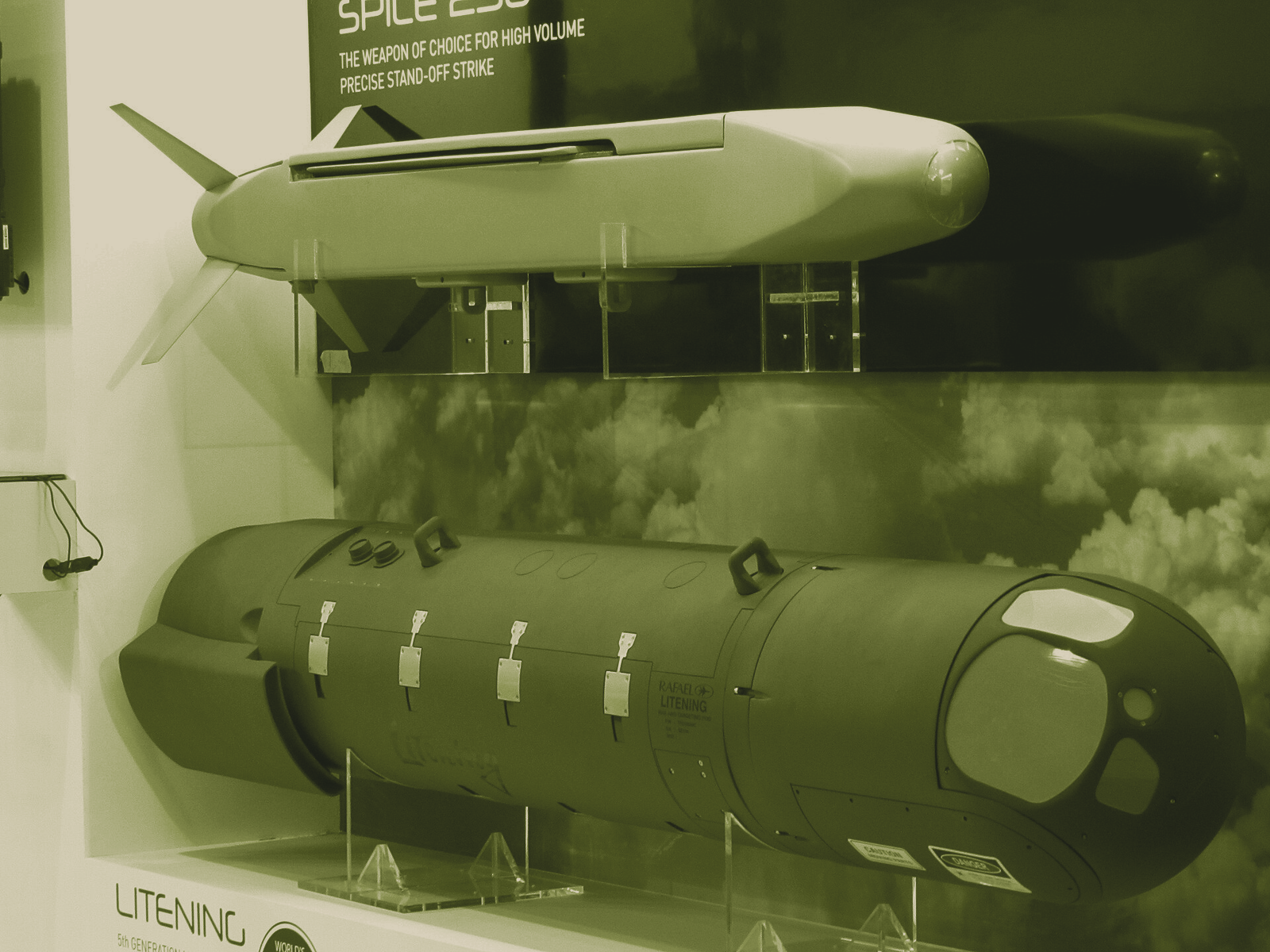
FIG.01 · Israel Image - SPICE precision-guided bomb. Photo by rhk111, CC BY-SA 4.0, via Wikimedia Commons.
Israel's GPS-independent electro-optical bomb kit and glide-weapon family — a scene-matching system that turns unguided bombs into precision stand-off munitions, proven from Balakot to Tehran.

Overview

SPICE — Smart, Precise Impact, Cost-Effective — is a family of stand-off precision weapons developed by Rafael Advanced Defense Systems. It exists both as add-on guidance kits that transform general-purpose and penetrator bombs into long-range smart munitions (SPICE 1000 and SPICE 2000) and as complete, purpose-built glide weapons (SPICE 250 and the turbojet-powered SPICE 250 ER). The defining edge is an autonomous electro-optical scene-matching terminal seeker that locks onto a pre-stored reference image, removing the dependency on satellite navigation that jammers can exploit. That architecture has made SPICE the Israel Air Force’s standard stand-off family and attracted an expanding list of international operators.

Development

Rafael built SPICE on guidance heritage from the Popeye (AGM-142 Have Nap) missile. The kit reached initial operational capability with Israeli F-16 squadrons in 2003, converting dumb 2,000 lb iron bombs into stand-off weapons with tail-mounted control fins, according to GlobalSecurity. An upgraded SPICE 1000 with deployable wings entered IAF inventory in 2018. In June 2019 Rafael publicly demonstrated an AI-driven Automatic Target Recognition (ATR) capability on the SPICE 250, enabling the weapon to autonomously identify and lock onto a target from its stored image library without operator cueing. The family expanded again in February 2021 when the SPICE 250 ER — a mini-turbojet variant with a range of at least 150 km — was unveiled at Aero India. For the US market, Lockheed Martin signed a teaming agreement with Rafael in May 2019 covering SPICE 1000/2000 kits, and the deal was broadened in November 2021 to make SPICE 250 available to US forces and Poland for the first time; Lockheed Martin at the time noted that “GPS is not required to operate any of the products within the SPICE family.” India established local co-production through Kalyani Rafael Advanced Systems, and on 29 December 2025 approved a procurement of up to 1,000 additional SPICE-1000 kits under a package valued at approximately $8.7 billion.

Design & capabilities

Every SPICE weapon flies an INS/GPS mid-course before handing off to an autonomous electro-optical seeker (CCD/IIR) that matches the observed scene against stored reference imagery. The system can ingest up to 100 target scenes per weapon, allowing a single round to select among multiple aimpoints, and the on-board Automatic Target Acquisition and deep-learning Automatic Target Recognition algorithms handle final lock-on without operator intervention. A man-in-the-loop option exists via a two-way datalink, though it can only manage one weapon at a time. Because the terminal phase is driven by optical scene-matching rather than satellite signals, the entire family is GPS-independent, retaining full accuracy even in jammed environments.

Rafael claims a circular error probable (CEP) of less than 3 meters (10 feet) and a 95% target-acquisition probability, per Israel Defense. The SPICE 2000 kit mates to 2,000 lb (907 kg) bodies — Mk 84 blast bombs, BLU-109 penetrating warheads, or RAP-2000 rockets — and uses tail-mounted control fins for a range of about 60 km. The SPICE 1000 fits 1,000 lb (453 kg) bodies and adds deployable wings, extending its reach to roughly 100 km (trade press reports cite up to 125 km). The SPICE 250 is a compact 125 kg all-up round carrying a 75 kg blast-fragmentation or penetration warhead; it can be carried four to a Smart Quad Rack, allowing an F-15 to haul 28 rounds. The SPICE 250 ER adds a miniature turbojet running on JP-8/10, stretching range to ≥150 km while preserving the same form factor and rack compatibility.

Variants

  • SPICE 2000 – kit for 2,000 lb Mk 84/BLU-109/RAP-2000 class warheads; ~60 km range; the heavy penetrator configuration used at Balakot and across Gaza/Beirut.
  • SPICE 1000 – kit for 1,000 lb bodies with deployable wings; ~100 km (to ~125 km per trade press); cleared for Israeli F-35s; subject of India’s December 2025 reorder.
  • SPICE 250 – 125 kg all-up glide round, 75 kg warhead, ~100 km, four-per-Smart Quad Rack; man-in-the-loop datalink.
  • SPICE 250 ER – turbojet-powered derivative, ≥150 km, same airframe/rack; selected for Germany’s Eurofighter EK program through a Diehl/Hensoldt partnership.

Combat record / operational use

SPICE entered Israeli service in 2003 and has been a central pillar of every major IAF air operation since. During the May 2021 Gaza conflict a SPICE bomb destroyed the Al-Sharouk tower in Gaza City. In the 2023 Gaza war the first documented SPICE 2000 strike occurred on 11 October at Khan Yunis, with further December strikes captured on video; investigators cited by Business Insider noted that the 2,000 lb blast effects extended up to 365 meters for fragments, prompting criticism when the weapon was used in dense urban areas. In October 2024 an Associated Press photograph caught a SPICE 2000 in flight moments before it leveled a Hezbollah-linked building in Beirut.

The type’s most widely reported foreign employment came on 26 February 2019, when Indian Mirage 2000 fighters launched five SPICE 2000 penetrators — each roughly 900 kg with an 80 kg explosive fill on time-delay fuses — against a Jaish-e-Mohammed camp near Balakot, Pakistan; open-source reporting noted that three weapons may have missed by tens of meters, though the overall effect was assessed as successful. During the 2025-2026 campaigns against Iran (Operation Rising Lion and Roaring Lion) the IAF deliberately employed SPICE 1000 and SPICE 250 on long-range missions into heavily jammed airspace over Tehran, with the Jerusalem Post reporting that the weapon’s GPS-independent image-matching was the stated reason for its selection. Rafael production lines ran “around the clock,” and the IDF expended more than 5,000 munitions in the opening phase of the 2026 campaign. The same reporting indicates SPICE 250s were used in Yemen, including against explosive-laden boats, with aircraft carrying up to 16 of the weapons to hunt mobile missile launchers and air-defense batteries.

Advantages

  • Genuine GPS-independence: terminal scene-matching maintains sub-3 m accuracy under heavy jamming that would defeat satellite-guided munitions.
  • AI-based automatic target recognition and up to 100 stored target scenes per weapon permit high-volume, simultaneous autonomous strikes — up to 28 SPICE 250s on a single F-15.
  • Combat-proven across four theaters and two air forces, with documented building-level precision from Gaza to Tehran.
  • Kit economics convert existing dumb-bomb stockpiles into 60–100 km stand-off weapons at far lower cost than powered missiles, with a common mission-planning system across the family.
  • Industrial depth: Lockheed Martin teaming for US/Polish sales, Kalyani Rafael co-production in India, and a Diehl/Hensoldt partnership for Germany’s Eurofighter EK, with over 60% of SPICE content already US-manufactured.

Drawbacks / limitations

  • Scene-matching demands up-to-date reference imagery and a recognisable optical scene; the Balakot miss-distance debate underscores that real-world accuracy can deviate from the 3 m CEP claim.
  • The heavyweight SPICE 2000’s blast effects in dense urban terrain drew sustained criticism during the Gaza war, with UN-experienced investigators calling the 2,000 lb class “overkill” and noting lethal blast to ~30 m and fragment reach to ~365 m.
  • Unpowered glide versions force the launch aircraft inside ~60–100 km, keeping it closer to long-range surface-to-air threats than a powered cruise weapon would; only the SPICE 250 ER fixes this, with the trade-off of the smallest warhead.
  • Man-in-the-loop guidance can steer only one weapon at a time, and the electro-optical seeker remains sensitive to weather and obscurants in the terminal phase, reverting to INS/GPS if vision is lost.
  • No published unit-cost or production-rate figures make procurement comparisons opaque.

Counterparts

Outlook

The intense GPS-jamming environments of the Iran campaigns have vindicated SPICE’s bet on optical scene-matching over satellite navigation, making it one of the most heavily expended Western-aligned precision weapons in active service. Growth vectors are clear: the turbojet 250 ER pushes the family into powered stand-off territory with a launch customer in Germany, Lockheed Martin’s teaming keeps the door open for wider US adoption, and India’s billion-dollar reorder anchors export volume. The twin challenges are stockpile depletion at 2026 expenditure rates and the collateral-damage politics that now shadow the 2,000 lb class in urban campaigns.

Key specifications

Spec Value
Type Precision glide-bomb guidance kit (SPICE 1000/2000) & autonomous glide munition (SPICE 250/250 ER)
Range SPICE 2000: ~60 km; SPICE 1000: ~100 km (to ~125 km per trade press); SPICE 250: ~100 km; SPICE 250 ER: ≥150 km
Speed (Mach / km·s⁻¹) Not publicly established (unpowered glide; SPICE 250 ER high-subsonic, no figure published)
Warhead (type & weight) SPICE 2000: ~907 kg host warhead (Mk 84/BLU-109/RAP-2000, ~80 kg fill); SPICE 1000: ~453 kg class; SPICE 250: 75 kg blast-fragmentation/penetration (125 kg all-up round)
Guidance INS/GPS midcourse + autonomous electro-optical (CCD/IIR) scene-matching with AI automatic target recognition; man-in-the-loop option; GPS-independent
Accuracy (CEP) <3 m (manufacturer claim; 10-ft per Rafael fact sheet); 95% acquisition probability
Launch platform(s) F-15, F-16, F-35 (SPICE 1000), Mirage 2000, Tornado, Gripen, Su-30 MKI, FA-50-class; up to 28 SPICE 250 on F-15 via Smart Quad Racks
Propulsion None (glide); SPICE 250 ER: miniature turbojet
Length / diameter / launch weight Dimensions not publicly established; launch weights ~907 kg class (SPICE 2000), ~453 kg class (SPICE 1000), 113–125 kg (SPICE 250)

Sources

  1. Wikipedia — “Spice (bomb).” https://en.wikipedia.org/wiki/Spice_%28bomb%29
  2. Lockheed Martin — “Lockheed Martin, Rafael partner to develop SPICE-250 weapon system for US military.” https://news.lockheedmartin.com/Lockheed-Martin-Rafael-partner-to-develop-SPICE-250-weapon-system-for-U-S-Military
  3. GlobalSecurity.org — “SPICE [Smart, Precise Impact and Cost-Effective].” https://www.globalsecurity.org/military/world/israel/spice.htm
  4. EDR Magazine — “Rafael extends SPICE 250 range with new turbojet engine.” https://www.edrmagazine.eu/rafael-extends-spice-250-range-with-new-turbojet-engine
  5. Airforce Technology — “Spice 250 Precision Guided Munition, Israel.” https://www.airforce-technology.com/projects/spice-250-precision-guided-munition/
  6. India Today — “SPICE-2000: Know all about the smart bomb Indian Air Force used for Balakot airstrike.” https://www.indiatoday.in/fyi/story/spice-2000-indian-air-force-balakot-airstrike-mirage-jets-1470988-2019-03-05
  7. Hindustan Times — “On Balakot anniversary, IAF video shows jets bombing target with Spice 2000 bombs.” https://www.hindustantimes.com/india-news/iaf-chief-flies-mirage-2000-to-mark-2nd-anniversary-of-balakot-operations-101614435945744.html
  8. Business Insider — “Israel's 2,000-pound SPICE bombs are highly accurate but could be overkill in Gaza.” https://www.businessinsider.com/israel-pounding-gaza-massive-spice-kit-bombs-2023-12
  9. The Jerusalem Post — “The advanced Israeli-tech helping US and Israeli pilots strike their targets in Iran.” https://www.jpost.com/defense-and-tech/article-888948
  10. Israel Defense — “Meet the SPICE Smart Bomb Guidance Kit Employed by the Israel Air Force.” https://www.israeldefense.co.il/en/node/60046
FIELD DISPATCH · WEEKLY

BattlePolicy Weekly — free.

Defense tech, startups, and security — weekly. No paywall.

Related
Israel · missiles · precision-guided · mortar · 120mm · elbit-systems · iron-stingPro

Iron Sting

Israel's 120 mm precision-guided mortar munition, the Iron Sting, transforms any standard smoothbore tube into a room-level, dual-mode (GPS/laser) strike asset — combat-proven since October 2023 in Gaza and Lebanon.

Israel · missiles · precision-guided · mortar · 120mm · elbit-systems · iron-sting
Israel · missiles · cruise-missile · loitering-munition · standoff-strike · man-in-the-loopPro

Delilah

Israel's air-launched turbojet loitering cruise missile — man-in-the-loop precision and multi-platform flexibility from F-16s to PULS MLRS. Combat-proven since the 2006 Lebanon War, and used to suppress Iranian air defences in the 2026 Iran campaign.

Israel · missiles · cruise-missile · loitering-munition · standoff-strike · man-in-the-loop
Israel · drones · uas · tactical-uas · isr · istar · vtol · orbiter · aeronautics · RafaelPro

Orbiter 4

Israel's Aeronautics Orbiter 4 is a Group 3 tactical UAS that packs 12 kg dual-payload ISR capability — EO/IR, SAR, SIGINT — into a 50 kg airframe with a 24-hour endurance and field-switchable VTOL option, already combat-proven in Gaza as the IAF's Nitzoz.

Israel · drones · uas · tactical-uas · isr · istar · vtol · orbiter · aeronautics · Rafael