GRID-REF 37°47′N 122°25′W
DISPATCH 02/26 · 9 Jun 2026
BATTLEPOLICY
Startup to front line. Strategy to consequence.
Lexicon · USA

THAAD

The Terminal High Altitude Area Defense — a wheeled, hit-to-kill interceptor system that destroys short- and medium-range ballistic missiles in their terminal phase, both inside and just above the atmosphere.
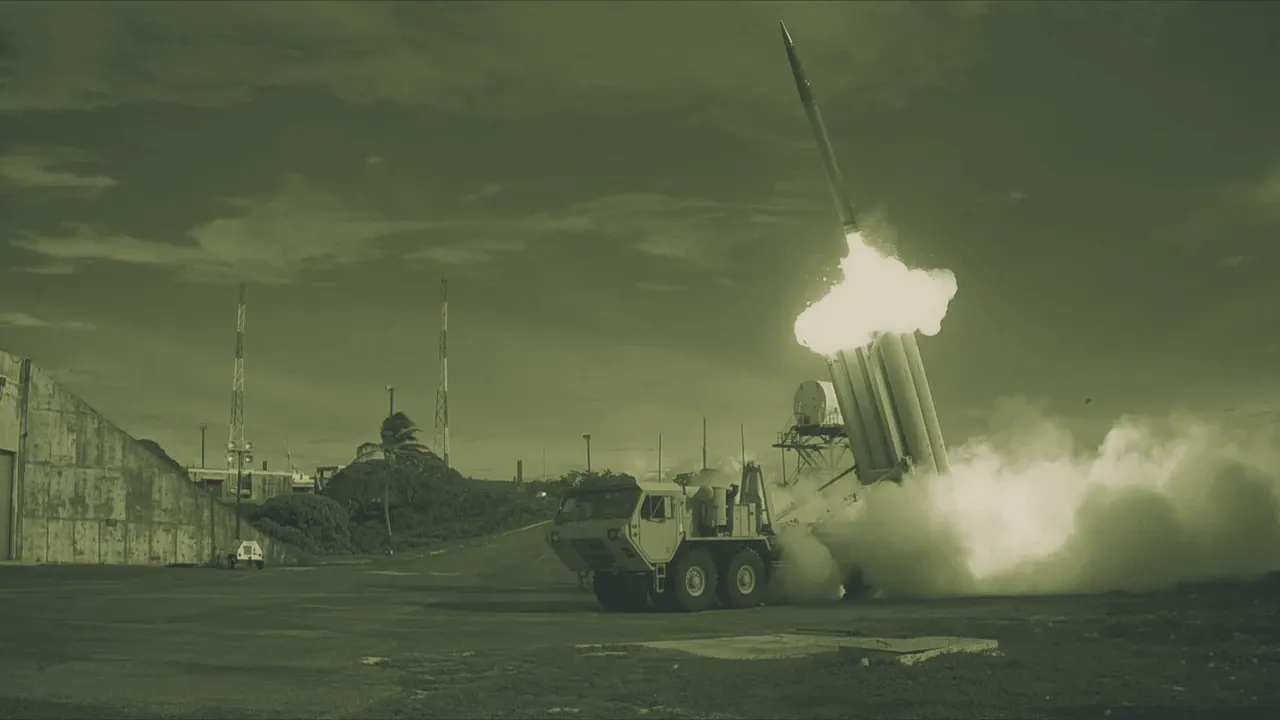
THAAD
FIG.01 · USA Image - THAAD. Photo by The U.S. Army Ralph Scott/Missile Defense Agency/U.S. Department of Defense, Public domain, via Wikimedia Commons_interceptors_is_launched_during_a_successful_intercept_test_-_US_Army.jpg).
The Terminal High Altitude Area Defense — a wheeled, hit-to-kill interceptor system that destroys short- and medium-range ballistic missiles in their terminal phase, both inside and just above the atmosphere, and the only dedicated upper-tier BMD layer to have seen combat.

Overview

THAAD is a mobile terminal-phase ballistic missile defense system fielded by the United States and sold to the UAE and Saudi Arabia. A battery combines a long-range X-band radar, six to eight truck-mounted launchers, and a pair of fire-control and communication nodes into a single road-mobile unit designed to intercept short-, medium-, and limited intermediate-range ballistic missiles at altitudes between the low endo-atmospheric and exo-atmospheric regimes. Unlike the Patriot and S-400 families, THAAD engages no aerodynamic targets—it is purpose-built for the ballistic-missile kill chain.

Development

Lockheed Martin developed the THAAD interceptor and system integration, while Raytheon/RTX supplied the AN/TPY-2 radar. The program passed its first successful hit-to-kill intercept in 1999 and was formally fielded in 2008, with the first operational battery activated that year. Production continues, and the U.S. Army fields at least seven batteries, each comprising about 95 soldiers, six launchers, 48 ready interceptors, one AN/TPY-2 radar, and two tactical operations centers, according to a Congressional Research Service overview and the service’s own order-of-battle data. CRS Wikipedia

Design & capabilities

The THAAD kill vehicle carries no explosive warhead; it destroys its target by sheer kinetic force, striking the incoming re-entry vehicle at hypersonic closing speeds. Each launcher holds eight canisterised interceptors, giving a single battery 48 ready rounds that can be salvoed as needed. The system’s engagement envelope reaches out to roughly 150–200 km in range and up to 150 km in altitude, covering the high-endo-atmospheric and low-exo-atmospheric layers where other SAMs typically cannot fight. MissileStrikes Middle East Monitor

The AN/TPY-2 radar is the battery’s eyes: an X-band, phased-array transportable system that can detect and track ballistic missiles at ranges reportedly up to 3,000 km, depending on operating mode. It shares data with Patriot and Aegis BMD assets through the Army’s Integrated Air and Missile Defense Battle Command System (IBCS). The entire battery is road-mobile and can be lifted by C-130 or C-17 aircraft, allowing rapid deployment to a theatre. Wikipedia radar

The system has no published reaction time, but its sensor-to-shooter loop is designed for rapid engagements against salvos of ballistic missiles.

Combat record / operational use

THAAD first saw combat in 2022 when a battery operated by the United Arab Emirates intercepted Houthi ballistic-missile salvos launched from Yemen, marking the system’s operational debut. MissileStrikes In October 2024 a U.S. THAAD battery was rushed to Israel, and it was subsequently employed during the Iranian ballistic-missile exchanges between late 2024 and early 2025. U.S. officials have repeatedly cited the system’s near-perfect test record—no fewer than 15 out of 15 intercepts in operational-style tests—as the justification for its combat confidence. CNN CRS

Advantages

  • Pure hit-to-kill lethality; no warhead removes the risk of unexploded ordnance or blast-frag-based miss.
  • Engages at the high-endo/exo-atmospheric boundary, giving a second chance when lower-layer systems fail.
  • Highly mobile—wheeled TELs and a transportable radar—enabling expeditionary deployments.
  • Interoperable with Patriot and Aegis BMD via IBCS, forming a layered missile-defense shield.
  • Demonstrated success in combat and a near-perfect test history.

Drawbacks / limitations

  • No capability against aircraft, cruise missiles, or drones; the interceptor has no aerodynamic-target seeker.
  • Small ready magazine—48 interceptors per battery—can be overtaxed by a mass salvo of ballistic missiles.
  • Very high cost: a battery costs upwards of $800 million historically (full-lifecycle estimates approach $2.5 billion) and each interceptor ~$11–12 million.
  • The AN/TPY-2’s powerful X-band emissions make the radar an attractive SEAD/anti-radiation target.
  • Range and altitude are insufficient against intercontinental or advanced long-range ballistic missiles with maneuvering re-entry vehicles.

Counterparts

  • S-400 Triumf (Russia) — long-range layered SAM with some anti-ballistic capability in the 40N6 missile claim.
  • HQ-9B (China) — long-range SAM with limited terminal-BMD ambitions, unproven in combat.

Outlook

THAAD remains in serial production and is the only upper-tier, hit-to-kill terminal BMD system to have proved itself in war. Demand from Gulf partners continues, and the U.S. Army is exploring modest upgrades in interceptor agility and seeker sensitivity. While it will never be a mass-fielded weapon, its niche as the “upper-layer hammer” of the U.S. missile-defense shield is secure.

Key specifications

Spec Value
Type Mobile terminal-phase ballistic missile defense system
Engagement range ~150–200 km
Engagement altitude up to ~150 km (high-endo to low-exo-atmospheric)
Target set short-, medium-, and limited intermediate-range ballistic missiles (terminal phase)
Interceptor(s) THAAD hit-to-kill interceptor (no warhead)
Radar / fire control AN/TPY-2 X-band transportable radar; integrated with IBCS
Reaction time not publicly established
Simultaneous engagements 48 ready interceptors per battery; salvos possible
Mobility wheeled TELs; C-130/C-17 transportable

Sources

  1. CRS — The THAAD System (IF12645) — https://www.congress.gov/crs-product/IF12645
  2. Wikipedia — Terminal High Altitude Area Defense — https://en.wikipedia.org/wiki/Terminal_High_Altitude_Area_Defense
  3. Wikipedia — AN/TPY-2 transportable radar — https://en.wikipedia.org/wiki/AN/TPY-2_transportable_radar
  4. CNN — What is THAAD? — https://www.cnn.com/2024/10/14/middleeast/thaad-missile-interceptors-israel-defense-intl-hnk-ml/index.html
  5. Middle East Monitor — US to deploy THAAD in Israel — https://www.middleeastmonitor.com/20241015-us-to-deploy-thaad-missile-defence-system-in-israel-to-be-operational-against-ballistic-and-hypersonic-missiles/
  6. MissileStrikes — THAAD: Specs, Combat Record — https://missilestrikes.com/weapons/thaad/
FIELD DISPATCH · WEEKLY

BattlePolicy Weekly — free.

Defense tech, startups, and security — weekly. No paywall.

Related
Ukraine · USA · Funding · Swarmer · drones · defense tech · venture capital · Pentagon

Ukraine turned its drone war into an industry. Now Wall Street is pricing it.

Swarmer's Nasdaq debut, a wave of Western venture money and a Pentagon FPV contract show Ukrainian defense tech crossing from battlefield to balance sheet, at a valuation that has outrun the revenue.

Ukraine · USA · Funding · Swarmer · drones · defense tech · venture capital · Pentagon
USA · Autonomy · Shifters · Ace Capital Partners

Shifters raises $10.2M to put robots first into tunnels and rubble

The US-Israeli startup raised a $10.2 million seed led by Ace Capital Partners to scale ground robots that enter tunnels and rubble before troops.

USA · Autonomy · Shifters · Ace Capital Partners
USA · Policy · AI · Anthropic · autonomous weapons · Pentagon

Trump orders faster military AI and bars vendors from switching off fielded models

A new national security memo tells the Pentagon to onboard frontier commercial AI at speed, strips vendors of the power to shut it down mid-mission, and resets the rules for autonomous weapons within 90 days.

USA · Policy · AI · Anthropic · autonomous weapons · Pentagon