Ukraine Finished the Refinery List. Now It Has to Keep Them Offline.
A $50,000 drone flew 2,500 kilometers to Omsk and completed a target list Kyiv worked through for two years. Reach is no longer the problem. What remains is a race between repair crews and strike tempo, and a second front against the tankers that move whatever Russia still refines.
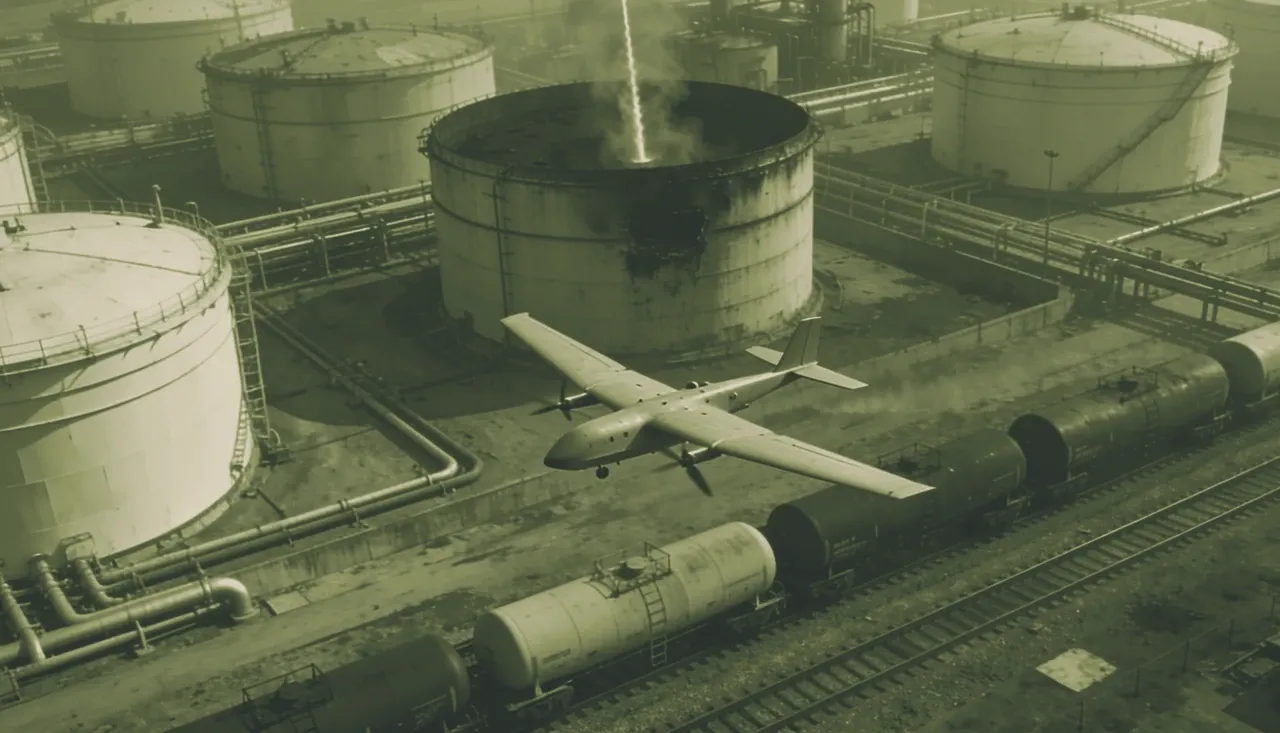
A $50,000 drone flew 2,500 kilometers to Omsk and crossed off the last name on a list Kyiv has worked through for two years. Reach is no longer the problem. What remains is a race between Russian repair crews and Ukrainian strike tempo, plus a second front against the tankers that move whatever still gets refined.
Ukraine has run out of major Russian refineries to hit for the first time, and that is now the campaign's central problem. On the night of July 6, roughly seven Ukrainian drones flew more than 2,500 kilometers to strike the Omsk refinery in western Siberia, the Kyiv Independent reported, citing Ukraine's General Staff. The military described Omsk as the last of Russia's 11 largest gasoline producers to be struck during the full-scale invasion. That claim comes from Kyiv and has not been independently verified, but the mapping done by United24 Media of all 11 plants is consistent with it.
Omsk was the one that was supposed to be out of range. It processed about 22 million metric tons of crude in 2024, roughly 440,000 barrels a day, and turned out 5 million tons of petrol and 8 million tons of diesel, Reuters reported. Two industry sources told the agency the plant halted processing after the strike, and exchange data showed it stopped offering gasoline and diesel on the St. Petersburg commodity exchange from Tuesday.
Which unit took the worst of it is still disputed, as the Kyiv Post noted. Ukraine's General Staff said preliminary assessments pointed to the ELOU-AVT-11 primary refining unit, rated at 8.4 million tons a year. Reuters' sources instead described a fire at the CDU-10 crude distillation unit, about 38% of the refinery's processing capacity at 24,580 tons a day, with a second unit, CDU-11, shut after damage to supporting infrastructure and expected back sooner, according to OilPrice.com.
The consequences are already at Russian pumps. Almost all of Russia's 83 regions report gasoline shortages or supply disruption, CNN found in an analysis of official statements and local reporting, with more than 50 regions acknowledging problems officially and Irkutsk and Transbaikal declaring a state of heightened alert. Kpler's lead refining analyst, Sumit Ritolia, estimates Russian gasoline production is running about 20% below domestic demand. Energy analysts cited by Fortune put a quarter or more of Russian refining capacity offline. On July 8, Deputy Prime Minister Alexander Novak announced a ban on diesel exports through the end of July. Global benchmark diesel prices rose almost 13% on Wednesday before easing back, CNN reported, citing Intercontinental Exchange data.
A $50,000 drone beat a $500,000 missile
The aircraft that reached Omsk was new. It was an Extended Range variant of Fire Point's FP-1, Euromaidan Press reported: longer wings, extra fuel, and a range that Fire Point designer Denys Shtilerman puts at 3,400 kilometers, more than triple the original. The basic FP-1 costs about $50,000. Fire Point says it builds 300 FP-1s and comparable FP-2s a day.
Russia's defenses had beaten the expensive alternative two days earlier. On July 4 Russian forces sortied a rare Beriev A-50U radar aircraft, picked up a flight of Fire Point FP-5 cruise missiles heading for targets deep inside Russia, and shot all of them down. The FP-5 runs to roughly $500,000. On July 6 an A-50U and a Su-57 both hunted the Omsk-bound drones. Michael Bohnert, an analyst at RAND, told Euromaidan Press it was the first time he had seen both platforms operating in the same place, and that the drones flew low enough that the radars could not separate them from the terrain.
Seven drones at roughly $50,000 each puts the cost of the Omsk raid near $350,000, below the price of a single FP-5. Fire Point recently enlarged the FP-1 warhead from 60 kilograms to 105, and David Axe wrote in Euromaidan Press that the damage at Omsk points to the heavier version. Bohnert reckons the drones were tracked for hours on the way in, because an FP-1 is slow and would have taken hours to reach Omsk.
The repairers versus the attackers
Completing the target list converts the campaign from a reconnaissance problem into an attrition problem, and that is a harder fight to win. Sergey Vakulenko, who spent 25 years in the Russian oil and gas industry and is now a senior fellow at the Carnegie Russia Eurasia Center, framed it precisely in comments to CNN: "In this race between the repairers and the attackers the balance is shifting." He credited both the frequency of attacks and the number of drones per attack.
Russia's repair crews are competent, and the Kremlin has cut planned maintenance schedules to buy capacity, per Putin's own accounting on state television. Some plants stay down for a long time. United24 Media reports the Moscow refinery at Kapotnya, which supplied around 60% of the capital region's fuel, is expected to remain offline until early 2027, while Ryazan has been suspended since May 15 and Syzran shut after damage to its AVT-6 unit. David Axe, writing in Euromaidan Press, expects Omsk itself may return to service before long, and wrote that the July 6 raid is unlikely to be a one-off.
Two structural facts favor Kyiv. Sanctions choke the imported spare parts that secondary units need, so the repairs that matter most are the slowest. And the strikes are landing at the start of Russia's high-demand season, which Ritolia notes runs until September. Russia has been reduced to buying gasoline from India, according to Reuters, and Kommersant reports the government weighing lower-quality fuel onto the market. The central bank trimmed rates by only a quarter point this month, citing "a temporary contraction in motor fuel production." Putin, in the same state television appearance where he called the shortages "not critical," said the most urgent task was to increase production of air-defense systems.
Brovdi's 35 ships
Ukraine opened a second line of attack this week, against the ships that move fuel rather than the plants that make it. Over four days its Unmanned Systems Forces struck 35 tankers, dry cargo ships and support vessels, commander Robert "Madyar" Brovdi said on Telegram, including 14 overnight into July 9. Ukraine's Defence Ministry gave CBC News a count of 36 vessels, of which 32 were shadow-fleet tankers. The General Staff confirmed 12 tankers, a tugboat and a dry cargo ship in the latest wave. Brovdi named the ships, among them the Chelsea-6, the Ilya Repin and the Panamanian-flagged Galiaskar Kamal, and said the shadow fleet was "thinning."
These are Ukrainian claims, and the counts vary by outlet and by window. The SBU published footage of one of them. On July 8 a Sea Baby naval drone hit the stern of the Suezmax tanker Blue near occupied Yalta, inside Ukraine's exclusive economic zone, causing what the agency called significant damage. The Institute for the Study of War logged the strike in its July 8 assessment.
Ukraine's General Staff said the vessels carried fuel and lubricants to Russian military units and moved petroleum products around sanctions. Those hulls are harder to replace than a damaged distillation column, because the shadow fleet exists to carry cargo that mainstream shipping and insurance markets refuse. Brovdi said two tankers hit earlier in the week were delivering a combined 7,000 metric tons of fuel to Crimea, about 200 rail tank cars by his reckoning, and that between July 1 and 5 his units struck 37 energy nodes across the occupied peninsula and southern Ukraine. Crimea's occupation authorities suspended fuel sales to civilians outright on June 21.
NATO prices the problem at $40 billion
At the NATO Summit Defence Industry Forum in Ankara on July 7, the day after the Omsk raid, allies committed more than $40 billion over five years to counter-drone capabilities under an initiative called Drone Edge, according to NATO. The alliance said members would train five times as many drone operators by the end of 2027, that Finland, France and Sweden had joined its flight-training program, and that its Support and Procurement Agency had awarded a surveillance-drone contract worth hundreds of millions of dollars. Britain used the same summit to unveil a $50 billion deep-precision-strike push with about a dozen European partners. Defense News reported that the figure aggregates programs already underway, including a £3 billion British contribution, and described the initiative as pooling rather than building. Germany signed a letter of intent on July 7 for the ground-launched Tomahawk, as many as 400 Block Vb rounds worth more than $1 billion, The War Zone reported. Chancellor Friedrich Merz told the Bundestag the purchase would "close an important strategic gap." The longest-range indirect-fire system the German army fields today, the MARS II rocket launcher, reaches about 43 miles.
NATO's $40 billion over five years is aimed at a class of weapon whose decisive example, by Euromaidan Press's accounting, costs $50,000 and comes off a line at 300 a day. Germany's 400 Tomahawks at more than $1 billion work out near $2.5 million a round, at a range Shtilerman claims his $50,000 airframe already exceeds.
European defense equities have moved the other way. Rheinmetall is down roughly a third year to date, CNBC reported, including a near-19% fall after Berlin reversed plans to buy six warships. KNDS, the Franco-German maker of the Leopard 2, postponed its Paris and Frankfurt listing on July 1, saying the process would resume "upon the return of more favorable market conditions" after failing to persuade investors to back a valuation above €12 billion, against earlier talk of €25 billion. Czechoslovak Group jumped 33% on its January debut and has since given up about 60% of its value. CNBC reported that investors are questioning whether Europe's defense spending boom can translate into earnings growth quickly enough.
What to watch
The near-term test is Omsk's restart date, and whether Ukraine strikes the plant a second time once it restarts. At sea, watch whether Russia's shadow-fleet losses show up as fewer sailings into the Sea of Azov or as replacement hulls. Vakulenko wrote in June that the Russian oil industry's resilience is being stretched dangerously thin. Novak's diesel export ban runs to July 31, and Morningstar strategist Michael Field told CNBC that KNDS could revive its listing later this year if sentiment improves.
Frequently Asked Questions
What made the Omsk strike different from earlier refinery attacks?
Distance and finality. Omsk sits more than 2,500 kilometers from Ukraine's border in western Siberia, and Ukraine's General Staff described it as the last of Russia's 11 largest gasoline producers to be hit, per the Kyiv Independent. Euromaidan Press reported the raid used a new extended-range variant of Fire Point's FP-1 drone.
How much does the drone that hit Omsk cost?
About $50,000 in its basic configuration, according to Euromaidan Press, against roughly $500,000 for Fire Point's FP-5 cruise missile. Fire Point says it produces 300 FP-1s and comparable FP-2s per day.
How bad is Russia's fuel crisis?
CNN's analysis found almost all of Russia's 83 regions reporting gasoline shortages or supply disruption. Kpler analyst Sumit Ritolia estimates gasoline production is running about 20% below domestic demand, and energy analysts cited by Fortune put a quarter or more of refining capacity offline. Russia banned diesel exports through the end of July.
Why is Ukraine attacking tankers instead of only refineries?
Because a damaged refinery is a repair problem and a damaged sanctioned tanker is a replacement problem. Ukraine's Unmanned Systems Forces said they struck 35 vessels in four days; Ukraine's Defence Ministry told CBC News the count was 36, including 32 shadow-fleet tankers. The SBU hit the Suezmax tanker Blue with a Sea Baby naval drone on July 8.
What is NATO's Drone Edge initiative?
A commitment announced at the Ankara summit on July 7 to invest more than $40 billion over five years in counter-drone capabilities, train five times as many drone operators by the end of 2027, and set up a marketplace of NATO-tested counter-drone systems, according to NATO.
Are the Ukrainian strike claims independently verified?
Not fully. The vessel counts and the "last of 11 refineries" milestone come from Ukraine's military and vary between outlets. Reuters confirmed through two industry sources that the Omsk refinery halted processing, and the Kyiv Post noted that damage assessments conflict.
AI-generated summary, reviewed by an editor. More on our AI guidelines.

Marcus Schuler
Marcus Schuler edits BattlePolicy, a daily defense-technology brief connecting the companies and capabilities behind modern war to the contest among Europe, the US, Russia, and China.