Ukraine Turned the Russian Arsenal Into a Catalog for Its Allies
Ukraine's new TrophyLab portal hands vetted allies the blueprints, teardowns, and physical samples of captured Russian weapons. The real export is the time an ally saves building what defeats it.
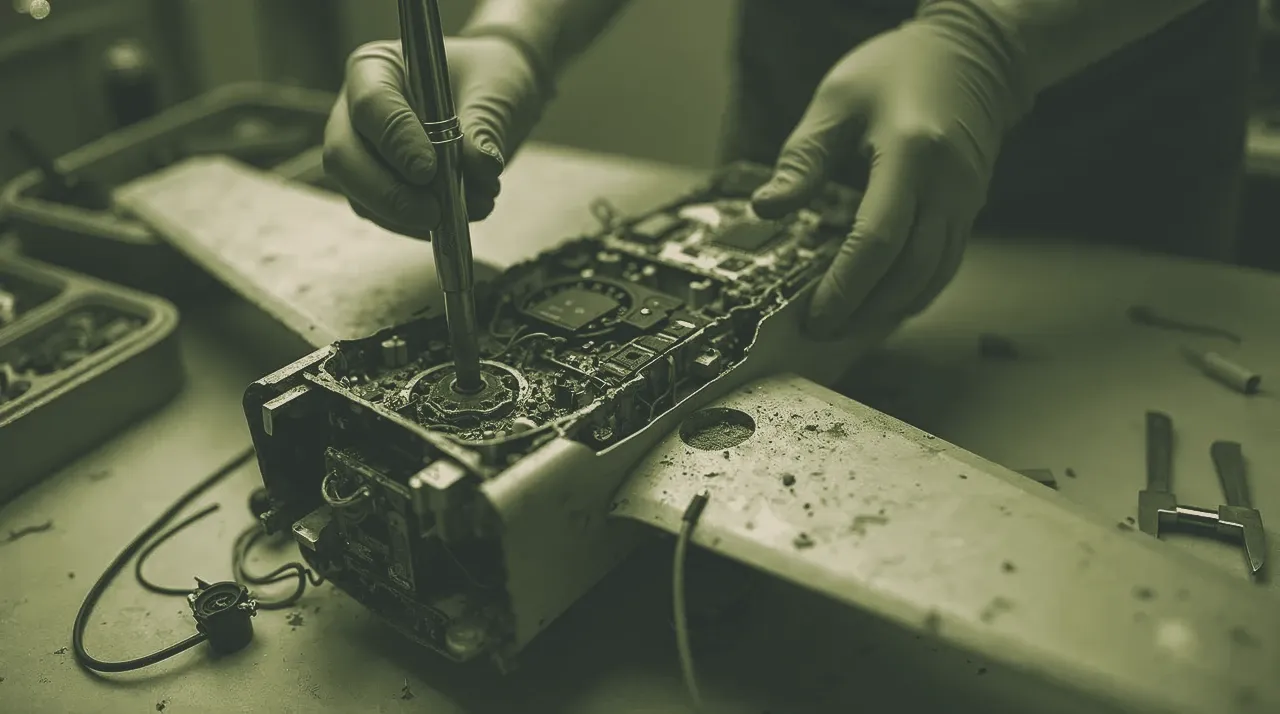
Ukraine's new TrophyLab portal hands vetted allies the blueprints, teardowns, and physical samples of captured Russian weapons. The real export is the time an ally saves building what defeats it.
What happened
Ukraine has stopped treating captured Russian weapons as war trophies and started treating them as a product line. On June 19, Defense Minister Mykhailo Fedorov announced TrophyLab, an access-controlled portal that gives cleared partners the technical intelligence Ukraine has pulled from seized Russian hardware, Defense News reported June 22. The site already lists more than 115 captured samples across 79 categories and more than 225 completed studies, figures the Ministry of Defense repeats across the official TrophyLab pages.
The catalog is already specific. Among the items offered for study are a Kinzhal hypersonic missile and a T-90M tank, Defense News reported. Anyone can browse the categories, which the home page lists as rocket and missile weapons, sea-launched cruise missiles, armored vehicles, small arms, air-launched munitions, aircraft, and electronic-warfare assets. The sample pages and the research results sit behind registration, the user guide states, and applicants are screened for sanctions, ties to Russia, and registration in temporarily occupied territories, with review of a company running up to 10 business days. Fedorov framed the platform as a tool for "the entire civilized world," but it is a vetted partner network wearing the interface of an open database.
Beyond the digital files, the portal lets verified partners request the captured hardware itself for non-destructive inspection, disassembly, or full destruction testing, a provision confirmed by Defense News, the user guide, and Resilience Media. Defense News calls the launch a formalization of what Kyiv has done informally with select partners since 2022. The portal turns that ad hoc sharing into one state-run pipeline, from capture to partner lab.
The product is cycle time, not the hardware
The value of TrophyLab is speed. Ukraine already has the component forensics, the laboratory reports, and the stored samples; what it lacked was a way to route that work to engineers without recreating it every time. The about page says the platform is designed to let users avoid duplicating first-pass exploitation, and Defense News reports vetted users reach blueprints, component analyses, and schematics produced by Ukrainian state laboratories and intelligence agencies. Each item page can carry technical specifications, a research summary, links to the underlying studies, and a list of analyzed components, per the user guide.
What a teardown yields is concrete, and Ukraine has shown the math before. When the country's anti-corruption agency stripped down a single Russian Supercam reconnaissance drone, it logged roughly 40 foreign components and found a civilian CCTV camera, an x86 hobby board, and a consumer GPS unit, per the agency's public database. Multiply that across missile seekers, electronic-warfare modules, and armored optics and the case for a shared catalog is obvious. A partner lab that no longer has to capture, transport, and reverse-engineer a system from scratch saves weeks. Fedorov's pitch, quoted by the Kyiv Independent, is exactly that: physical equipment for testing "significantly shortening the development cycle for countermeasures."
89 Shaheds a night, against a target that keeps moving
Russia launched 89 Shahed-type drones at Ukraine overnight on June 22, the Air Force said via the Kyiv Independent; air defenses downed 79. Every intercepted airframe is a teardown waiting to happen, and the threat does not hold still. The Institute for the Study of War reported in May 2025 that Russian frontline units integrate tactical innovations quickly, citing motorcycle assault columns screened by electronic-warfare gear positioned at the front, center, and rear to defeat Ukrainian drones. Countermeasure work has to be empirical and iterative against an adversary rewriting its own tactics, which is the loop TrophyLab is built to compress. The user guide's pitch to registered users is to study enemy designs, find the weak points, and build the counter faster than Moscow can patch.
Dataroom, Test in Ukraine, and now the adversary's hardware
TrophyLab is the newest layer of a stack Ukraine has spent 2026 assembling: turning hard-to-replicate war knowledge into governed industrial interfaces. Brave1 Dataroom gives more than 100 Ukrainian companies real battlefield visual and thermal imagery to train AI against Shahed-type drones, Ukrinform reported in June. Test in Ukraine routes foreign products into structured field validation with Ukrainian troop feedback, and hundreds of international firms have applied, Business Insider reported. The Brave-country bilaterals fund co-production outright, with a Brave Germany program for deep-strike weapons noted by Defense News and a Brave France tranche of 20 million euros, about 23 million dollars, for missiles, unmanned systems, and counter-air technology announced June 17, per the Kyiv Independent.
Dataroom monetizes Ukraine's own data and Test in Ukraine monetizes its battlefield, while TrophyLab is the layer that leverages the adversary's hardware. For a counter-drone, electronic-warfare, or missile-defense firm, the offer is access to Russian technical reality, its components, its vulnerabilities, and its physical samples, without standing up a separate capture-and-exploitation pipeline, and the chance to prove a counter against the real system, as Resilience Media put it. The catch is that the commercial terms are blank. Resilience Media reported it is unclear whether Ukraine will charge or treat better anti-Russian equipment as payment in kind, and no pricing, intellectual-property rule, sample-priority policy, or named foreign user has been disclosed. For now the platform shapes demand more than it earns revenue. It tells allied buyers which Russian systems Ukraine holds and has studied, which can steer procurement toward Russian-specific counters long before an invoice exists.
The second payoff: 2,453 components and a sanctions case
Captured hardware pays a policy dividend on top of the tactical one. Ukraine's anti-corruption agency built an open database listing 2,453 foreign components found in Russian and Iranian weapons, with US-made parts topping it at 1,816, ahead of Switzerland's 120, Japan's 96, China's 87, and Germany's 75, the Kyiv Independent reported in 2023. At a 2024 Senate hearing, Senator Richard Blumenthal described a list of 211 chips and semiconductors embedded in Russian weapons, of which 87 were made by Intel, Analog Devices, AMD, and Texas Instruments, Capital News Service reported. A RUSI analysis relayed by Reuters found more than 450 foreign components in recovered Russian weapons. The same teardown that exposes a vulnerability also documents a supply-chain breach, so a serious TrophyLab user pairs its engineers with export-control and sanctions staff.
The wager, and the exposure
Ukraine's most exportable asset in 2026 may be its curated knowledge of how to kill Russian systems, more than the drones it builds itself. RUSI estimates Ukrainian drone output climbed from roughly 3,000 to 5,000 units in 2022 to more than 2.2 million in 2024, with projections near 4.5 million for 2025, a scale that still rides on the foreign component chains RUSI warns are a strategic weakness. The Center for Strategic and International Studies argues modern militaries have to embrace continuous evolution rather than fixed solutions, and TrophyLab is administrative machinery for that idea.
The exposure runs two ways. Legally, the May 2026 Cabinet decision on trophy property lets state customers export captured weapons under Ukraine's treaties without extra authorization, the Ministry of Economy said and Euromaidan Press reported, but the Lieber Institute notes captured-weapon use stays bound by international law, and partner-country import rules are their own gauntlet. Operationally, the openness is double-edged: the same catalog that helps allied engineers would tell Moscow what Ukraine has captured and which weaknesses those engineers are chasing. The access denials for sanctioned firms, Russian-linked entities, and occupied-territory registrants address that risk without erasing it.
What to watch
Four indicators will show whether TrophyLab becomes a capability or stays an interface. First, any named partner or completed project, which Kyiv has so far kept quiet. Second, a pricing or intellectual-property disclosure that would turn demand shaping into a market. Third, a fielded countermeasure that traces back to a specific TrophyLab sample or study. Fourth, a sample-export case that actually clears a partner country's import controls. Until then, the portal is best read as Ukraine putting three years of informal exploitation work behind a repeatable process, a guarded front door to the enemy's arsenal with the lights behind it still mostly off to the public.
Frequently Asked Questions
What is TrophyLab?
It is an access-controlled portal launched by Ukraine's Ministry of Defense that gives vetted partners technical intelligence drawn from captured Russian military hardware, including blueprints, component analyses, and research findings from Ukrainian state laboratories and intelligence agencies, Defense News reported. The official site lists more than 115 captured samples across 79 categories and more than 225 completed studies.
Who can use it, and is it public?
It is not public. Eligible users include Ukrainian defense forces and manufacturers, foreign defense ministries, partner-country defense companies that meet Ministry requirements, and accredited scientific institutions, per Defense News and the user guide. Anyone can see the category list, but sample pages and research results require registration, and access is denied to sanctioned entities, firms tied to Russia, and entities registered in occupied territories.
Can partners get the physical weapons, not just the data?
Yes, on a case-by-case basis. Verified partners can request captured hardware for non-destructive inspection, disassembly, or full destruction testing, according to Defense News, the user guide, and Resilience Media. A user files a request on the item page and administrators coordinate transfer with the institution holding the sample. It is adjudicated, not automatic.
How does TrophyLab differ from Brave1 Dataroom and Test in Ukraine?
They are three layers of the same data architecture. Brave1 Dataroom exposes Ukraine's own battlefield imagery to train AI, and more than 100 Ukrainian companies use it, Ukrinform reported. Test in Ukraine routes foreign products into field validation with troop feedback, with hundreds of applicants, per Business Insider. TrophyLab is the layer that leverages the adversary's hardware rather than Ukraine's own data.
Why do captured Russian weapons matter beyond Ukraine?
Teardowns yield both countermeasures and sanctions evidence. Ukraine's anti-corruption agency catalogued 2,453 foreign components in Russian and Iranian weapons, with US-made parts topping the list at 1,816, the Kyiv Independent reported. A RUSI analysis relayed by Reuters found more than 450 foreign components in recovered Russian weapons, exposing the supply chains that keep Moscow's arsenal running.
Will Ukraine charge partners for access?
It is not yet clear. Resilience Media reported it is unknown whether Ukraine will charge for TrophyLab or treat better anti-Russian equipment as payment in kind. No pricing, intellectual-property terms, or named foreign user has been made public, so the near-term effect is demand shaping rather than a functioning commercial market.
AI-generated summary, reviewed by an editor. More on our AI guidelines.

Marcus Schuler
Marcus Schuler edits BattlePolicy, a daily defense-technology brief connecting the companies and capabilities behind modern war to the contest among Europe, the US, Russia, and China.