Ukraine's Drone War Just Closed a Pipeline Kyiv Says It Never Targeted
Four tankers hit in four days shut the Caspian Pipeline Consortium terminal at Novorossiysk, halting roughly 80% of Kazakhstan's crude exports. Most of those barrels belong to Chevron, ExxonMobil and Shell, and Kyiv denies responsibility.
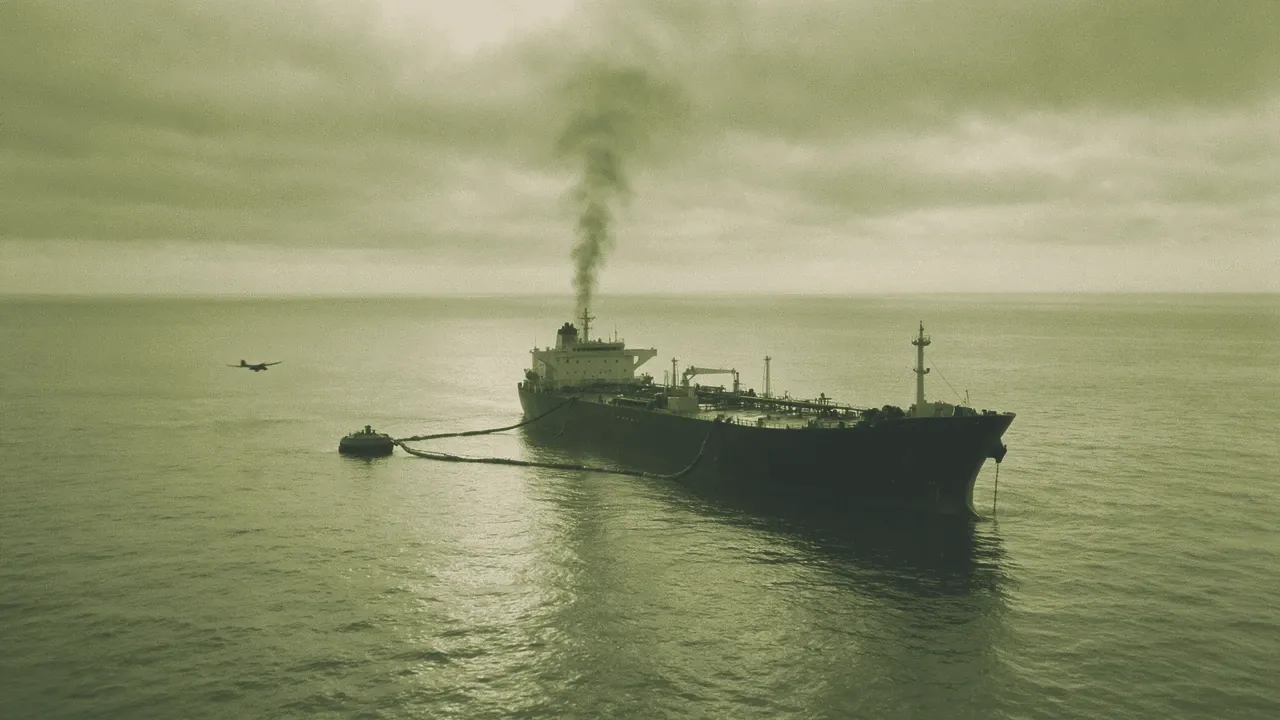
Four tankers hit in four days shut the Caspian Pipeline Consortium terminal at Novorossiysk, halting roughly 80% of Kazakhstan's crude exports. Most of those barrels belong to Chevron, ExxonMobil and Shell, and Kyiv denies responsibility.
What happened
Ukraine's campaign against Russian oil logistics has stopped being a Russian problem, and the first state to pay for that is one that is not in the war.
On July 20 a drone hit the Cameroon-flagged tanker NELSA while it was loading at Single Point Mooring 1 at the Caspian Pipeline Consortium terminal outside Novorossiysk. The strike started a fire and 22 crew were evacuated, according to CPC. The vessel stayed afloat and no oil was spilled. It was the fourth tanker struck in four days at the same terminal.
The sequence, as reported by Euronews, began on July 17 with the Nordic Zenith, empty and inbound to load Kazakh crude, which caught fire and was extinguished by its crew. On July 19 the Liberia-flagged ASIA and the Marshall Islands-flagged NISSOS IOS were hit while loading. Kazakhstan's energy ministry said the mooring facilities themselves were undamaged. CPC called the July 20 strike the fifth act of aggression against a civilian facility, and noted that the consortium is under no sanctions regime.
The commercial effect landed the next day. Reuters reported on July 21, citing three industry sources, that CPC had stopped accepting Kazakh crude into the system entirely, because tanker operators would no longer send vessels to the terminal. Bloomberg reported the same halt in piped supply. S&P Global Commodity Insights put the volume at risk at roughly 1.5 million barrels per day of Kazakh and Russian exports.
Chevron, Exxon and Shell own most of the halted barrels
The consortium runs a 1,510-kilometre pipeline from Kazakhstan's Tengiz, Kashagan and Karachaganak fields to the Black Sea, carrying about 80% of Kazakh crude exports and more than 1% of global supply. CPC shipped roughly 70.5 million tonnes in 2025, more than three-quarters of it belonging to foreign shareholders, with Chevron, ExxonMobil, KazMunayGas, Eni and Shell among the producers using the line. That ownership makes the terminal something other than a Russian asset with foreign investors attached, and it is why this strike series carries consequences a hit on a Novorossiysk naval pier would not.
Kazakhstan's foreign ministry called the attacks an unacceptable infringement on the country's economic interests and deliberate acts aimed at destabilising lawful international trade. Astana said an agreed mechanism for exchanging information about civilian vessels entering the Black Sea to load CPC oil had been disregarded, and reserved the right to seek compensation under international law. A campaign built to drain Russian export revenue has interrupted the cash flow of three Western majors and the budget of a Central Asian state that never recognised Russia's annexations.
Kyiv claims tanker strikes, and denies these ones
Ukrainian forces were active against Black Sea tanker traffic on the same night two of the CPC vessels were hit. The General Staff said its long-range drones struck two Russian tankers in the Black Sea and a floating crane in the Sea of Azov overnight on July 19, per the Kyiv Independent. President Volodymyr Zelensky put the figure at three shadow fleet tankers plus four oil depots in Stavropol Krai, and the SBU said one of its naval drones hit the tanker Avero, which it described as carrying Russian crude to China and India in breach of the G7 and EU embargo.
Ukraine's ambassador to Kazakhstan, Victor Mayko, told The Times of Central Asia there is no evidence the attacks were carried out by Ukraine and that Kazakhstan has never been regarded as a military target. Mayko said Russian electronic warfare can disable Ukrainian drones and in some cases take control of them, and asked that the possibility of a Russian provocation be investigated. CPC has not formally attributed any of the four incidents.
Both positions can hold at once without settling the operational question, which is what a weapon costing a few tens of thousands of dollars does when it is fired in volume at a target set defined by function rather than registry. A loading tanker at a fixed mooring presents much the same signature whether the crude going into it is Russian or Kazakh, and the discrimination that matters happens at the point of tasking rather than in terminal guidance. Ukraine spent July running a sustained operation against Russia's shadow fleet across the Black Sea and the Sea of Azov, striking dozens of vessels to choke logistics into occupied Crimea as the peninsula's fuel crisis deepened, the Kyiv Independent reported. Robert Brovdi, who commands Ukraine's Unmanned Systems Forces, listed hits on a shadow fleet cargo vessel and 13 electrical infrastructure sites in Crimea and other occupied areas on July 19 alone.
The battlefield and the startup story — free in your inbox every week. No paywall.
Subscribe Free →Two delivery systems are in play. SBU naval drones run the surface attacks, while long-range one-way strike drones fly against port and depot infrastructure, and both are cheap enough to expend against a merchant hull, which is what has driven the tasking volume up.
War-risk premiums above 1% closed the terminal
Additional premiums for Black Sea transits have risen above 1% of a vessel's value after both sides escalated attacks on shipping, The Insurer wrote, citing multiple marine market sources. At that level the risk charge on a single mid-size tanker runs into seven figures per voyage. Kazakhstan's energy ministry confirmed the moorings themselves were undamaged, so what shut the route was the refusal of owners to accept the voyage rather than any physical destruction of the terminal.
Kazakh barrels had become more important to European refiners as an alternative to Middle Eastern supply, Bloomberg noted, and that substitution is now squeezed at both ends: CENTCOM completed a tenth consecutive night of strikes on Iranian targets on July 20, and the IRGC has been attacking tankers in the Strait of Hormuz. Losing optionality at Novorossiysk and at Hormuz in the same week leaves European refiners somewhere materially worse than losing either alone.
Moscow gains an argument it has been making without much evidence for four years. Russia has long claimed that Ukrainian deep strikes threaten third countries and global energy security. A halted Western-owned export route, an evacuated crew and a warning from Kazakhstan that the attack could disrupt lawful international trade gave Moscow a ready-made illustration of that argument without firing a shot.
Astana’s alternatives can carry only a fraction of that volume. Shipments through Aktau and the Baku-Tbilisi-Ceyhan pipeline reached 1.3 million tonnes in 2025 and are projected to rise to 1.6 million tonnes in 2026, while about 1.1 million tonnes goes to China, according to The Times of Central Asia. Compared with the 70.5 million tonnes handled by CPC, these routes offer producers limited relief, not a replacement.
A campaign that outgrew its target list
Ukraine’s recent operations in the Sea of Azov and against shadow-fleet vessels showed what drones can do to Russian trade even without a conventional navy. Novorossiysk is a less forgiving target. Ukraine has the range to strike it, but no way to confine the economic damage to Russian cargo. Once insurers judge the approaches unsafe, every ship pays. An underwriter cares less about the intended target than about the waters a vessel must cross.
Ukraine laid out a narrower case at the International Maritime Organization on June 25. Merchant ships carrying oil and strategic resources, Kyiv argued, can help finance Russia’s war. It was referring to Russian crude, resources removed from occupied territory and the shadow fleet. Kazakh oil was not part of the argument. But a boundary that looks clear in a legal filing becomes blurred around a shared terminal. Chevron’s cargo uses the same port and faces the same insurance market as Rosneft’s.
What to watch
CPC has given no date for resuming Kazakh crude shipments. Even a quick restart, however, would not restore the position of two weeks ago. War-risk cover priced above 1% of a vessel’s hull value would make Novorossiysk a substantially more expensive route. That added cost and exposure could bring Chevron and ExxonMobil to Washington, asking the administration to rein in Kyiv. Russia would then benefit from pressure applied by American business rather than by its own weapons.
Astana has left open the possibility of seeking compensation under international law. Filing a claim would require Kazakhstan to state formally whom it holds responsible, triggering the attribution dispute Ukraine has so far avoided. Mayko has described the incident as a provocation. That explanation becomes much harder to defend if a fifth vessel is hit at the same terminal.
Frequently Asked Questions
What is the Caspian Pipeline Consortium?
A 1,510-kilometre pipeline carrying crude from Kazakhstan's Tengiz, Kashagan and Karachaganak fields to a marine terminal at Novorossiysk on Russia's Black Sea coast. Per Euronews, it handles about 80% of Kazakhstan's oil exports and more than 1% of global supply, and its producers include Chevron, ExxonMobil, KazMunayGas, Eni and Shell.
How many tankers were hit, and when?
Four in four days, according to Euronews and CPC statements: the Nordic Zenith on July 17 while empty and inbound, the ASIA and NISSOS IOS on July 19 while loading, and the NELSA on July 20 at Single Point Mooring 1. The NELSA fire forced 22 crew to evacuate. No oil was spilled and the moorings were not damaged.
Has Ukraine claimed the attacks?
No. Ukraine's ambassador to Kazakhstan, Victor Mayko, told The Times of Central Asia there is no evidence Ukraine carried them out and raised the possibility of Russian electronic warfare hijacking Ukrainian drones. Separately, Ukraine's General Staff said it struck two Russian tankers in the Black Sea overnight on July 19, and Zelensky cited three shadow fleet tankers, per the Kyiv Independent. CPC has not formally attributed any incident.
Why did exports stop if the terminal was not destroyed?
Insurance and crew risk, not physical damage. Reuters reported on July 21, citing three industry sources, that CPC stopped accepting Kazakh crude because tanker operators would not send vessels. The Insurer reported Black Sea war-risk premiums have risen above 1% of a vessel's value.
Can Kazakhstan route its oil elsewhere?
Only partially. Per The Times of Central Asia, exports via Aktau and the Baku-Tbilisi-Ceyhan pipeline reached 1.3 million tonnes in 2025 and are projected at 1.6 million tonnes in 2026, with about 1.1 million tonnes going to China. CPC moved roughly 70.5 million tonnes in 2025, so the alternatives cover a small fraction of the volume.
How much oil is at stake?
S&P Global Commodity Insights put roughly 1.5 million barrels per day of Kazakh and Russian exports at risk from the disruption. Kazakhstan's foreign ministry said it reserves the right to seek compensation under international law.
AI-generated summary, reviewed by an editor. More on our AI guidelines.

Marcus Schuler
Marcus Schuler edits BattlePolicy, a daily defense-technology brief connecting the companies and capabilities behind modern war to the contest among Europe, the US, Russia, and China.