Ukraine's drone war stopped raiding Russia's rear and started controlling it
A week after Ukraine funded its "logistics lockdown," commanders claim fire control over the Luhansk region and the Crimea supply corridor. The mid-range drone has become a theory of victory, and its limits are now the real question.
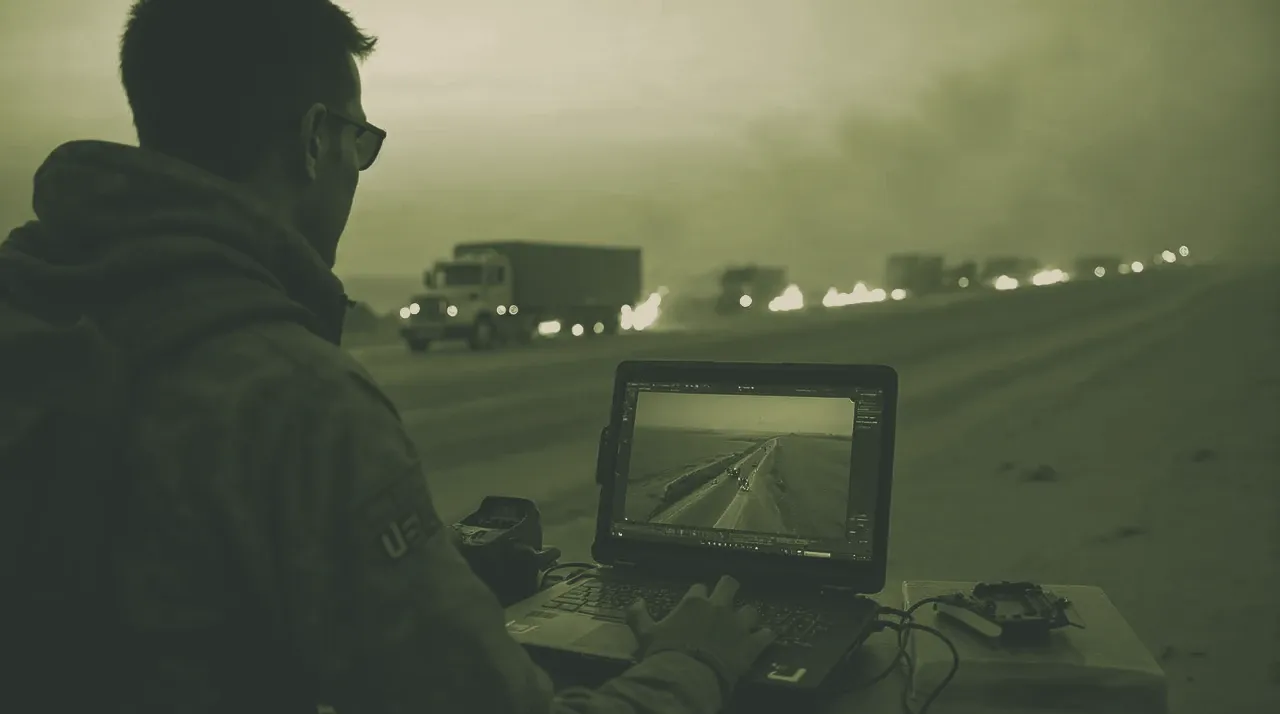
A week after Ukraine funded its "logistics lockdown," commanders claim fire control over the Luhansk region and the Crimea supply corridor. The mid-range drone has become a theory of victory, and its limits are now the real question.
Ukraine has stopped calling its strikes on Russia's rear raids and started calling them control. On June 1, the commander of Ukraine's 3rd Army Corps, Brigadier General Andrii Biletskyi, said his drones now hold fire control over the occupied Luhansk region, naming Luhansk, Starobilsk, Alchevsk, Bryanka and Kadiivka, after a strike on the Izvaryne checkpoint more than 205 kilometers behind the line, United24 Media reported. A week earlier, Defense Minister Mykhailo Fedorov had put 5 billion hryvnia, about $113 million, behind a campaign he called a "logistics lockdown." Fedorov framed that money as a way to scale strikes on Russia's rear. A week on, a corps commander is describing the result as fire control over a region.
The wager behind the campaign is large. Ukraine is testing whether a war can be turned by strangling an enemy's supply lines at scale, using cheap drones it builds itself, instead of by breaking its front. The instrument is a drone class Kyiv did not field in quantity a year ago, aimed at the roads and depots that feed Russia's southern front, and the effort now reaches back to the factories being asked to build millions of them.
The Morrigan and a class of drone that did not exist in volume
The capability has a name now. On the weekend, the 412th Nemesis Brigade of Ukraine's Unmanned Systems Forces published footage of a fixed-wing strike drone it calls the Morrigan, a single-propeller aircraft roughly four to five feet long, launched from a rail without a runway and built to operate behind enemy lines, Business Insider reported. The brigade said the Morrigan had already struck air defense and support targets in Crimea and was now running what it called a logistical hunt from Mariupol to the peninsula.
The Morrigan sits in a band Ukraine mostly skipped until this year, the stretch 20 to 300 kilometers behind the front where Russia keeps fuel, ammunition, repair shops and command posts, per Business Insider. These middle-strike drones are lighter than the long-range platforms that hit refineries inside Russia and use fixed wings rather than the first-person-view quadcopters that dominate the contact line. Defense analysts and Ukrainian officials describe the goal plainly, Reuters wrote on May 28: slow Russia's advance by making its safe rear unsafe. Retired Australian general Mick Ryan, who tracks the campaign, put it in older terms in his Futura Doctrina newsletter: this is interdiction, the Cold War AirLand Battle idea of destroying second-echelon forces and their logistics, with drones now the effector that long-range artillery and strike aircraft once were.
Luhansk to Crimea, and a road Russia spent $11.8 billion to protect
The map is where the claim gets specific. The campaign's center of gravity is the R-280 highway, the M-14 route Russian authorities renamed "Novorossiya," which runs about 370 miles from Rostov-on-Don through occupied Mariupol, Berdyansk and Melitopol into Crimea, Business Insider noted. It is Russia's primary land line of communication to the peninsula, and it has only grown in importance as Ukrainian strikes degraded the Kerch Bridge, Ryan wrote. Russia spent roughly $11.8 billion between 2024 and 2026 building road, rail and port redundancy across the occupied south, the Center for European Policy Analysis found, precisely to disperse its logistics out of drone range. Concentrating supply through that network created the chokepoints the drones now work.
The pressure shows in Russian behavior. On May 29, analysts tracking the route logged a single-day record of 483 Russian transport vehicles reported neutralized, according to figures cited by CGTN; the monitoring group Oko Gora had counted at least 86 burned trucks and fuel tankers on two highways over three preceding weeks, Ryan noted, with one CEPA analyst placing the total destroyed beyond the front at more than 125, most in May. Kherson's occupation governor Vladimir Saldo closed part of the R-280 to civilian traffic on May 21. Crimea and Sevastopol introduced fuel rationing from May 31, capping 92-octane sales at 20 liters a vehicle, CGTN reported. Ukraine's Defense Ministry says the effect reaches the front itself: Russian assaults have become less frequent and more poorly prepared, and Fedorov's figures put Russian losses per square kilometer of advance at 179 in April, up from 67 the previous October.
The battlefield and the startup story — free in your inbox every week. No paywall.
Subscribe Free →The Hornet, the e-points, and a 20-million-drone ask
The money and the machines have caught up to the doctrine. The campaign's other workhorse is the Hornet, an AI-guided strike drone produced by Swift Beat, the company founded by former Google chief executive Eric Schmidt, with a targeting system trained on thousands of hours of combat footage and a Starlink link that lets it work past 160 kilometers in heavy jamming, CGTN reported, citing Defence Express on a find-fix-finish cycle now compressed to under four minutes from 15 to 25 minutes in 2024. The Institute for the Study of War, citing Russian military bloggers, assessed that existing Russian electronic warfare is ineffective against the Hornet and that Moscow is unlikely to adapt within six to 12 months.
Procurement has been rewired to match. Fedorov's first tranche flows directly to high-performing brigades through Ukraine's e-points system, which scores units on confirmed strikes and lets the best buy without waiting on central tenders, with a second competitive phase meant to scale production, CGTN reported. Brigades order from manufacturers on the Brave1 Market and DOT-Chain platforms, which Reuters likened to an Amazon for weapons listing 800 products from 200 makers, and accelerators such as Defence Builder seed startups with $10,000 and a four-month program. Disclosed defense investment inside Ukraine rose from $1.1 million in 2023 to $105 million last year, the Ukrainian Council of Defense Industries Investor Club estimates. On June 4, Deputy Defense Minister Mstislav Banik told the NATO Parliamentary Assembly that Ukraine could build 20 million drones a year with allied funding, against the roughly four million it built in 2025, and asked partners for $60 billion in 2026 support, Kyiv Post reported. For comparison, Banik's team puts Russian output at 1.2 to 1.8 million drones a year.
What interdiction can and cannot do
Interdiction wears an army down, but it does not by itself take ground or end a war, and that caution comes from doctrine as much as from skeptics. In a June 4 essay, German general staff officer Lieutenant Colonel Marc-Andre Walther argued in Small Wars Journal that tactical success, even sustained, does not automatically become operational advantage, and that UAV engagements fought outside a cohesive scheme of maneuver tend to dissipate rather than accumulate into a decision. His own remedy actually validates the deep-strike instinct: he endorses pushing autonomous systems further into the enemy rear, where their utility grows over time. But the point stands that interdiction shapes a campaign without resolving it, which is also what analysts cited by Reuters said in late May.
Ukraine's own vulnerabilities make the same case. For all its mastery of cheap drones, Kyiv still has no answer to Russian ballistic missiles beyond the Patriot, which is in short supply, Euronews reported; Zelensky has asked Washington for a license to produce the interceptors and called the 60 to 65 anti-ballistic missiles available each month nothing against the threat, after Russia fired 33 ballistic missiles in a single overnight barrage. The same drones that can close a supply highway cannot intercept the missiles Russia fires at Ukrainian cities. Russian commentators concede the squeeze even so: the TopWar outlet acknowledged that Ukrainian forces have partially paralyzed southern Russia's land corridor to Crimea, while calling for symmetric strikes on Ukraine's rear.
What to watch
The next test is whether fire control spreads. United24 frames Luhansk as the first instance of a model Ukraine intends to extend across Donetsk, Zaporizhzhia, Kherson and Crimea, which would turn a corridor campaign into a theater-wide one. Watch the production line behind it: whether NATO legislators move on Banik's $60 billion request and the 20-million-drone target, and whether Germany and Norway's co-production deals deliver mid-range drones to the front this summer as planned. And watch Russia's adaptation clock against the bloggers' six-to-12-month estimate for countering the Hornet. If the rear stays unsafe and the factories scale through the summer, Ukraine will have turned a tactic into a doctrine. Whether that doctrine can do more than hold the line is the question the next phase of the war answers.
Frequently Asked Questions
What is a "middle-strike" drone?
It is a class of strike drone built to hit targets roughly 20 to 300 kilometers behind the front, the band where an army keeps fuel, ammunition and command posts, per Business Insider. They are lighter than the long-range drones that hit refineries inside Russia and typically use fixed wings rather than the first-person-view quadcopters used at the contact line.
What is the Morrigan?
The Morrigan is a domestically produced Ukrainian fixed-wing strike drone disclosed by the 412th Nemesis Brigade, roughly four to five feet long and launched from a rail without a runway, Business Insider reported. The brigade said it has struck air defense and support targets in Crimea and is being used against the Mariupol-to-Crimea supply corridor.
What is the "logistics lockdown"?
It is a program Defense Minister Mykhailo Fedorov announced on May 27, backed by about $113 million, to scale up mid-range drone strikes on Russian supply lines, CGTN reported. Funds flow first to high-performing brigades through Ukraine's e-points system, with a later competitive phase meant to expand production.
Is the campaign actually changing the war?
It is degrading Russian logistics and, by Ukraine's account, slowing Russian assaults, with losses per square kilometer of advance rising to 179 in April from 67 the previous October, per Fedorov. But Small Wars Journal argues tactical and attritional success does not automatically become operational advantage, and Ukraine still cannot stop Russian ballistic missiles, which remain in short Patriot supply, Euronews reported.
How many drones is Ukraine trying to build?
Deputy Defense Minister Mstislav Banik told the NATO Parliamentary Assembly on June 4 that Ukraine could produce 20 million drones a year with allied funding, against roughly four million built in 2025, and asked partners for $60 billion in 2026 support, Kyiv Post reported.
AI-generated summary, reviewed by an editor. More on our AI guidelines.

Marcus Schuler
Marcus Schuler edits BattlePolicy, a daily defense-technology brief connecting the companies and capabilities behind modern war to the contest among Europe, the US, Russia, and China.