Wing Loong II
China’s MQ-9-class armed drone — a turboprop MALE UCAV with 480 kg payload, 32-h endurance, and a combat-proven export record from Libya to Yemen and Sudan, priced to undercut Western alternatives.
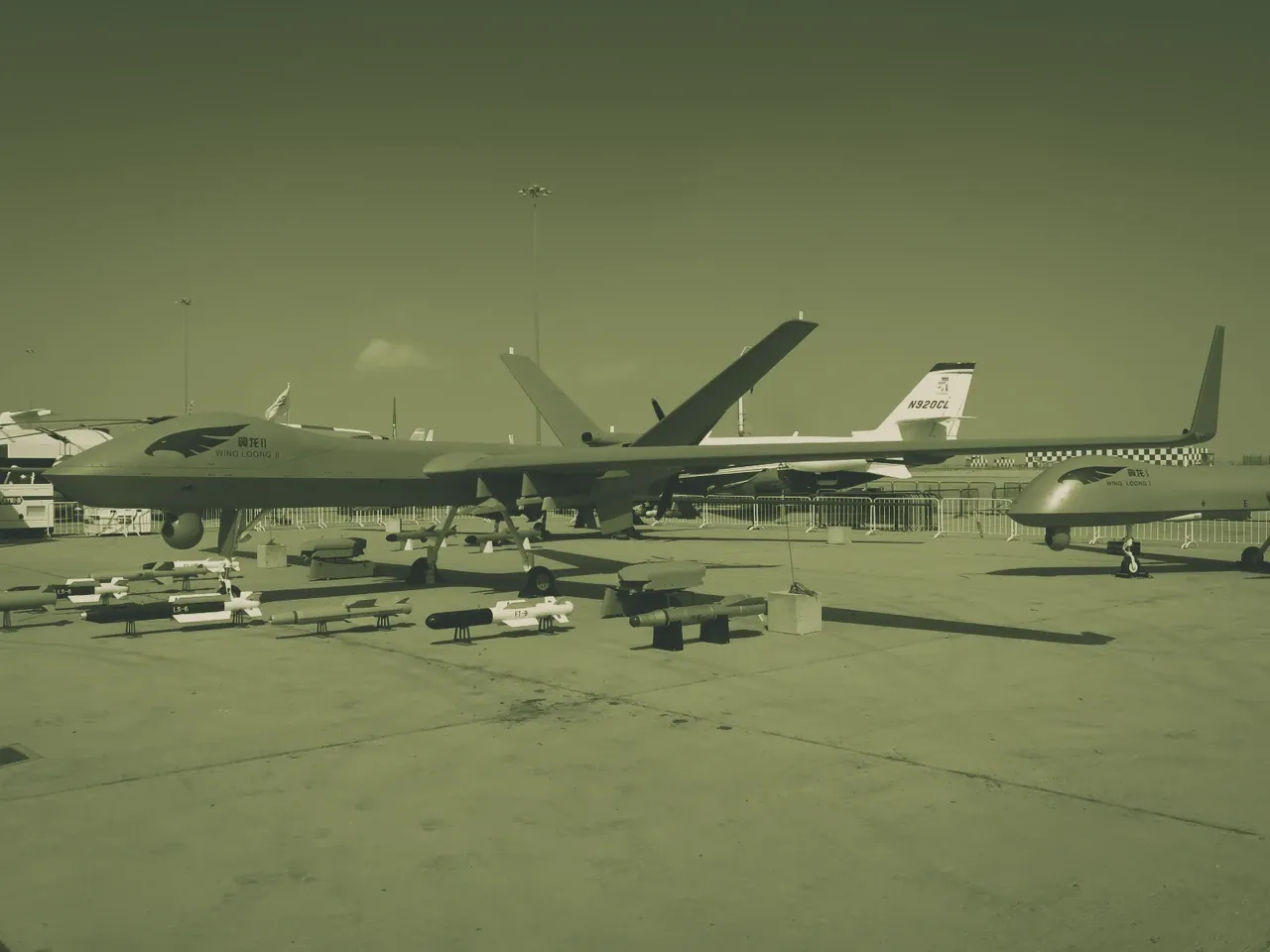
China's MQ-9-class armed drone — a turboprop MALE UCAV built by AVIC, fielding six hardpoints, SATCOM control, and an extensive export-customer combat record, all at roughly a tenth the unit cost of an MQ-9.
Overview
The Wing Loong II (Yilong-2, PLAAF designation GJ-2) is a medium-altitude, long-endurance (MALE) unmanned combat aerial vehicle developed by Chengdu Aircraft Industry under the Aviation Industry Corporation of China (AVIC). Roughly analogous in configuration to the US MQ-9 Reaper but sold at a fraction of the price, it carries up to 480 kg of ordnance on six hardpoints and is marketed as an armed ISR and precision-strike platform. According to SIPRI data analysed by Al Jazeera, China became the world’s leading exporter of armed combat drones over the decade to 2023, and the Wing Loong II is one of its flagship export products.
Development
AVIC flew the first Wing Loong II prototype in February 2017, an event recorded by AIN (Aviation International News) as a major step for China’s armed-drone ambitions. The People’s Liberation Army Air Force (PLAAF) accepted the type into service as the GJ-2 from November 2018, making it the primary Chinese MALE UCAV in PLAAF inventory alongside the smaller CH-4 Rainbow. Design work deliberately targeted the export market, where tight US export controls had left a gap that Chinese manufacturers filled with lower-cost alternatives. The United Arab Emirates became the launch export customer in 2017, ordering an undisclosed number of air vehicles, with further follow-on and licence-production deals brokered over the following years, including a reported co-production agreement with Pakistan for up to 48 airframes.
Design & capabilities
The Wing Loong II is a conventional turboprop-pusher design with a high-wing monoplane layout and V-tail. It is powered by a single WJ-9 turboprop producing 500–600 shp, which yields a maximum speed of 370 km/h and a cruise speed of about 200 km/h. Army Recognition’s product profile notes endurance of 20 hours at maximum payload and up to 32 hours in reduced-payload configuration. Operational range is typically 1,500 km, extendable to roughly 3,000 km via SATCOM relay, and the standard control link is a combination of line-of-sight (LOS) and BeiDou-enabled SATCOM.
The airframe measures 11 m long with a 20.5 m wingspan and a maximum take-off weight of 4,200 kg. Its six hardpoints can carry up to 480 kg of weapons, including the Blue Arrow 7 (a Hellfire-analogue anti-tank missile), AKD-10, TL-2, the LS-6 precision-glide bomb, the YJ-9E anti-ship missile, and a range of FT- and GB-series guided and unguided bombs, alongside a chin-mounted electro-optical/infrared turret and a synthetic-aperture radar. The system permits autonomous take-off and landing and is designed for single-operator control, lowering the crew burden for export customers.
Variants
No distinct production variants have been publicly designated beyond the baseline Wing Loong II / GJ-2, although export configurations may differ in the permitted weapons set and the inclusion of SATCOM equipment. The AVIC family also includes the smaller Wing Loong I and the larger, more advanced Wing Loong III.
Combat record / operational use
The Wing Loong II has almost no PLAAF combat record, its significance coming almost entirely from foreign operators. The United Arab Emirates deployed the platform in support of Khalifa Haftar’s Libyan National Army during the 2019-2020 western Libya campaign; a BBC investigation documented a January 2020 Blue Arrow 7 strike on a military academy in Tripoli that killed 26 cadets — the most lethal single known engagement by a Chinese-built drone at the time. Reuters reported that Haftar continued to receive additional Wing Loong II systems despite a UN arms embargo. Saudi Arabia has used the type against Houthi forces in Yemen; Nigeria deployed it against Boko Haram from 2023; Pakistan employed it in its January 2024 border strikes against Iran; and the UAE has again operated the drone in support of the Rapid Support Forces in Sudan, underscoring the platform’s spread across conflicts in Africa and the Middle East.
Advantages
- Highly competitive unit cost (roughly ~$4–6 M for an air vehicle, ground control station, and initial support package) — as little as one-tenth the cost of an MQ-9 system, enabling mass export adoption.
- Long endurance (up to 32 h in ISR configuration) and a 480 kg payload with six hardpoints, allowing a mix of guided missiles, glide bombs, and stand-off munitions.
- SATCOM capability and BeiDou navigation give it a BLOS control radius suited to the vast operational theatres in Africa and the Middle East.
- Single-operator autonomous take-off and landing simplifies training for export customers; co-production and technology-transfer deals (as with Pakistan) deepen client lock-in.
Drawbacks / limitations
- Performance and payload are inferior to the MQ-9 Reaper, especially in terms of onboard sensor suite quality, engine power, and weapons integration maturity.
- Combat survivability is limited to permissive airspace; like all MALE UCAVs of this generation, the Wing Loong II is vulnerable to man-portable air-defence systems, electronic warfare, and manned fighter threats.
- The Type’s combat use by Libyan and Sudanese factions, in some cases contrary to UN embargoes, exposes the operator to political and reputational risk while complicating the manufacturer’s own export control narrative.
- The domestic PLAAF fleet is relatively small (~60 airframes) and lacks a significant high-threat combat record, leaving the system’s full combat effectiveness to be inferred from third-party operators.
Counterparts
- MQ-9 Reaper (USA) — the gold-standard MALE UCAV against which the Wing Loong II benchmarks itself, at many times the cost.
- Orion (Inokhodets) (Russia) — Russia’s TB2/MQ-1C analogue, with a comparable payload and mission set but far smaller operational footprint.
Outlook
The Wing Loong II is firmly established as China’s premier export armed drone, and its combat record, while entirely foreign-customer, continues to grow in Africa and the Middle East. AVIC’s ongoing work on the larger Wing Loong III and the stealth-oriented GJ-11 Sharp Sword suggests the Wing Loong II will eventually become the lower-cost tier of a family that spans all MALE weight classes, while the current platform remains the most visible symbol of China’s drone-export dominance.
Key specifications
| Spec | Value |
|---|---|
| Type | Turboprop MALE armed UCAV |
| Endurance | 20 h at max load / 32 h reduced |
| Range | ~1,500 km operational (BLOS ~200–300 km, ~3,000 km via SATCOM) |
| Cruise / max speed | cruise ~200 km/h / max 370 km/h |
| Payload | up to 480 kg, 6 hardpoints (Blue Arrow 7, AKD-10, TL-2, LS-6 glide bomb, YJ-9E anti-ship, FT/GB bombs) |
| Datalink / control | LOS + SATCOM; BeiDou navigation |
| Autonomy level | Autonomous take-off/landing, single-operator |
| Dimensions / MTOW | length 11 m / wingspan 20.5 m / MTOW 4,200 kg |
| Launch & recovery | Runway |
Sources
- Army Recognition — Wing Loong 2 UAV MALE armed drone data, pictures, video https://armyrecognition.com/military-products/army/unmanned-systems/unmanned-aerial-vehicles/wing-loong-ii-2-uav-male-armed-drone-data-pictures-video-11906174
- Army Recognition — Analysis: The Wing Loong II drone and China's rise in the global armed UAV market https://www.armyrecognition.com/focus-analysis-conflicts/army/analysis-defense-and-security-industry/analysis-the-wing-loong-ii-drone-and-chinas-rise-in-the-global-armed-uav-market
- Wikipedia — CAIG Wing Loong II https://en.wikipedia.org/wiki/CAIG_Wing_Loong_II
- AIN — China's AVIC achieves first flight of Wing-Loong II UAV https://www.ainonline.com/aviation-news/defense/2017-02-28/chinas-avic-achieves-first-flight-wing-loong-ii-uav
- BBC News — UAE implicated in lethal drone strike in Libya https://www.bbc.com/news/world-africa-53917791
- Reuters — Libya's Haftar acquires combat drones despite UN embargo https://www.reuters.com/world/middle-east/libyas-haftar-acquires-combat-drones-despite-un-embargo-2026-04-02/
- Al Jazeera — How China became the world's leading exporter of combat drones (SIPRI data) https://www.aljazeera.com/news/2023/1/24/how-china-became-the-worlds-leading-exporter-of-combat-drones