GRID-REF 37°47′N 122°25′W
DISPATCH 02/26 · 9 Jun 2026
BATTLEPOLICY
Startup to front line. Strategy to consequence.
Lexicon · China

Z-20

China's indigenously developed 10-tonne-class medium utility helicopter — a fly-by-wire, five-blade rotorcraft directly comparable to the UH-60, serving as the PLA's primary air-assault, transport, and naval shipborne platform.
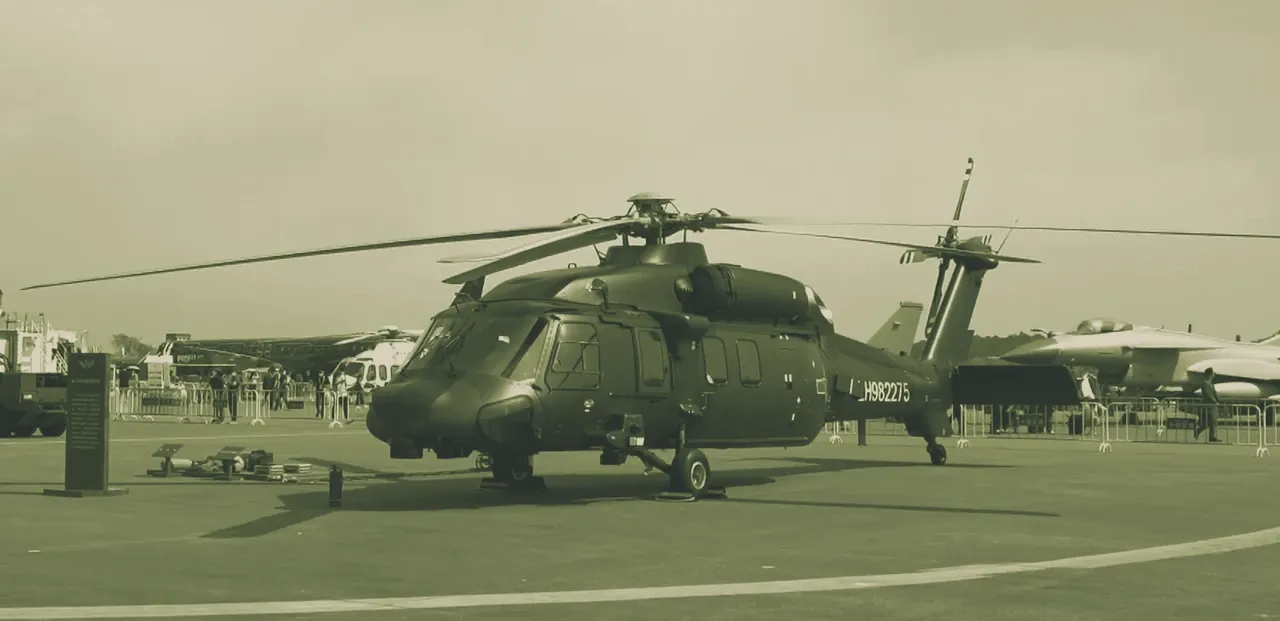
Z-20
FIG.01 · China Image - Z-20. Photo by 中国新闻社, CC BY 4.0, via Wikimedia Commons.
China's indigenously developed 10-tonne-class medium utility helicopter — a fly-by-wire, five-blade rotorcraft directly comparable to the UH-60, serving as the People's Liberation Army's primary air-assault, transport, and shipborne platform.

Overview

The Harbin Z-20 is a twin-engine, medium-lift utility helicopter that entered People's Liberation Army (PLA) service in October 2019, rapidly becoming the most prolific modern rotorcraft in Chinese military aviation. With a maximum takeoff weight in the 10-tonne class, it fills the same operational niche as the American Sikorsky UH-60 Black Hawk — troop transport, cargo lift, search and rescue, and special operations support — while branching into armed assault and naval anti-submarine warfare through a growing family of variants. Its fielding addresses a decades-old gap in China's domestic helicopter industry and provides the PLA with a platform unencumbered by foreign supply chains.

Development

The Z-20 originated from China's long-standing requirement for a credible medium utility helicopter. In 1984, China acquired 24 civil Sikorsky S-70C-2 Black Hawks for high-altitude operations, a type that remained in service but could not be replenished after the post-1989 US and EU arms embargoes blocked further military helicopter imports. In 2006, AVIC launched a formal "10-tonne helicopter project," tasking the Harbin Aircraft Industry Group (HAMC) with developing an indigenous replacement, according to Army Recognition and Wikipedia.

The prototype made its maiden flight on 23 December 2013 at a Harbin facility. Open-source reporting has alleged that Chinese engineers benefited from studying the partially crashed MH-60 stealth helicopter tail-section left behind during the 2011 Abbottabad raid, though this claim remains officially unconfirmed by Chinese or US authorities. The Z-20 was publicly unveiled during the 1 October 2019 National Day military parade, marking its formal entry into service.

Design & capabilities

The Z-20 occupies the 10-tonne utility class. Its airframe superficially resembles the UH-60 but incorporates distinctive design departures: a five-blade main rotor (versus the UH-60's four) for improved lift and reduced vibration, a more angular tail-to-fuselage fairing, and a full fly-by-wire flight control system. The fuselage is about 20 m long, with the main rotor spanning approximately 16 m. Internal capacity accommodates 12–15 fully equipped troops, around 1,500 kg of internal cargo, or up to 4,000 kg on an external sling hook, according to Army Recognition.

The helicopter is certified to operate from sites above 4,000 m altitude — a core requirement inherited from the PLA's S-70C operations in Tibet and the western highlands — and features rotor-blade de-icing. Defensive aids include a radar warning receiver, a missile approach warning system, and four chaff/flare dispensers. An electro-optical/infrared turret is fitted on armed assault and search-and-rescue variants. On the Z-20F naval derivative, a nose-mounted surface-search radar and a dipping sonar provide anti-submarine warfare capability, as detailed by Army Recognition.

Power comes from a pair of locally developed WZ-10 turboshaft engines — the designation "WZ-10" refers to the engine, not the Z-10 attack helicopter — each delivering approximately 1,600 kW (around 2,100 shp) and up to 2,000 kW in emergency power, as noted by Wikipedia. This represents a significant step in Chinese helicopter engine sovereignty, moving beyond the foreign powerplants that constrained earlier designs.

Variants

The baseline Z-20 utility helicopter has spawned multiple sub-types for specialized roles. The Z-20T is an armed assault variant fitted with two stub wings providing four external hardpoints that can carry AKD-9 or AKD-10 anti-tank guided missiles, CM-502KG non-line-of-sight missiles, rocket pods, and TY-90 air-to-air missiles. The Z-20S serves as a dedicated search-and-rescue platform with enhanced sensors and cabin equipment. Naval derivatives include the Z-20J (shipborne utility/patrol) and the Z-20F (anti-submarine warfare), the latter equipped with a surface-search radar, dipping sonar, and provision for lightweight torpedoes. The Z-20K/KA/KS designations denote Air Force and airborne-corps configurations, while the Z-20 PAP is a People's Armed Police variant.

Combat record / operational use

The Z-20 has no publicly confirmed combat record. Its operational footprint centers on PLA air-assault exercises, high-altitude border-region logistics, and increasingly frequent shipborne operations from People's Liberation Army Navy vessels, including the aircraft carrier Liaoning and the Type 075 amphibious assault ships. The Z-20 has been observed conducting search-and-rescue duties and troops lifts in the Western Theater Command, where its high/hot performance is most critical. As of the 2026 IISS Military Balance estimate, more than 230 airframes have been produced, making it the fastest-growing helicopter program in Chinese service, according to Army Recognition.

Advantages

  • Five-blade rotor and fly-by-wire controls deliver a high-altitude operational envelope certified above 4,000 m, critical for Tibetan plateau and western border deployments.
  • Indigenous WZ-10 turboshaft engine eliminates dependence on embargoed foreign powerplants.
  • A proliferating variant family — armed assault, naval ASW, SAR, and special operations — multiplies the platform's utility across all PLA service branches.
  • Large cabin (12–15 troops) and substantial sling capacity (4,000 kg) mirror the UH-60 class at a domestic production scale.
  • Shipborne compatibility extends PLA Navy at-sea rotary-wing capability beyond the smaller Z-9.

Drawbacks / limitations

  • No combat validation; all operational experience is confined to exercises and territorial patrols.
  • The S-70 lineage is widely reported as an indirect design influence, which may limit future exportability to markets wary of derivative technologies.
  • Engine development path (WZ-10) was protracted; earlier Chinese medium-lift programs were repeatedly stymied by powerplant shortfalls.
  • Navalized Z-20F ASW sensor integration and weapon-release envelopes remain untested in a contested maritime environment.

Counterparts

Outlook

The Z-20 is positioned as the PLA's medium utility backbone for the next generation, supplanting imported Mi-17s and the dwindling S-70C fleet. Serial production shows no sign of slowing, and the expansion of variant sub-types signals the PLA's intent to amortize the platform across land, naval, and paramilitary missions. Its real-world test will come not from parade-ground debut but from sustained high-tempo operations, where engine reliability, fly-by-wire durability, and at-sea ASW performance will define its lasting credibility.

Key specifications

Spec Value
Crew 2
Length / wingspan ~20 m / ~16 m main rotor
Max speed ~290 km/h cruise (up to ~360 km/h cited, variant-dependent)
Service ceiling ~6,000 m
Combat radius / range ~560 km combat range (Janes)
Payload 12–15 troops; ~1,500 kg internal / ~4,000 kg external sling
Hardpoints 4 (Z-20T armed variant)
Radar / sensors EO/IR turret; RWR, MAWS; Z-20F adds surface-search radar, dipping sonar
Powerplant 2 × WZ-10 turboshaft, ~1,600 kW (2,100 shp) each
Armament Z-20T: AKD-9/AKD-10 ATGMs, CM-502KG, rocket pods, TY-90 AAM; Z-20F: lightweight torpedoes

Sources

  1. Wikipedia — Harbin Z-20. https://en.wikipedia.org/wiki/Harbin_Z-20
  2. Army Recognition — AVIC Harbin Z-20 to become most delivered Chinese military helicopter. https://www.armyrecognition.com/archives/archives-aerospace-defense/aerospace-defense-2020/avic-harbin-z-20-to-become-most-delivered-chinese-military-helicopter
  3. Army Recognition — China's new Z-20T assault helicopter might be the US Black Hawk's strongest challenger. https://www.armyrecognition.com/news/aerospace-news/2025/chinas-new-z-20t-assault-helicopter-might-be-the-us-black-hawks-strongest-challenger
  4. Army Recognition — Harbin's new Z-20J shipborne helicopter strengthens Chinese Navy ASW. https://www.armyrecognition.com/news/navy-news/2024/harbins-new-z-20j-shipborne-helicopter-strengthens-anti-submarine-and-patrol-capacities-of-chinese-navy
  5. US Department of Defense — 2025 Annual Report to Congress: Military and Security Developments Involving the PRC. https://media.defense.gov/2025/Dec/23/2003849070/-1/-1/1/ANNUAL-REPORT-TO-CONGRESS-MILITARY-AND-SECURITY-DEVELOPMENTS-INVOLVING-THE-PEOPLES-REPUBLIC-OF-CHINA-2025.PDF
FIELD DISPATCH · WEEKLY

BattlePolicy Weekly — free.

Defense tech, startups, and security — weekly. No paywall.

Related
China · Air Defense · taiwan · interceptors · patriot

China is building air-defense mass opposite Taiwan while America spends its own

Beijing fielded the HQ-16F, a Patriot-class mobile air-defense missile, opposite Taiwan in the same weeks the US burned through the interceptors it would need to defend the island. The contest is magazine depth, not exquisite platforms.

China · Air Defense · taiwan · interceptors · patriot
China · Land · grenade-launcher · precision · sniper · 35mm · 40mm · norinco

QLU-11

China's semi-automatic precision grenade launcher, fielded in 35mm for the PLA and 40mm for export — delivering airburst rounds through a window at 600 m.

China · Land · grenade-launcher · precision · sniper · 35mm · 40mm · norinco