3rd Khordad
Iran's mobile medium-to-long-range SAM — a self-contained launcher-radar vehicle from the indigenous Raad family, Iran's rough Buk equivalent. It shot down a US RQ-4 Global Hawk over the Strait of Hormuz in 2019, the country's most famous air-defence kill.
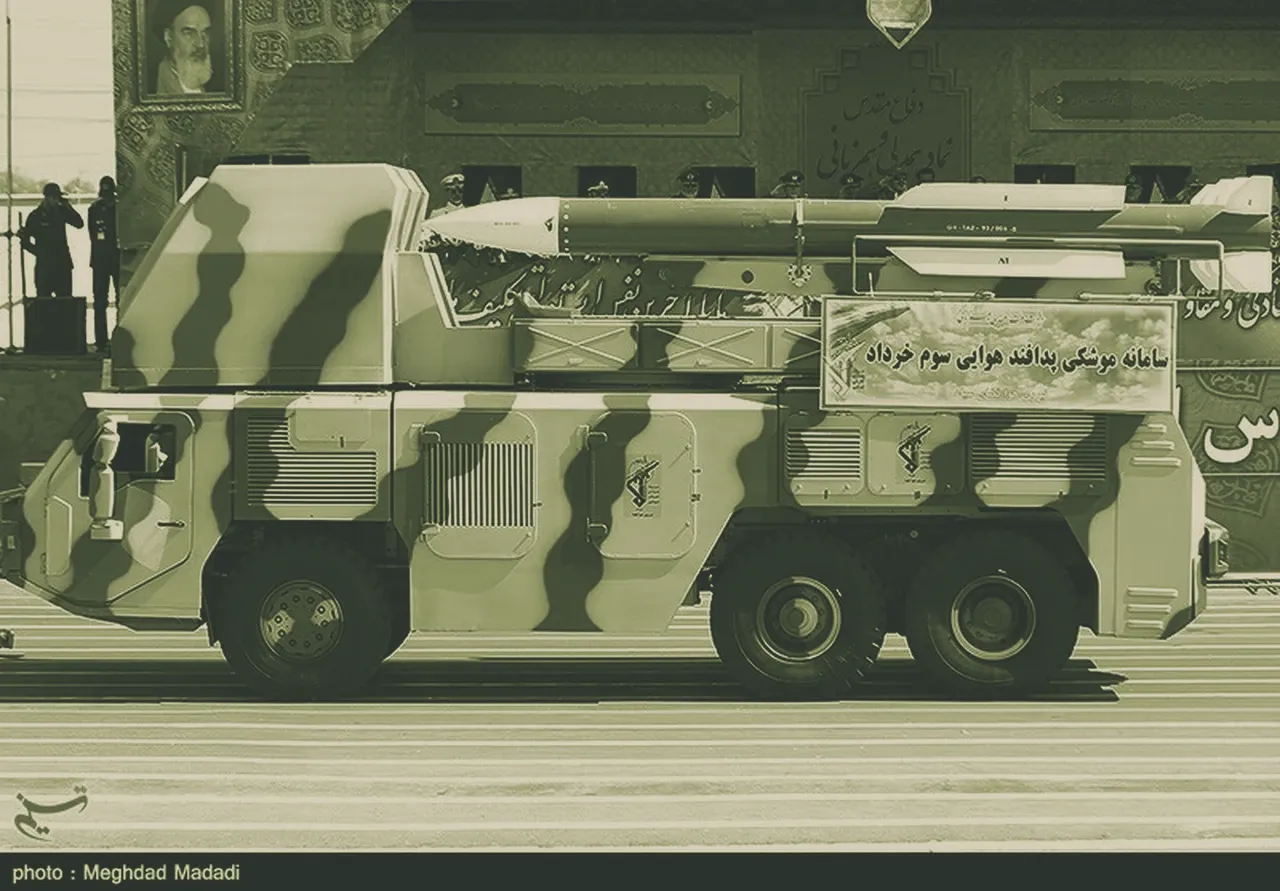
Iran's mobile medium-to-long-range surface-to-air missile system — a self-contained launcher-and-radar vehicle from the indigenous Raad family, Tehran's rough equivalent of Russia's Buk. In 2019 a 3rd Khordad shot down a US RQ-4 Global Hawk over the Strait of Hormuz, Iran's most famous air-defence kill.
Overview
The 3rd Khordad (in Persian Sevom Khordad, often rendered Khordad-3) is an Iranian road-mobile surface-to-air missile system and the most capable member of the indigenous Raad (Ra'ad) air-defence family. It is built around a self-contained TELAR — a single vehicle integrating the launcher, an active phased-array fire-control radar and the engagement electronics — so each unit can detect, track and engage targets semi-autonomously, in the manner of Russia's Buk. Developed by Iran's Ministry of Defence (MODAFL) and the Aerospace Industries Organization, it forms the mobile, survivable medium-range middle layer of Iran's integrated air defence, below the strategic Bavar-373. Its claim to fame is concrete combat success: it downed a high-flying US Navy Global Hawk in 2019.
Development
The carrier chassis associated with the system was first unveiled in December 2012 alongside the related Raad air-defence system, and the complete 3rd Khordad configuration was formally introduced at the 2014 IRGC achievements exhibition, according to Army Recognition. At unveiling it had a declared engagement range of roughly 75 km and an interception ceiling of 25–27 km; subsequent upgrades to missiles, seekers and radar pushed the maximum reported reach to about 200 km and 30 km with the long-range Taer-3 and Sayyad-3 interceptors. The 3rd Khordad belongs to a broader common-chassis family that includes the Raad, Tabas, Alam Al-Hodi and 9 Dey systems, plus the longer-range relative Khordad-15 (a separate system, not to be confused with this one).
Design & capabilities
The 3rd Khordad is built around a self-contained TELAR on a heavy multi-axle chassis (about 8.9 m long), carrying three to four ready interceptors in sealed canisters with an onboard active phased-array fire-control radar mounted ahead of the missile pack, plus hydraulic stabilizers deployed for firing. Per Army Recognition, the onboard radar's detection range is reported to exceed 200 km, and the system can engage four aerial targets simultaneously while guiding up to eight missiles. A defining feature is multi-missile compatibility from one launcher: it can fire short-, medium- and long-range interceptors without structural redesign.
The missile inventory spans the engagement envelope: the Taer-2 (50 km / 27 km ceiling), Taer-2A (75 km), Taer-2B (105 km), Sayyad-2 (75 km), Sayyad-2C (120 km), Sayyad-3 (150 km / 30 km), the long-range Taer-3 (200 km / 30 km), and the short-range 9 Dey (5–30 km). All use solid-fuel propulsion with inertial mid-course guidance, command updates from the fire-control radar, and terminal radar homing — enabling engagement of maneuvering aircraft, cruise missiles, UAVs and high-altitude reconnaissance platforms. A full battalion adds a central control station and the Bashir long-range search radar (reported 350 km), with four TELARs and eight reload (TEL) vehicles for 36 ready missiles.
Variants
- 3rd Khordad (Khordad-3): the standard long-range operational configuration described here.
- Raad (Ra'ad): the earlier related configuration unveiled in 2012.
- Tabas: a complementary configuration using a reflector-type radar instead of the phased array.
- Alam Al-Hodi / 9 Dey: members of the same missile-and-chassis family (9 Dey is a short-range box-launch configuration).
- Khordad-15: an extended-range related development — a different system, frequently confused with the 3rd Khordad.
Combat record / operational use
The 3rd Khordad's defining engagement came on 20 June 2019, when it shot down a US Navy RQ-4A BAMS-D Global Hawk high-altitude surveillance drone over (by Iran's account) Iranian airspace near the Strait of Hormuz — an incident that nearly triggered US military retaliation and remains Iran's most prominent air-defence kill. (This is the engagement that is frequently and wrongly attributed to the longer-range Bavar-373; the 3rd Khordad is the correct system.) Beyond 2019, the Khordad/Raad family forms the mobile, dispersed medium-range layer of Iran's air defence; in the 2025–26 Israeli and US air campaigns, after Iran's fixed strategic batteries were heavily suppressed, it was the survivable mobile and short-range systems — the layer the 3rd Khordad belongs to — that kept Iran's air defence "battered but biting," as analyzed by MiGFlug. Specific 3rd Khordad engagement results in those wars are not well attributed and should be treated cautiously.
Advantages
- Combat-proven: scored Iran's highest-profile air-defence kill (RQ-4 Global Hawk, 2019).
- Self-contained autonomous TELAR — detect, track and engage from one mobile vehicle; supports shoot-and-scoot survivability.
- Multi-missile flexibility (Taer/Sayyad/9 Dey) covers short to long range from a single launcher.
- Indigenous and sanctions-resilient, and embedded in a deep, layered, dispersed network that is hard to fully suppress.
Drawbacks / limitations
- Most range/capacity figures are Iranian-state claims; the well-corroborated combat fact is the 2019 RQ-4 shootdown (against a non-stealthy, non-maneuvering target).
- Medium-range tier — it lacks the reach of the strategic Bavar-373 or S-300 for top-cover.
- Untested at scale against top-tier stealth, electronic warfare and SEAD; like the rest of Iran's network it was heavily pressured in 2025–26.
- Component and microelectronics quality constrained by sanctions.
Counterparts
- Russia's Buk-M2/M3 (Buk-M3) — the closest design analog; the 3rd Khordad is Iran's "Buk equivalent," with a chassis visually echoing the Belarusian MZKT but configured differently.
- Bavar-373 (Iran) — the strategic long-range sibling that sits above it in the layered IADS.
- S-300 (Russia), Patriot PAC-3 (US) — higher-tier peers; HQ-9B (China) for the Chinese long-/medium-SAM comparison.
Outlook
The 3rd Khordad will remain a workhorse of Iran's medium-range air defence: mobile, multi-missile, and — unlike the scarce strategic batteries — numerous and survivable enough to keep contesting airspace after an opening suppression wave. Its trajectory is incremental: longer-range Taer-3/Sayyad-3 rounds, better radars and networking with the wider Raad family and search radars like Bashir. The signals to watch are whether Iran can harden the system and its sensors against the stealth-plus-EW combination that degraded its network in 2025–26, and whether it records any further verified kills against modern, defended aircraft rather than a lone surveillance drone. For now it is Iran's most combat-credible indigenous SAM, with a real but narrow track record.
Key specifications
| Spec | Value |
|---|---|
| Type | Mobile medium-to-long-range SAM (self-contained TELAR), Raad family |
| Engagement range | ~50 km (Taer-2) to ~200 km (Taer-3 / Sayyad-3) |
| Engagement altitude | ~27 km (Taer-2); up to ~30 km (Taer-3 / Sayyad-3) |
| Target set | Aircraft, AEW platforms, UAVs, cruise missiles, high-altitude reconnaissance |
| Interceptor(s) | Taer-2/2A/2B, Sayyad-2/2C/3, Taer-3, 9 Dey (solid-fuel; INS + command + terminal radar homing) |
| Radar / fire control | Onboard active phased-array FCS (>200 km detection); battalion adds Bashir search radar (~350 km) |
| Reaction time | Not publicly established |
| Simultaneous engagements | 4 targets / up to 8 missiles guided (claimed) |
| Mobility | Road-mobile TELAR (~8.9 × 2.5 × 2.5 m); battalion = control station + Bashir + 4 TELAR + 8 TEL (36 missiles) |
Sources
- Army Recognition — Khordad-3 (full specs, missile family, battalion structure, development history). https://armyrecognition.com/military-products/army/air-defense-systems/air-defense-vehicles/khordad-3
- MiGFlug — Battered but Biting: Inside Iran's Air Defence Network (Khordad/Raad in the layered IADS; 2025–26 survivability). https://migflug.com/jetflights/battered-but-biting-inside-irans-air-defence-network/
- FPRI — Shallow Ramparts: Air and Missile Defenses in the June 2025 Israel–Iran War. https://www.fpri.org/article/2025/10/shallow-ramparts-air-and-missile-defenses-in-the-june-2025-israel-iran-war/
- Iran Watch — Table of Iran's Missile/Air-Defence Arsenal. https://www.iranwatch.org/our-publications/weapon-program-background-report/table-irans-missile-arsenal
- Al Jazeera — What are Iran's weapons as it fights the US and Israel? https://www.aljazeera.com/news/2026/3/1/what-are-irans-weapons-as-it-fights-the-us-and-israel
- Palestine Chronicle — Inside Iran's Air Defense Network (mobile/dispersed survivability). https://www.palestinechronicle.com/how-did-iran-shoot-down-a-us-fighter-jet-inside-irans-air-defense-network/
- Bulgarian Military — Russia denied Iran S-400 amid Israeli air assault (IADS context). https://bulgarianmilitary.com/2025/07/01/why-russia-denied-iran-s-400-system-amid-israeli-air-assault/
- CFR Global Conflict Tracker — Iran's war with Israel and the US. https://www.cfr.org/global-conflict-tracker/conflict/confrontation-between-united-states-and-iran
🔒 The Analyst Section on 3rd Khordad is for BattlePolicy Pro members. Below the line: procurement and contract history, the suppliers and companies behind the system, our head-to-head analyst view of the systems it actually competes with, and the BattlePolicy assessment note. Unlock the full file with BattlePolicy Pro →