Anduril Roadrunner
A reusable, jet-powered vertical-takeoff interceptor built to hunt drones at an order-of-magnitude lower cost than legacy missiles — and land again if the threat evaporates.
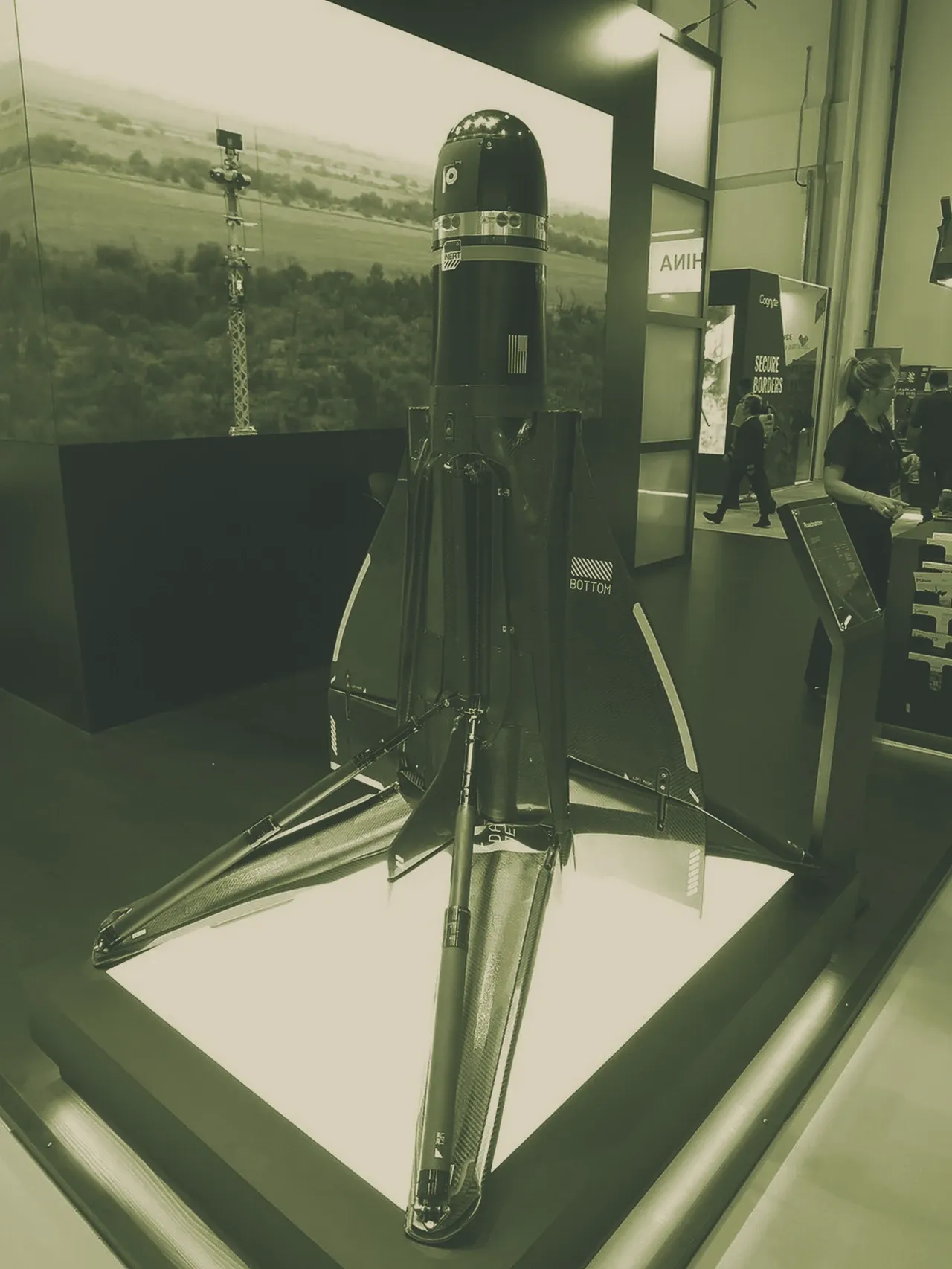
Overview
The Anduril Roadrunner is a modular, twin-turbojet autonomous air vehicle designed to give ground and naval forces a reusable counter-UAS and short-range air-defence option. Its high-explosive variant, Roadrunner-M, operates as a loitering interceptor: it can be launched on a threat cue, accelerate to high sub-sonic speed, destroy the target with a proximity-fuzed warhead, and — if no engagement is required — return to base, land vertically, and be refuelled for the next sortie. The system was developed internally by Anduril Industries, entered low-rate production for an undisclosed US customer in 2023, and was publicly revealed in December 2023 with hundreds of rounds already in production. The logic is economic: a Roadrunner-M costs roughly half a RIM-116 Rolling Airframe Missile and a fraction of an ESSM or SM-2, directly attacking the cost-curve mismatch of million-dollar interceptor versus thousand-dollar threat that the Red Sea drone campaign exposed.
Development
Roadrunner was Anduril’s archetypal product-company play — a two-year sprint from “napkin sketch” to operational validation, funded entirely in-house. The concept grew out of the company’s earlier Sentry-tower counter-UAS work for SOCOM and U.S. Customs and Border Protection, and the conviction that almost every expensive part could be made cheaper at scale. Proprietary fast-start turbojets, thrust-vectoring control, and carbon-fibre airframes were all developed internally to keep unit costs in the low hundreds of thousands of dollars. Full-size prototypes had flown extensive test campaigns ahead of the December 2023 unveiling, and a paying US customer — later identified through procurement records as U.S. Special Operations Command — had already placed orders. SOCOM paid $12.5 million for “Roadrunner CUxS Hardware” in December 2022 and requested a further $19 million in FY2024, making the system one of the earliest fielded components of the Pentagon’s accelerated counter-drone push.
Design & capabilities
Roadrunner’s core is a reusable air-vehicle that takes off and lands vertically from a self-contained “Nest” hangar. The interceptor variant, Roadrunner-M, carries a proximity-fuzed high-explosive warhead and is pitched as roughly three times more manoeuvrable in G-force and with three times the warhead payload capacity of market peers, while sustaining high sub-sonic speeds. Anduril claims an engagement envelope that is “ten times the one-way effective range” of comparable offerings, although precise range and altitude figures have not been published; open-source reports suggest the vehicle has engaged drone targets at ranges around 16 km (10 mi) in testing. Onboard sensors and processing handle terminal intercept autonomously, but a human operator must authorize the engagement. The system is sensor-agnostic: targets are cued via Anduril’s Lattice command-and-control fabric, which can ingest data from Sentry towers, third-party air-defence radars, or shipboard combat systems. A single operator can supervise multiple Roadrunner squadrons, and the Nest can sit unattended for months before launching at the “first hint of danger,” according to manufacturer statements. If no intercept is needed, the vehicle returns, lands vertically, and can be refuelled and readied to relaunch in minutes, a capability the company describes as giving commanders “launch-without-regret” freedom.
Variants
- Roadrunner (base vehicle): the reusable, modular airframe; demonstrated in an XPRIZE-funded wildfire-detection configuration carrying electro-optical sensors.
- Roadrunner-M (munition): the high-explosive interceptor variant; the only version known to have been ordered by the Pentagon.
Combat record / operational use
Anduril has stated that Roadrunner “has been operationally deployed for Combat Evaluation since January 2024” in undisclosed priority regions where U.S. forces face drone threats — language that points at the Middle East during the Houthi uncrewed-systems campaign. No engagement results have been publicly released, and the Pentagon has never formally acknowledged which services took the 500-plus Roadrunner-M rounds ordered in October 2024. However, U.S. military briefing slides obtained by the press identify Roadrunner as a SOCOM counter-drone program, and Defense News confirmed the $250 million contract for Roadrunner-M alongside Pulsar electronic-warfare systems. A naval operational chapter opened in March 2025 when Admiral Daryl Caudle, commander of U.S. Fleet Forces Command, announced that Roadrunner-M and Raytheon’s Coyote Block 2 would be integrated onto Arleigh Burke-class destroyers of the USS Gerald R. Ford carrier strike group, drawn from the Navy’s live-fire experience of expending SM-2s and other expensive munitions against Houthi drones. The ships conducted pre-deployment training with the interceptors before sailing to the Middle East in 2025. Meanwhile, the U.S. Marine Corps folded Roadrunner-M into a broader family of systems under a 10-year, $642 million programme-of-record for installation defence awarded in March 2025, ensuring the system’s sustained procurement path.
Advantages
- Reusability fundamentally shifts interceptor cost calculus: hundreds of sorties that end without an interception cost almost nothing, avoiding the “million-dollar missile against a $50,000 drone” trap.
- Loitering en-route adds decision time and persistent ISR, unlike a one-shot SAM.
- Sensor-agnostic architecture (Lattice) integrates into existing radar and C2 networks without a bespoke fire-control stack.
- Vertically-launched, containerised Nest is transportable by truck, boat, or ship, and suited to remote semi-autonomous emplacement.
- Designed for scalable production with in-house turbojets and carbon-fibre construction; Pentagon moved to a 500-unit order within a year of unveiling.
Drawbacks / limitations
- Virtually all key performance data — range, altitude, loiter time, warhead, seeker — remain unpublished, making the manufacturer’s “10×/3×” claims unverifiable.
- Unit cost, while lower than traditional SAMs, is still several times that of dedicated expendable interceptors such as the Coyote Block 2 (~$100,000–125,000); the business case collapses if every sortie ends in a kill.
- High-subsonic speed limits the target set to drones, loitering munitions, and cruise missiles; ballistic missiles and fast jets are beyond the envelope, and Anduril itself positions Roadrunner below Patriot-class systems.
- No publicly confirmed combat intercepts, and operators remain opaque — the services fielding Roadrunner have never been officially named.
- Shipboard integration with Aegis and deck operations is nascent; details of the destroyer fit have not been disclosed.
Counterparts
- Iron Dome (Israel)
- Pantsir-S1 (Russia)
- Raytheon Coyote Block 2 (USA) — expendable jet-powered drone interceptor, a direct cost-competitor in the same US Navy counter-UAS effort.
Outlook
Demand signals point upward: SOCOM’s counter-drone line, the Navy’s destroyer integration as a precursor to a wider fleet refit for anti-drone defence, the USMC’s installation-defence programme of record running to 2035, and the Pentagon’s Replicator initiative all feed a growing requirement. Anduril is standing up a dedicated Roadrunner production line at its $1 billion Arsenal-1 plant in Ohio, with output expected by the end of 2026, and the company’s $5 billion Series H funding round in May 2026, which valued it at $61 billion, was driven in part by this contract momentum. The open questions are whether Roadrunner-M can deliver publicly confirmed kills, whether the Navy ties the system into Aegis or keeps it as a bolt-on, and how long the reusability-cost advantage holds against expendable rivals and directed-energy weapons that promise zero per-shot munition cost.
Key specifications
| Spec | Value |
|---|---|
| Type | Reusable VTOL twin-turbojet autonomous interceptor (Roadrunner-M = HE-warhead variant) |
| Engagement range | Not publicly established (press reports indicate ~16 km / 10 mi demonstrated) |
| Engagement altitude | Not publicly established |
| Target set | Small/medium UAS, loitering munitions, cruise missiles, low-flying aircraft |
| Interceptor(s) | Roadrunner-M (high-explosive, proximity-fuzed) |
| Radar / fire control | Sensor-agnostic via Anduril Lattice (Sentry towers, third-party radars, or shipboard C2) |
| Reaction time | Not publicly established (launches from Nest at “first hint of danger” claim) |
| Simultaneous engagements | Not publicly established (single operator can supervise multiple squadrons, company claim) |
| Mobility | Containerised “Nest” hangars; road-mobile, watercraft/ship-transportable; shipboard integration on Arleigh Burke-class from 2025 |
Sources
- Anduril Industries — “Anduril Unveils Roadrunner & Roadrunner-M.” https://www.anduril.com/news/anduril-unveils-roadrunner-and-roadrunner-m
- The War Zone — “Roadrunner Reusable Anti-Air Interceptor Breaks Cover.” https://www.twz.com/roadrunner-reusable-anti-air-interceptor-breaks-cover
- Defense News — “Anduril lands $250 million Pentagon contract for drone defense system.” https://www.defensenews.com/unmanned/2024/10/08/anduril-lands-250-million-pentagon-contract-for-drone-defense-system/
- Designation-Systems.net — “Anduril Roadrunner.” https://www.designation-systems.net/dusrm/app4/roadrunner.html
- Anduril Industries — “Anduril Awarded 10-Year $642M Program of Record to Deliver CUAS Systems for U.S. Marine Corps.” https://www.anduril.com/news/anduril-awarded-10-year-642m-program-of-record-to-deliver-cuas-systems-for-u-s-marine-corps
- The War Zone — “Coyote, Roadrunner Loitering Drone Interceptors To Arm U.S. Navy Destroyers.” https://www.twz.com/sea/coyote-roadrunner-loitering-drone-interceptors-to-arm-u-s-navy-destroyers
- Business Insider — “See the 2 anti-drone missiles the US Navy is using to defend aircraft carriers.” https://www.businessinsider.com/anduril-roadrunner-raytheon-coyote-drones-us-navy-carriers-2025-5
- Breaking Defense — “As Fury production starts, Anduril pledging a different production approach at Arsenal-1.” https://breakingdefense.com/2026/03/as-fury-production-starts-anduril-pledging-a-different-production-approach-at-arsenal-1/
- Analytics Insight — “Anduril Valuation Reaches $61 Billion After $5 Billion Series H Funding Round.” https://www.analyticsinsight.net/news/anduril-valuation-reaches-61-billion-after-5-billion-series-h-funding-round