Arena-M
Russia's radar-cued hard-kill tank shield, and the first serial Russian active protection system credited with shooting down FPV drones. In its combat debut one tank killed seven drones, then ran out of ammunition and died.
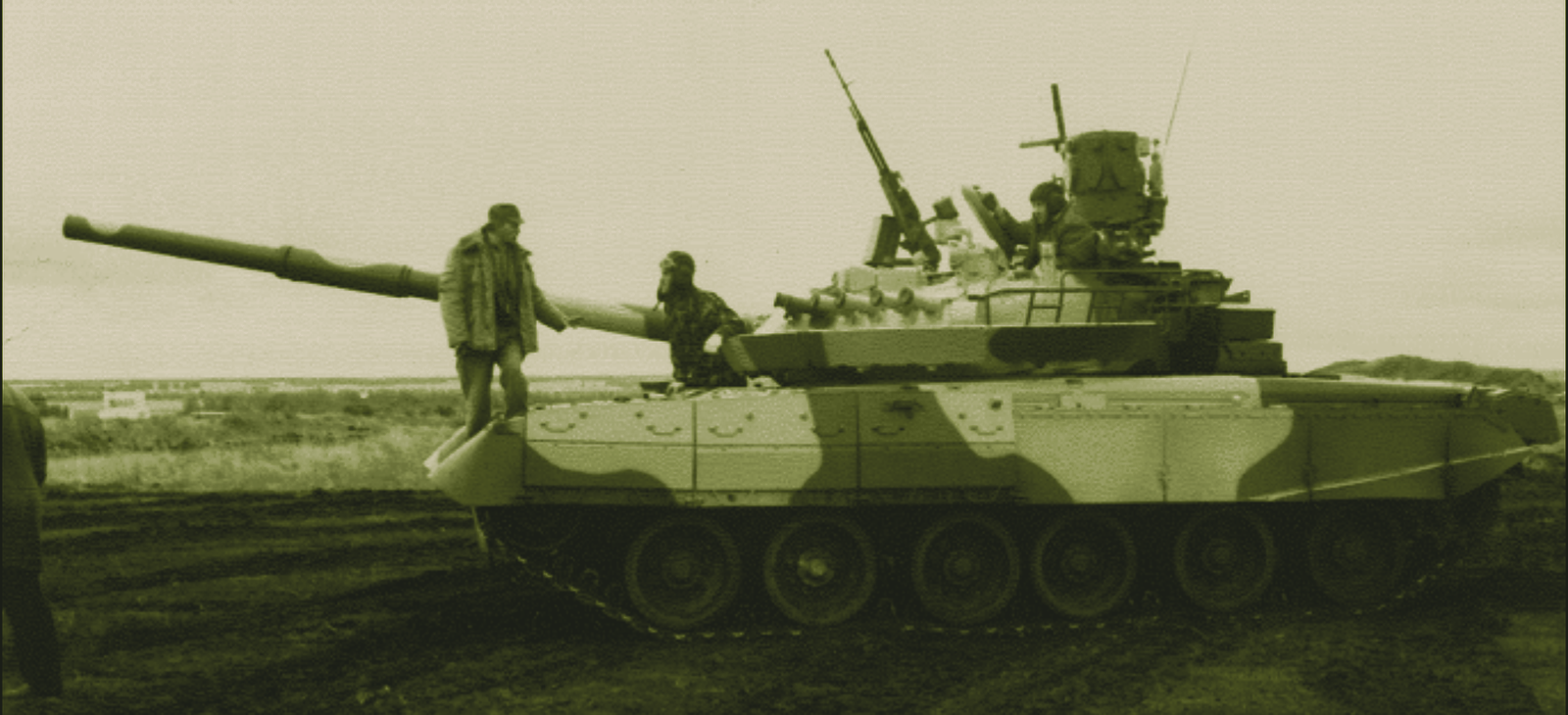
Russia's radar-cued hard-kill tank shield, and the first serial Russian active protection system credited with shooting down FPV drones rather than only missiles. In its documented combat debut one T-72B3A destroyed seven drones, exhausted its magazine, and was then destroyed itself.
Overview
Arena-M is a hard-kill active protection system (APS) developed by the Kolomna Machine-Building Design Bureau for Russian main battle tanks. It combines a radar that detects incoming threats with a protected launcher firing defensive submunitions that destroy the threat before it reaches the vehicle. The concept dates to the Soviet-era Arena programme; what makes the M variant significant is that it has been credited with intercepting first-person-view attack drones, the weapon that has done more than any other to make armoured manoeuvre difficult in Ukraine.
The system's combat debut came in July 2026, fitted to T-72B3A tanks during a Russian mechanised assault near Shakhove in eastern Ukraine. Its performance in that action is unusually well documented for a Russian system, because the Ukrainian unit that fought against it described what happened: one Arena-M-equipped tank shot down seven FPV drones before its magazine ran dry, and was then destroyed. Ukrainian accounts put the cost of killing an Arena-M tank at 15 to 20 FPV drones, against a handful for an unprotected one.
That single engagement contains the whole assessment. Arena-M works, and saturation defeats it.
Development
The Arena active protection system originated in the Soviet and early Russian period as an answer to anti-tank guided missiles and rocket-propelled grenades — the threats that dominated armoured warfare from the 1970s through the 2000s. It was never fielded at scale, and Russian armour entered the 2022 invasion of Ukraine essentially without functioning hard-kill protection, relying instead on explosive reactive armour and, later, on improvised cope cages and anti-drone netting.
The FPV drone changed the requirement. Cheap first-person-view quadcopters attacking from above and behind defeated reactive armour, cage improvisations and crew reaction alike, and by 2024–25 they accounted for a substantial share of Russian armoured losses. In 2023 Russian state media reported that Arena-M would be fitted to T-90M and T-80BVM tanks, with T-72B3 and T-72B3M under consideration.
Fielding took until 2026. T-72B3A tanks equipped with Arena-M were reportedly transferred to the front on 13 July 2026, and by 24 July Ukrainian FPV footage showed strikes against them. The system's makers claimed by mid-2026 that Arena-M could intercept not only anti-tank missiles and shells but FPV drones as well — the claim that the Shakhove assault would test.
Design & capabilities
Arena-M follows the standard hard-kill APS architecture, with adaptations for the drone threat.
- Sensor: a radar station mounted on the turret, providing 360-degree detection of approaching threats and computing an intercept solution. Radar cueing is what distinguishes a true APS from passive protection, and it is also the system's principal vulnerability, since the radar must radiate.
- Effectors: a protected launcher firing defensive submunitions that detonate to destroy or disrupt an incoming threat at standoff distance from the hull. The launcher being armoured is a specific lesson from earlier APS designs, whose exposed effector cassettes were vulnerable to small-arms fire and fragmentation.
- Threat set: anti-tank guided missiles, rocket-propelled grenades and shaped-charge projectiles — the traditional APS target — plus, per manufacturer claims and now combat reporting, FPV attack drones.
- Coverage: described as providing layered all-round defence. Engaging a slow, small, erratically flown quadcopter is a materially different radar and fire-control problem from engaging a fast, ballistic ATGM, and Arena-M's credited drone intercepts indicate the M variant's processing was reworked for it.
- Platform: fielded on the T-72B3A; earlier announcements named the T-90M and T-80BVM as intended recipients.
- Magazine: finite and, on the evidence of Shakhove, small enough to be exhausted by around seven engagements. Exact capacity has not been disclosed, and reload is not possible under fire.
Russian reporting has compared Arena-M favourably to foreign equivalents, particularly Israel's Trophy — a claim that should be read as promotional, since Trophy has a far longer and better-documented operational record, though against a different threat mix.
Variants
- Arena (original): The Soviet/Russian-era system developed against ATGMs and RPGs, never widely fielded.
- Arena-M: The current variant, with reworked sensors and effectors credited with FPV drone interception. Announced 2023 for T-90M and T-80BVM; fielded in combat on the T-72B3A from July 2026.
No sub-variants have been publicly identified. The T-72B3A itself represents a layered configuration in which Arena-M is combined with cope cages and anti-drone netting rather than replacing them.
Combat record / operational use
Arena-M's operational record is short, specific and unusually well sourced.
The first documented battlefield use occurred in July 2026 during a Russian mechanised assault near Shakhove in eastern Ukraine. Ukrainian forces repelled the attack and published video of FPV strikes destroying at least seven T-72B3A tanks, some of them Arena-M equipped.
The most informative account comes from Ukrainian combat drone specialist Dmytro Putiata, who spoke directly with the Ukrainian unit involved and published his findings on 8 August 2026. According to that account, one T-72B3A's Arena-M destroyed seven FPV drones before its magazine was exhausted, after which the tank was struck and destroyed. It was the first time Arena-M had been credited with shooting down drones in combat.
Independent corroboration followed. Janes reported on 17 August 2026 that a Russian tank — numbered 133 in the footage — was observed for the first time "likely using Arena-M" to successfully engage a quadcopter FPV drone. That is the closest thing to a neutral technical confirmation available.
Ukrainian assessments of the practical effect converge on a figure: destroying an Arena-M-equipped T-72B3A takes roughly 15 to 20 FPV drones, with some accounts citing higher counts. Against a tank without APS the number is far lower. At the same time, footage released by a Ukrainian National Guard unit reportedly shows an FPV drone striking the rear of an Arena-M-fitted T-72B3A without any visible interception — consistent with either magazine exhaustion, a coverage gap in the rear arc, or a failure to engage.
In July 2026 the Omega Special Operations Center of Ukraine's National Guard destroyed an Arena-M-equipped vehicle for the first time.
Advantages
- Genuinely intercepts FPV drones — the first serial Russian APS credited with doing so in combat, corroborated by Janes as well as by Ukrainian sources.
- Multiplies the cost of a kill — raising the requirement from a handful of drones to 15–20 imposes real ammunition, operator and sortie costs on the attacker.
- Radar-cued and automatic — engagement happens faster than crew reaction, against threats that give almost no warning.
- Protected launcher — armouring the effector addresses a known weakness of earlier APS designs exposed to fragmentation and small arms.
- Layers with existing protection — used alongside cope cages and netting rather than instead of them, giving overlapping coverage.
- Restores some manoeuvre — Russian doctrine has begun building mechanised breakthrough concepts around APS-equipped vehicles, which would be impossible without some drone protection.
- Broad threat coverage — retains the original anti-ATGM and anti-RPG capability alongside the new counter-drone role.
Drawbacks / limitations
- Magazine depth is the binding constraint — seven intercepts and then nothing, in the one documented case. Ukrainian tactics need only send more drones than the tank has rounds.
- No reload under fire — once exhausted, the vehicle reverts to passive protection for the remainder of the engagement.
- Radar emits — an active radar on a tank turret is a signature for Russian-facing electronic support measures to detect and for artillery to target.
- Coverage gaps — footage of a successful rear-aspect FPV strike suggests either an arc limitation or a failure mode not publicly explained.
- Fielded on an older hull — combat use has been on the T-72B3A rather than the T-90M originally announced, so the protection sits on a platform that is otherwise vulnerable.
- Danger to accompanying infantry — hard-kill APS effectors are hazardous to dismounts near the vehicle, a general limitation of the category that is particularly acute in the close-in assault role.
- Small sample — essentially one well-documented engagement supports the entire assessment.
Counterparts
- Trophy APS (Israel) — the most combat-proven hard-kill APS, with a far longer record against ATGMs and RPGs.
- T-72B3 (Russia) — the base hull family; the T-72B3A is the Arena-M-equipped variant.
- T-90M Proryv and T-80BVM (Russia) — the platforms originally named for Arena-M fitting.
- Fiber-optic FPV drone (Ukraine/Russia) — the jam-immune drone class that soft-kill defences cannot stop, making hard-kill APS the only remaining answer.
- Baba Yaga (Ukraine) — the heavy bomber drone attacking from above, a different geometry from the FPV threat Arena-M addresses.
- Merkava Mk 4 (Israel) — the Trophy-equipped reference platform Russian commentary compares Arena-M against.
Outlook
Arena-M is the clearest evidence yet that the FPV drone's dominance over armour is contestable rather than permanent. For roughly three years the reasonable assessment was that cheap drones had made tanks unusable in the open; a system that forces an attacker to expend fifteen to twenty drones per kill changes that arithmetic materially, even without stopping anything absolutely.
But magazine depth caps the achievement, and Ukraine's answer is arithmetic rather than technical. Sending twenty drones instead of five is a logistics decision, not an engineering programme, and Ukrainian FPV production comfortably supports it — Ukrainian sources claim a production ratio of roughly sixteen FPV drones to every ten Russian. As long as an attacker can saturate faster than a defender can reload, hard-kill APS raises the price of armoured operations without restoring them.
The development to watch is doctrinal. Meta-Defense has reported Russian efforts to build a mechanised breakthrough doctrine around Arena-M-equipped vehicles — using APS tanks to lead assaults that unprotected armour could not survive. If that concept produces results, Arena-M will matter far beyond its interception statistics, because it will have restored a manoeuvre option the drone war removed. If Shakhove is representative — seven tanks destroyed in the debut action — it will not.
For Western armies the read is unambiguous. Every NATO tank fleet faces the same FPV problem and most have no hard-kill APS fitted at all. Russia has now demonstrated combat drone interception from a turret-mounted system on a 1970s hull. The question for European programme offices is not whether the technology works but why it is not fitted.
Key specifications
| Spec | Value |
|---|---|
| Type | Hard-kill active protection system (radar-cued) |
| Threat set | Anti-tank guided missiles, RPGs, shaped-charge projectiles, and FPV attack drones |
| Sensor | Turret-mounted radar station with all-round detection |
| Effector | Protected launcher firing defensive submunitions at standoff distance |
| Magazine | Not disclosed; exhausted after seven intercepts in the documented Shakhove engagement |
| Coverage | Layered all-round; rear-aspect penetration observed in at least one case |
| Platform(s) | T-72B3A in combat use; T-90M and T-80BVM named in 2023 announcements |
| Combat debut | July 2026, Russian mechanised assault near Shakhove, eastern Ukraine |
| Demonstrated effect | One tank destroyed seven FPV drones before magazine exhaustion; 15–20 drones assessed as needed to kill an equipped tank |
| Developer | KBM (Kolomna Machine-Building Design Bureau) |
Sources
- Forbes (David Hambling) — "Russia's FPV-Stopping Arena System For Tanks Gets Combat Debut." https://www.forbes.com/sites/davidhambling/2026/08/10/russias-fpv-stopping-arena-system-for-tanks-gets-combat-debut/
- Euromaidan Press — "Russia's tank shield shot down seven drones — Ukraine destroyed the tank anyway." https://euromaidanpress.com/2026/08/11/russias-tank-shield-shot-down-seven-drones-ukraine-destroyed-the-tank-anyway/
- Ars Technica — "Ukrainian drones overwhelm Russian tanks' new active protection system—for now." https://arstechnica.com/gadgets/2026/08/ukrainian-drones-overwhelm-russian-tanks-new-active-protection-system-for-now/
- Janes — "Russian tank observed for first time likely using Arena-M APS against UAV." https://www.janes.com/defence-intelligence-insights/defence-news/land/russian-tank-observed-for-first-time-likely-using-arena-m-aps-against-uav
- Militarnyi — "Russian Arena-M APS Intercepts FPV Drones on the Front Line for the First Time." https://militarnyi.com/en/news/russian-arena-m-aps-intercepts-fpv-drones-on-the-front-line-for-the-first-time/
- Meta-Defense — "The Arena-M Hard-Kill APS becomes the cornerstone of a new Russian mechanized breakthrough doctrine." https://meta-defense.fr/en/2026/08/18/arena-m-russian-mechanized-breakthrough-doctrine/
- Wikipedia — "Arena (countermeasure)." https://en.wikipedia.org/wiki/Arena_(countermeasure)
- Rossiyskaya Gazeta — "Комплекс активной защиты 'Арена-М' показывает себя лучше зарубежных аналогов." https://rg.ru/2026/08/03/kompleks-aktivnoj-zashchity-arena-m-pokazyvaet-sebia-luchshe-zarubezhnyh-analogov.html
- Institute for the Study of War — "Russian Offensive Campaign Assessment, August 9, 2026." https://understandingwar.org/research/russia-ukraine/russian-offensive-campaign-assessment-august-9-2026/
🔒 The Analyst Section on Arena-M is for BattlePolicy Pro members. Below the line: procurement and contract history, the suppliers and companies behind the system, our head-to-head analyst view of the systems it actually competes with, and the BattlePolicy assessment note. Unlock the full file with BattlePolicy Pro →
Below this point
- Analyst Section
- Procurement & contracts
- Suppliers & related companies
- Comparable systems — analyst view
- Analyst note