Arrow-3
Israel's exoatmospheric hit-to-kill ballistic missile interceptor, jointly developed with the U.S., combat-proven against Houthi and Iranian missiles, and now fielded by Germany as the first European upper-tier system.
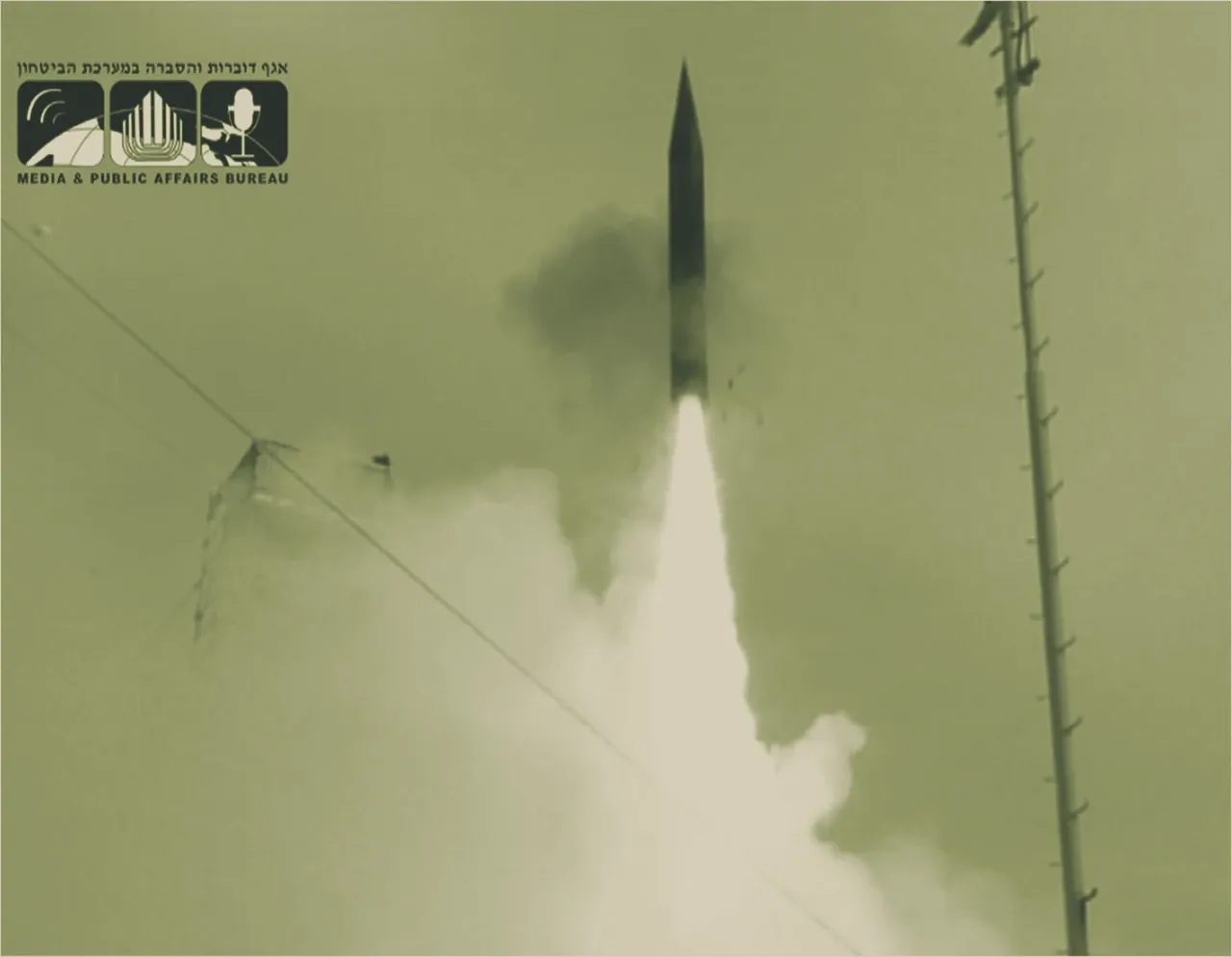
Israel's upper-tier exoatmospheric ballistic-missile interceptor — a hit-to-kill weapon jointly developed with the U.S., combat-proven against Houthi and Iranian salvos, and now anchoring Germany's contribution to European Sky Shield.
Overview
The Arrow-3, also known as Hetz 3, is the top tier of Israel’s multi-layered air and missile defense stack, designed to intercept medium- and long-range ballistic missiles outside the atmosphere using a body-to-body hit-to-kill kill vehicle. Developed cooperatively by Israel and the United States and operational since 2017, Arrow-3 sits above Arrow-2, David’s Sling, and Iron Dome, and its German Arrow Weapon System (AWS-G) configuration has made it the first European-fielded exoatmospheric interceptor.
Development
Israel and the United States launched Arrow-3 development in August 2008 as the successor to Arrow-2, aiming for a full exoatmospheric intercept capability. Israel Aerospace Industries (IAI) is the prime contractor, with Boeing producing 40–50% of interceptor content and the U.S. Missile Defense Agency contributing well over $1 billion across fiscal years 2008–2021, according to Wikipedia. The interceptor’s kill-vehicle concept — a solid-fuel motor with thrust-vectoring and a gimbaled seeker — was deliberately simpler and cheaper than liquid-divert designs; then-MDA director Lt. Gen. Patrick O’Reilly called it “more advanced than what we have ever attempted in the U.S.” The first fly-out test occurred in February 2013, and the first exoatmospheric intercept took place on 10 December 2015. Arrow-3 was declared operational on 18 January 2017.
Germany selected Arrow-3 under the European Sky Shield Initiative, with the Bundestag approving a €4 billion ($4.6 billion) purchase in June 2023 and U.S. approval following in August 2023. The first elements were handed over and the system achieved initial operational capability at Holzdorf Air Base on 3 December 2025, with delivery confirmed by Breaking Defense and The Times of Israel. An expansion package worth approximately €3 billion ($3.1 billion) was approved in December 2025, bringing the total program to more than $6.5 billion.
Design & capabilities
Arrow-3 is a two-stage, solid-fuel exoatmospheric anti-ballistic missile with a hit-to-kill kill vehicle. The kill vehicle uses a thrust-vectoring solid rocket motor and a gimbaled hemispheric seeker, employing proportional navigation for maneuvering. The design allows the interceptor to be launched toward a predicted volume of space and redirected mid-flight, dramatically reducing dependence on external terminal guidance, as detailed by Wikipedia.
The system's flight range is reported to be up to approximately 2,400 km, with an engagement altitude above 100 km (exoatmospheric). It is intended to defeat medium- to intercontinental-range ballistic missiles, including those carrying weapons of mass destruction, and Israeli officials have noted it can be adapted for anti-satellite missions.
Fire control relies on the EL/M-2080 Green Pine / Super Green Pine family of long-range radars and the “Golden Citron” battle-management center; U.S. AN/TPY-2 radar deployed in Israel contributes early warning. In the German AWS-G configuration, described by Army Recognition, the system adds “Hazelnut Tree” launcher control and uses trailer-mounted erector-launchers with six sealed canisters each, deployed at fixed sites. A single battery is expected to intercept salvos of more than five ballistic missiles within 30 seconds.
Variants
- Arrow 2: lower-tier, endo/exo-atmospheric blast-fragmentation predecessor in the same family.
- Arrow 3: baseline exoatmospheric hit-to-kill interceptor.
- AWS-G (Arrow Weapon System Germany): German-specific configuration with trailer-mounted launchers and tailored command-and-control.
- Arrow 4: successor in development, outside the scope of this entry.
Combat record / operational use
Arrow-3 transitioned rapidly from test range to wartime workhorse. The Arrow system logged its first combat use on 31 October 2023 — an Arrow-2 intercept of a Houthi missile, assessed as the first exoatmospheric combat intercept and first instance of space warfare — and Arrow-3 scored its first kill on 9 November 2023, downing a Houthi ballistic missile bound for Eilat.
In Iran’s 13–14 April 2024 attack, Arrow-3, together with U.S., UK, French and Jordanian support, helped defeat the barrage. During the 1 October 2024 “True Promise II” strike of approximately 200 ballistic missiles, video analysis identified 18 Arrow-3 launches from four sites, with about 15 midcourse intercepts estimated; the data implied either a ~50% single-shot probability of kill or a two-on-one engagement doctrine, and 32 missiles still penetrated to Nevatim, partly because the Iranian salvo coordination prevented Israeli crews from reloading launchers, according to Arms Control Wonk and FPRI.
The heaviest test came in the 12-day Israel–Iran war of June 2025. Iran launched roughly 550 medium-range ballistic missiles, of which 480–500 arrived as viable threats. Backed by Arrow-2/3, David’s Sling, Iron Dome, and 36 U.S. THAAD interceptors, Israeli defenses achieved an estimated 92.6–93.5% intercept rate — the INSS estimated ~95%, and the Israel Defense Ministry later cited 86% for the Arrow system — while 31–71 missiles caused impacts. At least 34 Arrow-3 launches were documented on video, with a low-confidence extrapolation reaching roughly 131, and U.S. officials said Israel was running low on anti-ballistic interceptors by the war’s end, as reported by FPRI and Missile Matters.
Arrow-3 was engaged again in June 2026. After a ceasefire on 8 April 2026, Iran fired 24 ballistic missiles at Israel on 7–8 June; the IDF stated all were intercepted or fell in open areas with no casualties. However, satellite imagery suggested damage to a hangar at Ramat David Air Base, as noted by Axios and The Times of Israel.
Advantages
- Combat-proven exoatmospheric kill: scored the world’s first operational space intercept, and demonstrated interception rates of approximately 86–95% under massed ballistic missile attacks.
- Agile divert capability: thrust-vectored kill vehicle with gimbaled seeker allows dramatic mid-course trajectory changes and reduces reliance on external tracking; salvo capacity of >5 ballistic missiles per battery within 30 seconds.
- Software upgradability: improvements drawn from the 2024 engagements were credited with the enhanced performance observed in June 2025.
- Export validation: Germany’s AWS-G fills a NATO upper-tier gap and anchors the European Sky Shield with a proven exoatmospheric interceptor.
Drawbacks / limitations
- Magazine depth: by the end of the June 2025 war U.S. officials assessed Israel was running low on Arrow interceptors, and JINSA-reconstructed counts put Arrow-3 at roughly 41.5% of observed interceptors, raising concerns about campaign endurance.
- Cost asymmetry: multi-million-dollar interceptors against an Iranian arsenal estimated at around 1,500 remaining missiles and 200 launchers after June 2025 makes attrition economics unfavorable.
- Saturation and reload vulnerability: in the October 2024 True Promise II attack, coordinated large salvos prevented launcher reloads, resulting in 32 missile penetrations to Nevatim.
- Not hermetic: even with layered defenses, 31–71 Iranian missiles struck Israel or nearby areas in June 2025, and a possible hit damaged a hangar at Ramat David in June 2026.
- Fixed basing: silo-based deployment in Israel and fixed siting of German AWS-G launchers simplify an adversary’s targeting problem compared to mobile systems; Germany’s full three-site architecture is not expected to be complete until about 2030.
Counterparts
- THAAD (USA)
- S-400 Triumf (Russia)
Outlook
Arrow-3’s trajectory is defined by inventory replenishment and its European expansion. Rebuilding interceptors expended from 2023 to 2026 — while scaling production with Boeing and executing Germany’s expanded >$6.5 billion program toward three operational sites by roughly 2030 — is the binding constraint. Although the system proved its effectiveness under the highest-volume ballistic missile attacks ever faced by an air defense, the June 2025 lesson stands: deep magazines and launcher reload resilience, not single-shot performance, decide long campaigns, especially as Iran continues to rebuild its missile stocks and test Israeli defenses between ceasefires.
Key specifications
| Spec | Value |
|---|---|
| Type | Two-stage, solid-fuel exoatmospheric anti-ballistic missile with hit-to-kill kill vehicle |
| Engagement range | Up to ~2,400 km |
| Engagement altitude | >100 km (exoatmospheric) |
| Target set | Medium- to intercontinental-range ballistic missiles (including WMD-armed) |
| Interceptor(s) | Arrow 3 kill vehicle (thrust-vectored solid motor, gimbaled seeker) |
| Radar / fire control | EL/M-2080 Green Pine / Super Green Pine; “Golden Citron” (battle management); AN/TPY-2 (early warning cue); German AWS-G adds “Hazelnut Tree” launcher control |
| Reaction time | Not publicly established |
| Simultaneous engagements | Battery can intercept salvos of >5 ballistic missiles within 30 seconds |
| Mobility | Fixed/silo-based (Israel); trailer-mounted erector-launchers with six sealed canisters, fixed sites (Germany) |
Sources
- Wikipedia — Arrow 3 — https://en.wikipedia.org/wiki/Arrow_3
- INSS — The Israel–Iran War: Air Defense Performance — https://www.inss.org.il/social_media/the-israel-iran-war-air-defense-performance/
- FPRI — Shallow Ramparts: Air and Missile Defenses in the June 2025 Israel-Iran War — https://www.fpri.org/article/2025/10/shallow-ramparts-air-and-missile-defenses-in-the-june-2025-israel-iran-war/
- Arms Control Wonk — A Fistful of Interceptors: ABM Performance During True Promise II — https://www.armscontrolwonk.com/archive/1220797/a-firstful-of-interceptors-abm-performance-during-true-promise-ii/
- Missile Matters (Substack) — How Did Israel’s Missile Defense Perform in the “12-Day War”? — https://missilematters.substack.com/p/how-did-israels-missile-defense-perform
- Breaking Defense — Germany receives first Arrow 3 air defense system from Israel — https://breakingdefense.com/2025/12/germany-receives-first-arrow-3-air-defense-system-from-israel/
- The Times of Israel — Israel delivers Arrow 3 to Germany, in largest defense export deal ever — https://www.timesofisrael.com/israel-delivers-arrow-3-to-germany-in-largest-defense-export-deal-ever/
- Army Recognition — Germany Strengthens European Air Defense Capabilities With Israeli Arrow 3 Hypersonic Missile Interceptor — https://www.armyrecognition.com/news/army-news/2025/germany-strengthens-european-air-defense-capabilities-with-israeli-arrow-3-hypersonic-missile-interceptor
- Axios — Iran fires missiles at Israel for first time since ceasefire — https://www.axios.com/2026/06/07/iran-israel-missiles-us-tehran-negotiations-ceasefire-risk
- The Times of Israel — Satellite images appear to indicate damage at IAF base following Iranian missile attacks — https://www.timesofisrael.com/satellite-images-appear-to-indicate-damage-at-iaf-base-following-iranian-missile-attacks/