Bayraktar Akinci
Turkey's heavy-strike twin-turboprop UCAV — a 24-hour HALE platform that carries cruise missiles, air-launched ballistic weapons and an AESA radar, and the cornerstone of a 16-country export franchise built on aggressive co-production offers.
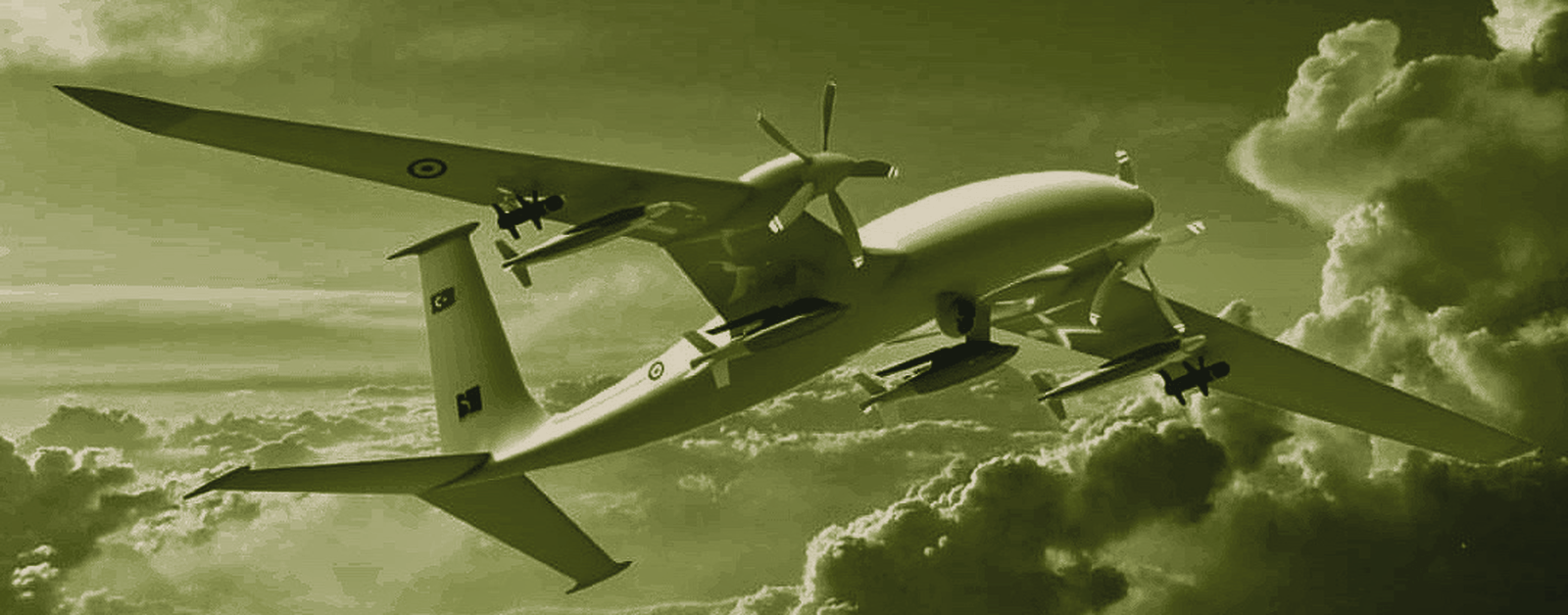
Turkey’s heavy-strike HALE UCAV — a 24-hour twin-turboprop that combines a 1,500-kg payload with cruise missiles, air-launched ballistic munitions and an AESA radar, underpinning a 16-country export drive built on technology transfer and local co-production.
Overview
The Bayraktar Akinci (Turkish “Raider”) is a high-altitude long-endurance (HALE) twin-turboprop unmanned combat aerial vehicle developed by Baykar. Sized for strategic strike and ISTAR, the platform routinely operates at 30,000 ft with a 24-h endurance, carries 1,500 kg of sensors and ordnance on eight hardpoints, and is cleared for a uniquely broad family of Turkish-made stand-off weapons. Its combination of deep-magazine strike persistence, an AESA radar, and aggressive co-production export terms has made it the world’s most widely exported heavy UCAV, with 16 customer nations by early 2026 according to Defence Turkey.
Development
Baykar began Project Akinci to step from the tactical TB2 into the strategic HALE class. Preliminary design closed in June 2019, the first aircraft was unveiled at TEKNOFEST September 2019, and the maiden flight followed on 6 December 2019 Airforce Technology. The type entered Turkish service on 29 August 2021 after a rapid test campaign that included live-firing of guided munitions from April 2021. Baykar funded the program largely from export revenue, which reached $1.8 billion in both 2023 and 2024 and roughly $2.2 billion in 2025, representing about one-quarter of Turkey’s defence-aerospace exports Baykar.
A block improvement path followed: the more powerful Akinci-B (2×750 hp) flew in March 2022 and set a national altitude record of 45,118 ft that June Wikipedia. The Akinci-C (2×850 hp) and the first MURAD AESA radar-equipped aircraft both flew in early 2025 Baykar. By March 2025 the fleet had surpassed 100,000 flight hours.
Design & capabilities
The Akinci airframe is a conventional twin-boom pusher layout with a 20 m wingspan, 12.3 m length and a 6,000 kg MTOW Baykar. Two turboprop engines (450 hp, 750 hp or 850 hp depending on variant) drive five-blade propellers, giving a cruise speed of ~280 km/h (150 kt) and a maximum of 361 km/h (195 kt). Triple-redundant autopilot and sensor fusion support fully autonomous taxi, take-off, cruise and landing, with dual LOS and SATCOM beyond-line-of-sight control links.
A simultaneous EO/IR/laser-designator turret (ASELFLIR-500/600 or CATS) provides day-night targeting, supplemented by an Aselsan MURAD multi-mode AESA radar, SAR/GMTI and a SIGINT suite. The internal bay holds ~400 kg and the external stations carry up to ~950 kg, giving a total practical load of 1,500 kg across eight hardpoints Airforce Technology. The ordnance catalogue is exceptionally wide: MAM-L/TOLUN smart munitions, guidance-kit bombs up to Mk-84, IHA-230/ UAV-230 supersonic air-launched ballistic missiles (tested to 155 km), SOM-A/Çakır cruise missiles, and the KEMANKEŞ-1 AI-guided mini cruise missile that scored its first UCAV live-fire against airborne targets in October 2025 Army Recognition.
Variants
- Akinci-A – original configuration with 2×450 hp Ivchenko-Progress AI-450T engines.
- Akinci-B – upgraded 2×750 hp PT6A-135A engines; set the 45,118 ft altitude record in June 2022.
- Akinci-C – most capable variant with 2×850 hp engines, five-blade propellers; first flight February 2025.
- MURAD-AESA configuration – AESA radar integrated from March 2025, initially on Akinci-B/C airframes.
Combat record / operational use
The Akinci flew its first combat mission on 13 February 2022, principally used in Turkey’s Pençe-Kilit operations against PKK targets in northern Iraq. The PKK’s armed wing claimed to have shot one down over Qandil in March 2025, and a separate crash occurred there in October 2025 Wikipedia.
The aircraft’s most-publicised mission was non-kinetic: on 19–20 May 2024, an Akinci despatched from Turkey at Iran’s request flew 2,100 km and searched for 7.5 hours in fog-bound mountains; Turkish officials state it detected the heat signature of the helicopter carrying Iranian President Raisi and transmitted the coordinates RFE/RL. Iranian authorities publicly downplayed the drone’s contribution.
During the May 2025 India–Pakistan clashes, Pakistan reportedly employed Akincis alongside TB2s in mass waves of 300–600 drones; Indian accounts claim the large majority were intercepted by the Akashteer-integrated air-defence network — both sides’ narratives remain unverified by independent sources European Times.
Export customers have used the aircraft in Libya, the Sahel, and Sudan’s civil war. A Malian Akinci was shot down by Algerian air defences after a border incursion in 2025, and in March 2026 a Sudanese Akinci downed another in a friendly-fire engagement with an Eren air-to-air munition Wikipedia. Domestically, nine Akincis flew 1,551 hours of search-and-rescue and damage-assessment sorties after the February 2023 earthquakes.
Advantages
- Class-leading export payload capacity: 1,500 kg across eight hardpoints, enabling carriage of cruise missiles, air-launched ballistic weapons and the KEMANKEŞ-1 mini cruise missile — ordnance classes no other export UCAV routinely carries.
- True HALE persistence: 24-hour endurance at 30,000 ft, coupled with an AESA radar, SAR/GMTI and SIGINT, turns the Akinci into a combined strike, ISTAR and command-and-control node.
- Manufacturer-funded, co-production export model: Baykar’s 16-country franchise by January 2026 — including a $3.1 billion Saudi deal for ≥60 aircraft with ~70 % local assembly, and a Leonardo joint venture in Italy — offers technology-transfer terms that Western suppliers rarely match Defence Turkey Türkiye Today The Aviationist.
- Operational flexibility: demonstrated rapid long-range response (Turkey-to-Iran crash-site mission) and sustained multi-role employment for strike, SAR and maritime patrol in combat and disaster-relief settings.
Drawbacks / limitations
- Survivability against modern IADS: the aircraft is a large, non-stealthy turboprop airframe, and 2025–2026 losses in Libya, Mali, Qandil and Sudan confirm it is vulnerable to radar-guided SAMs and even friendly-fire engagements.
- Contested performance narratives: Indian claims from the May 2025 conflict suggest that layered air-defence networks can neutralise Akinci-led waves, although these accounts remain unverified European Times.
- Foreign engine dependency: the Akinci-A uses Ukrainian AI-450T engines, while the -B and -C rely on Canadian PT6-class turboprops, creating sanctions and export-control risks for users with restricted access.
- Opaque cost and performance data: the unit price is not publicly disclosed, and much of the combat-effectiveness narrative is shaped by manufacturer and customer statements.
Counterparts
- MQ-9 Reaper (USA)
- Wing Loong II (China)
Outlook
Akinci’s export footprint continues to expand through 2026, with Saudi local assembly set to begin, Indonesian co-production signed, and the LBA Systems joint venture with Leonardo opening a European final-assembly line that could unlock EU/NATO certification paths The Aviationist. The weapons roadmap — including the KEMANKEŞ-1 air-to-air mini cruise missile, the UAV-230 supersonic ballistic missile and the MURAD AESA — pushes the platform into stand-off and counter-air roles that no other exported UCAV currently occupies. The principal open questions are whether the loss rate will erode customer confidence, how Baykar balances Akinci against its jet-powered Kizilelma in the same export discussions, and whether the drone can credibly operate against high-end IADS at its normal engagement altitude.
Key specifications
| Spec | Value |
|---|---|
| Type | Twin-turboprop HALE UCAV |
| Endurance | 24+ h |
| Range | 6,000 km operational (7,507 km demonstrated) |
| Cruise / max speed | ~280 km/h (150 kt) cruise; 361 km/h (195 kt) max |
| Payload | 1,500 kg total (8 hardpoints) |
| Datalink / control | Triple-redundant LOS + SATCOM BLOS |
| Autonomy level | Fully autonomous taxi, take-off, cruise and landing with sensor-fusion autopilot |
| Dimensions / MTOW | Wingspan 20 m, length 12.3 m, height 4.1 m; 6,000 kg MTOW |
| Launch & recovery | Runway take-off and landing |
Sources
- Baykar Technology — Bayraktar AKINCI official product page. https://baykartech.com/en/uav/bayraktar-akinci/
- Baykar Technology — Bayraktar AKINCI surpasses 100,000 flight hours. https://baykartech.com/en/press/bayraktar-akinci-surpasses-100000-flight-hours/
- Wikipedia — Baykar Bayraktar Akinci. https://en.wikipedia.org/wiki/Baykar_Bayraktar_Akinci
- Airforce Technology — Bayraktar Akinci Unmanned Combat Aerial Vehicle, Turkey. https://www.airforce-technology.com/projects/bayraktar-akinci-unmanned-combat-aerial-vehicle-ucav/
- RFE/RL — Turkey Claims Its Drone Was Instrumental In Finding Wreckage Of Iranian Helicopter. https://www.rferl.org/a/turkey-iran-drone-raisi-search/32959633.html
- Defence Turkey — The Strategic Rise of Türkiye–Saudi Arabia Defense Cooperation. https://defenceturkey.com/news/the-strategic-rise-of-turkiyesaudi-arabia-defense-cooperation-from-arms-procurement-to-industrial-partnership
- Türkiye Today — Saudi Bayraktar Akinci UCAV operators graduate as $3B deal advances. https://www.turkiyetoday.com/region/saudi-bayraktar-akinci-ucav-operators-graduate-as-3b-deal-advances-3208385
- Army Recognition — Turkish Baykar KEMANKEŞ-1 Mini Cruise Missile Hits Airborne Targets. https://www.armyrecognition.com/news/aerospace-news/2025/turkish-baykar-kemankes-1-mini-cruise-missile-hits-airborne-targets-in-first-live-fire-from-akinci-drone
- The Aviationist — LBA Systems to Build TB2, TB3, Akinci and Kizilelma UCAVs in Italy. https://theaviationist.com/2025/11/09/lba-systems-to-build-ucavs-in-italy/
- European Times — Operation Sindoor: How Pakistan's Counter-Strike Campaign Failed. https://europeantimes.org/operation-sindoor-how-pakistans-counter-strike-campaign-failed-against-indias-air-defence-architecture/