GRID-REF 37°47′N 122°25′W
DISPATCH 02/26 · 9 Jun 2026
BATTLEPOLICY
Startup to front line. Strategy to consequence.
Lexicon · Europe

Beretta M9

The US military's iconic 9mm service pistol from 1985 to 2017 — a double-action hammer-fired design that defined the NATO sidearm era and remains in wide legacy and allied service.
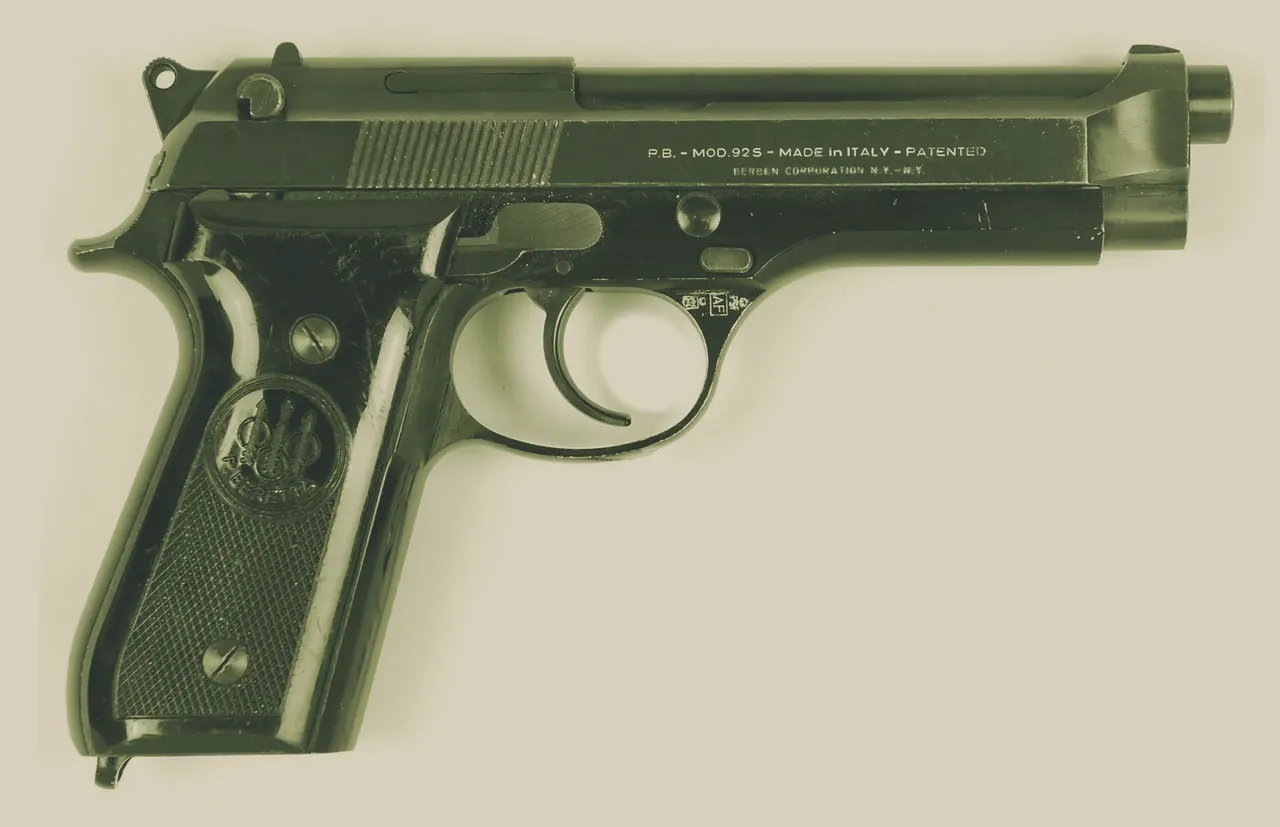
Beretta M9
FIG.01 · Europe Image - Beretta M9. Photo by U.S. Bureau of Alcohol, Tobacco, Firearms and Explosives, Public domain, via Wikimedia Commons.jpg).
The US military's iconic 9mm service pistol from 1985 to 2017 — a double-action hammer-fired design that defined the NATO sidearm era and remains in wide legacy and allied service.

Overview

The Beretta M9 is a semi-automatic, double-action/single-action (DA/SA) service pistol chambered in 9×19mm NATO. Adopted by the US armed forces in 1985 as the standard sidearm, it is the military variant of the commercial Beretta 92FS. The M9 served through the Gulf War, the interventions in Somalia and the Balkans, and the long wars in Iraq and Afghanistan, before being formally superseded as the US standard by the modular SIG Sauer M17/M18 from 2017. Although no longer the US front-line issue pistol, the M9 family remains in secondary and reserve service, and the 92FS continues to be produced for commercial and law enforcement markets worldwide. The design’s aluminum-alloy frame, open-top slide, and falling-locking-block action made it a benchmark NATO 9mm DA/SA handgun, with millions of the 92-series produced.

Development

The M9 traces its lineage to the Beretta 92 series, introduced in the mid-1970s. The 92FS, which won the US XM9 pistol trials, incorporated an enlarged hammer pin that prevented the slide from separating from the frame in the event of rear-end failure. The US formally adopted the M9 after a 1985 selection that broke a decades-long reliance on the .45-caliber M1911A1, making it the standard issue sidearm across all military branches. Beretta USA manufactured the bulk of the US-market pistols, with peak contract inventory reaching approximately 350,000–380,000 guns. The adoption process and detailed service history are documented in the Wikipedia entry and the broader Beretta 92 family overview.

Design & capabilities

The M9 is a hammer-fired, DA/SA pistol with a short-recoil, falling locking-block action—a Beretta hallmark distinct from the tilting-barrel systems common in many modern designs. Its aluminum-alloy frame keeps the weight to about 0.95 kg empty, while the open-top slide design reduces the chance of ejection failures. The manual safety doubles as a decocker, mounted on the slide, and the trigger guard is squared for a two-handed hold. A 15-round staggered magazine is standard, and the fixed barrel delivers a muzzle velocity of approximately 381 m/s (1,250 ft/s), a figure routinely cited in commercial spec sheets and confirmed by Beretta’s official product page for the 92FS. Detailed dimensional data, including overall length (217 mm), barrel length (125 mm), and height (137 mm), are collated in the Craft Holsters review. An effective range of about 50 m is typical for 9mm service pistols.

Variants

The M9 family evolved over its service life. The baseline M9 was followed by the M9A1, which added an accessory rail, checkered front and backstrap, and a beveled magazine well. The M9A3, introduced later, featured a thinner Vertec-style grip, a threaded barrel, removable front sight, and additional ergonomic enhancements; it was evaluated by US forces but not adopted in quantity. The commercial 92FS remains the civilian analog, while a compact, officer-sized M9-based model and the select-fire 93R exist outside the standard issue line.

Combat record / operational use

The M9 was carried by US personnel in every major engagement from the 1989 Panama intervention through the withdrawal from Afghanistan in 2021. It saw extensive use in Iraq and Afghanistan, where the 9mm cartridge and 15-round magazine provided greater capacity than the legacy .45, though the pistol drew criticism for its weight, large grip circumference, and, in some instances, for reduced terminal effect on unprotected personnel. The slide-mounted safety, if inadvertently activated during a reload or malfunction clearance, was also noted as a training challenge. The M9’s service record, including operational feedback, is detailed in the same Wikipedia M9 entry. After the 2017 transition, thousands of M9-series pistols remained in armories and with non-infantry units, continuing a legacy that overlaps with the newer striker-fired modular sidearm.

Advantages

  • Proven DA/SA system with a distinct safety/decocker that allows a holster-ready hammer-down condition.
  • Alloy frame and 15-round magazine were competitive for much of the service life.
  • Open-top slide design helps prevent stovepipes and enhances reliability in dusty conditions.
  • Extensive worldwide parts and accessory support thanks to decades of production.
  • Smooth fixed-barrel lockup contributes to solid accuracy for a service pistol.

Drawbacks / limitations

  • Large grip circumference can be uncomfortable for small-handed shooters and is less accommodating than modern polymer-frame pistols.
  • Slide-mounted safety is easily bumped during manipulation, a well-documented ergonomic issue.
  • Heavier than later polymer, striker-fired designs (the M17/18 weigh 0.80–0.84 kg empty).
  • Original M9 lacked an accessory rail, which limited integration of lights and lasers until the M9A1 update.
  • 15-round capacity was later surpassed by service pistols offering 17- or 21-round magazines as standard.

Counterparts

Outlook

The Beretta M9 is now a legacy system in the US inventory, but it remains in service in some reserve, training, and non-infantry units, and continues to be issued by allied forces that adopted the 92FS. Commercial production of the 92FS and its derivatives remains healthy, and the platform’s widespread global user base ensures that the M9 will persist as a relevant handgun for many years, particularly in nations where a DA/SA metal-frame 9mm is still preferred. No further large-scale US military procurement is anticipated, and its place in the US combat squad has been permanently filled by the striker-fired M17/M18.

Key specifications

Spec Value
Crew 1
Combat weight 0.95 kg (empty)
Length / width / height 217 mm / 38 mm / 137 mm
Main armament 9×19mm NATO
Secondary armament None
Armor & protection Not publicly established
Engine & power Not publicly established
Power-to-weight Not publicly established
Road / cross-country speed Not publicly established
Operational range ~50 m (effective)

Sources

  1. Beretta — 92FS product page — https://www.beretta.com/en-us/product/92fs-FA0043
  2. Wikipedia — Beretta M9 — https://en.wikipedia.org/wiki/Beretta_M9
  3. Wikipedia — Beretta 92 — https://en.wikipedia.org/wiki/Beretta_92
  4. Craft Holsters — Beretta 92 FS Review — https://www.craftholsters.com/beretta/guides/92-fs
FIELD DISPATCH · WEEKLY

BattlePolicy Weekly — free.

Defense tech, startups, and security — weekly. No paywall.

Related
Ukraine · Europe · Air Defense · Alta Ares · counter-drone · shahed

Alta Ares raises €50M to mass-produce drone interceptors proven over Ukraine

Alta Ares, a Franco-Ukrainian maker of AI drone interceptors used in Ukraine, raised €50 million to scale production as demand for cheap air defense climbs.

Ukraine · Europe · Air Defense · Alta Ares · counter-drone · shahed
Europe · Autonomy · Airbus · U145 · H145

Airbus unveils the U145, an uncrewed H145 built for contested resupply

Airbus is turning its best-selling H145 light twin into a pilotless cargo helicopter for frontline resupply, with a maiden flight due late 2026 and service entry not before the early 2030s.

Europe · Autonomy · Airbus · U145 · H145