Boxer
The Boxer is a modular 8×8 multirole armoured vehicle – a common drive platform that accepts mission-specific modules to deliver protected mobility in roles from troop transport to infantry fighting vehicle and reconnaissance.
A modular 8×8 multirole armoured vehicle jointly developed by Germany and the Netherlands, built around a common drive platform and interchangeable mission modules that allow a single fleet to serve as an armored personnel carrier, infantry fighting vehicle, command post, ambulance, or reconnaissance vehicle.
Overview
The Boxer, formally designated the Multi-Role Armoured Vehicle (MRAV) and known in German service as the Gepanzertes Transport-Kraftfahrzeug (GTK) and in Dutch service as the Gepantserde Transport Voertuig (GTV), is an 8×8 wheeled armoured vehicle built by the ARTEC consortium (KNDS/KMW and Rheinmetall). Its defining feature is a modular architecture: a standardised drive module carries a mission module that can be exchanged in the field in under an hour, turning a single base vehicle into an APC, IFV, mobile command post, ambulance, engineer vehicle, or logistics carrier. The first production vehicles were handed over to the German and Dutch armies in 2009, and the type has since been adopted by Lithuania, Slovenia, Australia (211 Combat Reconnaissance Vehicles) and the United Kingdom, which with 623 vehicles ordered is the largest Boxer customer. The Boxer’s combination of strategic mobility, high protection, and heavy armament options has made it the reference wheeled combat vehicle for a generation of European 8×8 programmes.
Development
Germany and the Netherlands launched the Boxer programme in 1999 under the Organisation for Joint Armament Cooperation (OCCAR), aiming to replace ageing M113 and Fuchs fleets with a single common vehicle. The ARTEC consortium — formed by Krauss-Maffei Wegmann (now part of KNDS) and Rheinmetall — was awarded the development contract, and the first prototype was rolled out in 2005. Series production was approved in 2006, and the first vehicles entered service with the German Army (GTK Boxer) and the Royal Netherlands Army (GTV Boxer) in 2009, according to Rheinmetall. The modular concept was validated through a decade of NATO missions before being scaled to export: Australia selected the Boxer in 2016 for its Land 400 Phase 2 Combat Reconnaissance Vehicle requirement, ordering 211 vehicles with a bespoke Lance two-man turret, while the United Kingdom joined the program in 2018, ordering 523 vehicles (later increased to 623) as the core of its new Mechanised Infantry Vehicle fleet, with the first British Boxers delivered in 2022 and operational capability declared the same year.
Design & capabilities
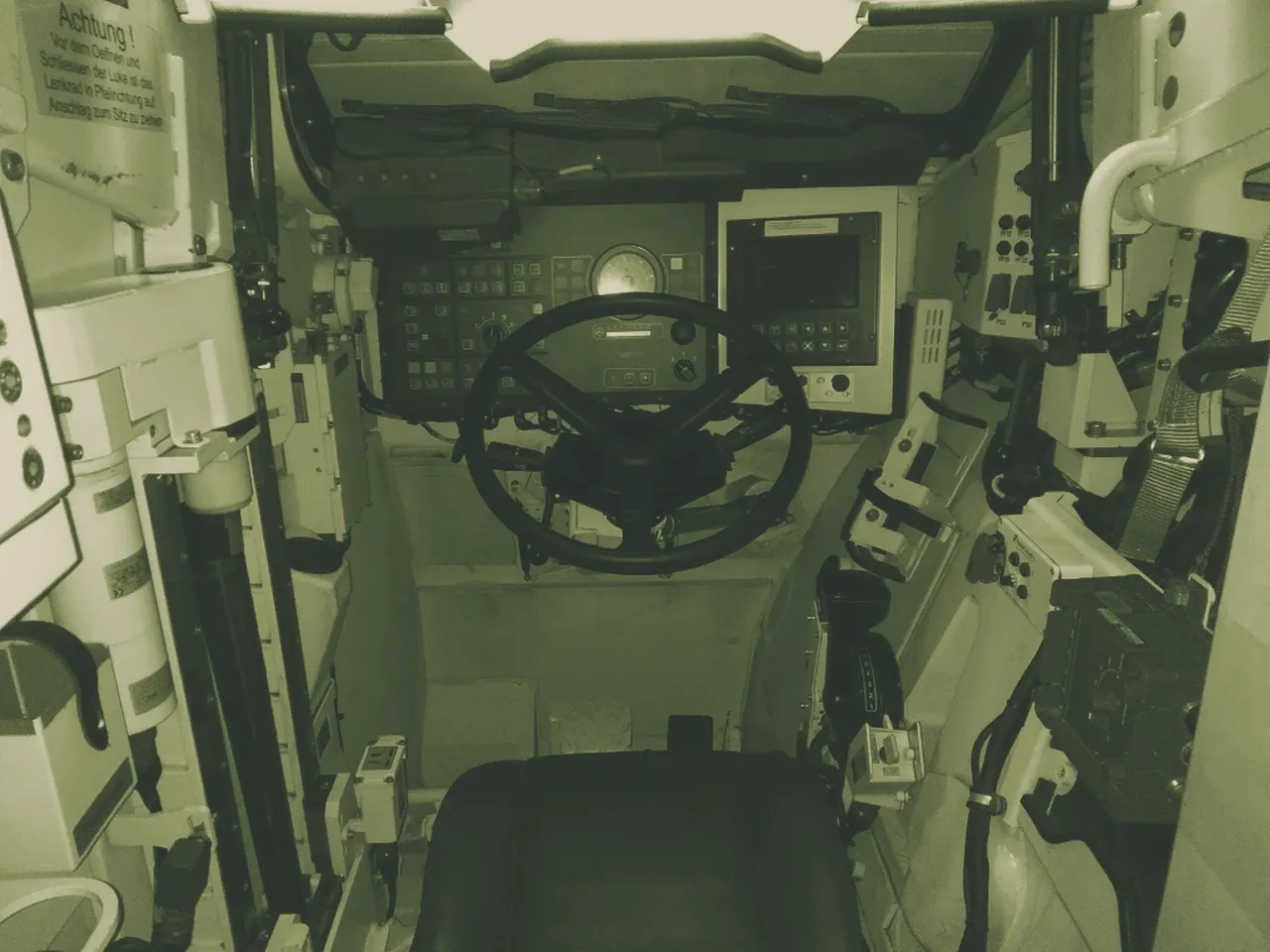
The Boxer’s modularity is its central design principle: a common 8×8 drive module — containing the powerpack, running gear, and driver’s station — mates with a mission module mounted via four quick-release points and a decoupled rear structure that isolates the crew compartment from blast and vibration. Mission modules are developed for eight roles, including: a standard APC with a remote weapon station (7.62 mm, 12.7 mm, or 40 mm automatic grenade launcher); an infantry fighting vehicle with the Lance turret mounting a 30 mm Rheinmetall MK30-2/ABM autocannon and a Spike-LR or MELLS anti-tank guided missile; a command post; an ambulance; a cargo variant; and an engineer vehicle. The vehicle’s modular spall liner, add-on ballistic armour, and mine-blast protection kit provide protection scalable up to threat conditions, and the decoupled mission module significantly reduces under-belly blast transfer. Power comes from an MTU 8V 199 TE20 diesel developing 530 kW (∼711 hp), mated to an Allison fully automatic transmission, giving the ∼36.5-tonne vehicle a road speed in excess of 100 km/h and an operational range of around 1,100 km, as specified by Rheinmetall and confirmed on the UK Boxer ICV. The driver operates from a fully digital cockpit with a 360-degree camera system; the mission module can be configured with a digital backbone that integrates battle-management, communications, and remote-weapon-station controls.
Variants
The Boxer family encompasses all mission-module roles. Key production variants include:
- Boxer APC (GTK/GTV) – baseline protected mobility variant with a KMW FLW 200 or Protector RWS, crew of 3 plus 7 dismounts.
- Boxer IFV (Lance) – fitted with the KNDS Lance 2.0 turret, 30 mm MK30-2/ABM, coaxial 7.62 mm MG, and anti-tank guided missiles; crew of 3 plus 6 dismounts.
- Boxer Command Post – extended mission module with additional workstations, masts, and communications suites.
- Boxer Ambulance – raised-roof module for medical evacuation with litters and treatment area.
- Boxer CRV (Australia) – heavy reconnaissance variant with a Lance turret, advanced sensors, and a targeting mast, optimised for the Australian Army’s Land 400 Phase 2 requirement. Detailed on the Australian Department of Defence project page.
- Boxer MIV (UK) – the British Mechanised Infantry Vehicle builds on the APC/command-post family, with a UK-specific electronic architecture, protected crew-served weapons, and local assembly at Rheinmetall BAE Systems Land (RBSL) in Telford.
Combat record / operational use
The Boxer has not seen high-intensity frontline combat, but it has accumulated significant operational experience in NATO and coalition missions. German and Dutch Boxers have deployed to Afghanistan as part of the ISAF mission, where they were used for patrols, convoy protection, and quick-reaction force duties, demonstrating far better protection and mobility than the legacy Fuchs and M113 carriers. Since 2017, German Boxers have formed part of the multinational NATO enhanced Forward Presence (eFP) battlegroup in Lithuania, operating alongside the Lithuanian Army’s own Boxer fleet. The Australian Combat Reconnaissance Vehicle variant entered full service in 2022, according to the Australian Department of Defence, and the British Boxer MIV was declared operationally available the same year, with the UK fleet rapidly integrating into the British Army’s 7th Light Mechanised Brigade and beginning exercises in Europe.
Advantages
- True modularity – a single drive-module fleet reduces logistics and training overhead while allowing rapid role-change in the field (module swap <1 hour).
- High strategic and tactical mobility – road speeds above 100 km/h and a range of 1,100 km allow rapid self-deployment and sustained operational tempo.
- Scalable protection – modular armour and mine-blast kits, decoupled mission module, and spall liners give high survivability against IEDs, mines, and ballistic threats.
- Growth potential – the digital architecture, generous internal volume (14.5 m mission module), and reserve power capacity make the Boxer a strong candidate for future active protection, laser-warning, and counter-drone systems.
- Interoperable base – common drive modules used across Germany, the Netherlands, Lithuania, Slovenia, Australia and the UK enable shared sustainment and upgrade paths.
Drawbacks / limitations
- High baseline weight – ~36.5 tonnes in APC configuration limits air-transportability by C-130 and means the vehicle requires heavy-lift assets for strategic movement; ground pressure can be an issue in soft terrain.
- Cost – unit and programme costs are among the highest in the 8×8 class, driven by modularity and protection levels, potentially capping fleet sizes for budget-constrained armies.
- No fielded active protection – unlike tracked IFVs such as the CV90 Mk IV or Puma that offer Iron Fist or MELLS-hosted APS, production Boxers currently rely on passive armour and soft-kill measures, although hard-kill options are being studied.
- Cross-country mobility – while perfectly adequate for wheeled doctrine, the Boxer cannot match the tactical agility or trench-crossing performance of a tracked IFV in heavy terrain, a consideration that Germany and the UK address by pairing Boxer brigades with tracked Puma or Challenger 3 formations.
Counterparts
Outlook
The Boxer is firmly established as the medium-weight wheeled standard for a growing NATO and partner fleet, and its production lines are set to run well into the 2030s. The United Kingdom’s 623-vehicle programme remains the single largest order, guaranteeing a long-life sustainment pipeline, while Australia’s 211 CRV fleet is the pillar of its heavy reconnaissance capability. Germany is modernising its Boxer fleet with new command-post and engineer variants, and has initiated a medium-term requirement for a Boxer-based 120 mm mortar carrier. Lithuania, which already fields the Boxer IFV, is evaluating a second tranche of vehicles to replace its remaining M113s. The platform is also in contention for future 8×8 requirements in Slovenia, Slovakia, and other Central European armies. The next step for Boxer will almost certainly involve the integration of a soft-kill/hard-kill active protection system and a dedicated counter-uncrewed-aerial-system (C-UAS) effector, lessons learned from the Ukraine war that are already shaping the longer-term upgrade roadmap across the ARTEC partnership.
Key specifications
| Spec | Value |
|---|---|
| Crew | 3 + 7 (APC); 3 + 6 (IFV) |
| Combat weight | ~36.5 t (APC) |
| Length / width / height | ~7.93 m / ~2.99 m / ~2.37 m (hull) |
| Main armament | RWS (7.62 mm / 12.7 mm / 40 mm AGL); Lance turret with 30 mm MK30-2 and ATGM (IFV) |
| Secondary armament | Coaxial 7.62 mm MG; smoke grenade launchers |
| Armor & protection | Modular ballistic and mine-blast armour, spall liner, decoupled mission module |
| Engine & power | MTU V8 199 TE20, 530 kW (~711 hp) |
| Power-to-weight | not publicly established |
| Road / cross-country speed | >100 km/h (road); cross-country not publicly established |
| Operational range | ~1,100 km (road) |
Sources
- Rheinmetall — Boxer – Armoured transport vehicle. https://www.rheinmetall.com/en/products/wheeled-armoured-vehicles/boxer
- KNDS Group — BOXER GTV. https://knds.com/en/products/systems/boxer/boxer-gtv
- OCCAR — BOXER – A Multi Role Armoured Vehicle. https://occar.int/our-work/programmes/boxer-a-multi-role-armoured-vehicle
- Australian Department of Defence — Combat Reconnaissance Vehicle (Boxer CRV). https://www.defence.gov.au/defence-activities/projects/combat-reconnaissance-vehicle