GRID-REF 37°47′N 122°25′W
DISPATCH 02/26 · 9 Jun 2026
BATTLEPOLICY
Startup to front line. Strategy to consequence.
Lexicon · Europe

FN SCAR

The FN SCAR is Belgium's modular special-operations combat assault rifle in 5.56 mm (Mk16) and 7.62 mm (Mk17), adopted by USSOCOM and over a dozen other forces, combining a short-stroke piston with quick-change barrels.
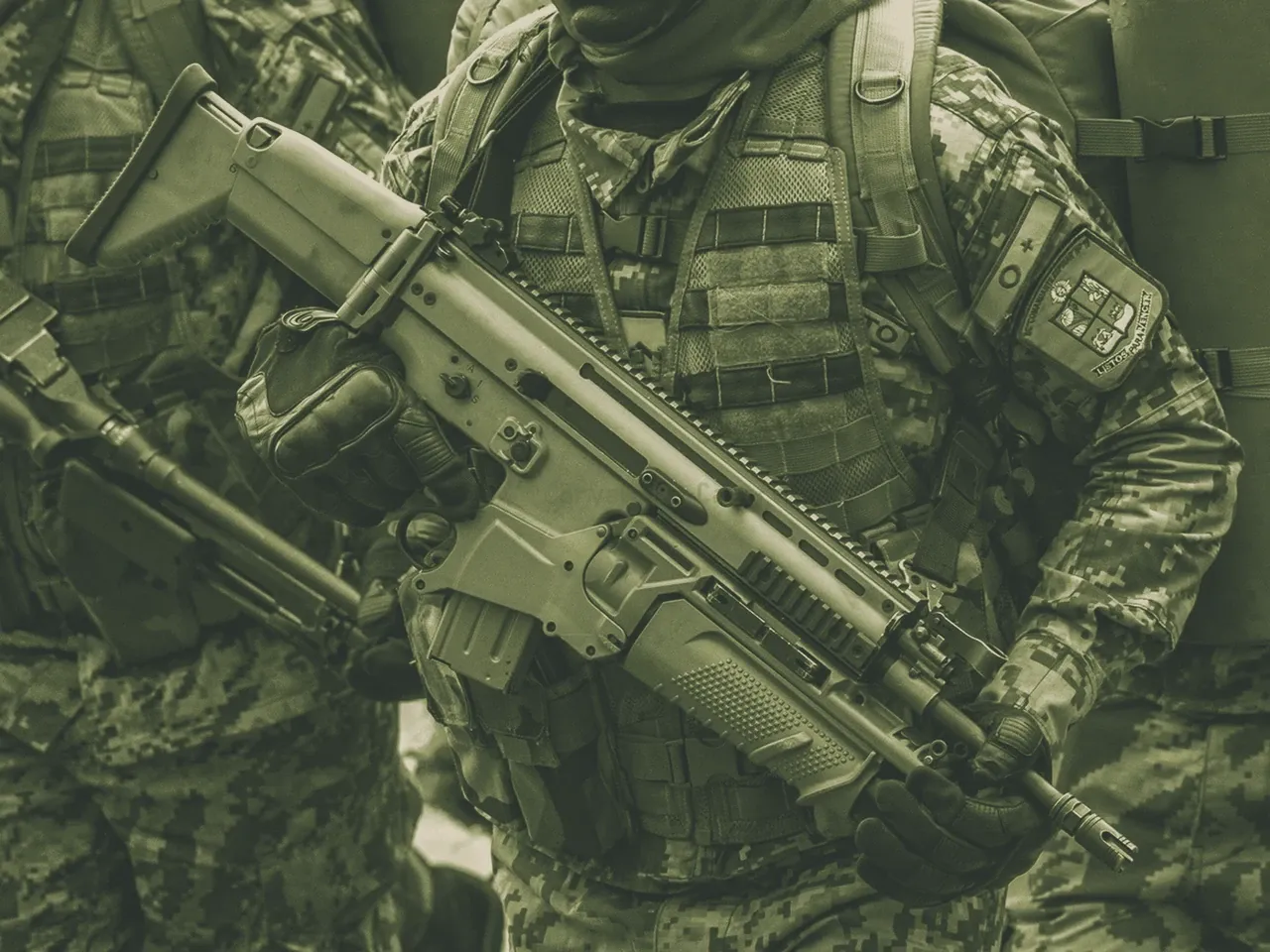
FN SCAR
FIG.01 · Europe Image - fn-scar. Photo by Bryan L. Castro, CC BY-SA 4.0, via Wikimedia Commons.
Belgium's modular special-operations combat assault rifle — the Mk16 SCAR-L (5.56 mm) and Mk17 SCAR-H (7.62 mm) — adopted by USSOCOM and over a dozen other forces, combining a short-stroke piston with quick-change barrels in a folding-stock platform.

Overview

The FN SCAR (Special Operations Forces Combat Assault Rifle) is a modular, select-fire rifle family engineered by FN Herstal for the US Special Operations Command’s (USSOCOM) SCAR competition. It is fielded in two principal calibers: the Mk16 SCAR-L chambered in 5.56×45 mm NATO and the heavier Mk17 SCAR-H in 7.62×51 mm NATO. The weapon’s short-stroke gas piston, quick-change barrel, and aluminium-alloy receiver give it the flexibility to serve as a compact carbine, a standard infantry rifle, or a designated marksman’s platform, and it has been adopted by both special operations forces and conventional armies across NATO and beyond.

Development

The SCAR program was launched in the early 2000s to replace the M4A1 carbine, Mk 18 CQBR, and several legacy 7.62 mm rifles within USSOCOM, with an emphasis on modularity, enhanced reliability, and the ability to swap barrels in the field. FN Herstal won the competition in 2004 with its SCAR-L and SCAR-H designs, and production began the same year, according to Wikipedia. The rifle entered operational service with USSOCOM in 2009, and FN America was later contracted to supply additional units. Subsequently, FN adapted the platform for a wide range of international customers, including the Belgian Armed Forces, who made the SCAR-L and SCAR-H their standard individual weapon.

Design & capabilities

The SCAR family is built around a gas-operated short-stroke piston and a rotating bolt, an architecture that reduces fouling and heat transfer into the receiver compared to direct-impingement designs. The cold-hammer-forged barrel is user-interchangeable, with standard lengths of 355 mm (14 in) for the SCAR-L and 400 mm (16 in) for the SCAR-H; close-quarters combat barrels (254 mm) and long-barrel options (457 mm) are also available, as noted by FN Herstal. The aluminium-alloy upper receiver integrates a full-length Picatinny rail for optics, and the folding, telescoping polymer stock reduces the rifle’s overall length to 635 mm (SCAR-L) or 711 mm (SCAR-H) for transport. The SCAR-L feeds from a 30-round STANAG magazine, while the SCAR-H uses a 20-round box. Both variants offer select-fire capability, with a cyclic rate of approximately 625 rounds per minute for the 5.56 mm model and around 600 rounds per minute for the 7.62 mm version, as documented by Weaponsystems.net.

Variants

  • Mk16 SCAR-L — 5.56×45 mm NATO; primary SOF carbine/rifle, with barrel options and STANAG magazines.
  • Mk17 SCAR-H — 7.62×51 mm NATO; battle rifle / designated marksman role; shares the same modular architecture and quick-change barrel capability.
  • Mk20 SSR (Sniper Support Rifle) — a precision-rifle derivative of the SCAR-H adopted by USSOCOM, featuring a longer, free-floating barrel and enhanced trigger group.
  • FN SCAR-SC — a sub-carbine variant chambered in 5.56 mm, introduced for the law-enforcement and specialist military market.

Combat record / operational use

The SCAR’s first operational deployments came with USSOCOM units in Afghanistan and Iraq shortly after its 2009 introduction. The Mk16 was initially issued in theatre alongside the heavier Mk17, but USSOCOM later shelved further purchases of the 5.56 mm variant and concentrated on the Mk17 and the Mk20 sniper-support rifle, as reported by Wikipedia. The Mk17’s 7.62 mm punch gave special operations forces greater reach and terminal effect against adversaries armed with intermediate cartridges, and it remains the primary SCAR variant in US special operations service. The Belgian Armed Forces, which made the SCAR-L and SCAR-H their standard service rifle, have employed the weapon in NATO deployments and peacekeeping missions. French special forces also carry the SCAR-H, and Norway, Germany, Lithuania, Peru, and Chile are among the other operators that have fielded the platform in various calibers.

Advantages

  • True modularity across calibers and barrel lengths reduces logistic complexity for mixed units.
  • Short-stroke gas piston keeps the action cleaner and cooler than direct-impingement rifles, boosting reliability in adverse conditions.
  • User-interchangeable barrels allow a single receiver to morph from a CQB carbine to a precision rifle.
  • Ambidextrous controls (selector, magazine release, bolt catch) and a folding, multi-position stock enhance ergonomics.
  • Chambered in both 5.56 mm and 7.62 mm NATO, providing a lightweight carbine and a harder-hitting battle rifle from one manual of arms.

Drawbacks / limitations

  • The rifle is heavier than many competing 5.56 mm carbines (3.29 kg empty for the SCAR-L).
  • Recoil is sharper than DI-system counterparts because of the higher reciprocating mass of the piston assembly.
  • Magazine and accessory commonality breaks down: the SCAR-H’s proprietary magazine does not share STANAG compatibility.
  • USSOCOM’s decision to scale back the Mk16 highlights a perceived lack of advantage over the M4A1 for close-quarters work.
  • Cost per unit and limited transparency in military production figures make it harder for budget-constrained forces to adopt.

Counterparts

Outlook

The FN SCAR family remains in production and active service, buoyed by strong adoption among European NATO allies and persistent demand for the 7.62 mm Mk17 and Mk20 marksman variants. While US special operations has gravitated in part to the newer 6.8 mm XM7 and continues to use the M4A1 for certain applications, the SCAR platform’s proven reliability and modularity ensure it will remain a fixture in allied arsenals. The growing emphasis on peer-to-peer combat and the proliferation of body armour may reinforce the relevance of the 7.62 mm SCAR-H and its derivatives for designated marksmanship and long-range engagements.

Key specifications

Spec Value
Crew 1 (operator)
Combat weight 3.29 kg (SCAR-L) / 3.58 kg (SCAR-H) empty
Length / width / height 889 mm / 635 mm (SCAR-L extended/folded); 965 mm / 711 mm (SCAR-H); width and height not publicly established
Main armament 5.56×45 mm NATO (SCAR-L) / 7.62×51 mm NATO (SCAR-H)
Secondary armament none
Armor & protection not applicable
Engine & power not applicable
Power-to-weight not applicable
Road / cross-country speed not applicable
Operational range 500 m (SCAR-L) / 600 m (SCAR-H) effective

Sources

  1. FN Herstal — FN SCAR-L Mk2 product page. https://fnherstal.com/en/defence/portable-weapons/fn-scar-l-mk2/
  2. Weaponsystems.net — FN SCAR-L entry. https://weaponsystems.net/system/674-FN+SCAR-L
  3. Wikipedia — FN SCAR. https://en.wikipedia.org/wiki/FN_SCAR
FIELD DISPATCH · WEEKLY

BattlePolicy Weekly — free.

Defense tech, startups, and security — weekly. No paywall.

Related
Ukraine · Europe · Air Defense · Alta Ares · counter-drone · shahed

Alta Ares raises €50M to mass-produce drone interceptors proven over Ukraine

Alta Ares, a Franco-Ukrainian maker of AI drone interceptors used in Ukraine, raised €50 million to scale production as demand for cheap air defense climbs.

Ukraine · Europe · Air Defense · Alta Ares · counter-drone · shahed
Europe · Autonomy · Airbus · U145 · H145

Airbus unveils the U145, an uncrewed H145 built for contested resupply

Airbus is turning its best-selling H145 light twin into a pilotless cargo helicopter for frontline resupply, with a maiden flight due late 2026 and service entry not before the early 2030s.

Europe · Autonomy · Airbus · U145 · H145