Palantir AIP
Palantir AIP is the company's generative-AI and autonomous-agent layer, built to connect LLMs and other models to controlled enterprise, intelligence and military workflows.
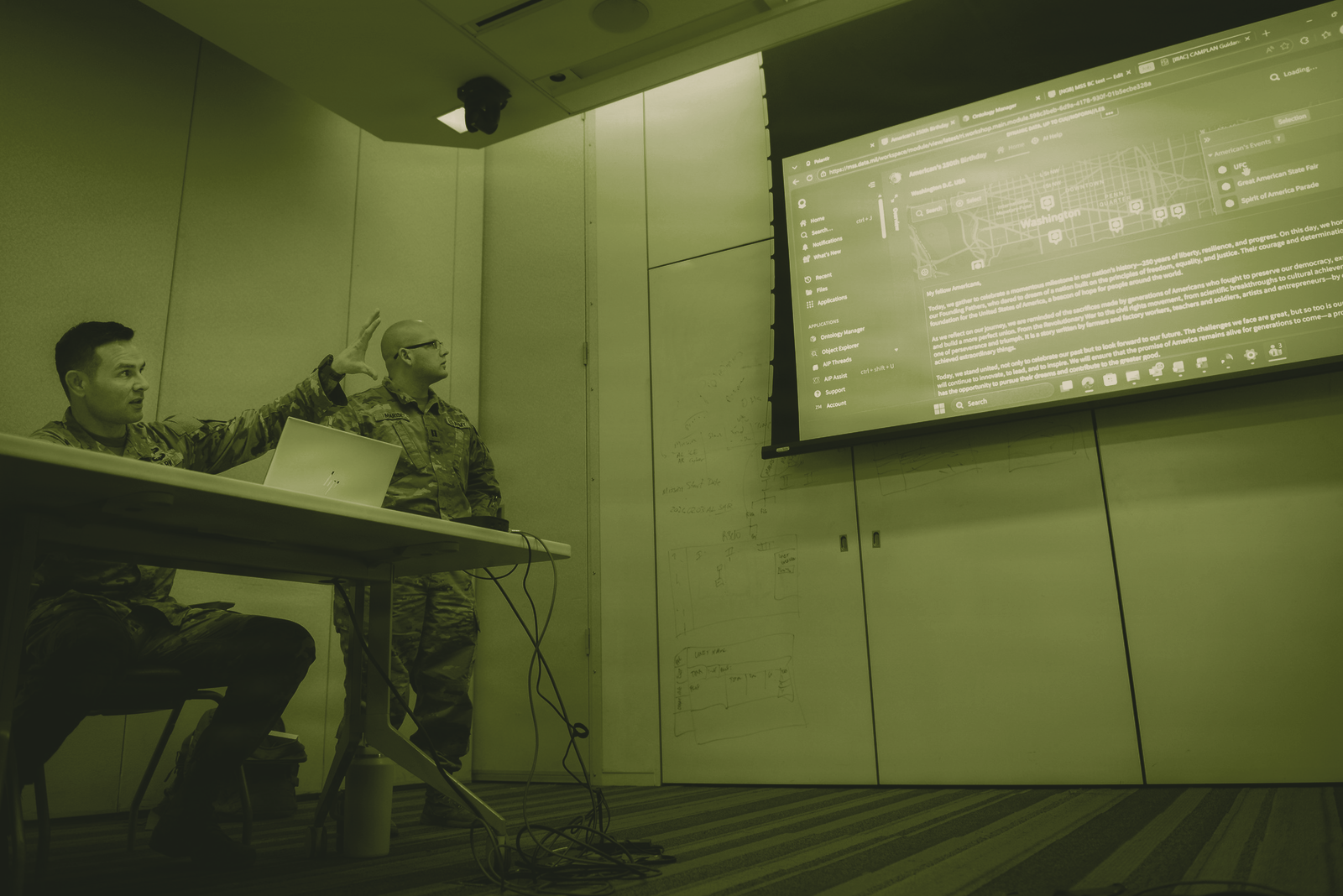
Palantir's generative-AI and autonomous-agent orchestration layer, built to connect LLMs and other models to controlled enterprise, intelligence and military workflows.
Overview
Palantir AIP, short for Artificial Intelligence Platform, is Palantir Technologies' large-language-model and AI-agent layer for enterprise, government and defense users. It is not a stand-alone weapon system and is not a replacement for Palantir Gotham or Foundry; it sits above those data platforms and connects commercial, open-source and classified-environment AI models to customer data, permissions and workflows. Palantir describes AIP as a platform for deploying AI across controlled operational environments, including classified networks and tactical-edge settings, with governance mechanisms intended to define what a model can see, what it can do and which human approvals are required before action is taken on a model output, according to Palantir AIP for Defense.
In defense use, AIP's most visible role is as the LLM layer inside the US Department of Defense's Maven Smart System, where CSIS identifies Palantir AIP tools such as Maven Threads, Maven Agent Studio and Maven Logic as components that let users query, build and release LLM-enabled workflows inside the broader Maven environment, according to CSIS. The platform is also marketed across commercial sectors, where Palantir has used short, hands-on "AIP Bootcamp" engagements as its primary adoption motion.
Development
Palantir announced AIP in April 2023 as an artificial-intelligence platform for enterprise and military use, after CEO Alex Karp previewed the company's "new platform" in an April shareholder communication. The first broad public rollout followed at AIPCon on 1 June 2023, where Palantir said it would livestream demonstrations and customer announcements from 25 customers, according to the company's AIPCon announcement. Palantir's June 2023 Foundry release notes then described early activation of AIP inside selected Foundry enrollments, beginning with AIP Assist and expanding into tools such as Pipeline Builder, Workshop, Slate, Quiver, Code Repositories and Notepad, according to Palantir Foundry documentation.
The company's go-to-market model shifted quickly toward AIP Bootcamps: one-to-five-day engagements in which Palantir engineers and customer teams work on live data, build an operational ontology and attempt to produce at least one deployable workflow. Palantir described these bootcamps as a way to deploy "full-spectrum AI in days," using real customer environments rather than generic demos, in a Palantir engineering blog. The format later extended into public-sector and defense settings, including a Carahsoft-hosted AIP Bootcamp in Reston, Virginia in August 2024, according to PVM.
AIP's defense distribution widened in August 2024, when Palantir and Microsoft announced an expanded partnership to deploy Palantir Foundry, Gotham, Apollo and AIP in Azure Government and Azure Government Secret environments. Microsoft said the arrangement would give US defense and intelligence customers access to Palantir tooling and Azure OpenAI Service capabilities on classified-capable cloud infrastructure, according to Microsoft and Reuters.
Design & capabilities
AIP is best understood as a model-orchestration, permissioning and agent-runtime layer over Palantir's data platforms. Palantir says the platform can connect commercial models such as Claude, GPT-class systems and Gemini, as well as open-source models such as Llama and other model families, to customer-controlled data without letting third-party model providers retain or retrain on the customer's information, according to Palantir AIP. Its architecture is built around Palantir's Ontology concept: data, objects, workflows, permissions and operational actions are modeled together so that a user or AI agent interacts with governed representations of the enterprise rather than an unrestricted data lake.
The platform's defense framing centers on three capabilities: deploying models across networks from classified enclaves to tactical-edge devices; controlling model visibility and action permissions through guardrails tied to roles, classification markings and mission purpose; and remaining model-agnostic rather than dependent on one AI vendor. Palantir's AIP for Defense materials also state that the product is built around AI-ethics principles and is designed for responsible military AI use, although those are company claims rather than independently audited performance guarantees.
AIP's control pattern is human-in-the-loop or human-on-the-loop rather than fully autonomous lethal decision-making. In the documented enterprise workflow, agents can generate proposals through tools such as AIP Logic, Workflow Builder, Automate, Pipeline Builder or application integrations; those proposals are then reviewed, refined, approved or rejected by an authorized human. The same access-control model applies to agents and human users: if a person cannot see a dataset or execute an action, the agent running under that user's permissions should not be able to do so either, according to Palantir AIP.
AIP's model layer has continued to evolve. In November 2024, Palantir and Anthropic announced a partnership to bring Claude models to AWS-hosted US intelligence and defense environments through AIP, according to Palantir investor relations. In June 2026, Palantir and NVIDIA announced a sovereign-AI initiative for running NVIDIA Nemotron open models across Palantir AIP, Foundry, Ontology and Apollo for US government agencies and critical-infrastructure operators, according to NVIDIA and Business Wire.
Variants
- AIP: the baseline enterprise platform for connecting LLMs, AI agents and automated workflows to governed organizational data.
- AIP for Defense: the defense and national-security configuration, framed for classified networks, tactical-edge deployment, military guardrails and interoperability with defense AI models.
- AIP Assist and Foundry-integrated tools: early AIP capabilities embedded into Foundry applications such as Pipeline Builder, Workshop, Slate, Quiver, Code Repositories and Notepad.
- Maven Smart System AIP tools: Maven Threads, Maven Agent Studio and Maven Logic, identified by CSIS as AIP tools embedded in the US DoD's Maven Smart System.
- AIP Bootcamps: an adoption and implementation format rather than a separate software variant, but operationally important because Palantir uses bootcamps to build live-data workflows with customers.
- Sovereign-AI / open-model integrations: AIP deployments using models such as NVIDIA Nemotron in environments where the customer wants more control over model hosting and dependency risk.
Combat record / operational use
AIP has no combat record in the sense of a missile, aircraft or sensor with public kill claims. Its operational relevance is as software embedded in military decision-support, targeting-support, intelligence-analysis and command workflows. CSIS states that AIP is the LLM layer through which the Maven Smart System uses large language models, including tools for ad hoc document analysis, agent creation and no-code LLM function development, according to CSIS. That makes AIP part of the software stack supporting Maven's operational use, but not the whole Maven program and not a discrete munition or targeting sensor.
Open reporting connects AIP-adjacent Palantir and Anthropic systems to US defense operations in 2025-2026, but the details remain heavily bounded by official secrecy and vendor claims. CSIS reported that Claude's use through MSS/AIP was connected to US operations during the 2026 Iran campaign and to another Palantir-enabled operation involving the February 2026 capture of former Venezuelan president Nicolas Maduro, while emphasizing that the systems and workflows involved were not fully public, according to CSIS. The Washington Post separately reported on Anthropic AI and an Iran-related campaign in 2026, underscoring the sensitivity of the model-provider layer in national-security use, according to The Washington Post.
The same episode exposed an operational limitation: model-provider dependence can become a supply-chain and policy risk. During a 2026 Pentagon dispute with Anthropic, CNBC reported that the department designated Anthropic a supply-chain risk and that several defense-technology firms began moving away from Claude as a precaution, according to CNBC. Reuters also reported that Anthropic resisted Pentagon contract language related to permitted defense uses, according to Reuters. For AIP, the episode reinforced the importance of model-agnostic routing and accredited alternatives rather than reliance on a single frontier-model vendor.
Advantages
- Model-agnostic design: AIP can route across commercial, open-source and sovereign or classified-environment models rather than being tied to one LLM provider, according to Palantir AIP.
- Data-control architecture: customer data remains governed by Palantir's Ontology, role-based permissions, classification markings, purpose controls and audit trails.
- Defense distribution: Azure Government and Azure Government Secret availability give US defense and intelligence customers an accredited cloud path for deployment, according to Microsoft.
- Rapid adoption motion: AIP Bootcamps compress prototyping and workflow delivery into short engagements using live customer data, according to Palantir.
- Maven integration: AIP has a defined role inside the Maven Smart System's LLM-enabled tools rather than remaining a generic enterprise-AI product.
- Auditability emphasis: Palantir's design claims focus on traceable model use, logged actions and human review, which are critical for military AI governance.
Drawbacks / limitations
- Vendor concentration: AIP deepens dependence on Palantir's platforms, ontology model and engineering services, even when the underlying LLMs are interchangeable.
- Model-provider risk: the 2026 Anthropic dispute showed that an accredited model inside defense workflows can become politically, legally or operationally contested, according to Politico.
- Limited public validation: claims about guardrails, human control and model safety are mostly vendor-stated or described by analysts; detailed independent audits of operational defense use are not public.
- Integration burden: classified-network deployment, accreditation and model swapping are slow engineering tasks, not simple software toggles.
- Ambiguous boundaries: AIP is often discussed alongside Gotham, Foundry, Maven Smart System, Apollo and third-party model providers, making contract value and responsibility difficult to isolate.
- Policy exposure: defense AI use sits inside unsettled debates over lethal autonomy, surveillance, data rights and lawful-use restrictions.
Counterparts
- Palantir Gotham (the intel/targeting OS AIP layers onto)
- Maven Smart System (DoD AI-targeting program using AIP)
- Shield AI Hivemind (autonomy AI stack)
Outlook
AIP is likely to remain central to Palantir's defense and commercial growth because it turns the company's existing data platforms into controlled AI-agent environments. Its near-term trajectory depends less on raw model performance than on distribution, accreditation, trust and the ability to swap models without breaking certified workflows. The Anthropic dispute pushed the US defense AI ecosystem toward a multi-model posture, while the Microsoft and NVIDIA partnerships point to AIP becoming a broker between government data environments and multiple AI-model supply chains. The decisive questions are whether AIP's guardrails can be independently trusted at operational scale, whether customers accept deeper Palantir lock-in, and whether future defense AI policy narrows or expands the range of permissible autonomous-agent use.
Key specifications
| Spec | Value |
|---|---|
| Type | Enterprise/government/defense generative-AI and autonomous-agent orchestration platform ("AI operating system" layered atop Gotham and Foundry) |
| Developer / origin | Palantir Technologies; United States; AIP launched April 2023, public rollout from 1 June 2023 (AIPCon) |
| First fielded | Commercial and government/defense customers from mid-2023 (AIP Bootcamps); defense framing formalized via "AIP for Defense" |
| Architecture | LLM/model-agnostic routing layer over Palantir's Ontology data layer; guardrailed agent/automation runtime with human-in-the-loop / human-on-the-loop controls, audit logging, and role-/marking-/purpose-based access control shared with human users; deployable from classified networks to the tactical edge |
| Key programs / customers | US DoD Maven Smart System (AIP as embedded LLM layer - Maven Threads / Maven Agent Studio / Maven Logic); Microsoft Azure Government classified-cloud deployment (Aug 2024); 90+ commercial industries by 2024; NVIDIA Nemotron sovereign-AI initiative (2026); partner/systems-integrator ecosystem including Vanyar |
| Status | In active commercial and defense production use; expanding rapidly in 2026, with the underlying LLM-vendor layer in flux following the 2026 Anthropic/Pentagon rupture |
Sources
- Palantir — AIP for Defense. https://www.palantir.com/platforms/aip/defense/
- Palantir — Artificial Intelligence Platform. https://www.palantir.com/platforms/aip/
- CSIS — "What Is Maven Smart System and What Does It Do?" https://www.csis.org/analysis/what-maven-smart-system-and-what-does-it-do
- Maginative — "Palantir Announces Artificial Intelligence Platform for Enterprise and Military Use." https://www.maginative.com/article/palantir-announces-artificial-intelligence-platform-for-enterprise-and-military-use/
- PR Newswire — "Palantir Announces Live Stream of Its First AIPCon." https://www.prnewswire.com/news-releases/palantir-announces-live-stream-of-its-first-aipcon-with-ai-demos--announcements-from-25-customers-301835283.html
- Palantir Docs — Foundry announcements, June 2023. https://palantir.com/docs/foundry/announcements/2023-06/
- Palantir Blog — "Deploying Full-Spectrum AI in Days: How AIP Bootcamps Work." https://blog.palantir.com/deploying-full-spectrum-ai-in-days-how-aip-bootcamps-work-21829ec8d560
- LinkedIn — Palantir Technologies AIP Bootcamps post. https://www.linkedin.com/posts/palantir-technologies_announcing-aip-bootcamps-ted-mabrey-at-activity-7110311425360699392-4BD6
- PVM — "Palantir AIP Bootcamp August 2024." https://blog.pvmit.com/pvm-blog/palantir-aip-bootcamp-august-2024
- Microsoft — "Palantir and Microsoft Partner to Deliver Enhanced Analytics and AI Services to Classified Networks." https://news.microsoft.com/source/2024/08/08/palantir-and-microsoft-partner-to-deliver-enhanced-analytics-and-ai-services-to-classified-networks-for-critical-national-security-operations/
- Reuters — "Palantir to deploy AI products on Microsoft Azure for US government agencies." https://www.reuters.com/technology/palantir-deploy-ai-products-microsoft-azure-us-government-agencies-2024-08-08/
- Palantir Investor Relations — "Anthropic and Palantir Partner to Bring Claude AI Models to AWS for U.S. Government Intelligence and Defense Operations." https://investors.palantir.com/news-details/2024/Anthropic-and-Palantir-Partner-to-Bring-Claude-AI-Models-to-AWS-for-U.S.-Government-Intelligence-and-Defense-Operations/
- Anthropic — "Anthropic and the Department of Defense to Advance Responsible AI in Defense Operations." https://www.anthropic.com/news/anthropic-and-the-department-of-defense-to-advance-responsible-ai-in-defense-operations
- CNBC — "Pentagon blacklist Anthropic defense tech Claude." https://www.cnbc.com/2026/03/04/pentagon-blacklist-anthropic-defense-tech-claude.html
- Reuters — "Anthropic digs in heels in dispute with Pentagon." https://www.reuters.com/world/anthropic-digs-heels-dispute-with-pentagon-source-says-2026-02-24/
- Politico — "Pentagon tells Anthropic it has designated the company a supply-chain risk." https://www.politico.com/news/2026/03/05/pentagon-tells-anthropic-it-has-designated-the-company-a-supply-chain-risk-00814758
- The Washington Post — "Anthropic AI Iran campaign." https://www.washingtonpost.com/technology/2026/03/04/anthropic-ai-iran-campaign/
- DefenseScoop — "DOD Palantir Maven Smart System contract increase." https://defensescoop.com/2025/05/23/dod-palantir-maven-smart-system-contract-increase/
- Military.com — "Pentagon expands Palantir's role in AI contract." https://www.military.com/feature/2026/03/22/pentagon-expands-palantirs-role-ai-contract.html
- Yahoo Finance — "Palantir's AIP momentum continues to transform." https://finance.yahoo.com/technology/ai/articles/palantirs-aip-momentum-continues-transform-161700746.html
- DefenseScoop — "Army taps Anduril to lead NGC2 common data layer baseline." https://defensescoop.com/2026/06/22/army-taps-anduril-lead-ngc2-common-data-layer-baseline/
- Morningstar / PR Newswire — "Palantir and AIP specialist firm Vanyar launches." https://www.morningstar.com/news/pr-newswire/20260423cn41856/palantir-and-aip-specialist-firm-vanyar-launches
- NVIDIA — "Palantir Secure AI for US Agencies with Nemotron Open Models." https://blogs.nvidia.com/blog/palantir-secure-ai-us-agencies-nemotron-open-models/
- Business Wire — "Palantir Launches Engine for Deploying NVIDIA Nemotron Open Models in Sovereign Environments." https://www.businesswire.com/news/home/20260629390275/en/Palantir-Launches-Engine-for-Deploying-NVIDIA-Nemotron-Open-Models-in-Sovereign-Environments
🔒 The Analyst Section on Palantir AIP is for BattlePolicy Pro members. Below the line: procurement and contract history, the suppliers and companies behind the system, our head-to-head analyst view of the systems it actually competes with, and the BattlePolicy assessment note. Unlock the full file with BattlePolicy Pro →