Pinaka
India's rocket artillery — the Pinaka fires a salvo of twelve rockets in under a minute, saturating targets out to 40 km and, in guided versions, 75–120 km. Battle-proven since Kargil in 1999 and used again in 2025, it is now exported to Armenia.
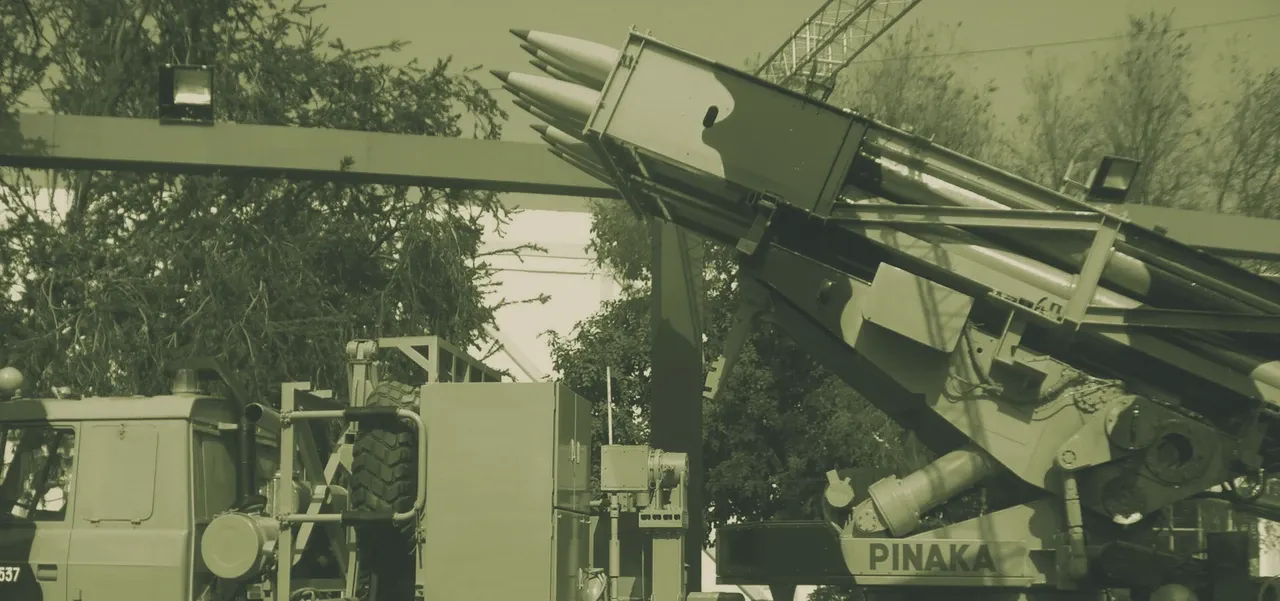
India's rocket artillery — the Pinaka (named for the bow of Lord Shiva) is a multi-barrel rocket launcher that hurls a salvo of twelve rockets in under a minute, blanketing targets out to 40 km with unguided rockets and, in newer guided versions, striking precisely at 75 to 120 km and beyond. Battle-proven since the 1999 Kargil War and used again in 2025, it has become one of India's indigenous defence successes — now exported to Armenia, courted by France and Vietnam, and being stretched to ever-longer ranges to counter Chinese and Pakistani rocket forces.
Overview
The Pinaka is an indigenous Indian multi-barrel rocket launcher (MBRL) system developed by the Defence Research and Development Organisation (DRDO) — specifically its Armament Research and Development Establishment (ARDE) — and produced with industry partners including Tata Advanced Systems and Larsen & Toubro. A Pinaka launcher fires a salvo of twelve 214mm rockets in roughly 44 seconds, saturating an area target with a single battery's worth of firepower, then displacing before counter-battery fire arrives. The original unguided rockets reach about 40 km; successive variants have added range and, crucially, precision guidance — guided Pinaka rockets now strike at 75–90 km, a long-range guided version reaches 120 km, and still longer-ranged versions (150, 200, even 300 km) are in development to match Chinese rocket systems. Combat-proven, mass-produced for the Indian Army, and now exported, the Pinaka is a flagship of India's indigenous rocket-artillery capability.
Development
The Pinaka was developed by DRDO/ARDE from the 1980s–1990s to give the Indian Army an indigenous area-saturation rocket system (complementing imported Russian systems), entering service around 2000, per Wikipedia and DRDO. It was famously combat-proven in the 1999 Kargil War, where it was used to bombard Pakistani positions. The system then evolved: the Mk-I (~38–40 km), the Mk-I Enhanced (~45 km), and guided variants (Pinaka Mk-II / Guided Pinaka, ~60–90 km) that add a navigation-and-control kit for precision, per NDTV and AlphaDefense. DRDO is now developing long-range guided versions reaching 120 km and beyond (150, 200, even 300 km approved for development) explicitly to counter China's long-range guided rocket systems, per The Defense Post. The Pinaka has also become an export product: Armenia is a customer, and France and Vietnam have shown interest in Indian rockets — making it part of India's arms-export drive. It was reportedly used again in combat during the 2025 India-Pakistan escalation.
Design & capabilities
A Pinaka battery mounts a launcher with twelve 214mm rocket tubes on a high-mobility truck chassis, able to fire all twelve rockets in a ~44-second salvo and then quickly reposition ("shoot and scoot") to evade counter-battery fire, supported by replenishment-loader, command-post and radar vehicles. The unguided Mk-I rocket reaches about 40 km with various warheads (high-explosive, pre-fragmented, anti-personnel/anti-materiel, incendiary, mine-scattering); the guided variants add an inertial-navigation/satellite guidance-and-control kit that turns the area-saturation rocket into a precision weapon, extending range to 75–90 km (Guided Pinaka) and 120 km (long-range guided), with 150/200/300 km versions in development. The mix of salvo saturation (for area targets, troop concentrations, logistics) and guided precision (for point targets at long range) makes Pinaka a flexible rocket-artillery system. It is mobile, indigenous and relatively affordable, and its long-range guided variants are explicitly aimed at matching the reach of Chinese systems along the Himalayan frontier. The trade-off of unguided salvos is dispersion (mitigated by the guided versions), but as a combat-proven, evolving, home-built MLRS it is a major Indian capability.
Variants
- Pinaka Mk-I: the baseline unguided rocket (~38–40 km).
- Pinaka Mk-I Enhanced: improved range (~45 km).
- Guided Pinaka / Mk-II: precision-guided rockets (~60–90 km).
- Long-range guided Pinaka: ~120 km, with 150/200/300 km versions in development.
- A full battery includes launcher, loader-replenishment, command and radar vehicles.
Combat record / operational use
The Pinaka has a real combat record: it was used in the 1999 Kargil War to bombard Pakistani positions in difficult mountain terrain, an early validation of the indigenous system, and it was reportedly employed again during the 2025 India-Pakistan escalation. Operationally it equips the Indian Army's rocket-artillery regiments, deployed both against Pakistan and along the Chinese frontier, where its long-range guided variants are intended to counter Chinese rocket forces. Its role is area-saturation and (increasingly) precision rocket fire — suppressing and destroying troop concentrations, artillery, logistics and point targets at ranges beyond conventional tube artillery. The combination of a proven combat history, mass production for a large army, and active development of ever-longer-ranged guided versions makes Pinaka central to India's rocket-artillery modernization. Its export to Armenia (and interest from France and Vietnam) marks it as part of India's growing arms-export profile.
Advantages
- Rapid saturation — twelve rockets in ~44 seconds blanket area targets, then shoot-and-scoot.
- Indigenous — home-built; reduces reliance on imported rocket systems.
- Combat-proven — used since the 1999 Kargil War and again in 2025.
- Guided and long-range — precision variants reach 75–120 km, with 150–300 km in development.
- Exported — Armenia is a customer; France and Vietnam have shown interest.
Drawbacks / limitations
- Unguided dispersion — baseline rockets saturate rather than precisely strike (eased by guided variants).
- Counter-battery exposure — like all artillery, a priority target for drones and counter-fire.
- Logistics-heavy — a battery needs launcher, loader, command and radar vehicles plus rocket resupply.
- Range ramp ongoing — the longest-range guided versions are still in development.
- Contested 2025 data — recent combat use is reported but details are limited/disputed.
Counterparts
The Pinaka sits among the world's multiple-launch rocket systems alongside the US M142 HIMARS (more precise/longer-range with guided rockets), Russia's BM-30 Smerch and BM-21 Grad, South Korea's K239 Chunmoo, and China's long-range guided rocket systems (which its long-range variants are meant to counter). Within India's arsenal it is the rocket-artillery complement to the BrahMos cruise missile and the Akash air defence, part of a growing indigenous-and-exportable family. Its distinction is being a combat-proven, indigenous MLRS that has evolved from unguided area saturation toward long-range precision — closing the gap with systems like HIMARS and Chinese guided rockets while remaining affordable and home-built. Where HIMARS leads on precision and Smerch on legacy mass, the Pinaka is India's own answer, increasingly capable as its guided long-range variants mature.
Outlook
The Pinaka is a flagship of India's indigenous artillery and a growing export. Its trajectory is the fielding of longer-range guided variants (120 km now, 150/200/300 km in development) to match Chinese rocket forces along the Himalayan frontier, continued mass production for the Indian Army, and the pursuit of exports after Armenia (with France and Vietnam interested). The variables to watch are the maturation of the long-range guided rockets, the system's survivability against the drone-and-counter-battery threat that has reshaped the artillery duel, and India's export success. The Ukraine war's lessons — the lethality of precise, long-range rocket artillery and the vulnerability of the launchers — apply directly. For India, the Pinaka is a combat-proven, steadily-improving home-built capability and an export earner; for the wider rocket-artillery market, it is an affordable, increasingly precise alternative from an emerging supplier, central to India's effort to counter China and Pakistan with indigenous firepower.
Key specifications
| Spec | Value |
|---|---|
| Type | Multi-barrel rocket launcher (MLRS) / rocket artillery |
| Origin | India — DRDO/ARDE (with Tata, L&T) |
| In service | ~2000 |
| Rockets | 12 × 214mm per launcher; ~44-second salvo |
| Range (unguided) | ~38–45 km (Mk-I / Enhanced) |
| Range (guided) | ~75–90 km; 120 km (long-range); 150/200/300 km in development |
| Warheads | HE, pre-fragmented, incendiary, mine-scattering, etc. |
| Battery | Launcher + loader/replenishment + command + radar vehicles |
| Combat use | Kargil War (1999); 2025 |
| Operators | India, Armenia (France/Vietnam interested) |
| Status | In service |
Sources
- Pinaka multi-barrel rocket launcher — Wikipedia
- PINAKA Mk-I and Mk-II — DRDO
- India Tests Latest Pinaka as France, Armenia Line Up — NDTV
- India Approves 300 km Pinaka Rocket System — The Defense Post
- Pinaka MBRL 120 km Range Upgrade — AlphaDefense
- Pinaka Multi-Barrel Rocket Launcher — Tata Advanced Systems
🔒 The Analyst Section on Pinaka is for BattlePolicy Pro members. Below the line: procurement and contract history, the suppliers and companies behind the system, our head-to-head analyst view of the systems it actually competes with, and the BattlePolicy assessment note. Unlock the full file with BattlePolicy Pro →