Puma IFV
Germany's premier tracked IFV — a 30 mm airburst cannon, modular armor, and the most powerful engine in its class, equipping the Bundeswehr's Panzergrenadier units and the NATO Very High Readiness Joint Task Force.
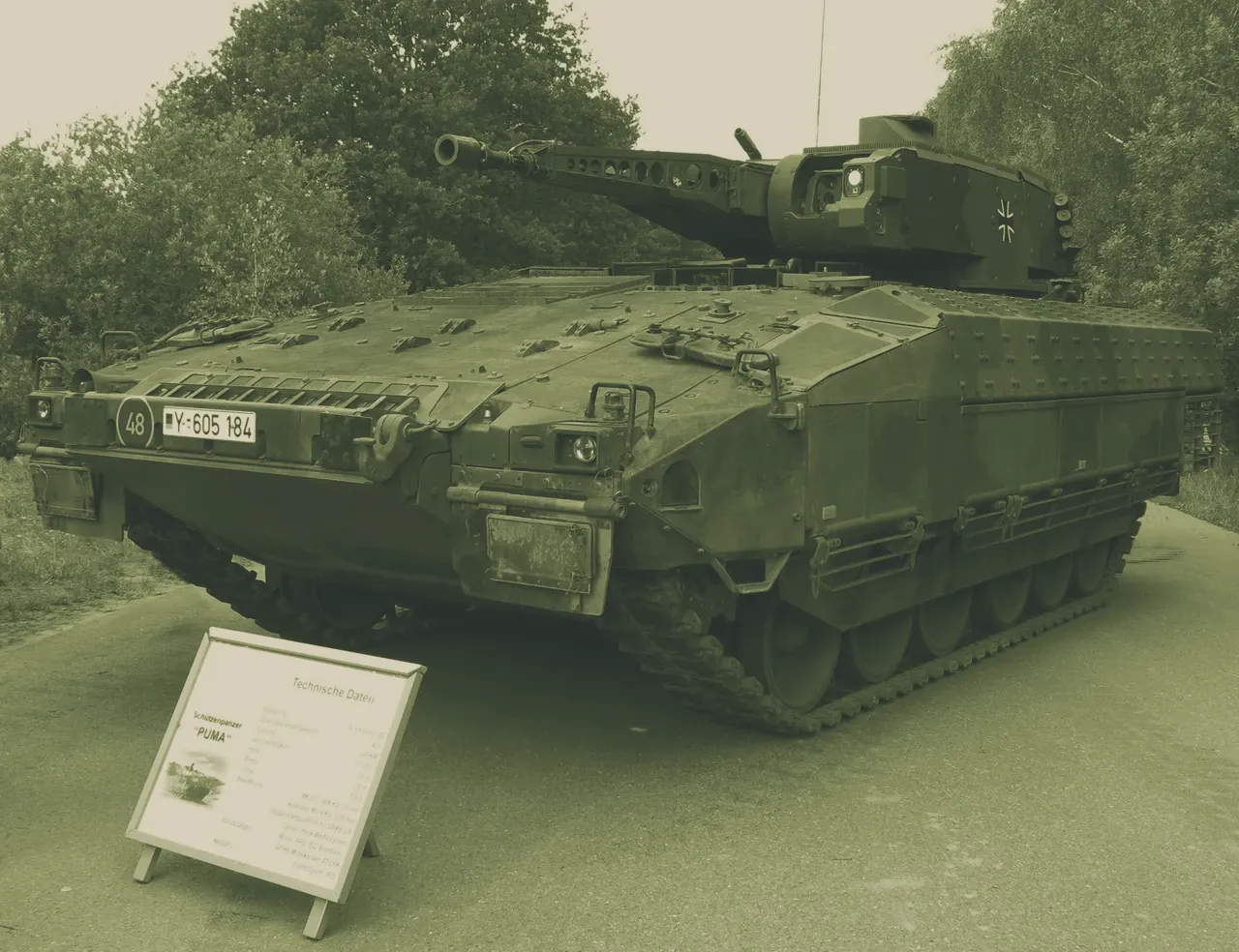
Germany's premier tracked infantry fighting vehicle, armed with a 30 mm airburst cannon and Spike-LR missiles, protected by scalable modular armor, and propelled by the most powerful engine in its class — equipping the Bundeswehr's Panzergrenadier units and the NATO Very High Readiness Joint Task Force.
Overview
The Schützenpanzer Puma is the German Army’s main tracked infantry fighting vehicle, built by PSM — a joint venture of Rheinmetall and KNDS (formerly KMW). It fields a 30 mm airburst-capable autocannon, a long-range Spike-LR anti-tank missile, and a unique modular armor package that lets units tailor protection weight between 31.5 and 43 tonnes. The Puma has the highest motive power of any current IFV (~1,088 hp) and has been in Bundeswehr service since 2015; no export orders have been secured to date. A widely publicized December 2022 technical failure that sidelined an entire exercise platoon of 18 vehicles triggered a sustained reliability improvement program.
Development
The Puma was conceived from the late 1990s to replace the ageing Marder in German Panzergrenadier battalions. Army Technology notes that the system was designed to meet an increasing protection requirement while maintaining strategic mobility, and the first prototype was delivered in 2005. Series production commenced in 2010 and the initial vehicles entered service with the Bundeswehr in 2015, according to Rheinmetall. The first contract lot of 350 vehicles was completed by 2021; a second tranche of 229 additional vehicles was subsequently funded, bringing the planned German fleet to roughly 579, as recorded by Wikipedia.
Design & capabilities
The Puma accommodates a crew of three (commander, gunner, driver) and carries a section of six dismounted infantry. Its main armament is the Rheinmetall MK 30-2/ABM airburst munition-capable 30 mm cannon, paired with a coaxial 5.56 mm MG4 and a MELLS (Spike-LR) guided missile with a range beyond 4,000 m. An MTU 10V 892 diesel delivers 800 kW (~1,088 hp), giving the level-A 31.45-t vehicle a power-to-weight ratio of about 34.6 hp/t.
Protection is built around a modular “Level A/B/C” system: level A meets STANAG 4569 Level 4+ threats on the frontal arc while keeping weight down for air-deployability; level C pushes combat weight to 43 t with maximum ballistic, mine and IED protection. The decoupled running gear reduces blast transfer from under-belly explosions, and the hull is prepared for an active protection system, though none has yet been operationally fitted. Army Recognition details the modular armor suite and notes that the vehicle was developed with APS-capable architecture from the outset.
Combat record / operational use
The Puma has no combat history. It equips German Panzergrenadier battalions and contributes to the NATO Very High Readiness Joint Task Force (VJTF). In December 2022, during an exercise at the Bergen-Hohne training area, all 18 Pumas of a single panzergrenadier company suffered technical failures — predominantly turret electrical faults and engine issues — rendering them non-operational. The incident, widely reported in German media and summarized by Wikipedia, prompted a high-level Bundeswehr reliability review and an urgent improvement programme. Subsequent efforts have concentrated on turret-electronics hardening and engine-bay cooling.
Advantages
- Highest power-to-weight in the IFV class — ~34.6 hp/t (level A) grants exceptional tactical mobility and ability to keep pace with main battle tanks.
- Programmable airburst munition — the MK 30-2/ABM is highly effective against entrenched infantry and light structures, as described by Rheinmetall.
- Scalable modular armor — level A (31.5 t) for strategic/air-deployable missions, level C (43 t) for high-threat environments, without permanent weight penalty.
- Integrated long-range ATGM — the MELLS (Spike-LR) launcher provides anti-armor reach beyond 4 km, mounted under armor for stability and protection.
- Mine/IED survivability — decoupled running gear and belly armor reduce blast transfer and crew casualties.
- APS-ready architecture — future active protection systems can be integrated without major structural modification.
Drawbacks / limitations
- High unit cost and complexity — the vehicle remains expensive to acquire and sustain, limiting the size of the Bundeswehr fleet and deterring exports.
- Readiness concerns — the 2022 exercise failure exposed fragility in turret electronics and thermal management; reliability is still undergoing remediation.
- No active protection system fielded — despite an APS-capable design, the Puma currently lacks an operational hard-kill system.
- Heavy maximum configuration — at 43 t level C, the vehicle strains tactical bridges and strategic airlift.
- Combat untested — all performance data are derived from exercises and trials; real-world survivability against modern threats is unproven.
Counterparts
- BMP-3 (Russia)
- ZBD-04A (China)
- M2 Bradley (USA)
- CV90 (Sweden)
Outlook
The Puma will remain the Bundeswehr’s principal mechanized-infantry platform through the 2030s, with the 229-vehicle second tranche bridging the gap until a next-generation concept emerges. The reliability program aims to mature the turret electronics and cooling systems, while potential integration of an active protection system would finally realize the vehicle’s design ambition. Its high-end capabilities align with NATO’s renewed emphasis on heavy mechanized warfare, but the absence of export orders reflects the platform’s cost and complexity. If readiness improves and APS materializes, the Puma will likely influence future European IFV development; without it, the vehicle’s full promise remains unrealised.
Key specifications
| Spec | Value |
|---|---|
| Crew | 3 + 6 dismounts |
| Combat weight | 31.45 t (level A) – 43 t (level C) |
| Length / width / height | 7.6 m / 3.9 m / 3.6 m (turret roof) |
| Main armament | 30 mm Mauser MK 30-2/ABM (programmable airburst) |
| Secondary armament | coaxial 5.56 mm MG4; MELLS (Spike-LR) ATGM |
| Armor & protection | modular steel/composite A/B/C; mine/IED belly; decoupled running gear; APS-capable (no APS fielded) |
| Engine & power | MTU 10V 892, 800 kW (~1,088 hp) |
| Power-to-weight | ~34.6 hp/t (level A) |
| Road / cross-country speed | ~65–70 km/h (road); cross-country not publicly established |
| Operational range | ~600–650 km |
Sources
- Rheinmetall — “Puma – Infantry fighting vehicle” — https://www.rheinmetall.com/en/products/tracked-armoured-vehicles/puma-infantry-fighting-vehicle
- Army Technology — “Puma AIFV Tracked Infantry Fighting Vehicle” — https://www.army-technology.com/projects/puma_tracked/
- Wikipedia — “Puma (German infantry fighting vehicle)” — https://en.wikipedia.org/wiki/Puma_(German_infantry_fighting_vehicle)
- Army Recognition — “Puma IFV tracked armored infantry fighting vehicle Germany” — https://armyrecognition.com/military-products/army/infantry-fighting-vehicles/tracked-vehicles/puma-kmw-germany-uk