R-360 Neptune
Ukraine's indigenous subsonic cruise missile, developed for coastal defense but now a deep-strike land-attack weapon. It sank the Russian cruiser Moskva in 2022 and, in its Long Neptune form, claims a 1,000 km reach.
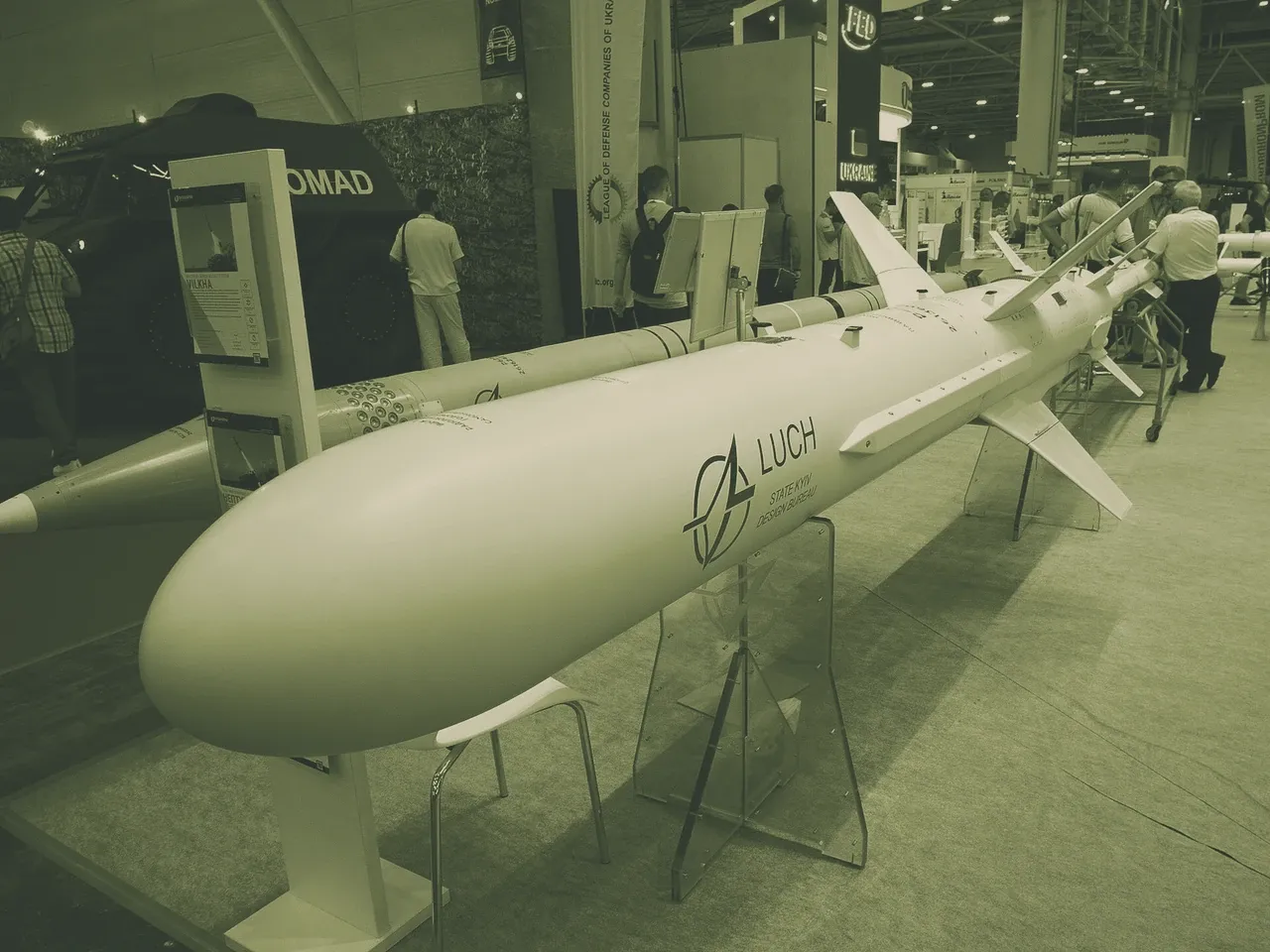
Ukraine's indigenous subsonic cruise missile, born for coastal defense, that sank the Black Sea Fleet flagship and now strikes deep into Russia as a land-attack weapon in a family of variants with a claimed reach of up to 1,000 km.
Overview
The R-360 Neptune is a Ukrainian-developed subsonic cruise missile originally conceived as a coastal anti-ship weapon and later adapted for deep land-attack missions. Fielded by the Ukrainian Navy, it gained global notoriety for sinking the Russian cruiser Moskva in April 2022 and has since been continuously upgraded into a family that includes a long-range land-attack variant with a declared range of 1,000 km. The missile is the centerpiece of the RK-360MC mobile coastal defense complex, launched from truck-mounted canisters, and has become Ukraine's primary sovereign strike asset for hitting Russian military, energy and industrial targets far behind the front lines.
Development
Luch Design Bureau began Neptune in the mid-2010s as a deep modernization of the Soviet Kh-35 anti-ship missile, driven by Russia’s 2014 annexation of Crimea, which left Ukraine’s Black Sea defenses acutely exposed, according to Wikipedia. The weapon was unveiled at the 2015 Arms and Security exhibition in Kyiv, with early flight tests from 2016 and a first successful flight on 30 January 2018; a 100 km range test followed in August 2018 Wikipedia. The first training battalion of the RK-360MC system, based on the USPU-360 truck launcher, was delivered to the Ukrainian Navy in March 2021, only months before Russia’s full-scale invasion. Wartime urgency spurred the conversion to land attack: by 2023 a modified R-360 with GPS-assisted inertial navigation and an imaging-infrared terminal seeker was striking ground targets. An extended-range program announced in April 2024 produced the visibly enlarged Long Neptune (RK-360L), shown publicly in August 2025; its 1,000 km range and 260 kg warhead were officially displayed at the Zbroya exhibition in October 2025, as documented by Defense Express and Militarnyi. An interim variant with side fuel “bulges” was revealed in October 2025, reported by TWZ.
Design & capabilities
Neptune is a subsonic cruise missile fired from a truck-mounted four-round canister. The baseline R-360 measures 5.05 m with a 38 cm body diameter, weighs 870 kg including its solid-fuel booster, and cruises on a Motor Sich MS400 turbofan. Mid-course guidance relies on inertial navigation; the anti-ship version uses an active radar seeker for terminal homing, while the land-attack modification adds GPS assistance and an imaging-infrared terminal sensor. The Long Neptune variant stretches the fuselage to about 6 m (without booster) and widens it to roughly 50 cm, carrying a 260 kg warhead—a 73% increase over the original 150 kg—without sacrificing the claimed 1,000 km range, as detailed by Defense Express. The missile is launched from the USPU-360 Tatra T815-7 8×8 truck, which can fire from up to 25 km inland as part of the RK-360MC complex that includes reload and command vehicles. The recently observed “bulged” variant, believed to carry additional internal fuel rather than external tanks, suggests an effort to offer a mid-range option using the same launch infrastructure, according to TWZ and H I Sutton.
Variants
- R-360 Neptune (anti-ship): 150 kg high-explosive warhead, active radar terminal guidance, ~280–300 km range; secondary ground-attack capability.
- Land-attack R-360: fielded in 2023 with GPS-assisted INS and an imaging-infrared terminal seeker; Ukrainian officials claim a range of ≥360 km.
- R-360L / RK-360L “Long Neptune” (Neptune-D): 1,000 km claimed range, 260 kg warhead, enlarged fuselage (~6 m, ~50 cm diameter), larger wings and fins; capable of engaging both land and sea targets.
- Unnamed interim “bulged” variant: features side fuel bulges, likely offering a mid-range step between the baseline and the Long Neptune while retaining the original launcher.
Combat record / operational use
Neptune’s combat debut came in April 2022: Ukrainian officials claimed that it damaged the frigate Admiral Essen on 3 April, and on 13 April two Neptunes struck the Black Sea Fleet flagship Moskva, a 12,000-ton cruiser, which sank under tow. Russia attributed the loss to a fire, but the sinking made Neptune globally famous and, according to Defense Minister Reznikov, helped convince allies that arming Ukraine paid off Wikipedia. From August 2023, a modified land-attack Neptune destroyed an S-400 radar at Cape Tarkhankut and S-400 systems near Yevpatoriia. In 2024, strikes included the landing ship Kostiantyn Olshansky and the salvage ship Kommuna in Sevastopol, as well as ground targets: a Port Kavkaz oil depot on 31 May 2024, geolocated by the Institute for the Study of War; a Shahed drone depot in Krasnodar; and a Kursk airbase warehouse. In March 2025 President Zelenskyy announced that the Long Neptune had hit a target 1,000 km away during combat testing—an attack analysts linked to the Tuapse refinery (Euromaidan Press). Later strikes attributed to Neptunes include the Karachev electronics plant, the Oryol thermal power plant, and on 31 May 2026 the Novoshakhtinsk refinery, where the Ukrainian Navy said Neptune missiles knocked out both AVT-1 and AVT-2 crude distillation units, as reported by Interfax-Ukraine. In all, the Navy claimed more than 50 successful Neptune strikes in a single year by October 2025 (United24). First combat footage of the Long Neptune was released by President Zelenskyy in November 2025 and was assessed as possibly linked to strikes on Novorossiysk (TWZ).
Advantages
- Proven ship-killer: sank the 12,000-t cruiser Moskva, one of the largest warships lost since WWII.
- Successfully evolved into a deep-strike weapon with over 50 claimed precision strikes on Russian military and industrial targets.
- Long Neptune triples range to a claimed 1,000 km while increasing warhead weight to 260 kg—defying the usual range-payload trade-off.
- Mobile, truck-mounted launchers that can fire from up to 25 km inland complicate enemy targeting and have survived years of counter-battery strikes.
- Fully indigenous supply chain (Luch, Motor Sich, Radionix, Arsenal) makes the program immune to Western restrictions on long-range strike use.
Drawbacks / limitations
- Subsonic speed and conventional flight profile make the missile interceptable; Russia has claimed multiple shoot-downs, and on at least one occasion an S-300 interception was followed by an Iskander strike on the launcher after drone reconnaissance.
- Relatively modest warhead—150 kg (baseline) and 260 kg (Long Neptune)—limits terminal effects against hardened or very large targets when compared with Western land-attack cruise missiles.
- Key performance figures, most notably the 1,000 km range, rest on Ukrainian government/manufacturer claims and are hard to verify independently; missile accuracy (CEP) is not publicly established.
- Production volume (≈100 missiles in 2024) remains small relative to the density of Russian air defenses and the size of the target set.
- Exclusive Ukrainian Navy operation and a four-missile-per-launcher salvo limit cap the scale of individual strike packages, especially when compared with the mass drone raids the missiles are often paired with.
Counterparts
Outlook
Neptune is evolving into Ukraine’s standard sovereign medium-range cruise missile, with production being scaled up and a co-development agreement with Romania pointing toward NATO-adjacent export potential. The counter-game is sharpening, however: Russian drone-cued Iskander strikes on launchers and claimed S-300 intercepts mean survivability increasingly depends on dispersion and tight coordination with drone and decoy waves. Further strikes on Russian refineries and defense-industry targets at the 500–1,000 km depth demonstrated by the Long Neptune are expected to continue.
Key specifications
| Spec | Value |
|---|---|
| Type | Subsonic anti-ship/land-attack cruise missile (ground-launched, truck-mounted) |
| Range | Baseline R-360: ~280–300 km; Long Neptune/RK-360L: ~1,000 km (claimed) |
| Speed (Mach / km·s⁻¹) | Subsonic (high subsonic cruise; exact Mach not publicly established) |
| Warhead (type & weight) | 150 kg HE (R-360); 260 kg HE (Long Neptune, claimed) |
| Guidance | INS + active radar (anti-ship); GPS-assisted INS + imaging-infrared (land-attack); Long Neptune: satnav/INS with radar and IR terminal homing (claimed) |
| Accuracy (CEP) | Not publicly established |
| Launch platform(s) | USPU-360 8×8 truck (Tatra T815-7) with 4-round launcher, part of RK-360MC coastal complex; can fire from up to 25 km inland |
| Propulsion | Solid-fuel booster + Motor Sich MS400 turbofan sustainer |
| Length / diameter / launch weight | 5.05 m / 38 cm / 870 kg (R-360, with booster; container 5.3 × 0.6 × 0.6 m); Long Neptune ~6 m body, ~50 cm diameter, weight not publicly established |
Sources
- Wikipedia — R-360 Neptune. https://en.wikipedia.org/wiki/R-360_Neptune
- TWZ — New 'Bulged' Neptune Cruise Missile Variant Emerges In Ukraine. https://www.twz.com/news-features/new-bulged-neptune-cruise-missile-variant-emerges-in-ukraine
- Militarnyi — Long-Range Neptune Cruise Missile Unveiled With Larger Size and New Design. https://militarnyi.com/en/news/long-range-neptune-cruise-missile-unveiled-with-larger-size-and-new-design/
- Defense Express — Warhead Weight of the 1,000 km Ukraine's Long Neptune (RK360L) Revealed, and It's a Welcome Surprise. https://en.defence-ua.com/weapon_and_tech/warhead_weight_of_the_1000_km_ukraines_long_neptune_rk360l_revealed_and_its_a_welcome_surprise-16005.html
- Euromaidan Press — Ukraine's new Long Neptune missile hits Russian target 1,000 km away, Zelenskyy says. https://euromaidanpress.com/2025/03/16/ukraines-new-long-neptune-missile-hits-russian-target-1000-km-away-zelenskyy-says/
- Interfax-Ukraine — Novoshakhtinsk refinery struck with Neptune coastal missile system — Navy. https://en.interfax.com.ua/news/general/1173220-amp.html
- United24 Media — Ukraine's Neptune Cruise Missiles Carried Out 50+ Precision Strikes on Russia in 2024. https://united24media.com/latest-news/ukraines-neptune-cruise-missiles-carried-out-50-precision-strikes-on-russia-in-2024-12269
- Covert Shores (H I Sutton) — New Variant Of Neptune Cruise Missile Breaks Cover. https://www.hisutton.com/Ukrainian-Neptune-Missile.html
- TWZ — Ukraine's Long Neptune Cruise Missile Seen In Action For The First Time. https://www.twz.com/land/ukraines-long-neptune-cruise-missile-seen-in-action-for-the-first-time
- Institute for the Study of War — Russian Offensive Campaign Assessment, May 31, 2024. https://www.understandingwar.org/backgrounder/russian-offensive-campaign-assessment-may-31-2024