Russia's 'Iva' Missile Looks Chinese. The Demand Behind It Is Ukrainian.
An unmarked shoulder-fired missile in a Rostov air-defense team resembles China's QW series. Its origin is unconfirmed, but Ukraine's drone campaign explains why Russia wants it.
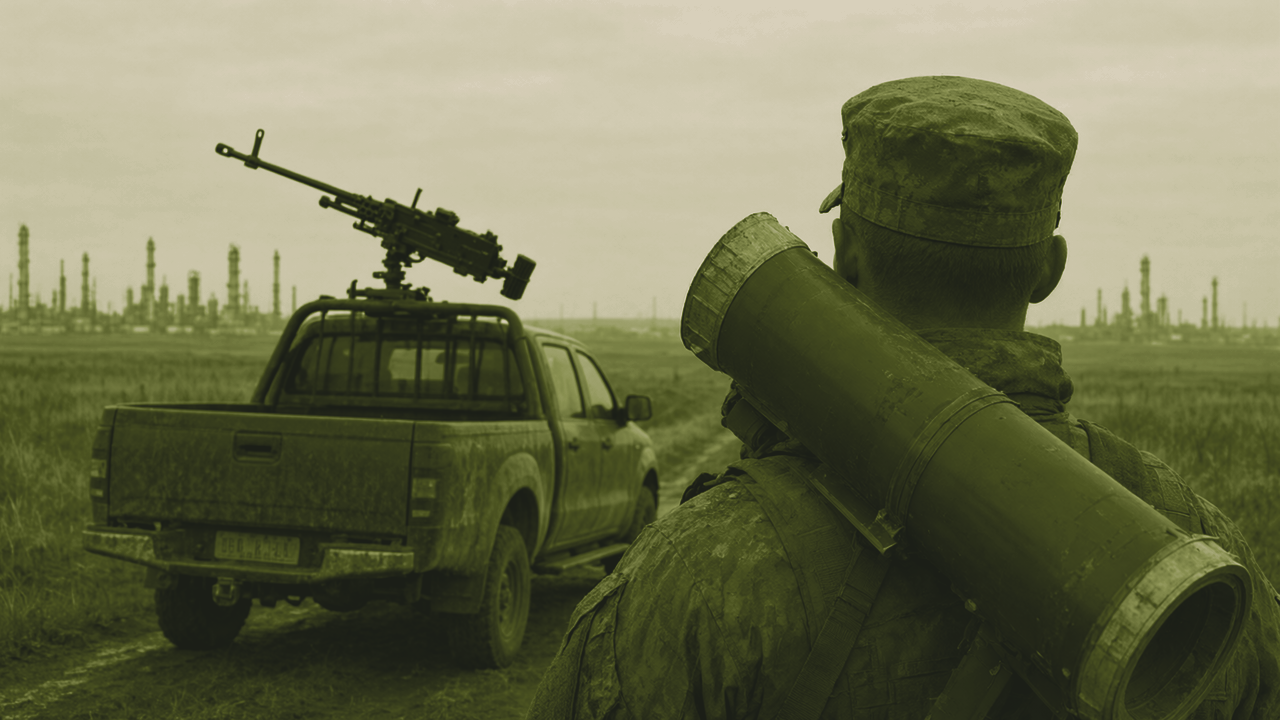
An unmarked shoulder-fired missile in a Rostov air-defense team resembles China's QW series. Its origin is unconfirmed, but Ukraine's drone campaign explains why Russia wants it.
The 51st Air Defense Division on state television
The unmarked shoulder-fired missile that Rossiya 1 showed in late September matters less as a weapon than as a sign of what Russia's rear now requires. The state channel's report followed a mobile fire group of the 51st Air Defense Division in Rostov Oblast, one of the small teams Russia posts around critical infrastructure to shoot down Ukrainian drones. An operator held up a launcher he called "Iva." It matches nothing in Russian service.
The Armourer's Bench, which traced the segment to the channel's News of the Week program, distinguished the launcher from Russia's Strela-3, Igla and Verba. The unit also displayed a triple PKT machine-gun mount and a mount of four AK-74s. A transit case held two missiles, a firing unit and four batteries. Only a serial number on the tube was visible. The operator quoted 4,000 meters without saying whether he meant range or altitude.
The open-source account TheDeadDistrict circulated the footage on Sept. 28 and first called the weapon an Iranian Misagh-2. The War Zone compared it with Iran's Misagh-3 and China's QW-18, QW-18A and QW-19, and judged a box-like component under the front of the tube more consistent with the Chinese family. Scarce imagery of later Iranian variants, it cautioned, means Iran cannot be excluded. Neither the model nor the supplier is established.
The demand is easier to read than the supply. On Sept. 25, Rostov Governor Yuri Slyusar acknowledged that the Novoshakhtinsky refinery, roughly 14 kilometers from the Ukrainian border, had temporarily halted after a Ukrainian strike. China's embassy in Washington says Beijing has "never provided lethal weapons to any party to the conflict." A Chinese-pattern missile on a Russian shoulder puts that sentence under examination, whichever route the launcher took.
Frequently Asked Questions
What is the "Iva" missile?
"Iva" is the name a Russian soldier gave to a shoulder-fired air-defense missile shown in a Rossiya 1 report on a mobile fire group of the 51st Air Defense Division in Rostov Oblast. It does not match Russia's Strela-3, Igla or Verba, according to The Armourer's Bench.
Is the Iva a Chinese weapon?
That is unconfirmed. The War Zone and Militarnyi found the launcher most closely resembles China's QW-18 or QW-19, but an Iranian Misagh variant, a Russian copy or licensed production cannot be ruled out. The launcher carried no visible markings beyond a serial number.
Has China admitted supplying weapons to Russia?
No. China's embassy in Washington said Beijing has "never provided lethal weapons to any party to the conflict," in a statement to POLITICO. No evidence so far ties the Rostov launcher to a direct Chinese shipment.
Why would Russia need foreign shoulder-fired missiles?
Ukraine's long-range drones now strike refineries from Rostov to Perm, roughly 1,449 kilometers from the border by the Institute for the Study of War's measure. Defending many dispersed sites takes large numbers of cheap, portable missiles, and Militarnyi assessed that foreign systems may indicate Russian industry cannot meet that demand.
What can the QW-19 do?
The U.S. Army's ODIN equipment guide lists the QW-19 with a range of 0.5 to 6 kilometers, a maximum altitude of 4,000 meters, a dual-band imaging infrared seeker and a laser proximity fuse. It is made by China Aerospace Science and Industry Corporation.
AI-generated summary, reviewed by an editor. More on our AI guidelines.
Read next — from the Lexicon
Below this point
- CASIC's QW-18 and QW-19
- Rostov, Perm and the Oct. 2 raid
- Beijing, Tehran or a Russian factory
- The line between components and weapons
- What to watch
CASIC's QW-18 and QW-19
The QW family is the kind of portable air defense a dispersed rear needs. China Aerospace Science and Industry Corporation showed the QW-18 in 2006 with a dual-band infrared seeker and unveiled the QW-19 upgrade in 2014. The later design added a digital seeker, a contact-proximity fuse and an inertial mode that permits launch before lock.
The U.S. Army's ODIN equipment guide lists the QW-19's engagement range at 0.5 to 6 kilometers, with dual-band imaging infrared guidance and a laser proximity fuse. Its maximum altitude is 4,000 meters, the same figure the Russian operator gave. One matching number does not identify a missile, but it sits alongside the matching hardware.
Militarnyi pointed to the same clue from another angle: an additional element in the launcher's nose section that is absent from available photographs of the Misagh-3. The Iranian weapon is itself based on the QW series, and Pakistan builds related missiles as the Anza. The Ukrainian outlet could not say whether the Rostov launcher is a QW-18 or a QW-19.
The name settles nothing. "Iva" is Russian for willow, The War Zone noted, and Verba, the name of Russia's own 9K333, is a willow species. It considers the echo unlikely to be a coincidence. A Russian label on a foreign-pattern tube would fit an import, a copy or a licensed build equally well.
Rostov, Perm and the Oct. 2 raid
Ukraine's strike geography turns a missile with a few kilometers of reach into a procurement problem. Ukraine's General Staff reported hitting the Novoshakhtinsky refinery, which processes about 7.5 million tons a year, along with Gamma-S1 and Kasta-2E2 radars nearby on the night of Sept. 24 to 25. The same night it struck the Lukoil refinery in Perm, which the Institute for the Study of War places roughly 1,449 kilometers from the border.
A week later Russia's Defense Ministry claimed 646 Ukrainian fixed-wing drones intercepted or destroyed between 8 p.m. on Oct. 1 and 8 a.m. on Oct. 2, over 13 oblasts, Crimea and two seas. The figure could not be independently verified. Ukraine's General Staff confirmed strikes that night on the Volgograd refinery, which processes about 14.8 million tons a year, and on the Samara oil dispatch station, with fires at both.
A defender cannot cover that map with large surface-to-air batteries. The Robert Lansing Institute described the answer as a ladder: electronic warfare, then mobile fire groups with machine guns and cannon, then shoulder-fired missiles, then the expensive systems. Firing big interceptors at cheap drones, it assessed, is economically inefficient. It also cited Vladimir Putin's own Oct. 1 estimate that the refinery strikes cost Russia about 1% of GDP.
Russia is hiring for the lower rungs. Defense Minister Andrei Belousov announced work on mobile fire groups in June. In Leningrad Oblast they are formed from reservists on three-year contracts, Governor Alexander Drozdenko said; recruits are promised 200,000 rubles, about $2,300, plus 100,000 rubles for each downed drone, and men up to 62 can join. The Moscow Military District told TASS it is forming FPV-interceptor units from reservists as well.
Recruiting operators does not supply their missiles. Every team posted at a refinery, depot or airfield needs its own, and the teams are being hunted. Mykola Kolesnyk, commander of Ukraine's 422nd Unmanned Systems Regiment, told the Kyiv Independent that mobile fire groups are "our number one target," and described a strike on one guarding the E58 highway in occupied southern Ukraine.
Beijing, Tehran or a Russian factory
Three supply routes are plausible, and none is established. Militarnyi's reading is that foreign shoulder-fired missiles may indicate Russian industry cannot meet the military's demand. That is an argument about quantity. Nothing in the footage shows the launcher outperforming an Igla or a Verba.
- Direct from China. No evidence ties the Rostov launcher to a Chinese shipment, and it would contradict Beijing's stated position outright. The documented support is industrial. POLITICO obtained shipping records showing state-owned Jilin Chemical Fiber Group sent 46 tons of carbon-fiber chemicals to Alabuga-Volokno, a Rosatom subsidiary that supplies Russia's Shahed-pattern attack drone production, under a customs code used for textiles such as nylon and polyester. DroneSec chief executive Mike Monnik called Russia's drone program "critically dependent" on Chinese components.
- Through Iran. Reuters reported in July that Iran was to receive 300 to 400 Chinese shoulder-fired missiles worth $60 million to $70 million through a Hong Kong intermediary. The systems named were the QW-12 and FN-16, not the models the Rostov launcher resembles. A European security source told the agency that contracts for the QW-18 and QW-19 were also under discussion. China's Foreign Ministry called the report groundless, and The War Zone found no evidence linking the deal to Russia.
- Built in Russia. Lansing argued that a license or a production line would matter most, because Moscow could then scale a Chinese-derived design without continuous deliveries of complete missiles. That model is also harder to reach with sanctions. Missing factory markings would fit it, though markings alone prove nothing.
Chinese missiles do travel by indirect roads. Ukrainian units have been photographed with Chinese FN-6 and FN-16 launchers since late 2025, and how those arrived remains unclear.
The line between components and weapons
A complete missile would change the category of Chinese help, if a Chinese transfer were confirmed. NATO has called Beijing a decisive enabler of Russia's war through its support for the defense industry, and Secretary General Mark Rutte framed the problem in June around sanctions circumvention and dual-use goods. Carbon fiber can be argued over. A shoulder-fired missile cannot.
The launcher also arrives beside other reported steps. Reuters reported in May, citing three European intelligence services, that about 200 Russian servicemen had trained covertly in China. A Chinese contingent is among the foreign forces at Russia's Center-2026 exercise, which involves about 47,000 personnel in all. Neither fact shows a missile deal.
Lansing's own judgment is restrained. The direct threat from the system is limited, it concluded, and origin is the key intelligence gap. The consequence it draws for Ukraine is practical: if Chinese industry helps Russia scale inexpensive air defense, Moscow could thicken protection around factories and refineries, free its costlier systems for strategic sites and blunt the long-range drone campaign.
What to watch
- The same launcher in units beyond the 51st Air Defense Division.
- Dozens or hundreds of identical systems, which Lansing treats as the mark of a supply or production channel.
- Markings, wreckage or a captured example that settles where the weapon was made.
- Deliveries under Iran's reported missile contracts.
- U.S. sanctions on Jilin Chemical Fiber. David Albright, president of the Institute for Science and International Security, said the shipping documents would allow them.
One launcher in one unit is an anomaly. A second unit makes it a supply line.

Marcus Schuler
Marcus Schuler edits BattlePolicy, a daily defense-technology brief connecting the companies and capabilities behind modern war to the contest among Europe, the US, Russia, and China.