Shahed-149 Gaza
Iran's largest Shahed-family reconnaissance-strike UCAV, presented as a turboprop answer to the MQ-9 Reaper with long-endurance ISR and precision-strike roles, but with performance and production claims still dependent on Iranian and trade-press reporting.
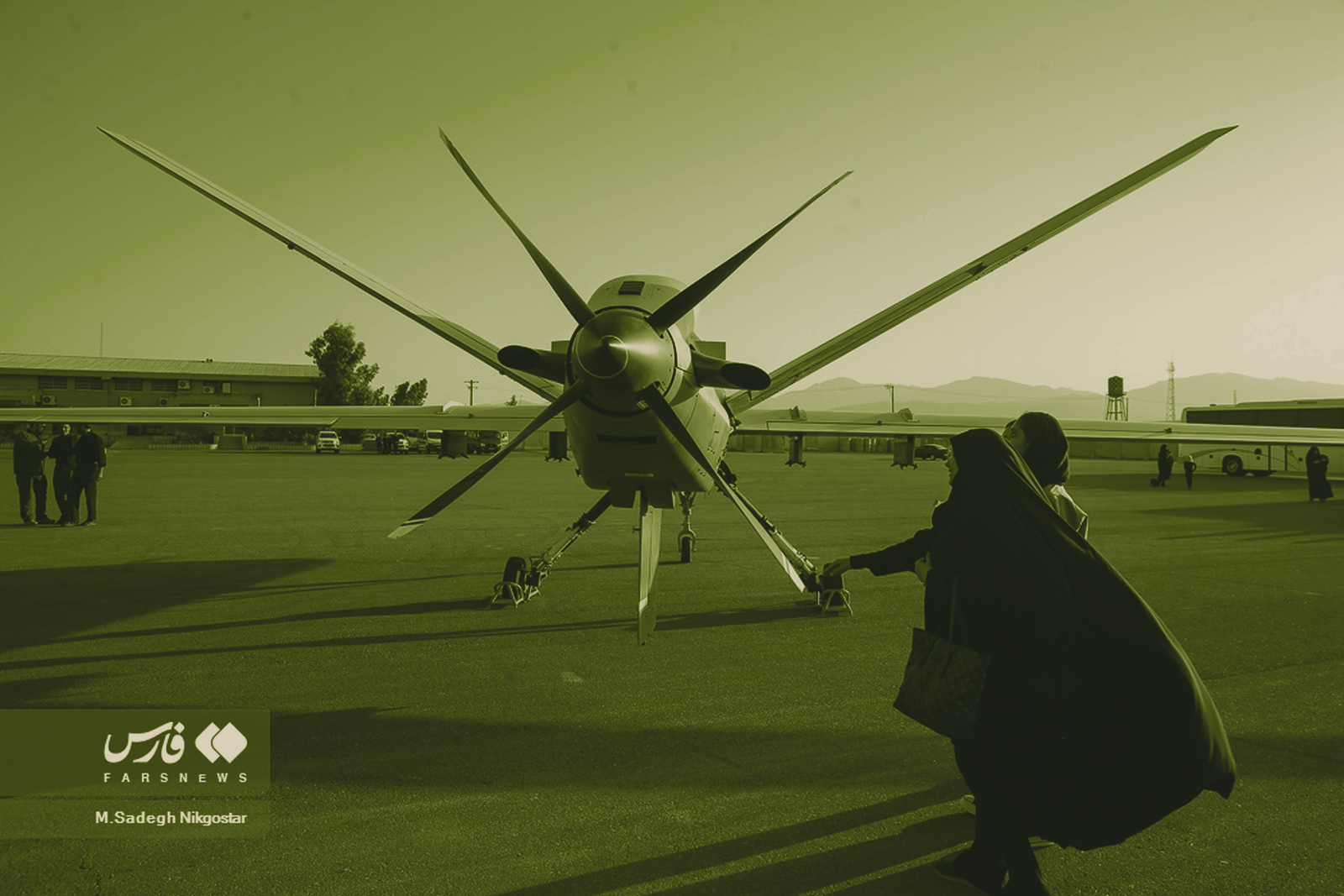
Iran's largest Shahed-family reconnaissance-strike UCAV, presented by Tehran as a long-endurance turboprop platform for ISR and precision strike, with headline performance claims that remain externally unverified.
Overview
The Shahed-149 Gaza is a large Iranian uncrewed combat aerial vehicle associated with the Islamic Revolutionary Guard Corps Aerospace Force and the wider Shahed/HESA drone ecosystem. Iranian and trade-press sources describe it as a high- or medium-altitude long-endurance reconnaissance-strike platform, visually and conceptually similar to the US MQ-9 Reaper but built around Iranian sensors, weapons and command networks. Its public record is dominated by state-backed unveiling, test and exercise reporting rather than independently verified operational use.
The aircraft is important less because its advertised figures are independently confirmed than because it shows the direction of Iran's higher-end UAV ambitions. Compared with the expendable Shahed-136 family, the Gaza is a reusable, runway-operated aircraft intended to loiter, surveil and release guided munitions. The type's claimed endurance, payload and range vary across public reporting, so its practical value depends on how much of Iran's advertised performance can be sustained under real air-defense, electronic-warfare and command-link pressure.
Development
Iran unveiled the Shahed-149 on 21 May 2021 and named it "Gaza" after the Gaza Strip, a political framing tied by Iranian officials to the May 2021 Israel-Gaza escalation, according to GlobalSecurity.org and Wikipedia. The aircraft is credited to Shahed Aviation Industries, the IRGC-linked design house behind several Iranian UAV families, with production associated with HESA, Iran's state aircraft-manufacturing enterprise.
The type reportedly completed flight tests and was accepted for IRGC Aerospace Force service in April 2022, but the underlying test record has not been released in a form that permits independent verification. A later prototype or upgraded configuration was shown in 2023 with external changes described by Army Recognition as including an added hardpoint and improved landing gear. Iranian outlets and trade press subsequently presented the aircraft as operational after live-fire strike tests in 2025, but those reports remain tied to Iranian exercise footage and official claims rather than third-party combat evidence.
Design & capabilities
The Gaza is a single-engine turboprop UCAV with a conventional long-wing layout, a rear-mounted propeller and tricycle landing gear. Open-source descriptions consistently place it above the Shahed-129 in size and mission scope, while Army Technology describes it as the largest member of the Shahed drone family and broadly similar to the MQ-9 Reaper in shape, size and role.
Performance figures should be treated as Iranian-sourced claims. The baseline public specification set describes a 10 m length, 21 m wingspan, 3.2 m height, 3,200 kg maximum takeoff weight, a 340 km/h cruise speed, a 7,000 km range, a 2,500 km operating radius, 24 hours of endurance and an 11,000 m service ceiling, as summarized by Wikipedia. Later Iranian and trade-press reporting raises the claimed endurance to as much as 35 hours and the operating radius to 4,000 km; Defense Mirror reports the 4,000 km claim in connection with the aircraft's operationalization, while Press TV links the later figures to the January 2025 strike demonstration. No reviewed source reconciles the earlier 24-hour/2,500 km claim with the later 35-hour/4,000 km claim.
The payload picture is similarly uneven. Early descriptions refer to up to 13 bombs and an internal rotary release arrangement, while 2025 reporting often describes a ~500 kg weapons payload and up to 13 Sadid-345 precision-guided glide bombs. Press TV's account of the January 2025 test instead describes a demonstrated external load of eight Sadid-345 bombs carried two per hardpoint across four external stations. The safest reading is that "13" is an Iranian-claimed maximum munition count, while the externally demonstrated configuration is four hardpoints with an eight-bomb test load.
The sensor suite is not publicly detailed. Public reporting cites an electro-optical/infrared day-vision camera with 100-120x zoom, but no independently verified radar, electronic-warfare or satellite-control package has been documented in the allowed sources. Datalink architecture, autonomy level and resistance to jamming are therefore not publicly established.
Variants
The public record points to at least two visible configurations rather than a fully documented variant family. The 2021 aircraft was presented as the baseline Shahed-149 Gaza, with claimed internal or semi-internal munitions carriage and long-endurance reconnaissance-strike functions. The 2023/2025 configuration shown in Iranian reporting appears to add or emphasize external hardpoints and revised landing gear; Defense Mirror described it as an upgraded Gaza drone, but no separate official variant designation is publicly established.
Combat record / operational use
No independently confirmed combat use of the Shahed-149 Gaza has been documented in the reviewed sources. Its public operational record consists of unveiling events, reported service acceptance, flight demonstrations and an Iranian exercise strike demonstration, not verified wartime employment against a real adversary target.
The most concrete public use was a January 2025 live-fire demonstration during Iran's Payambar-e-A'azam 19 / Eqtedar 1403 exercise sequence. Iranian and trade-press reporting said the Gaza struck mock ground targets with eight Sadid-345 glide bombs from Shahid Abbas Karimi Air Base near Kashan; Tehran Times and Press TV framed the event as evidence of IRGC long-range strike and surveillance capability. Army Recognition reported that Iran declared the platform operational after successful strike tests, but this remains a state-backed exercise claim.
Iran has promoted the Gaza for export, including in trade-press reporting that frames it as a lower-cost alternative to Western MALE UCAVs. Army Recognition notes that survivability against modern integrated air defenses remains uncertain and that buyers would need to invest in concepts of operation, dispersal and electronic protection to obtain the advertised sortie value. No confirmed foreign operator, export contract or combat deployment is publicly established.
Advantages
- Long-endurance ISR-strike concept: Iranian claims of 24-35 hours endurance would give the Gaza a persistent surveillance and strike role if achieved in operational conditions.
- Larger payload class than earlier Iranian tactical UAVs: repeated reporting cites ~500 kg of weapons or mission payload, enough for multiple guided munitions.
- Reusable platform: unlike one-way Shahed loitering munitions, the Gaza is intended for runway recovery, sensor carriage and repeated sorties.
- Domestic ecosystem fit: HESA and Shahed Aviation Industries can integrate the aircraft into Iran's existing UAV, munitions and IRGC command structures.
- Political-export appeal: the aircraft gives Iran a flagship UCAV for states and armed clients outside Western supply channels, even if confirmed exports are absent.
Drawbacks / limitations
- Unverified performance: range, endurance, payload and production figures rely heavily on Iranian state or trade-press reporting, with no independent flight-test dataset.
- Conflicting payload descriptions: sources differ between internal carriage of up to 13 bombs, a ~500 kg weapons payload and a demonstrated external eight-bomb load.
- Survivability is unproven: no public record shows the Gaza operating against modern integrated air defenses, fighter patrols or sustained electronic attack.
- Command-link vulnerability unknown: satellite-control, line-of-sight control and anti-jam capabilities are not publicly established.
- No confirmed combat record: the January 2025 event was an exercise strike on mock targets, not verified wartime use.
- Production scale uncertain: Military Factory cites ~25 units, but this is an unverified open-source estimate rather than an official production disclosure.
Counterparts
- Mohajer-10 (IR large UCAV)
- MQ-9 Reaper (US MALE UCAV)
- Karrar (IR jet drone)
Outlook
The Shahed-149 Gaza is likely to remain Iran's prestige reusable UCAV unless a larger or more survivable design emerges. Its near-term value is as a long-endurance ISR and strike platform for permissive or semi-permissive airspace, and as an export symbol for buyers seeking armed drones outside Western channels. The central uncertainty is not whether Iran can display and fly the aircraft, but whether it can sustain reliable operations, secure control links and protect a slow turboprop UCAV against modern air defenses.
Future evidence that would materially change the assessment includes confirmed foreign deliveries, serial-production imagery, independently verifiable combat use, or detailed proof of robust beyond-line-of-sight control. Without that evidence, the Gaza should be treated as a credible Iranian program with unproven high-end performance rather than as a validated peer to the MQ-9 Reaper.
Key specifications
| Spec | Value |
|---|---|
| Type | Large MALE/HALE reconnaissance-strike UCAV |
| Endurance | 24 h claimed in early public specifications; up to 35 h claimed in later Iranian reporting |
| Range | 7,000 km claimed ferry range; 2,500 km claimed operating radius in early reporting; up to 4,000 km claimed in later Iranian reporting |
| Cruise / max speed | ~340 km/h cruise; ~340-350 km/h reported max/cruise claims |
| Payload | ~500 kg reported payload; up to 13 guided bombs claimed; eight Sadid-345 glide bombs demonstrated in 2025 exercise reporting |
| Datalink / control | not publicly established |
| Autonomy level | not publicly established |
| Dimensions / MTOW | length 10 m; wingspan 21-22 m; height 3.2 m; MTOW ~3,100-3,200 kg (claimed) |
| Launch & recovery | Conventional runway takeoff and landing |
Sources
- Wikipedia — Shahed 149 Gaza. https://en.wikipedia.org/wiki/Shahed_149_Gaza
- Wikipedia — Shahed drones. https://en.wikipedia.org/wiki/Shahed_drones
- GlobalSecurity.org — Shahed-149. https://www.globalsecurity.org/military/world/iran/shahed-149.htm
- Army Recognition — Iran unveils new prototype of Shahed-149 Gaza drone. https://www.armyrecognition.com/archives/archives-aerospace-defense/aerospace-defense-2023/iran-unveils-new-prototype-of-shahed-149-gaza-drone
- Army Recognition — Iran declares Shahed-149 Gaza operational after successful strike tests. https://www.armyrecognition.com/news/army-news/2025/breaking-news-iran-declares-shahed-149-gaza-drone-copy-of-us-mq9-reaper-operational-after-successful-strike-tests
- Army Recognition — Shahed-149 Gaza export and operational analysis. https://www.armyrecognition.com/?view=article&id=358406&catid=318
- Press TV — What latest test of IRGC super-heavy Gaza drone demonstrated. https://www.presstv.ir/Detail/2025/01/29/741799/explainer-what-latest-test-irgc-super-heavy-gaza-drone-demonstrated
- Defense Mirror — Iran unveils upgraded Shahed-149 Gaza drone. https://defensemirror.com/news/34638/Iran_Unveils_Upgraded_Shahed_149____Gaza____Drone
- Defense Mirror — Iran's 4000 km range attack drone Shahed-149 operationalized. https://www.defensemirror.com/news/38690/Iran-s-4000-Km-Range-Attack-Drone-Shahed-149-Operationalized
- Tehran Times — IRGC unveils highly advanced Gaza drone during major drill. https://www.tehrantimes.com/news/509150/IRGC-unveils-highly-advanced-Gaza-drone-during-major-drill
- Military Factory — HESA Shahed-149 Gaza. https://www.militaryfactory.com/aircraft/detail.php?aircraft_id=2550
- Army Technology — Shahed-136 kamikaze UAV, Iran. https://www.army-technology.com/projects/shahed-136-kamikaze-uav-iran/
- Milivox — Iran Shahed-149 Gaza drone analysis. https://milivox.media/iran-shahed-149-gaza-drone-analysis/
- Quwa — Shahed drone, Iran's attrition weapon and the cost-exchange crisis of 2026. https://quwa.org/iran/military-news-iran/shahed-drone-irans-attrition-weapon-and-the-cost-exchange-crisis-of-2026/
Image - A Shahed-149 "Gaza" drone on the tarmac at an Iranian air base. Photo by Mehrdad Esfahani / Student News Agency (snn.ir), attribution-only license, via Wikimedia Commons.
🔒 The Analyst Section on Shahed-149 Gaza is for BattlePolicy Pro members. Below the line: procurement and contract history, the suppliers and companies behind the system, our head-to-head analyst view of the systems it actually competes with, and the BattlePolicy assessment note. Unlock the full file with BattlePolicy Pro →