Su-34 Fullback
Russia’s heavy strike fighter-bomber — a side-by-side two-seat Su-27 derivative that became the principal launch platform for UMPK glide bombs over Ukraine and the most heavily contested Russian combat jet.
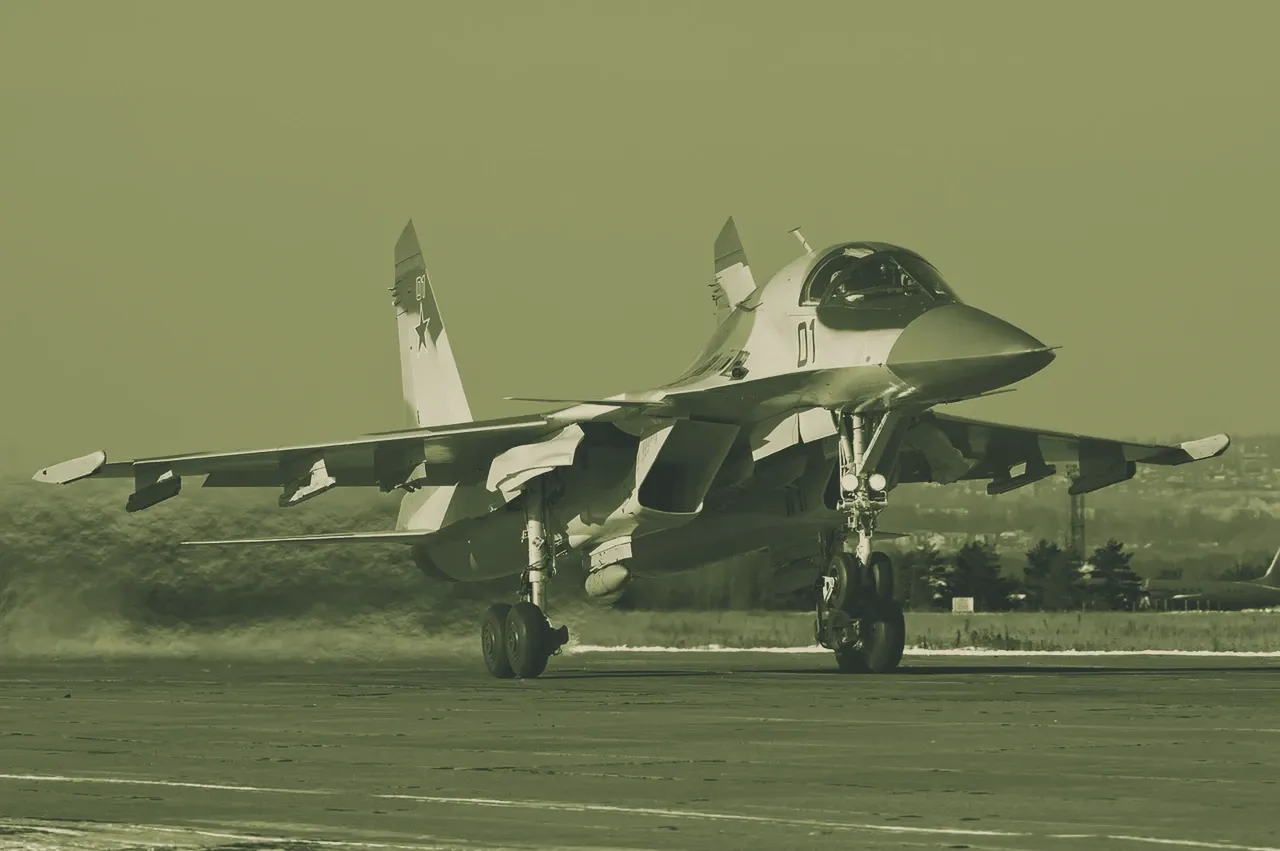
Russia’s supersonic strike fighter-bomber — a twin-seat Su-27 derivative that evolved into the workhorse of glide-bomb warfare over Ukraine and the most heavily attrited Russian combat jet.
Overview
The Sukhoi Su-34 (NATO reporting name “Fullback”) is a heavy, twin-engine, twin-seat tactical strike aircraft that grew out of the Su-27 Flanker family and entered Russian service in 2014. Its distinctive flattened nose, side-by-side cockpit, and enormous internal fuel capacity earned it the unofficial moniker “Hellduck” and made it the longest-legged Russian tactical jet in operational service. Although originally designed for deep interdiction, the Su-34 emerged after 2023 as Russia’s premier launch platform for UMPK-guided glide bombs — a role that has defined the air war over Ukraine and placed the Fullback at the center of intense attrition. While production at Novosibirsk has been accelerated to replace combat losses and worn-out airframes, the type has become the single most-targeted Russian fixed-wing platform, with dozens of airframes visually confirmed destroyed or damaged by mid-2025.
Development
The Su-34’s roots trace to late-1970s studies of a dedicated strike derivative of the Su-27, and the official Su-27IB (T-10V) programme was launched in 1986 around the Sh-141/V004 attack radar. The T-10V prototype first flew on 13 April 1990, but the disintegration of the Soviet Union starved the programme of funding for nearly a decade; the first production-standard aircraft did not fly until 28 December 1994, and state trials dragged on until September 2011. Series production finally began in 2005, and the type formally entered Russian Aerospace Forces (VKS) service on 21 March 2014. Early serial orders under contracts of 2008 (32 aircraft) and 2012 (92 aircraft) brought the fleet to 131 operational airframes by December 2020, according to Wikipedia. A follow-on order for 24 modernised Su-34M (“NVO/Sych”) aircraft was placed in 2020, and from June 2022 the Novosibirsk Aircraft Production Association (NAZ) switched all output to the upgraded standard. The full-scale invasion of Ukraine triggered a surge in deliveries that pushed NAZ to roughly double its pre-war production tempo; seven batches were handed over in 2025 alone, and the plant entered 2026 with additional airframes already in build (RuAvia.su).
Design & capabilities
The Su-34 is built around a modified Su-27 airframe with a widened forward fuselage that seats the two-person crew side-by-side in a 17 mm-thick titanium armoured bathtub. The cockpit is pressurised to allow mask-free operation up to 10,000 m, and there is enough cabin space for the crew to stand or lie down during the multi-hour missions that the type’s fuel capacity enables. Internal fuel is 12,100 kg, and with three 3,000-litre drop tanks the Fullback achieves a ferry range of up to 7,000 km, placing it in the same endurance class as the F-15E Strike Eagle (The War Zone). Power comes from two Saturn AL-31FM1 afterburning turbofans, each delivering 132 kN, giving a maximum speed of Mach 1.8 at altitude.
The main sensor is the Leninets V004 (Sh-141) passive electronically scanned array radar, which provides terrain-following/terrain-avoidance modes, a detection range of 200–250 km against large surface targets and about 90 km against a fighter-sized target. The standard defensive suite centres on the Khibiny (L-175V) electronic-countermeasures pod, while electro-optical targeting is handled by the Platan system. The modernised Su-34M adds a Kopyo-DL rear-facing radar for threat warning, an upgraded electro-optical/infrared targeting pod, enhanced communications and a wider range of precision-guided munitions. From July 2025 the VKS also fielded the Su-34 with modular Sych reconnaissance pods in radio-technical, radar and optical configurations, turning the bomber into a tactical ISR platform (Army Recognition).
The airframe is cleared for a maximum external payload of 12,000-14,000 kg across 12 hardpoints, though typical tactical loads are around 8,000 kg. The built-in armament is a single 30 mm GSh-30-1 cannon with 180 rounds. For air-to-air self-defence the Su-34 can carry R-73, R-77 and R-27-series missiles, but its primary repertoire is air-to-surface: a wide range of Kh-25, Kh-29, Kh-31, Kh-35, Kh-58 and Kh-59 missiles, KAB-500/1500 guided bombs, and rockets. The decisive adaptation for the Ukraine war came when the VKS integrated the UMPK (universal planning and correction module) kit, which turns unguided FAB-250, FAB-500, FAB-1500 and FAB-3000 bombs into stand-off glide weapons released at 35-50 km from the target, and UMPB D-30SN glide bombs with ranges stated to be “100 km or more” in some delivery profiles (European Security & Defence).
Variants
- Su-27IB / T-10V – prototype configuration, side-by-side crew demonstrator.
- Su-32FN – export-oriented maritime-strike variant with additional search-radar capability; marketed but never sold.
- Su-34 (baseline) – standard VKS strike variant, in production from 2005 to ~2022.
- Su-34M / NVO “Sych” – modernised version under the 2020 contract: upgraded radar, sights, communications, expanded Khibiny EW suite, Kopyo-DL rear-warning radar, and new guided-weapon integration. Replaced the baseline model in production from mid-2022.
- Su-34 armed reconnaissance – VKS fleet fit with Sych multi-sensor pods, fielded July 2025; modular optical, radar and signals-intelligence sensors.
- Su-34E / Su-34ME – export designation; Algeria ordered 14 Su-34ME aircraft in 2019, with desert-camouflaged airframes observed in production during 2025 (The Defense Post).
- Proposed EW/escort-jammer variant – mentioned in Russian defence media but not yet observed in operational service.
Combat record / operational use
The Su-34 saw its first operational outing in the 2008 Russo-Georgian war and later flew strike sorties from Khmeimim airbase during Russia’s Syrian intervention beginning in September 2015, typically carrying light loads of KAB-500S satellite-guided bombs. Those campaigns, however, were little more than a prelude to the air war over Ukraine that began in February 2022.
In the opening months of the full-scale invasion, Su-34 crews were forced to attack at low altitude with unguided bombs because the VKS lacked sufficient stocks of stand-off precision munitions. This exposed the fleet to dense Ukrainian short- and medium-range air defences and produced catastrophic losses. By July 2025 open-source analysts at Oryx had visually confirmed 41 Su-34s damaged or destroyed, making the Fullback the most heavily attrited Russian fixed-wing combat type in the war (Militarnyi). Media tallies earlier placed the number at roughly 36 airframes lost by June 2024.
The operational picture changed dramatically from early 2023, when the VKS began mass-issuing UMPK glide-bomb kits. Instead of penetrating the battle zone, Su-34s climbed to altitude, released 500-kg, 1,500-kg or even 3,000-kg glide bombs from 35-50 km behind the line of contact, and egressed. Typically flying in flights of two, often with Su-35S escort, each Su-34 could deliver up to four bombs per sortie. The weight of these stand-off attacks was decisive in grinding down Ukrainian positions at Avdiivka (early 2024) and later around Chasiv Yar, and the tactic remains the signature Russian air-to-ground effort of the war (JAPCC).
Nevertheless, attrition has continued. On 27 June 2025 a Ukrainian one-way drone strike hit Marinovka air base in the Volgograd region, destroying or damaging about five Su-34s on the ground — a loss subsequently confirmed by satellite imagery (Militarnyi). On 1 July 2025 a Su-34 crashed during a training sortie in Nizhny Novgorod region, and on 25 September 2025 Ukraine’s air force shot down a glide-bomb-carrying Su-34 near Vasylivka in occupied Zaporizhzhia (Newsweek). Across 2025, Russia lost at least 40 fixed-wing combat aircraft visually confirmed by Oryx, against an estimated 55 new fighter-type airframes delivered by Russian industry, indicating that despite a production surge the VKS tactical fleet may be shrinking (Aerospace Global News). At the same time, the Su-34 formally assumed an armed reconnaissance role in July 2025, with Sych pods compensating for the shrinking ISR fleet.
Advantages
- Exceptional unrefuelled reach — internal fuel of 12,100 kg plus three drop tanks gives a ferry range of 7,000 km and a tactical radius of ~1,100 km, comparable to the F-15E and sufficient to operate deep behind the line (The War Zone).
- Crew endurance — side-by-side armoured cockpit, pressurised for mask-free flight, with room to stand, lie down, and operate long-duration glide-bomb sorties of 5–8 hours.
- UMPK stand-off delivery — releasing guided bombs from 35-50 km (and farther with extended-range kits) keeps the platform largely outside shoulder-fired and short-range air-defence envelopes, dramatically improving survivability compared with low-level bombing.
- Sustained production — NAZ delivered seven batches in 2025 and moved to a higher output rate than pre-war levels, making the Su-34 the only frontline-bomber class in series production anywhere today.
- Multirole flexibility — can carry a broad array of air-to-surface missiles, guided and unguided bombs, and has been adapted in-theatre for tactical reconnaissance with modular Sych pods.
Drawbacks / limitations
- Heaviest combat losses of any Russian jet — 41 Su-34s visually confirmed damaged or destroyed by mid-2025; additional losses accumulated through 2025 and the fleet relies on rapid replacement to stay operationally relevant (Militarnyi).
- Vulnerability before stand-off weapons — early low-level bombing without guided munitions led to prohibitive attrition; even with glide bombs, ambushes by Patriot SAMs and other long-range systems have shot down bomb-carriers (e.g., the September 2025 Vasylivka kill) (Newsweek).
- Exposed on the ground — Ukrainian long-range drone strikes (Marinovka, June 2025) and sabotage attempts have destroyed or damaged multiple airframes, eroding the fleet without any air-to-air engagement.
- Airframe fatigue — around-the-clock bombing tempo is consuming service life faster than peacetime norms; a significant portion of new-build aircraft replaces worn-out jets rather than expanding the force.
- Weapon-dependent accuracy — when Ukrainian GNSS jamming degrades UMPK guidance, glide-bomb accuracy drops sharply, while UK intelligence has linked inadvertent bomb releases on Russian territory to crew fatigue and training shortfalls (JAPCC).
- Cost opacity — unit cost is not publicly established; one analyst assessment of the Algerian deal suggests a per-platform price well below typical Western figures, but the real production cost remains unverified.
Counterparts
- F-15EX Eagle II (USA)
- J-16 (China)
Outlook
Production of the Su-34M at Novosibirsk is set to continue at the heightened wartime rate through 2026 and beyond, as UAC openly targets further output increases to offset combat losses and airframe exhaustion. The first export of the modernised variant is materialising with Algeria’s 14-aircraft Su-34ME order, which will replace the Algerian Air Force’s Su-24MKs and establish Algeria as the launch export customer (The Defense Post). Yet the mission that made the Su-34 the centrepiece of Russian air power — glide-bomb attacks from medium stand-off — is under severe stress. Ukrainian electromagnetic warfare is successfully jamming UMPK satellite-guidance channels, and NATO-supplied GBAD is prosecuting bomb-carriers with increasing effectiveness. In response, Moscow is pushing development of longer-range powered bomb kits (UMPB D-30SN) that would allow the Su-34 to release weapons from even greater distances, potentially outside the SAM engagement zones that have already bled the fleet. Whether that technical shift can keep the Fullback relevant — and whether the VKS can sustain the fleet size needed to maintain the daily glide-bomb cadence — is the central question for the platform’s next chapter.
Key specifications
| Spec | Value |
|---|---|
| Crew | 2 (side-by-side) |
| Length / wingspan | 23.34 m / 14.7 m |
| Max speed | 1,900 km/h (Mach 1.8) at altitude |
| Service ceiling | ~17,000 m |
| Combat radius / range | ~1,100 km radius (ferry range 4,500 km, up to 7,000 km with three drop tanks) |
| Payload | 12,000–14,000 kg (practical ~8,000 kg) |
| Hardpoints | 12 |
| Radar / sensors | Leninets V004 PESA (Sh-141); Khibiny L-175V ECM; Platan EO targeting; Su-34M adds Kopyo-DL rearward-facing radar; Sych modular recon pods (EO/IR, radar, SIGINT) |
| Powerplant | 2 × Saturn AL-31FM1 afterburning turbofans, 132 kN each |
| Armament | 1 × 30 mm GSh-30-1 cannon (180 rds); R-73/R-77/R-27 AAMs; Kh-25/Kh-29/Kh-31/Kh-35/Kh-58/Kh-59 ASMs; KAB-500/1500 guided bombs; FAB-250/500/1500/3000 with UMPK kits; UMPB D-30SN glide bombs; S-8/S-13/S-25 rockets |
Sources
- Wikipedia — Sukhoi Su-34 — https://en.wikipedia.org/wiki/Sukhoi_Su-34
- The War Zone (TWZ) — Russia's Su-34 Fullback Strike Jet Is The King Of Hauling Gas — https://www.twz.com/43800/russias-su-34-fullback-strike-jet-is-the-king-of-hauling-gas
- ODIN / U.S. Army TRADOC Worldwide Equipment Guide — Su-34 (Fullback) Russian Fighter-Bomber Aircraft — https://odin.t2com.army.mil/WEG/Asset/Su-34%20%28Fullback%29%20Russian%20Fighter-Bomber%20Aircraft
- Militarnyi — Russia Receives Seventh Batch of New Su-34 Fighter Jets in 2025 — https://militarnyi.com/en/news/russia-receives-seventh-batch-of-new-su-34-fighter-jets-in-2025/
- Aerospace Global News — Russia lost dozens of aircraft in 2025 as war in Ukraine drags on — https://aerospaceglobalnews.com/news/russian-air-losses-2025-ukraine-gains/
- RuAvia.su — Final Batch of Su-34 Bombers Delivered to Russian Ministry of Defense in 2025 — https://ruavia.su/final-batch-of-su-34-bombers-delivered-to-russian-ministry-of-defense-in-2025/
- Newsweek — Ukraine Destroys Russian Su-34 Bomber Carrying Out 'Terrorist' Attacks — https://www.newsweek.com/ukraine-destroys-russian-su-34-bomber-carrying-out-terrorist-attacks-10760163
- Army Recognition — Russian Air Force adapts Su-34 fighter-bomber for reconnaissance missions over Ukraine — https://armyrecognition.com/news/aerospace-news/2025/russian-air-force-adapts-su-34-fighter-bomber-for-reconnaissance-missions-over-ukraine
- The Defense Post — Algeria Poised to Receive Russia's Su-34M Fighter Jets — https://thedefensepost.com/2025/08/11/algeria-russia-su34m-jets/
- European Security & Defence — Blood and dust: The rise of Russia's glide bombs — https://euro-sd.com/2025/07/articles/armament/45382/blood-and-dust-the-rise-of-russias-glide-bombs/
- JAPCC — Countering Russia's Glide Bomb Warfare in Ukraine — https://www.japcc.org/articles/countering-russias-glide-bomb-warfare-in-ukraine/