TOS-1A Solntsepyok
Russia's T-72-based 220 mm thermobaric multiple rocket launcher — the Solntsepyok is a short-range assault-breaching weapon that incinerates fortifications and has become a prime target for Ukrainian drone hunters.
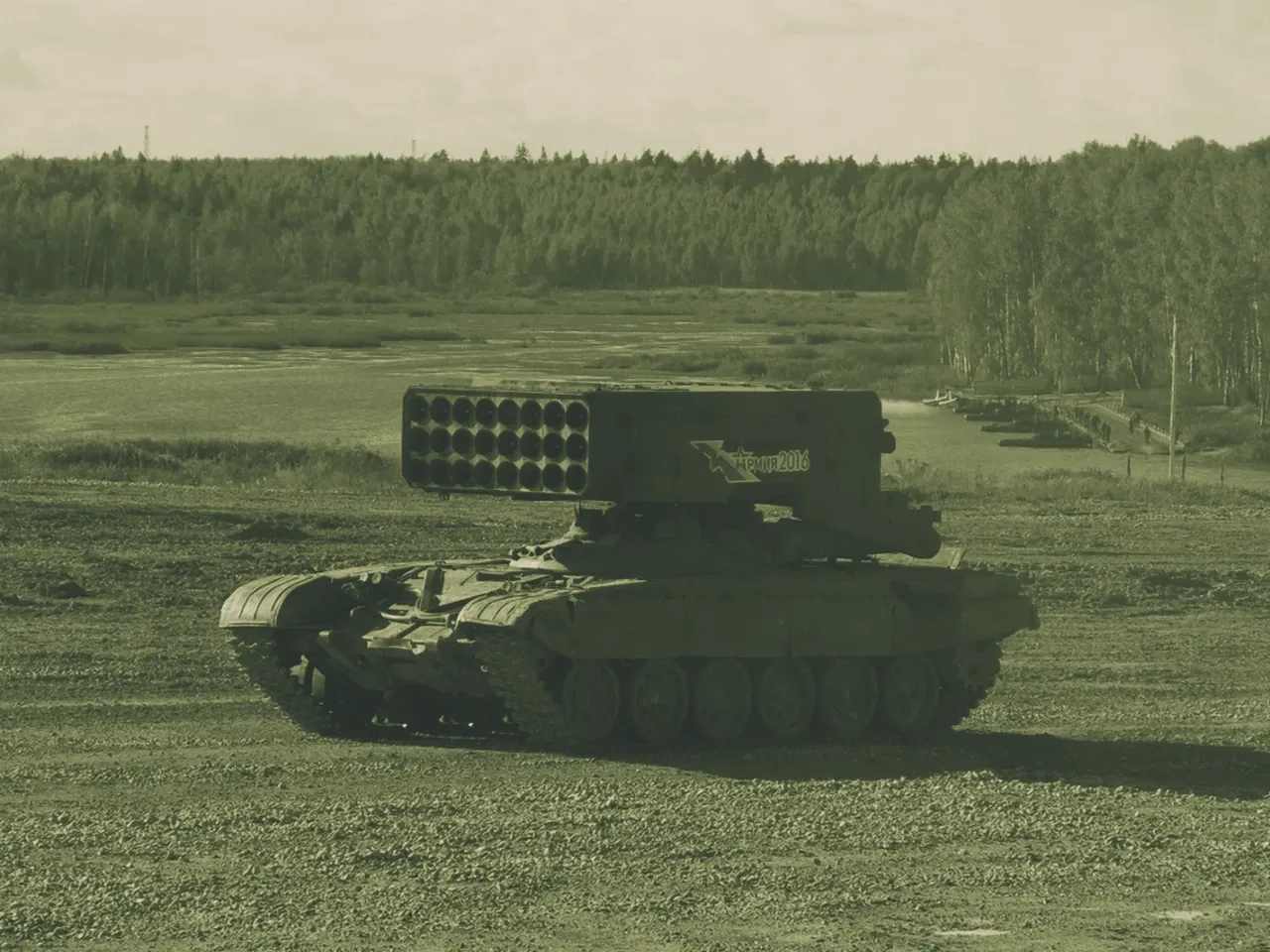
Russia's T-72-based 220 mm heavy flamethrower system — a short-range thermobaric rocket launcher that turns field fortifications into deathtraps, and one of the most destructively hunted vehicles in the war in Ukraine.
Overview
The TOS-1A Solntsepyok (Object 634B / BM-1) is a Russian self-propelled multiple rocket launcher designed to destroy dug-in infantry, fortifications and light armour at short range with thermobaric and incendiary rockets. Operated by Russia’s NBC Protection Troops rather than the artillery branch, it is classified as a “heavy flamethrower system” and has been exported to several Middle Eastern, North African, Central Asian and Caucasian states. Based on the T-72 main battle tank chassis, the vehicle combines tank-level protection with a 24-tube 220 mm launcher capable of saturating up to 40,000 m² with a single salvo GlobalSecurity. Since Russia’s full-scale invasion of Ukraine in 2022, the Solntsepyok’s extreme close-range employment has made it a priority target for Ukrainian FPV drones, ATGMs and artillery, with over two dozen confirmed destroyed and many more damaged or captured.
Development
The concept of a heavy short-range MLRS firing incendiary and thermobaric rockets emerged in the late 1970s, and the Omsk Transmash Design Bureau (KBTM) began development of the TOS-1 complex in the early 1980s, mating a 30-tube launcher to a T-72 hull. The system was reportedly first combat-tested by Soviet forces in Afghanistan’s Panjshir Valley in 1988–89, and the baseline TOS-1 Buratino entered service in 1988, though it was not publicly revealed until a 1999 exhibition in Omsk Wikipedia. The improved TOS-1A Solntsepyok, with a 24-tube launcher, a ballistic computer and rockets that reached 6 km, was introduced in 2003. In 2018, the Russian NBC Protection Troops received 30 updated vehicles with reactive armour and new launcher systems. Rocket evolution continued: a 2020 model extended range to 10 km, and a March 2020 upgrade included a heavier warhead. As the Ukraine war exposed survivability gaps, Russian manufacturers added anti-drone protection to vehicles delivered in late 2024 and 2025 DefenseMirror. Production remains ongoing, and the Moscow Military District is scheduled to receive additional TOS-1A and the wheeled TOS-2 Tosochka in 2026 TASS.
Design & capabilities
The Solntsepyok is built on the chassis of the T-72 main battle tank, providing protection against small-arms fire and shell splinters, augmented on later batches by reactive armour and factory-installed anti-drone electronic warfare systems. The launch vehicle (BM-1) carries 24 220 mm unguided thermobaric rockets in a vertically traversable turret; a full salvo can be fired in as little as 6 seconds, unleashing a fuel-air mixture that generates a prolonged overpressure wave and temperatures of up to 3,700 °C across an area of up to 40,000 m² according to manufacturer statements GlobalSecurity. The rockets (M0.1.01.04 series) weigh approximately 173–217 kg and have ranges of 3.5 km (earlier models) to 10 km (the M0.1.01.04M2), allowing the launcher to operate just beyond the effective range of most anti-tank guided missiles CAT-UXO. Each launcher is paired with a T-72-based TZM-T reload vehicle carrying 24 additional rockets and a 1-tonne crane; reloading takes about 24 minutes. The crew consists of three personnel. The vehicle weighs around 45.3 tonnes and is powered by an 840 hp V-84 multi-fuel diesel, giving a road speed of 60 km/h and an operational range of 550 km.
Variants
- TOS-1 Buratino (Object 634): the original 30-tube system with a rocket range of approximately 3.5 km.
- TOS-1A Solntsepyok (Object 634B): the current 24-tube version with improved fire control and 6-km rockets, later upgraded to 10 km.
- Rocket types: M0.1.01.04 (173 kg, 3.3 m), M0.1.01.04M (217 kg, 6 km), M0.1.01.04M2 (heavier warhead, 10 km range, minimum range 1,600 m).
- TZM-T (Object 563): dedicated reload vehicle on a T-72A chassis.
- TOS-2 Tosochka: wheeled successor (Ural truck chassis) with advanced fire control and automation, offered as a more mobile fire-support system TASS.
- T-80-based version: reported in final testing as of November 2025, with greater automation and range DefenseMirror.
Combat record / operational use
The TOS-1 first saw combat in the Soviet-Afghan war’s Panjshir Valley (1988–89) and was later used in the Second Chechen War. The TOS-1A made its combat debut in Iraq on 24 October 2014, where Iraqi forces employed it against ISIL at Jurf al-Sakhar and later in Mosul’s Old City Wikipedia. Syrian government forces have used the system since 2015, and Azerbaijan employed TOS-1As in the 2016 and 2020 Nagorno-Karabakh wars.
In Russia’s full-scale invasion of Ukraine, the Solntsepyok has been deployed from the first weeks for breaching fortifications and direct support of assault units, often firing partial salvos of 8–16 rockets from dispersed positions close to the front. Its short reach, however, places it squarely inside the envelope of Ukrainian FPV drones and ATGMs, making it a high-value target. Ukrainian forces have repeatedly destroyed TOS-1As with cheap first-person-view attack drones: in September 2025, the 429th “Achilles” regiment knocked out two launchers in the Kupiansk sector Kyiv Post; the 27th National Guard Brigade recorded another kill in October 2025 Militarnyi; the 63rd Mechanized Brigade struck one near Lyman in November 2025; Lasar’s Group destroyed one as it was firing in December 2025 Militarnyi; and a 129th Brigade drone destroyed a system in Kharkiv region on 4 April 2026 despite layered Russian EW protection Defense Express. The catastrophic secondary explosions that follow a hit are characteristic: loaded thermobaric rockets routinely obliterate the vehicle and endanger nearby troops.
By December 2025, open-source analysts at Oryx had visually confirmed 34 destroyed, damaged or captured TOS-1As and nine TZM-T loader vehicles Wikipedia. Ukrainian military accounts place the total number of “heavy flamethrower systems” lost at more than 35, including at least three captured vehicles, one of which was reportedly turned against Russian forces in April 2022.
Advantages
- Unmatched area effect: a single 24-rocket salvo can engulf up to 40,000 m² in a thermobaric blast that collapses dugouts and fortifications, for which there is effectively no protection other than a sealed underground bunker.
- Rapid fire-and-scoot: the full salvo can be discharged in about 6 seconds, and the system can go from march to fire in approximately 90 seconds, limiting exposure to counter-battery fire.
- Tank-level survivability: the T-72 hull and add-on ERA allow the vehicle to operate at the armoured spearhead; recent batches add factory anti-drone EW.
- Range growth: the 10-km M2 rocket pushes the launcher outside the range of many infantry ATGMs.
- Export success: sold to multiple partners, with combat proven credentials in Iraq, Syria and Nagorno-Karabakh.
Drawbacks / limitations
- Extremely short range: even at 10 km, the system must operate well inside the kill zone of FPV drones, artillery and ATGMs; it has been a “prime target” in Ukraine with dozens of confirmed losses.
- Catastrophic vulnerability: a single drone strike often causes a catastrophic detonation of the rocket load, destroying the vehicle instantly and posing a danger to nearby friendly units.
- Scarcity and loss rate: Russia’s active fleet is estimated at fewer than 40 operational launchers; the loss of 35+ systems since 2022 represents a substantial fraction of the inventory.
- Area, not precision: unguided rockets deliver saturation rather than pinpoint effects; documented use against populated areas raises serious humanitarian concerns.
- Heavy logistics: each launcher requires a dedicated T-72-based reload vehicle and a 24-minute reload cycle, making the two-vehicle team vulnerable and logistically demanding.
Counterparts
- M142 HIMARS (USA)
- PHL-191 (China)
Outlook
Serial production continues at Uralvagonzavod, with new deliveries explicitly oriented toward improving counter-drone survivability. Russia’s military district structures are institutionalizing heavy flamethrower units, and the Moscow Military District will receive both TOS-1A and the wheeled TOS-2 Tosochka through 2026. Meanwhile, a T-80-based successor is reportedly in final testing, promising greater range, automation and survivability. The TOS-1A will remain a battlefield terror weapon, but its future utility hinges on whether the latest protection kits can reduce the loss rate that has seen a sizeable portion of the pre-war fleet eliminated by cheap drones.
Key specifications
| Spec | Value |
|---|---|
| Crew | 3 |
| Combat weight | ~45.3 t |
| Length / width / height | 9.5 m / 3.6 m / 2.22 m (launcher lowered) |
| Main armament | 24 × 220 mm unguided thermobaric/incendiary rockets |
| Secondary armament | None (TZM-T loader carries a 5.45 mm RPKS-74) |
| Armor & protection | T-72 MBT hull armor; add-on reactive armor (2018+); factory anti-drone EW (2024–25 batches) |
| Engine & power | V-84 multi-fuel diesel, 840 hp (630 kW) |
| Power-to-weight | ~18.5 hp/t (est.) |
| Road / cross-country speed | 60 km/h road; cross-country not publicly established |
| Operational range | 550 km |
Sources
- Wikipedia — TOS-1 — https://en.wikipedia.org/wiki/TOS-1
- Kyiv Post — Two 'Legendary' Russian $15M Thermobaric Rocket Launchers Destroyed by Ukrainian FPV Drones — https://www.kyivpost.com/post/61126
- Militarnyi — Lasar's Group Destroys ТOS-1А Solntsepyok Heavy Flamethrower System — https://militarnyi.com/en/news/lasar-s-group-destroys-tos-1a-solntsepyok-heavy-flamethrower-system/
- Militarnyi — Pechersk Brigade of Ukraine's National Guard Destroys Russian TOS-1A Heavy Flamethrower System — https://militarnyi.com/en/news/pechersk-brigade-of-ukraine-s-national-guard-destroys-russian-tos-1a-heavy-flamethrower-system/
- TASS — Moscow Military District to receive TOS-1A, TOS-2 heavy flamethrower systems in 2026 — https://tass.com/defense/2109769
- TASS — TOS-2 heavy flamethrower is technologically advanced fire support system — Rostec — https://tass.com/defense/2089067
- CAT-UXO — 220mm TOS-1 Rocket — https://cat-uxo.com/explosive-hazards/rockets/220mm-tos-1-rocket
- Defense Express — russian TOS-1A Solntsepyok System Blown Up by Ukrainian Drone Strike in Kharkiv Region (Video) — https://en.defence-ua.com/news/russian_tos_1a_solntsepyok_system_blown_up_by_ukrainian_drone_strike_in_kharkiv_region_video-18057.html
- GlobalSecurity.org — TOS-1A Solntsepek (Sun) 220mm MRL — https://www.globalsecurity.org/military/world/russia/tos-1a.htm
- DefenseMirror — Heavy Flame Thrower with New Anti-Drone Protection Delivered to Russian Army — https://defensemirror.com/news/40526/Heavy_Flame_Thrower_with_New_Anti_Drone_Protection_Delivered_to_Russian_Army