Trident II D5
The UGM-133A Trident II D5 is the submarine-launched ballistic missile at the core of the United States and United Kingdom sea-based nuclear deterrents.
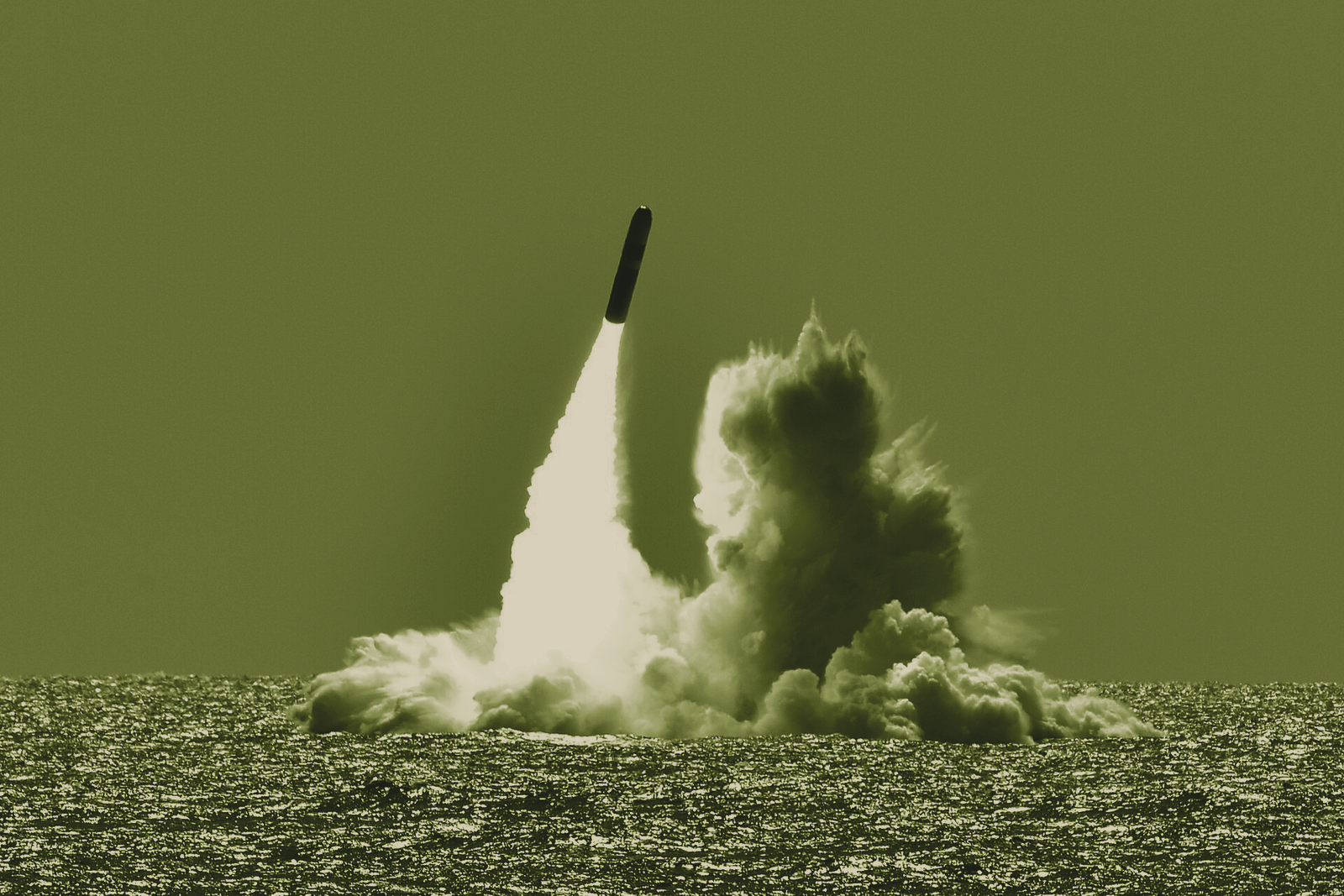
,_March_26,_2008.jpg)
The UGM-133A Trident II D5 is a three-stage, intercontinental-range submarine-launched ballistic missile forming the sea-based nuclear deterrent of the United States and United Kingdom.
Overview
The Trident II D5 is a solid-propellant submarine-launched ballistic missile developed for the US Navy and also operated by the Royal Navy. It entered US service in 1990 and UK service in 1994. The missile equips American Ohio-class and British Vanguard-class ballistic-missile submarines, while its life-extended derivatives are intended for the succeeding Columbia and Dreadnought classes.
Trident combines intercontinental reach, multiple independently targetable reentry vehicles and stellar-inertial guidance in a weapon designed primarily for survivable nuclear retaliation. Its range varies substantially with payload: CSIS Missile Threat gives a payload-dependent envelope of 2,000-12,000 km, while later D5 Life Extension performance is reported to exceed 12,000 km under some loading conditions.
The United Kingdom does not maintain a wholly separate missile inventory. British submarines draw missiles from a co-mingled US-UK pool maintained at Kings Bay, Georgia, although the UK owns and controls its nuclear warheads and independently authorizes their use. The arrangement makes Trident both a national strategic weapon and an unusually integrated bilateral deterrent program.
🔒 The full Trident II D5 file is for BattlePolicy Pro members. Below the line: development history, design and capabilities, variants, the combat record, advantages and limitations, comparable systems, outlook, the full specifications table, our sourcing, and the analyst assessment — procurement, suppliers and the BattlePolicy verdict. Unlock the full file with BattlePolicy Pro →
Below this point
- Development
- Design & capabilities
- Variants
- Combat record / operational use
- Advantages
- Drawbacks / limitations
- Counterparts
- Outlook
- Key specifications
- Sources
- Analyst Section
- Procurement & contracts
- Suppliers & related companies
- Comparable systems — analyst view
- Analyst note