Ukraine’s Sargan-3000 Sank a Drone Boat With a Machine Gun. The Target Could Not Shoot Back
Ukraine's gun-armed drone boat exposed a new Black Sea requirement: reusable unmanned interceptors that can defend ships and ports, then return for another engagement.
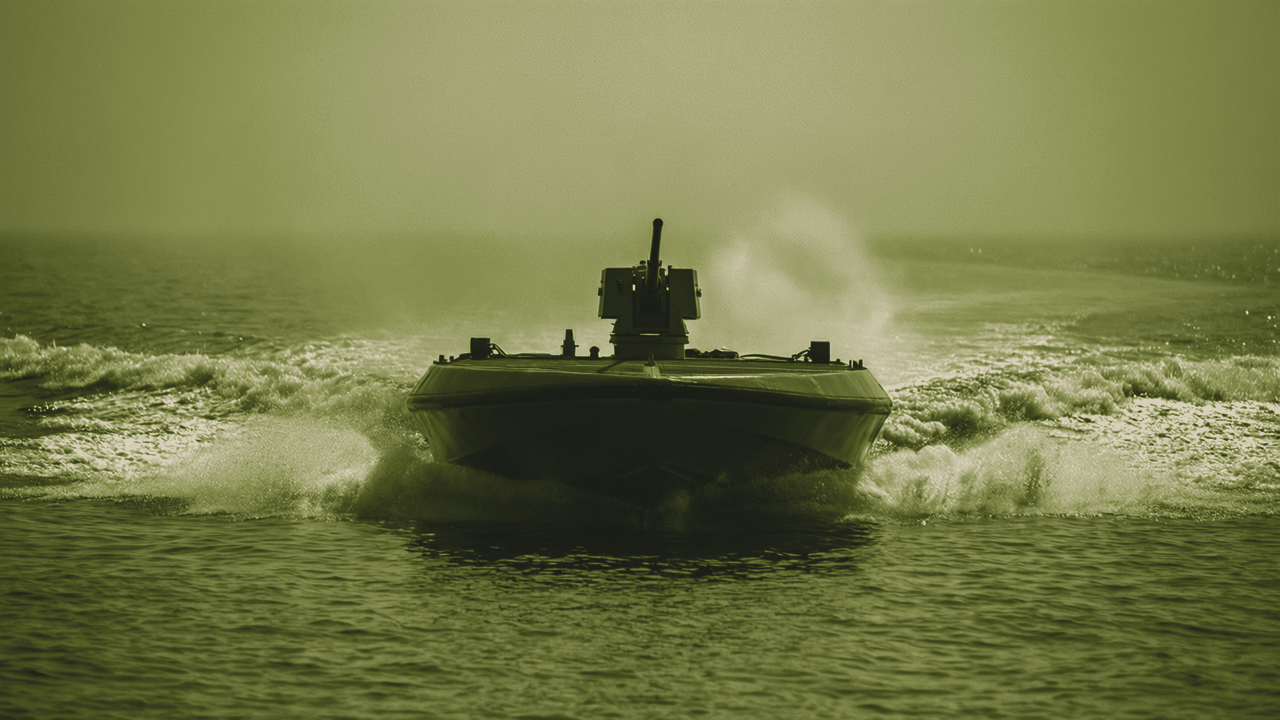
Ukraine’s gun-armed drone boat exposed a new Black Sea requirement: reusable unmanned interceptors that can defend ships and ports, then return for another engagement.
A drone boat that comes home after firing its gun changes what the category is for, and Ukraine’s Navy said on 12 September that its Sargan-3000 had destroyed a Russian unmanned craft in the Black Sea. In a 16 September assessment, Hudson Institute analyst Can Kasapoglu placed the initial engagement at roughly 1,000 yards. He found that the operator concentrated fire on the target’s communications antennas, apparently seeking to sever its command link, then closed and destroyed it at short range. H I Sutton identified the target as an improved Orcan type, called Zefir or Zephyr in some Russian sources. The lost boat matters less than the architecture: an intelligence cue, a reusable armed interceptor and remote precision fire turned a one-way strike corridor into contested surface combat.
The 81-second video
The Ukrainian Navy claimed on Telegram that HUR, also known as GUR, detected the Russian craft before a Sargan-3000 carrying a Protector 12.7 mm remote weapon station destroyed it. The service called the encounter “the first naval battle in history between unmanned boats.” The War Zone described the released 81-second video as opening with the Sargan’s onboard camera acquiring and engaging the target, followed by a closer view of the Protector firing. At about 30 seconds, the video switches to an aerial feed. Pieces break from the Russian craft under continued fire before it sinks stern first.
The evidence supports a narrower conclusion than the Navy’s historical claim. The War Zone could not independently verify the engagement and observed that the Russian boat did not appear armed, making this “a sea drone hunting down and destroying another that couldn’t fight back.” Defence Matters added that Ukraine disclosed neither the engagement distance nor the ammunition expenditure, communications arrangements or personnel involved. It also stressed that 12 September is the announcement date, not an established date or location for the encounter. One interception proves one engagement, not an interception rate. Russia has not confirmed the loss.
Frequently Asked Questions
What happened in the Black Sea on 12 September 2026?
Ukraine's Navy said on Telegram that HUR military intelligence detected a Russian uncrewed surface vessel and that a Sargan-3000 carrying a Protector 12.7 mm remote weapon station destroyed it, calling the encounter the first naval battle in history between unmanned boats. Hudson Institute analyst Can Kasapoglu put the initial engagement at roughly 1,000 yards.
Has the claim of a historical first been verified?
No. The War Zone could not independently verify the engagement and noted the Russian boat did not appear to be armed. Defence Matters pointed out that Ukraine disclosed neither the engagement distance nor the ammunition expended, and that 12 September is the announcement date rather than an established date or location. Russia has not confirmed the loss.
What is the Sargan-3000?
A Ukrainian uncrewed surface vessel, also called SeaWolf and built by Nordex, which entered Ukrainian Navy service in April 2026. The Russian outlet AmalNews lists it at 6.9 meters long, 2.2 meters wide, with a 450-kilogram payload, an operational radius of up to 1,600 kilometers and a speed of 40 to 55 knots. Hudson puts its range at up to 860 nautical miles.
Why did the operator fire at the antennas first?
Kasapoglu found the operator concentrated fire on the target's communications antennas, apparently to sever its command link, then closed and destroyed it at short range. H I Sutton has reported that Russian surface drones work with Geran-type aerial drones that provide oversight and act as radio repeaters extending the boats' mesh communications, which makes the link a target alongside the hull.
Does this mean an autonomous weapon chose its target?
Not on the available evidence. Defence Matters cautioned that an empty boat and a remotely operated turret do not show that software selected the target or authorized the shot, and Ukraine's announcement does not establish such a sequence.
Is Russia building a comparable capability?
It is testing one. Ushkuynik Research and Production Center CEO Alexey Chadayev told TASS on 15 September that the organization had completed large-scale tests in which interceptors launched from an unmanned surface vessel escorting a ship shot down target drones, with detection equipment on the escorted vessel and the interception systems on the escort USV. He said deployment depended on time and the readiness of Russian services.
AI-generated summary, reviewed by an editor. More on our AI guidelines.
Below this point
- Nordex’s 6.9-meter SeaWolf
- Russia’s Orcan fleet
- Kongsberg’s EUR 140 million line
- Two escort concepts
- What to watch

Marcus Schuler
Marcus Schuler edits BattlePolicy, a daily defense-technology brief connecting the companies and capabilities behind modern war to the contest among Europe, the US, Russia, and China.