Y-20
China's first indigenous strategic airlifter — a four-engine heavy transport known as the Kunpeng that bridges the PLA's force-projection gap, and the basis for a fast-growing aerial tanker fleet that extends Chinese airpower far beyond the first island chain.
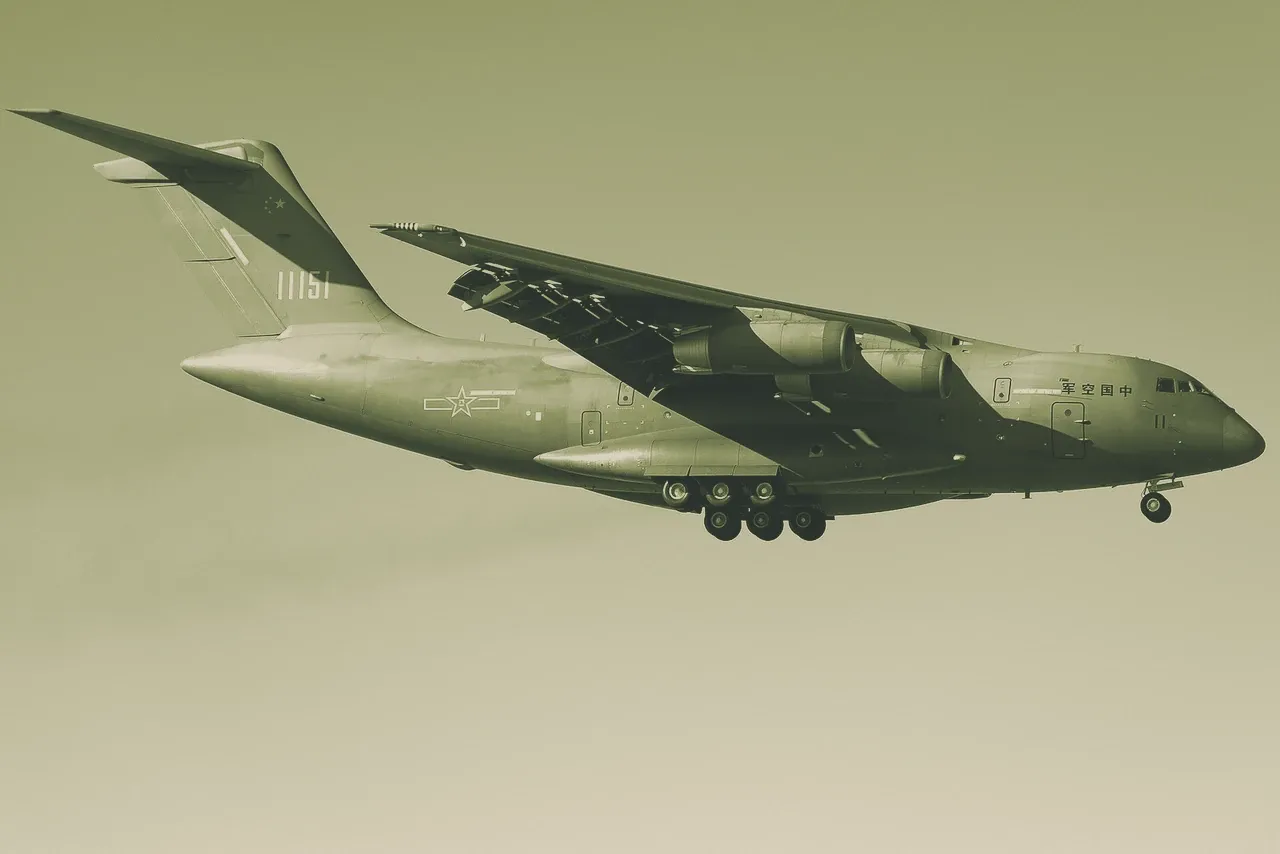
China's first indigenous strategic airlifter — a four-engine heavy transport that closed the PLA's power-projection gap, and the platform for the YY-20 aerial tanker that now stretches Chinese combat radius far beyond the first island chain.
Overview
The Xi’an Y-20, named Kunpeng after the mythical bird that transforms from a fish into an immense winged creature, is a strategic four-engine turbofan transport aircraft developed for the People’s Liberation Army Air Force (PLAAF). It is the first heavy airlifter designed and manufactured entirely in China, delivering a payload capacity broadly comparable to the Russian Il-76 and approaching that of the American C-17 Globemaster III. Beyond its primary airlift role, the type has rapidly spawned a dedicated aerial tanker variant — the YY-20 — that has dramatically increased the reach of the PLAAF’s combat aircraft, including its H-6N strategic bombers and new-generation fighters.
Development
The Y-20 program was launched in the late 2000s as part of China’s push to achieve strategic self-sufficiency in military airlift, a domain that had long relied on a small fleet of imported Il-76s. Xi’an Aircraft Industrial Corporation (XAC), an AVIC subsidiary, led the design and production effort, with the airframe drawing on both domestic aerodynamic expertise and technical inputs from the Antonov Design Bureau, which had previously collaborated on China’s earlier transport projects. The Y-20 first flew on 26 January 2013 and was accepted into PLAAF service in 2016, according to Wikipedia. Initial production aircraft used Russian-supplied D-30KP-2 turbofans or their Chinese clone, the WS-18, which left the fleet partly dependent on foreign engine supply. To eliminate this bottleneck, AVIC developed the Shenyang WS-20, a large high-bypass turbofan designed specifically for the Y-20. The engine-upgraded Y-20B entered PLAAF service and made its public debut on 3 September 2025, as reported by the Global Times, marking the aircraft’s full propulsion independence.
Design & capabilities
The Y-20 is a high-wing, T-tail monoplane designed to operate from semi-prepared runways and to carry outsized military cargo, including main battle tanks, helicopters and large vehicles. The fuselage is wide, giving the aircraft a distinctive “chubby” appearance that has earned it the informal nickname “Chubby Girl,” as noted by The National Interest. The airframe is built around a rear-loading ramp and a capacious cargo hold suited for paradrop, aerial delivery and rapid roll-on/roll-off loading. While exact performance parameters remain officially classified, open-source analysis suggests a maximum payload of approximately 66,000 kg, a maximum take-off weight of roughly 200,000 kg and a ferry range of about 7,800 km, with payload-range figures that closely mirror those of the Il-76MD-90A. The aircraft is flown by a crew of three and is equipped with modern glass cockpits, fly-by-wire controls and a defensive aids suite whose full composition has not been publicly disclosed.
The most operationally significant derivative is the YY-20 (sometimes designated YY-20A), China’s first large-scale indigenous aerial tanker. Employing a probe-and-drogue system, the YY-20 can refuel multiple fighter-sized receivers simultaneously and, critically, can also refuel heavy bombers such as the H-6N and the carrier-borne KJ-500 early-warning aircraft. Aviation Week has described the YY-20 as a transformational asset that, for the first time, gives the PLAAF the ability to sustain combat air patrols and long-range strike missions deep into the Western Pacific and over the Taiwan Strait.
Variants
- Y-20A: original production version with D-30KP-2 or WS-18 engines, in service since 2016.
- Y-20B: re-engined variant with four WS-20 high-bypass turbofans, providing improved take-off performance and range; confirmed operational in 2025.
- YY-20/YY-20A: dedicated aerial tanker variant with hose-drogue refuelling pods; in increasingly active service, with roughly 50 tanker airframes estimated by 2025.
- Special-mission platforms: a growing range of airborne early warning, electronic intelligence and command-and-control variants are under development, though few technical details have been released.
Combat record / operational use
The Y-20 has not yet been used in combat, but it has already become a central instrument of Chinese military and diplomatic power projection. It has conducted multiple non-combatant evacuation operations overseas, including the repatriation of Chinese citizens from conflict zones, and has been heavily employed for humanitarian relief missions across Asia and the Pacific. The YY-20 tanker variant, first seen in PLAAF service from around 2022, is now the backbone of a rapidly expanding aerial refuelling capability. Open-source imagery and reporting, such as that by Bulgarian Military, have documented YY-20s refuelling PLAAF combat aircraft including the H-6N strategic bomber, the J-20 stealth fighter and the KJ-500A early-warning aircraft. This tanker fleet extends the combat radius of H-6N cruise-missile carriers and the new J-35 carrier-based fighter to distances that allow China to threaten air and sea targets across the South China Sea and the western Pacific, a capability that analysts at List25 highlight as critical for operations near Taiwan.
Advantages
- First fully indigenous strategic airlifter, delivering propulsion independence with the WS-20 engine.
- Payload of roughly 66,000 kg closes the PLAAF’s heavy-lift gap and enables rapid deployment of mechanised forces.
- The YY-20 tanker variant breaks China’s previous dependence on a handful of Soviet-era Il-78 airframes, providing a scalable modern tanker fleet.
- Modular airframe design supports an expanding family of special-mission aircraft.
- Rugged design allows operation from unpaved and austere airstrips.
Drawbacks / limitations
- Cruise speed is limited to roughly Mach 0.75, making it slower than the C-17 and vulnerable in contested airspace.
- Production cost and exact fleet numbers are not publicly disclosed, but the output rate remains well below that of the C-17 programme at its peak.
- The YY-20’s probe-and-drogue system is incompatible with the flying boom used by US and allied receivers, limiting refuelling to Chinese-standard probes.
- The full potential of the WS-20 engine is not yet independently verified, and early examples relied on Russian powerplants.
- Detailed defensive aids and self-protection measures remain opaque, leaving open questions about survivability against modern surface-to-air missile threats.
Counterparts
- C-17 Globemaster III (USA)
- Il-76 (Russia)
Outlook
The Y-20 is now the backbone of the PLAAF’s strategic and theatre airlift capability, with fleet size estimated at roughly 80-plus aircraft and production ongoing. The confirmed entry into service of the WS-20-powered Y-20B removes the last major foreign dependency, while the YY-20 tanker fleet is expected to grow substantially, eventually numbering in the high tens of airframes and replacing all legacy Il-78 tankers. Multiple additional special-mission variants, including an all-new airborne early warning platform, are likely to appear as the airframe matures. The Y-20 thus straddles the same role accomplished by the C-17 in the US — airlift, airdrop and tanker — but with the added long-term ambition of becoming a universal full-spectrum airbase in the sky for a Chinese air force that is increasingly oriented toward power projection across the Asia-Pacific.
Key specifications
| Spec | Value |
|---|---|
| Crew | 3 (est.) |
| Length / wingspan | ~47 m / ~50 m |
| Max speed | ~Mach 0.75 (~918 km/h) |
| Service ceiling | 13,000 m (42,650 ft) |
| Combat radius / range | 4,000–7,500 km (payload-dependent); ~7,800 km ferry (est.) |
| Payload | ~66,000 kg (est.) |
| Hardpoints | None |
| Radar / sensors | Weather radar, navigation suite, RWR/defensive aids (details not publicly established) |
| Powerplant | 4 × turbofan: early D-30KP-2/WS-18; Y-20B with 4 × Shenyang WS-20 high-bypass turbofans |
| Armament | None |
Sources
- Wikipedia – Xi’an Y-20. https://en.wikipedia.org/wiki/Xi'an_Y-20
- The National Interest – Xi'an Y-20: Meet China's "Chubby Girl" Cargo Plane. https://nationalinterest.org/blog/buzz/xian-y-20-meet-chinas-chubby-girl-cargo-plane-bw-080725
- Aviation Week – Y-20 Revolutionizes China's Airlifter And Tanker Capacity. https://aviationweek.com/defense/aircraft-propulsion/y-20-revolutionizes-chinas-airlifter-tanker-capacity
- Global Times – China's engine-upgraded Y-20B transport, new special mission aircraft make debut. https://www.globaltimes.cn/page/202509/1342526.shtml
- Bulgarian Military – YY-20A aircraft spotted—China's 50-tanker PLAAF mystery grows. https://bulgarianmilitary.com/2025/02/21/yy-20a-aircraft-spotted-chinas-50-tanker-plaaf-mystery-grows/
- List25 – China Y-20 Tanker Extends PLA Airpower Near Taiwan. https://list25.com/china-y20-tanker-pla-airpower-taiwan/