Zelensky Orders 1,000 Drones a Day as Russian Refining Hits a 20-Year Low
Ukraine's refinery campaign is converting drone volume into lost Russian fuel, exports and revenue. Moscow's warehouse strikes on Kyiv impose severe civilian costs, but the confirmed damage has yet to expose a comparable economic bottleneck.
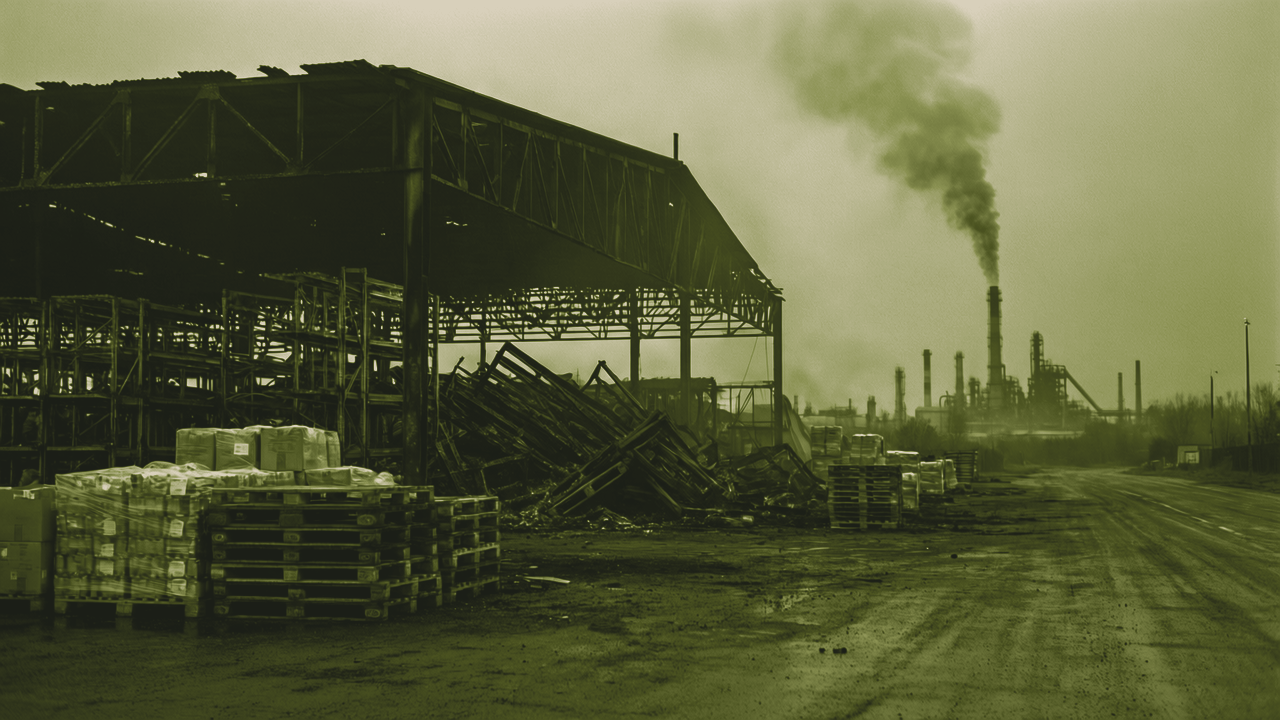
Ukraine's refinery campaign is converting drone volume into lost Russian fuel, exports and revenue. Moscow's warehouse strikes on Kyiv impose severe civilian costs, but the confirmed damage has yet to expose a comparable economic bottleneck.
1,000 Drones a Day
On Aug. 28, President Volodymyr Zelensky ordered Ukraine's defense industry to support 1,000 long-range drone strikes a day, up from an average of more than 300. He called them "long-range sanctions" after a meeting of the Staff of the Supreme Commander-in-Chief, Meduza reported, and set two linked tasks: accelerate interceptors against Russia's jet-powered Shaheds and make Ukrainian strikes inside Russia more frequent.
The order landed beside a measure of what 300-plus drones can already do. EA Analytics estimates Russia refined about 3.8 million barrels a day in August, its lowest level in more than 20 years, compared with a normal summer rate of 5.3 million to 5.5 million. Bloomberg counted at least 21 Ukrainian strikes on Russian refineries during the month, more than in any other month since the full-scale invasion, with four of the country's 10 largest plants attacked.
Both countries now direct massed drones against the other's economy. The exchange is asymmetric. Ukraine is disabling fixed industrial capital that converts crude into fuel and export earnings. Russia is burning warehouses, postal depots, grain infrastructure and retail distribution around Kyiv. Those strikes disrupt daily life and consume scarce interceptors, but their confirmed effects have not matched the leverage created by Russia's refinery outages.
Frequently Asked Questions
What exactly did Zelensky order on Aug. 28?
A production target of 1,000 long-range drones a day for what he calls "long-range sanctions" against Russia, up from an average of more than 300, set at a meeting of the Staff of the Supreme Commander-in-Chief, per Meduza and RBC-Ukraine.
How far has Russian refining fallen?
EA Analytics, cited by Bloomberg, estimates about 3.8 million barrels a day in August, the lowest in more than 20 years, against a normal summer rate of 5.3 to 5.5 million. July ran at 3.6 million, the lowest since May 2002, per Reuters.
Which Russian refineries are offline?
Perm suspended operations after an Aug. 21 strike that Dnipro OSINT assessed removed about 86% of its primary capacity; Lukoil's Kstovo plant halted after Aug. 26, per RBC-Ukraine; Orsk fully shut, per the Guardian.
What did Russia hit around Kyiv on Aug. 27 and 28?
Kyiv regional chief Tymur Tkachenko counted 14 warehouses, 16 houses and three apartment buildings damaged on Aug. 28; Nova Poshta said two sorting centers were destroyed; AP and Forbes Ukraine named retail distribution centers for toys, confectionery, electronics and groceries.
Why is the exchange described as asymmetric?
Ukraine's strikes remove fixed refining capacity that converts into lost exports, fuel imports and export bans. Russia's warehouse strikes disrupt consumer logistics and drain interceptors, but the confirmed damage has not exposed an equivalent strategic bottleneck.
What is holding back the 1,000-a-day target?
Financing, according to Zelensky: on Aug. 24 he said Ukraine could triple output for 140 million euros, against 340 million euros he says Russia spends, but lacks the budget, per the Kyiv Independent.
AI-generated summary, reviewed by an editor. More on our AI guidelines.
Below this point
- 3.8 Million Barrels
- Wildberries, Ozon and the Decree
- 872 Minutes Over Kyiv
- Perm and Kyiv's Warehouses
- The 140 Million Euro Constraint
- September's Print
3.8 Million Barrels
Ukraine's refinery campaign now compounds damage across production, domestic supply and exports. Russia processed 3.6 million barrels a day in July, the lowest rate since May 2002. A Bloomberg source put the first three weeks of August more starkly: gasoline production and domestic supply fell almost 20% from the same period in 2025, while diesel output dropped more than 23%.
The individual plants explain why. The Dnipro OSINT project assessed from satellite imagery that the Aug. 21 strike on Lukoil-Permnefteorgsintez knocked out about 86% of its primary refining capacity, or 11.3 million metric tons a year. The refinery, Russia's seventh-largest, has a design capacity of about 13 million tons. The imagery showed critical damage to the distillation columns of a 4.53-million-ton unit and repair cranes at two others. Operations were suspended.
Lukoil's Nizhny Novgorod refinery at Kstovo fully halted crude processing after the Aug. 26 strike, RBC-Ukraine wrote. The plant is Russia's fourth-largest, can process about 15 million tons a year and ranks as its second-largest gasoline producer. Orsk also fully shut, and at least six Russian regions reinstated or tightened gasoline sales restrictions.
Moscow is now importing fuel and blocking its export. The Guardian found that Russia bought 200,000 barrels of Turkish gasoline, shipped from Mersin to Primorsk aboard the sanctioned tanker Wendrix, the fifth seaborne fuel delivery this summer, bringing the total to 1 million barrels including Indian fuel routed through Egypt. Russia also arranged for Kazakhstan's Kondensat refinery to process Russian crude delivered by rail and send 70% of the fuel back. Imports from Belarus in June rose 141-fold from a year earlier.
Three industry sources told Reuters that Russia planned to extend its diesel export ban through September. Gasoline exports are already prohibited through Jan. 31 and jet fuel exports through November. Deputy Prime Minister Alexander Novak nevertheless insisted there was "no diesel fuel shortage on the domestic market." Before the strikes, Russia supplied about 10% of the world's diesel. That output now has to stay home.
Idle refineries have not simply freed crude for export. Bloomberg's tanker data showed seaborne flows falling to 3.46 million barrels a day in the four weeks through Aug. 23 as drone strikes on tankers cut Black Sea loadings. Russia is processing less crude, selling fewer refined products abroad and failing to export the surplus feedstock. Each channel cuts revenue.
Wildberries, Ozon and the Decree
Ukraine's second economic target set is Russian retail logistics. Since mid-July, more than 20 Wildberries distribution centers across 16 regions have been attacked, per Kyiv Post. At least seven of its 10 largest warehouses were knocked out, including the Koledino hub, which covers more than 200,000 square meters. Reuters calculated that 1.18 million square meters had been damaged or destroyed, more than one-fifth of the company's capacity. Wildberries accounts for about 10% of Russian retail sales.
Data Insight estimated Wildberries' destroyed inventory at 147 billion to 223 billion rubles, or $1.8 billion to $2.8 billion, with sellers losing another 445 billion to 507 billion rubles. Total losses could reach 800 billion rubles, about $10 billion. Attacks expanded to Ozon from Aug. 22, reaching Chapayevsk, Orenburg, Ufa and Dagestan. CNBC recorded an almost 30% fall in Ozon shares on the Moscow Exchange after six facilities were targeted within three days.
Ukraine's Center for Strategic Communications claims Wildberries also served as a gray-import route for FPV components, fiber-optic spools and tactical radios, and once carried an "Everything for the SMO" tag covering more than 200,000 items. Wildberries denies supplying Russia's armed forces and says weapons and military equipment are prohibited on its marketplace. The military linkage remains contested. The economic damage does not.
Putin's response exposes the defensive burden. His decree allows the state to seize commercially owned critical infrastructure when owners fail to protect it or repair strike damage quickly enough. Since May, Russian companies have been permitted to buy anti-aircraft guns, radar, specialized vehicles and electronic-warfare systems. Expert estimates Russia's civilian anti-drone market could reach 200 billion rubles in 2026. The War Zone assessed that military air-defense shortages leave too little equipment to cover the widening target set, which pushes protection costs onto plant and warehouse owners.
872 Minutes Over Kyiv
Russia's answer seeks economic paralysis through time as well as destruction. Ukraine's Foreign Ministry counted 13 air-raid alerts in Kyiv on Aug. 27, surpassing the previous record of 12 on March 1, 2022, according to the Kyiv Independent. The alerts lasted 872 minutes, nearly 15 hours. Eight more followed by the morning of Aug. 28. The ministry described "repeated drone launches keeping a city of millions under threat throughout the day."
Ukraine's Air Force said Russia launched 164 Shahed-type drones overnight on Aug. 28, half of them jet-powered; defenders downed 137, and strikes occurred at 16 locations. From 7 a.m., about 140 more followed, more than 100 of them jet-powered. Andrii Kovalenko of Ukraine's Center for Countering Disinformation said small groups of fast drones were arriving in waves to paralyze the capital.
The confirmed targets were heavily commercial. Companies identified distribution centers belonging to a toy chain, a confectionery producer and an electronics retailer. Forbes Ukraine named facilities used by Fora, Budynok Igrashek and Comfy. Nova Poshta said sorting centers near Kyiv and in Sumy were destroyed; the Kyiv-region site was struck twice more while firefighters worked. A book warehouse that shipped thousands of titles a day burned, and Zaporizhzhia Governor Ivan Fedorov said a drone struck an Epicenter hypermarket.
Kyiv regional chief Tymur Tkachenko counted 14 warehouses, 16 houses and three apartment buildings damaged on Aug. 28. Odesa Governor Oleh Kiper said another barrage damaged a grain elevator, and Ukrzaliznytsia recorded train delays exceeding 17 hours. Farm Minister Taras Vysotskyi said "roughly 90% of food logistics operated by retail chains have been destroyed," though he added that Ukrainians would not run out of food. Some Kyiv stores have occasionally lacked fruit, sugar and dairy.
Russia's Defense Ministry claimed its attacks struck military industry, refineries, logistics hubs and ports. It also alleged that one Kyiv-region warehouse held Flamingo cruise missiles and rocket-booster fuel. Ukrainian officials did not confirm that, and the Associated Press could not verify it. The verified warehouse list points to consumer logistics.
Perm and Kyiv's Warehouses
The economic exchange turns on the type of asset destroyed. Perm's distillation columns cannot be rerouted like parcels. Their loss removes annual processing capacity, forces imports, restricts exports and strands crude. Repeated strikes can also catch repairs in progress and hold a refinery below normal throughput.
Russia's warehouse campaign destroys inventory, interrupts food distribution and weakens the tax base. Yet warehouses are distributed assets, shipments move among surviving depots, and Ukraine's military supply keeps an external channel through allied assistance. Nothing confirmed in the Kyiv campaign matches losing 11.3 million tons of annual refining capacity at one plant.
The cost to Ukraine is still substantial. Fifteen-hour alert cycles suppress work and transport without requiring every drone to strike. They also drain interceptor stocks. Ukraine is short of Patriot missiles, and Zelensky said the country ran out of interceptors during one major attack on Kyiv earlier in August. Russia extracts economic damage even from drones that defenders destroy.
The 140 Million Euro Constraint
Zelensky's 1,000-a-day order assumes Ukraine already has the designs, ranges and factory capacity. On Aug. 24, he said Ukraine could produce about 200 to 300 long-range drones daily, alongside missiles and missile-drones reaching from roughly 350 to 3,000 kilometers. Four days later, he put the strike average above 300. The constraint, he said, is financing.
Zelensky claimed Ukraine could triple output for 140 million euros, against 340 million euros spent by Russia. Those are his figures, and no production contract or disbursement yet establishes the expansion. The order shifts the immediate decision to Kyiv's partners: factories can make more, but someone must fund the run rate.
The Coalition of the Willing called air defense an "urgent priority" on Aug. 24 and pledged deeper cooperation with Ukraine's defense industry, and Finnish President Alexander Stubb called deep strikes "a sensible military strategy" because they raise Russia's cost. Zelensky's July line to the Financial Times, "not one hundred but one thousand" drones toward Moscow, has become an industrial target.
Ukraine's bet is that accuracy is already adequate and daily volume will decide how often Russian plants are struck, repaired and struck again. Russia made the same wager this summer against Ukrainian air defense. Kyiv is applying it to refining capacity.
September's Print
The next evidence arrives in policy decisions and throughput. The diesel-ban extension that Reuters' sources described has yet to be announced. EA Analytics expects refining to recover slightly to about 4.2 million barrels a day in September if strikes slow, still well below the normal summer range.
Also watch whether allies fund the 140 million euro expansion, whether strikes on Wildberries and Ozon hold their cadence, and whether Russia's daytime jet-drone waves outlast two days. September refining will measure whether Zelensky's production order can deny Putin the assumption, as retired Australian general Mick Ryan put it in June, that time remains on Russia's side.

Marcus Schuler
Marcus Schuler edits BattlePolicy, a daily defense-technology brief connecting the companies and capabilities behind modern war to the contest among Europe, the US, Russia, and China.