GRID-REF 37°47′N 122°25′W
DISPATCH 02/26 · 12 Jun 2026
BATTLEPOLICY
Startup to front line. Strategy to consequence.
Lexicon · Europe

AASM Hammer

A modular French rocket-boosted precision glide-bomb kit that transforms standard bombs into jam-resistant stand-off weapons, proving critical in Ukraine where it retains accuracy under Russian GPS denial.
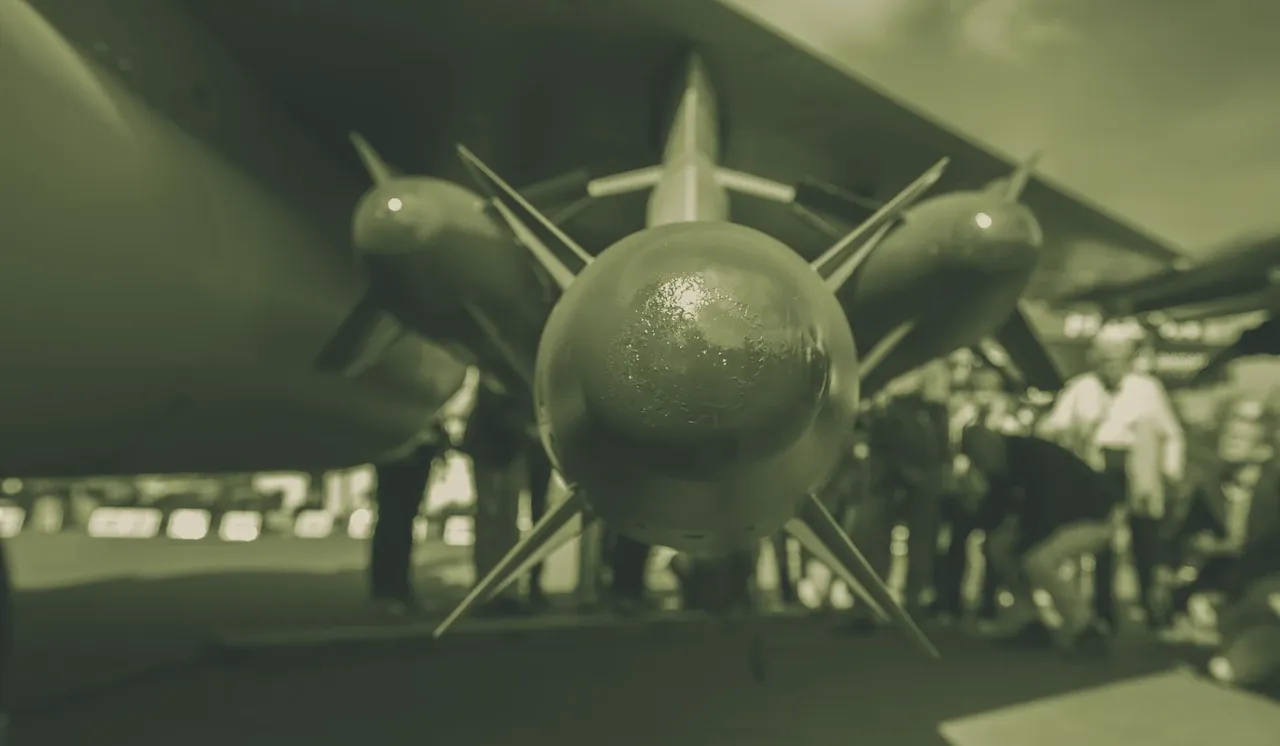
AASM Hammer
FIG.01 · Europe Image - AASM Hammer modular air-to-ground munition. Photo by Falcon® Photography from France, France, CC BY-SA 2.0, via Wikimedia Commons.jpg).
A modular French rocket-boosted precision glide-bomb kit that transforms 125–1,000 kg standard bombs into all-weather, jam-resistant stand-off weapons, operational since 2008 and a linchpin of Ukraine's air-to-surface strike capability against Russian GPS denial.

Overview

The AASM (Armement Air-Sol Modulaire), marketed as the Hammer (Highly Agile Modular Munition Extended Range), is a family of bolt-on guidance and range-extension kits manufactured by France's Safran Electronics & Defense. Fitted to existing general-purpose bomb bodies ranging from 125 kg to 1,000 kg, the kit combines rear-mounted folding fins and a solid-propellant rocket booster with a nose-mounted guidance section, producing a "rocket-bomb hybrid" capable of all-weather precision attack from stand-off distances and low-altitude release profiles. The weapon has been combat-proven in French service since 2008 and has become a signature Western munition in the Russo-Ukrainian War, where its resistance to GNSS jamming sets it apart from unboosted allied glide bombs.

Development

The French defence procurement agency (DGA) launched the AASM program in 1997, seeking a modular stand-off precision weapon that could be released from low altitude while the launch aircraft remained masked from ground-based air defenses. SAGEM (later absorbed into Safran) won the contract in 2000, and flight validation trials ran from December 2004 to July 2005, according to Wikipedia. The weapon officially entered French Air and Space Force service on the Rafale in 2007. A second production tranche, bringing the total order to 2,348 kits at a program cost of approximately €846 million, was authorized in 2009.

The original INS/GPS variant was followed by an imaging-infrared (IIR) version qualified in July 2008 and a semi-active laser (SALH) version qualified in April 2013, as detailed by Army Recognition. The 1,000 kg bomb-body variant completed qualification for the Rafale F4 standard in early 2023. To reduce unit cost, Safran developed the AASM Evolution (Block IV), targeting a per-kit price around €80,000, per a 2017 report by Wikipedia. The 2022 Russian invasion of Ukraine reversed a sleepy production tempo; output was quadrupled from pre-war levels, and at the June 2025 Paris Air Show, Safran unveiled the Hammer XLR family, an extended-range variant with apparent air intakes suggestive of a turbojet or solid-fuel ramjet, aiming for a range envelope of 150–200 km, though official specifications remain unpublished, according to Defence Express.

Design & capabilities

The AASM Hammer is not a unitary weapon but a modular kit family that integrates three primary guidance modes with a common range-extension tail section across four bomb-body weight classes (125, 250, 500, and 1,000 kg). The rear section houses a solid-propellant rocket booster and folding wings that deploy after release, propelling the weapon to a stand-off range of over 70 km from a high-altitude release, or approximately 15 km from a low-altitude launch, extendable to 40 km with a toss maneuver, according to Defence Express. The guidance section offers three fits: a baseline hybrid INS/GPS with decametric accuracy (~10 m CEP), an INS/GPS + imaging-infrared variant achieving metric accuracy (~1 m CEP) through terminal scene-matching, and an INS/GPS + semi-active laser seeker optimized for moving targets.

A defining feature, repeatedly stressed by Safran and validated in Ukraine, is the weapon's resilience to GNSS denial. The INS/GPS hybrid navigation system provides "excellent precision" even under the sophisticated GPS jamming that has degraded the effectiveness of other guided munitions, a quality the Safran CEO termed "absolutely critical in Ukraine" and the primary reason France pushed the weapon to Kyiv, as reported by Euromaidan Press. The weapon also supports a 90° off-axis launch capability, allowing the launch aircraft to engage targets not directly in its flight path, and permits up to six weapons to be released in a single pass against separate targets, per Safran.

Variants

  • AASM-125 / -250 / -500 / -1000: kits sized for 125 kg, 250 kg (Mk 82 class), 500 kg, and 1,000 kg bomb bodies. The 250 kg configuration is the most combat-proven; the 1,000 kg class qualified in 2023 [AASM-1].
  • INS/GPS (SBU-38): baseline hybrid inertial/GPS guidance with ~10 m CEP [AASM-1].
  • INS/GPS + IIR (SBU-64): adds imaging-infrared scene-matching for ~1 m CEP terminal accuracy [AASM-8].
  • INS/GPS + SALH (SBU-54): semi-active laser seeker for engaging mobile targets, qualified 2013 [AASM-1].
  • AASM Evolution (Block IV): cost-reduced production version targeting a lower per-unit price [AASM-1].
  • Hammer 250 XLR / 1000 XLR: extended-range concept unveiled at the 2025 Paris Air Show with a stated ambition of 150–200 km range, featuring apparent air intakes for an air-breathing propulsion system [AASM-4].

Combat record / operational use

The AASM made its combat debut on 20 April 2008, when a French Rafale struck a Taliban position in Afghanistan. During the 2011 NATO intervention in Libya, French forces expended 225 Hammers, including a notable strike that destroyed a Libyan G-2 Galeb light attack jet on the runway at Misrata and a tank kill at a range of 55 km, demonstrating the potency of the rocket-boosted profile, as documented by Defence Express. The weapon was subsequently employed in Mali and Operation Chammal against ISIS. In May 2025, Indian Rafales fired Hammers during Operation Sindoor strikes on targets in Pakistan, marking the weapon's first combat use by the Indian Air Force.

Ukraine represents the weapon's largest and most intensive operational deployment. French President Emmanuel Macron announced the provision of "several hundred" Hammers at a rate of 50 per month in January 2024, with the first Ukrainian combat employment occurring on 5 March 2024 from Soviet-era jets. By the end of 2024, approximately 600 kits had been delivered, a figure confirmed by the French National Assembly defense committee, according to The War Zone. Through 2025, the AASM became a "weapon of choice" for the Ukrainian Air Force because it continued to hit targets despite the pervasive Russian GPS jamming that had blunted the effectiveness of other guided munitions like JDAM, as reported by The Kyiv Independent. Safran adapted the kit for Ukraine's MiG-29, Su-27, Su-25, and Su-24 fleets in under four months during autumn 2023. On 27 February 2026, the first publicly released footage showed a Ukrainian Mirage 2000-5F releasing two AASM Hammers over the front line, expanding the donor jet from its initial air-defense role into air-to-surface strike, per UNITED24 Media. Ukrainian pilots typically employ the weapon from low altitude, using toss-bombing maneuvers to maximize stand-off range while remaining below the radar horizon of Russian medium-range SAMs.

Advantages

  • Proven resistance to GNSS jamming and spoofing, retaining accuracy in the dense electronic warfare environment over Ukraine, a critical discriminator compared to unboosted allied glide bombs.
  • The rocket booster provides genuine stand-off range (>70 km from altitude) and uniquely enables low-altitude release and toss-bombing profiles that mask the launch aircraft, fitting Ukrainian survival tactics.
  • True modularity across guidance types (INS/GPS, IIR, SALH) and bomb bodies (125–1,000 kg) allows a single weapon family to cover a wide target set, from fixed structures to moving armor.
  • Fire-and-forget operation reduces launch aircraft exposure time, and a 90° off-axis capability allows engagement of parallel or rear-quarter targets.
  • Rapid integration has been demonstrated repeatedly: the weapon was adapted to Ukraine's Soviet-era fleet in under four months and later integrated onto the Ukrainian Mirage 2000-5F, a jet France had never itself cleared for the weapon.

Drawbacks / limitations

  • High unit cost (~€164,000 per kit on a FY2011 basis, historically over an order of magnitude more than a JDAM kit) limits the affordable mass against the Russian glide-bomb model, which prioritizes volume over precision.
  • Practical release ranges from the low-altitude profiles dictated by the Ukrainian threat environment are typically 15–40 km, far below the brochure maximum of 70 km, and can still place the launch aircraft inside the engagement zones of Russian medium-range SAMs.
  • Delivery volumes to Ukraine, at 50 per month through 2024 and scaling to an approximate annual output of ~1,080 kits in 2025, are an order of magnitude below Russian UMPK glide-bomb expenditure rates, as noted by The Defense News.
  • The baseline INS/GPS version's 10 m CEP, while jam-resistant, is insufficient for precision-point aimpoints; metric accuracy requires the more expensive IIR or SALH terminal seekers.
  • Extended-range XLR variants remain development-stage concepts with no published official specifications, their claimed 150–200 km performance as yet unverified.

Counterparts

  • FAB UMPK (Russia) — a high-volume, lower-precision glide-bomb kit fitted to unguided bombs, representing the approach the AASM is meant to counter with precision.
  • Storm Shadow / SCALP-EG (UK/France) — a similarly jam-resistant, air-launched stand-off cruise missile occupying the tier above the AASM in its deep-strike role.

Outlook

The AASM Hammer's fortunes have been radically reshaped by the Ukraine war. From a proprietary but expensive French niche weapon with a modest production tempo, it has become a flagship Western munition in the most intense conventional air war in decades, its value anchored by its unique low-altitude launch profile and GNSS-denial resilience. The trajectory ahead is defined by three vectors: the industrial ramp toward a sustained output of over 1,000 kits annually, the development and fielding of the 150–200 km-class XLR to push launch aircraft definitively beyond the most threatening SAM engagement geometries, and the potential localization of production through the newly formalized Safran–BEL joint venture in India. France’s strategic bet is that precision-per-sortie can offset Russian mass, but the industrial challenge remains acute, with French stocks having been drawn down from aging inventory to sustain the Ukrainian supply line.

Key specifications

Spec Value
Type Modular precision guidance + range-extension kit (winglets + solid rocket booster) fitted to standard bomb bodies
Range >70 km from high-altitude release; ~15 km from low altitude (~40 km with toss maneuver)
Speed (Mach / km·s⁻¹) not publicly established
Warhead (type & weight) Host bomb body: 125, 250, 500, or 1,000 kg class (Ukraine standard: 242 kg Mk 82 HE); airburst option available
Guidance Hybrid INS/GPS (10 m CEP); INS/GPS + imaging-infrared (1 m CEP); INS/GPS + semi-active laser
Accuracy (CEP) ~10 m (INS/GPS); ~1 m (IIR/laser)
Launch platform(s) Rafale, Mirage 2000D, Mirage F1, F-16, HAL Tejas; in Ukraine: MiG-29, Su-27, Su-25, Su-24, Mirage 2000-5F
Propulsion Tail-mounted solid-propellant rocket booster with folding fins
Length / diameter / launch weight 250 kg version: length 3.1 m, diameter ~0.32 m, wingspan 0.78 m, launch weight ~340 kg

Sources

  1. Wikipedia — Armement Air-Sol Modulaire. https://en.wikipedia.org/wiki/Armement_Air-Sol_Modulaire
  2. Safran — AASM Hammer: Armement air-sol modulaire de haute précision. https://www.safran-group.com/fr/produits-services/aasm-hammertm-armement-air-sol-modulaire-haute-precision
  3. Defence Express — Capabilities and Specs of AASM Hammer, the Rocket-Bomb Hybrid Weapon That France Wants to Give Ukraine. https://en.defence-ua.com/weapon_and_tech/capabilities_and_specs_of_aasm_hammer_the_rocket_bomb_hybrid_weapon_that_france_wants_to_give_ukraine-9212.html
  4. Defence Express — Safran Unveils Latest-generation AASM Hammer XLR Glide Bombs with Dramatically Extended Range. https://en.defence-ua.com/weapon_and_tech/safran_unveils_latest_generation_aasm_hammer_xlr_glide_bombs_with_dramatically_extended_range_up_to_150200_km-14891.html
  5. The Kyiv Independent — France to ramp up AASM Hammer smart bomb production for Ukraine, media reports. https://kyivindependent.com/france-to-ramp-up-aasm-hammer-smart-bomb-production-for-ukraine-media-reports/
  6. Euromaidan Press — France boosts Hammer bomb output for Ukraine by nearly 40%. https://euromaidanpress.com/2025/05/05/france-boosts-hammer-bomb-output-for-ukraine-by-nearly-40/
  7. The War Zone — Ukraine Will Have Received 600 French Hammer Bombs By End Of Year. https://www.twz.com/air/ukraine-will-have-received-600-french-hammer-bombs-by-end-of-year
  8. Army Recognition — AASM Hammer. https://www.armyrecognition.com/military-products/army/missiles/bombs/aasm-hammer
  9. The Defense News — France Raises AASM Hammer Guided Bombs Production to 1,080 Units, Boosts Ukraine Supply. https://www.thedefensenews.com/news-details/France-Raises-AASM-Hammer-Guided-Bombs-Production-to-1080-Units-Boosts-Ukraine-Supply/
  10. UNITED24 Media — Ukraine's French-Supplied Mirage 2000 Bombs Russian Positions With AASM Hammer for the First Time. https://united24media.com/latest-news/ukraines-french-supplied-mirage-2000-bombs-russian-positions-with-aasm-hammer-for-the-first-time-video-16333
FIELD DISPATCH · WEEKLY

BattlePolicy Weekly — free.

Defense tech, startups, and security — weekly. No paywall.

Related
Europe · Ukraine · missiles · loitering-munition · one-way-attack · ai-guidance · vtol · STARK Defence · GermanyPro

Stark Virtus

Germany's combat-proven eVTOL loitering munition — a VTOL, AI-guided one-way attacker that pairs with reconnaissance drones for EW-resilient precision strikes.

Europe · Ukraine · missiles · loitering-munition · one-way-attack · ai-guidance · vtol · STARK Defence · Germany
Europe · Land · mlrs · rocket-artillery · hanwha · precision-strike · koreaPro

K239 Chunmoo

South Korea's wheeled multi-caliber multiple launch rocket system — firing guided rockets, tactical ballistic missiles, and unguided munitions from a single 8×8 chassis, now spreading across NATO's eastern flank.

Europe · Land · mlrs · rocket-artillery · hanwha · precision-strike · korea
Europe · Air Defense · shorad · counter-UAS · Rheinmetall · ahead · modular-turret · NATOPro

Skyranger 30

Rheinmetall’s modular, unmanned 30 mm gun-missile turret — NATO’s emerging standard for mobile short-range air defense against drones, loitering munitions and low-flying aircraft, rapidly adopted across five European armies.

Europe · Air Defense · shorad · counter-UAS · Rheinmetall · ahead · modular-turret · NATO