Agni-V
India's long-range deterrent — the Agni-V is a road-mobile, nuclear-capable ballistic missile that puts all of China within reach. In 2024 India test-fired a version carrying multiple independently-targeted warheads (MIRV), joining a small club of powers with that technology.
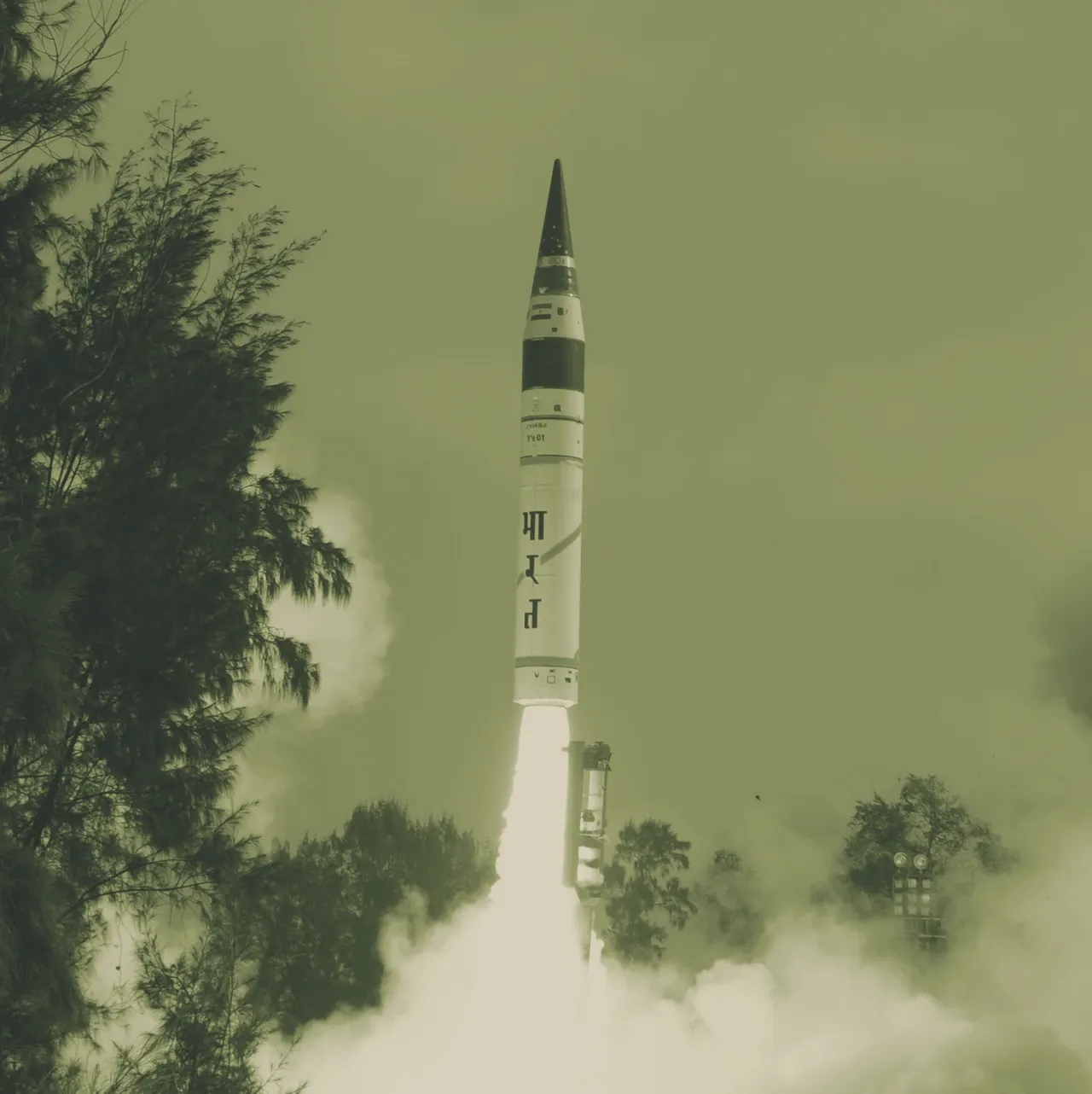

India's long-range deterrent — the Agni-V ("Fire") is a road-mobile, nuclear-capable ballistic missile that finally put all of China, and much of the world beyond, within India's reach. In 2024 India test-fired a version carrying multiple independently-targeted warheads (MIRV) — joining the small club of powers with that technology — and the canister-launched, mobile missile now forms the backbone of India's strategic deterrence, the longest arm of a nuclear force built around "credible minimum deterrence" and no-first-use.
Overview
The Agni-V is a nuclear-capable, long-range ballistic missile developed by India's Defence Research and Development Organisation (DRDO) for the Strategic Forces Command. Officially classed as an intermediate-range ballistic missile (IRBM) with a range "in excess of 5,000 km," it is widely assessed to be an intercontinental ballistic missile (ICBM) — analysts estimate its true range at 7,000–8,000 km, enough to cover all of China (including Beijing) and reach well beyond. It is a three-stage, solid-fuel missile carried in a sealed canister on a road-mobile launcher, giving it rapid, survivable, all-weather deployment. Its most significant recent advance is MIRV capability — the ability to carry several independently-targeted warheads on one missile — successfully tested in 2024 ("Mission Divyastra"). The Agni-V is the longest-ranged and most capable member of India's Agni family and the centrepiece of its strategic nuclear deterrent.
🔒 The full Agni-V file is for BattlePolicy Pro members. Below the line: development history, design and capabilities, variants, the combat record, advantages and limitations, comparable systems, outlook, the full specifications table, our sourcing, and the analyst assessment — procurement, suppliers and the BattlePolicy verdict. Unlock the full file with BattlePolicy Pro →
Below this point
- Development
- Design & capabilities
- Variants
- Combat record / operational use
- Advantages
- Drawbacks / limitations
- Counterparts
- Outlook
- Key specifications
- Sources
- Analyst Section
- Procurement & contracts
- Suppliers & related companies
- Comparable systems — analyst view
- Analyst note