Bayraktar TB2
Turkey's game-changing MALE armed UCAV — a low-cost, piston-engined platform that reshaped conflicts in Libya, Nagorno-Karabakh and Ukraine, proving that a cheap, recoverable drone can dominate the battlefield when air defences are absent.
Overview
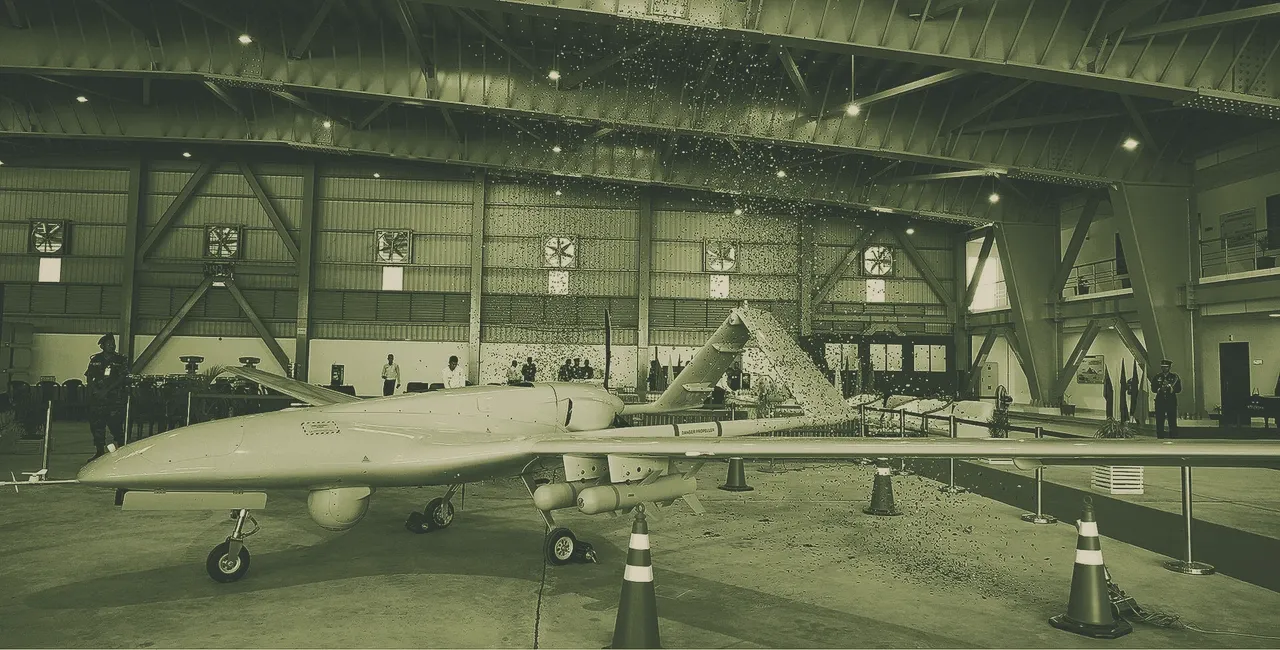
The Bayraktar TB2 is a medium-altitude long-endurance (MALE) armed unmanned combat aerial vehicle (UCAV) designed and built by the Turkish firm Baykar. A single-piston pusher-prop airframe carries a ~150 kg payload of precision-guided munitions and an electro-optical/infrared sensor turret, linked to the operator via line-of-sight radio. The type entered production in the mid-2010s and quickly became the signature weapon of Turkish-aligned forces in Libya, of Azerbaijan in the 2020 Nagorno-Karabakh war, and — perhaps most famously — of the Ukrainian armed forces in the opening phase of the 2022 Russian invasion. Its low unit cost of roughly $5 million per air vehicle, combined with the availability of effective micro-munition families like the Roketsan MAM series, has made the TB2 a highly asymmetric tool that forces adversaries to spend far more to counter it than it costs to field.
Development
Baykar began the TB2 as a private venture, building on the earlier Bayraktar TB1 radio-controlled mini-UAV, with the goal of creating a persistent armed overwatch aircraft that could meet the needs of the Turkish security forces. First flight came in 2014, and initial deliveries to the Turkish armed forces followed in the same year, making it the country's first indigenously developed armed UCAV. By late 2024 the global fleet had surpassed one million cumulative flight hours, a milestone that the manufacturer noted attested to the type's reliability and widespread operational adoption, according to a Baykar press release. Production ramped to several hundred airframes, with assembly lines meeting both domestic and export demand from more than thirty nations.
Design & capabilities
The TB2 is a twin-boom monoplane with a single 100 hp Rotax 912-iS four-cylinder engine driving a rear-mounted pusher propeller. A central pod houses the mission avionics, and a retractable chin-mounted electro-optical/infrared sensor provides laser designation, ranging, and full-motion video. Four under-wing hardpoints can carry a maximum external payload of approximately 150 kg. The standard weapon fit is the Roketsan MAM-L and MAM-C micro-munitions — laser-guided glide bombs that, despite their small size, deliver an effect out of proportion to their weight. Shephard Defence Insight records a typical endurance of around 27 hours and a maximum speed of 222 km/h, with a line-of-sight datalink that limits the control radius to roughly 150 km in its baseline configuration. The aircraft handles automatic take-off and landing, relieving the remote crew of the most workload-intensive flight phases, but relies on continuous pilot input for the mission payload. No native satellite-communications (SATCOM) system is fitted on the standard airframe — though a later variant, the TB2S, adds an integrated SATCOM dome to extend the operational radius.
Variants
The baseline TB2 is the primary production standard. The TB2S introduced a satellite-communications blister that permits beyond-line-of-sight control, addressing one of the baseline's most significant operational limitations. A launch-recovery variant designed for operation from the Turkish amphibious assault ship TCG Anadolu is also under test, with the smaller, folding-wing Bayraktar TB3 intended to fill the carrier-based UCAV role more permanently.
Combat record / operational use
The TB2 first attracted sustained international attention during the 2020 Nagorno-Karabakh war, where Azerbaijani forces used it to systematically destroy Armenian armored vehicles, artillery, and air-defense systems in the open, often capturing strike footage that was disseminated as propaganda. Wikipedia's curated combat summary notes that the platform then became a symbol of Ukrainian resistance after the February 2022 invasion, where its MAM-L munitions struck Russian supply columns, fuel trains, and Buk/Strela surface-to-air missile batteries in the war’s opening weeks, and a TB2 was reportedly involved in the operation that sank the guided-missile cruiser Moskva by providing a decoy distraction. However, Russian electronic-warfare assets and the expansion of layered air-defence coverage rapidly reduced the TB2’s survivability after the first months, a pattern that the open-source tracking community captured in the steep drop-off of verified strike videos. Outside Europe, GlobalMilitary.net documents export-customer combat employment in Libya, Syria, and East Africa, confirming that the TB2 remains a potent and widely used system wherever the adversary cannot sustain a modern IADS.
Advantages
- Cost-asymmetric: a ~$5 M air vehicle that forces an enemy to expend missiles costing hundreds of thousands of dollars, or to dedicate significant electronic-warfare assets.
- Loiter endurance: with ~27 hours of persistence, it can orbit a battle zone, conduct ISR, and strike targets of opportunity in a single mission.
- Precision micro-munitions: the MAM-L/C glide bombs allow strike into urban or complex terrain with low collateral damage.
- Export-friendly: no SATCOM, no advanced data-links, and a simple piston-engine design make it easy to transfer and maintain in a low-infrastructure environment.
- Doctrine-shaping: the TB2 demonstrated that a cheap, recoverable armed drone, used en masse, can produce strategic effects in a permissive air-defence environment.
Drawbacks / limitations
- Line-of-sight control: the baseline TB2’s 150 km radius limits its stand-off reach; extending it requires a high-value SATCOM gateway variant.
- Piston-engine signature: the 100 hp Rotax provides a modest acoustic and infrared signature that crewed air-defence systems can cue once they are alert.
- Survivability in contested airspace: once integrated air defence and modern EW are in place, the TB2 becomes a slow target, as proven in Ukraine after mid-2022.
- Limited payload: at 150 kg, it cannot carry the sort of 500-lb class bombs or anti-radiation missiles that a Reaper-class UCAV routinely sorties with.
Counterparts
- MQ-9 Reaper (USA)
- CH-4 Rainbow (China)
Outlook
Baykar continues to evolve the concept with the heavier Akıncı and the ship-capable TB3, while the baseline TB2 remains in serial production for a growing customer list. The type’s legacy is already secure: it was the drone that showed the world how a sub-$10M MALE platform, acquired in sufficient numbers and operated aggressively, could become the public face of an entire military campaign. However, its combat record also taught a sobering corollary — that its vaunted effectiveness plummets the moment it faces a modern IADS. The challenge for Baykar and its buyers is to retain the TB2’s asymmetric value in an electromagnetic environment that is only growing more hostile.
Key specifications
| Spec | Value |
|---|---|
| Type | Single-piston (100 hp) pusher UCAV |
| Endurance | ~27 h |
| Range | ~150 km LOS (up to ~300 km operational, definition-dependent) |
| Cruise / max speed | cruise ~130 km/h / max ~222 km/h |
| Payload | ~150 kg, 4 hardpoints (Roketsan MAM-L/C/T; EO/IR + laser designator) |
| Datalink / control | LOS (no native SATCOM on baseline) |
| Autonomy level | Remote-piloted, automatic takeoff/landing |
| Dimensions / MTOW | wingspan ~12 m / length ~6.5 m / ~700 kg |
| Launch & recovery | Runway |
Sources
- Baykar Technology — “Türkiye’s First Indigenous UCAV Bayraktar TB2 Exceeds 1 Million Flight Hours”. https://baykartech.com/en/press/turkiyes-first-indigenous-ucav-bayraktar-tb2-exceeds-1-million-flight-hours/
- Shephard Defence Insight — “Bayraktar Tactical UAS”. https://plus.shephardmedia.com/detail/bayraktar-tactical-uas/
- Wikipedia — “Baykar Bayraktar TB2”. https://en.wikipedia.org/wiki/Baykar_Bayraktar_TB2
- GlobalMilitary.net — “Bayraktar TB2”. https://www.globalmilitary.net/aircraft/bayraktar-tb2/