BM-21 Grad
The Soviet-era 122 mm Grad is the world’s most ubiquitous multiple rocket launcher — 40-tube burst fire, truck-mobile, and a massed-fire mainstay in both Russian and Ukrainian arsenals, now reliant on North Korean and Czech-brokered 122 mm ammunition pipelines.
Overview
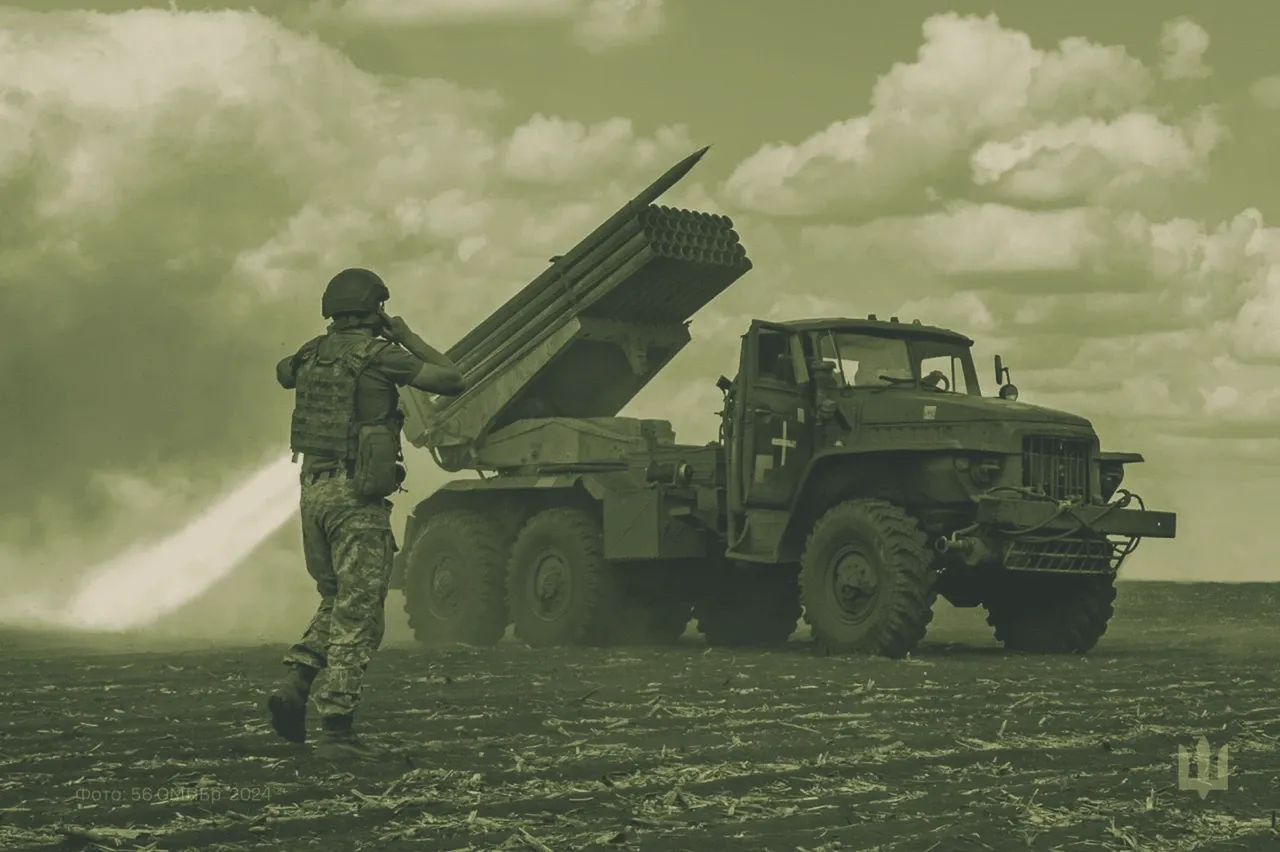
The BM-21 “Grad” (Russian for “hail”), full system index 9K51, is a truck-mounted 122 mm multiple rocket launcher that has been in continuous frontline service since 1963. A single launcher packs forty tubes and can ripple-fire them in roughly twenty seconds, saturating a grid square with some 256 kg of high-explosive fragmentation. The design trades precision for raw volume: its unguided rockets are area weapons, not point weapons. Over sixty years the Grad has been copied, modernised and produced in at least fifteen countries, making it the most widely distributed MLRS in history. In the Russia–Ukraine war it serves as the standard divisional- and brigade-level area-fire system on both sides, sustained by a global scramble for 122 mm ammunition.
Development
NPO Splav in Tula developed the 9K51 Grad in the early 1960s as the successor to the World War II Katyusha line, replacing launch rails with a cluster of 40 rifled tubes on a Ural-375D 6×6 truck Wikipedia. The system entered Soviet service in 1963 and saw its first combat use in March 1969 during the Sino-Soviet border clash on Damansky/Zhenbao Island AOAV. Massive export and foreign licensing followed: Military Balance data assembled by AOAV shows that of roughly 9,019 122 mm MLRS in active or reserve service worldwide circa 2020, 59% were Russian-made Grads or direct derivatives, 25% were Chinese copies and 4% were Czech RM-70s AOAV. The launcher migrated to the Ural-4320 diesel chassis in 1976, and Russia’s current-production successor, the automated 2B17/9K51M Tornado-G, appeared in the late 1990s and entered field units in numbers from the mid-2010s.
Design & capabilities
The BM-21 is built around a steel-tubed launch pack of 40 122 mm-calibre tubes, arranged in four banks of ten, and a simple traverse/elevation mechanism that can be laid from the cab or remotely from up to 64 m away. Standard rockets are the M-21OF/9M22 HE-FRAG family: each weighs 66 kg, carries an 18.4 kg warhead and reaches 20.1–20.75 km Wikipedia. Extended-range variants such as the Russian 9M521/9M522 push the reach to roughly 40 km, and some manufacturer-claimed figures for modernised rockets go up to 52 km in the Tornado-G. A full 40-round salvo departs in ~20 s; manual reload takes about 10 minutes for an exposed crew, although variants like the Ukrainian Bastion-2 carry a spare pack for quick auto-reload. Crew is three, sometimes supplemented to six when a reload section is attached. The truck cab is completely unarmoured — survivability relies on a “shoot-and-scoot” drill with emplace-to-fire times of about three minutes, followed by rapid displacement before counter-battery fires arrive.
Variants
The Grad family spans the original BM-21 on Ural-375D, the BM-21-1 on Ural-4320, and special-purpose spin-offs such as the 12-tube airborne BM-21V and the naval-base defence BM-21PD. Russia’s current-generation Tornado-G (9K51M) adds an automated fire-control system with satellite navigation, which Russian sources claim makes it “three times more effective” than the baseline. The Czech RM-70 and RM-70/85 introduce an armoured cab and an integral 40-rocket reload magazine. Ukraine has fielded a whole lineage on KrAZ or MAN chassis: Bastion-1 (2009), Bastion-2 (KrAZ-6322, auto-reload, ~6 built), BM-21U “Verba” (digital nav/comms, inducted September 2021), BM-21 UM “Berest” (double cab, digital FCS), and a 2025 National Guard rebuild on MAN 6×6 with fully digital electric lay, anti-drone jammers and remote control.
Combat record / operational use
The Grad has appeared in virtually every armed conflict since 1969, but the Russia–Ukraine war is by far its most intensive deployment. According to the 2024 Military Balance, Russia reportedly fielded 454 BM-21s plus over 160 Tornado-G launchers, with about 1,500 more in storage; Ukraine operated roughly 100 BM-21-family launchers plus eight Czech RM-70s. The war’s toll is staggering: Oryx has photo-confirmed the loss of at least 345 Russian BM-21s and associated command vehicles Oryx, and at least 80 Ukrainian 122 mm BM-21 variants Oryx as of mid-2026.
Ammunition supply became the system’s defining challenge from 2023 onward. Imagery in October–November 2023 revealed North Korean 122 mm Grad rockets on Russian positions, indicating Pyongyang was delivering “the entire nomenclature” of artillery ammunition Defence Express. Analysis by the OSC/Reuters in April 2025 counted 64 shipments and an estimated 4–6 million munitions from Rajin to Russian ports since September 2023, with 122 mm rockets forming a large share of the cargo Euromaidan Press. RUSI assessed that North Korean supplies represented 29–40% of all rounds Russia fired in that period, and frontline sources reported some Russian units using exclusively North Korean 122 mm rockets RUSI. On the Ukrainian side, a Czech-led ammunition initiative — 16 donor states, over €1.6 billion managed by late 2024 — emerged as the main external pipeline for large-calibre munitions, with roughly 1.8 million shells expected in 2025 RFE/RL. Ukraine also put its modernised launchers to work: Bastion-2s belonging to the 63rd Mechanised Brigade struck targets inside Russia in 2023 Army Recognition, while the BM-21U Verba was formally accepted into service in September 2021 Defence Express and the 2025 MAN-chassis rebuild introduced digital fire control and EW countermeasures Defence Express.
Advantages
- Unmatched ubiquity: fielded in 81 states, part of a global 122 mm ammunition ecosystem produced by Russia, China, North Korea, Turkey, Pakistan and others.
- Devastating burst firepower: one launcher delivers 40 rockets / ~256 kg of HE in under 20 seconds; an 18-launcher battalion can ripple 720 rockets in a single volley.
- Cheap, simple and truck-mobile; quick emplace-and-fire (~3 min), fire-from-cab or remote operation, and a shoot-and-scoot profile that complicates counter-battery.
- Endlessly modernisable: Tornado-G (Russia) and Ukraine’s Verba/Berest and digital MAN-chassis rebuilds add sat-nav, auto-laying and electronic protection to the same basic launch pack.
- Ammunition flexibility: HE-FRAG, incendiary, mine-laying and extended-range rockets all use the same 40-tube launcher.
Drawbacks / limitations
- Notoriously inaccurate and imprecise; unguided, fin-stabilised rockets produce error footprints typically ~160 m × 300 m at max range, creating severe danger when used near populated areas.
- Zero crew protection: the soft-skinned cab and large launch signature make the vehicle highly vulnerable to drone-directed counter-battery, as confirmed by hundreds of visual-documented losses on both sides.
- Short reach relative to modern systems: standard rockets top out around 20 km; even extended-range 122 mm seldom exceeds 40 km, far inside the envelopes of guided MLRS like HIMARS.
- Manual reload of 40 tubes (~10 min with exposed crew) on the baseline vehicle, though some variants address this.
- Ammunition-hungry at industrial scale: both sides out-shoot 122 mm production, forcing Russia to rely heavily on North Korean stocks and Ukraine on a complex Czech-managed global procurement chain.
Counterparts
- M142 HIMARS (USA) — precision-guided, longer-range wheeled MLRS that has redefined rocket artillery in Ukraine; represents the move away from area-saturation.
- PHL-191 (China) — modern long-range MLRS with modular guided rockets, representing the Chinese evolution beyond its Type-81 Grad clone.
Outlook
After six decades the Grad is not fading away — it is being consolidated and stretched. Russia maintains deep strategic reserves (~1,500 hulls) and continues Tornado-G production, fed by a steady North Korean ammunition stream that the front-line demands. Ukraine keeps digitising its launchers (Verba/Berest, MAN-chassis rebuilds) while fuelling them through the Czech-brokered global 122 mm market and domestic refurbishment programmes. The system’s future is therefore a contest of ammunition supply and industrial endurance grafted onto a 1963-era vehicle — and a continuing survivability crisis for a soft-skinned launcher whose loss-count already runs into the hundreds.
Key specifications
| Spec | Value |
|---|---|
| Crew | 3 (up to 6 with reload section) |
| Combat weight | 13.71 t |
| Length / width / height | 7.35 m / 2.40 m / 3.09 m |
| Main armament | 40 × 122 mm launch tubes; 9M22/M-21OF HE-FRAG rocket (20.1–20.75 km); extended-range rockets to ~40 km (52 km claimed for Tornado-G) |
| Secondary armament | None integral; crew small arms; Bastion-2 variant carries two MANPADS |
| Armor & protection | None (unarmored truck cab) |
| Engine & power | ZiL-375 V8 gasoline, 180 hp (Ural-375D); later Ural-4320 diesel 180 hp; derivatives use other chassis |
| Power-to-weight | ~13 hp/t (est.) |
| Road / cross-country speed | 75 km/h road; cross-country speed not publicly established |
| Operational range | 405 km (up to ~750 km road range on some chassis) |
Sources
- Wikipedia — “BM-21 Grad” — https://en.wikipedia.org/wiki/BM-21_Grad
- AOAV (Action on Armed Violence) — “What is a Grad?” — https://aoav.org.uk/2021/what-is-a-grad/
- Defense Express — “North Korea supplies Russia with entire nomenclature of artillery ammunition, including rockets for the Grad MLRS” — https://en.defence-ua.com/news/north_korea_supplies_russia_with_entire_nomenclature_of_artillery_ammunition_including_rockets_for_the_grad_mlrs-8544.html
- RUSI — “Brothers in Arms: Assessing North Korea’s Contribution to Russia’s War in Ukraine” — https://www.rusi.org/explore-our-research/publications/commentary/brothers-arms-assessing-north-koreas-contribution-russias-war-ukraine
- Euromaidan Press — “Reuters: North Korea has supplied half of Russia’s ammunition in Ukraine — that’s 6 million shells” — https://euromaidanpress.com/2025/04/15/reuters-north-korea-has-supplied-half-of-russias-ammunition-thats-6-million-shells/
- RFE/RL (Schemes) — “Czech Initiative Criticized For Costs, Quality, And Delays — But Keeps Ammo Flowing To Ukraine” — https://www.rferl.org/a/schemes-investigation-czech-ammo-ukraine/33406541.html
- Army Recognition — “Ukraine deploys 6x6 Bastion-2 122mm MLRS against Russian troops” — https://www.armyrecognition.com/focus-analysis-conflicts/army/conflicts-in-the-world/russia-ukraine-war-2022/ukraine-deploys-6x6-bastion-2-122mm-mlrs-against-russian-troops
- Defense Express — “The Grad 2.0 MLRS: How Ukraine’s National Guard Gave the BM-21 System a High-Tech Makeover” — https://en.defence-ua.com/weapon_and_tech/the_grad_20_mlrs_how_ukraines_national_guard_gave_the_bm_21_system_a_high_tech_makeover-14488.html
- Defense Express — “BM-21U Grad/Verba MLRS, 80K6KS1 ‘Phoenix’ Air Defense Radar System Officially Inducted into Ukrainian Military Service” — https://en.defence-ua.com/news/bm_21u_gradvilkha_mlrs_80k6ks1_phoenix_air_defense_radar_system_officially_inducted_into_ukrainian_military_service-1973.html
- Oryx — “Attack On Europe: Documenting Russian Equipment Losses” — https://www.oryxspioenkop.com/2022/02/attack-on-europe-documenting-equipment.html
- Oryx — “Attack On Europe: Documenting Ukrainian Equipment Losses” — https://www.oryxspioenkop.com/2022/02/attack-on-europe-documenting-ukrainian.html