Challenger 2
The British Army's sole main battle tank since 1998 — a heavily armoured, 62.5-tonne brute with a unique 120 mm rifled gun, set to be replaced by the smoothbore-armed Challenger 3.
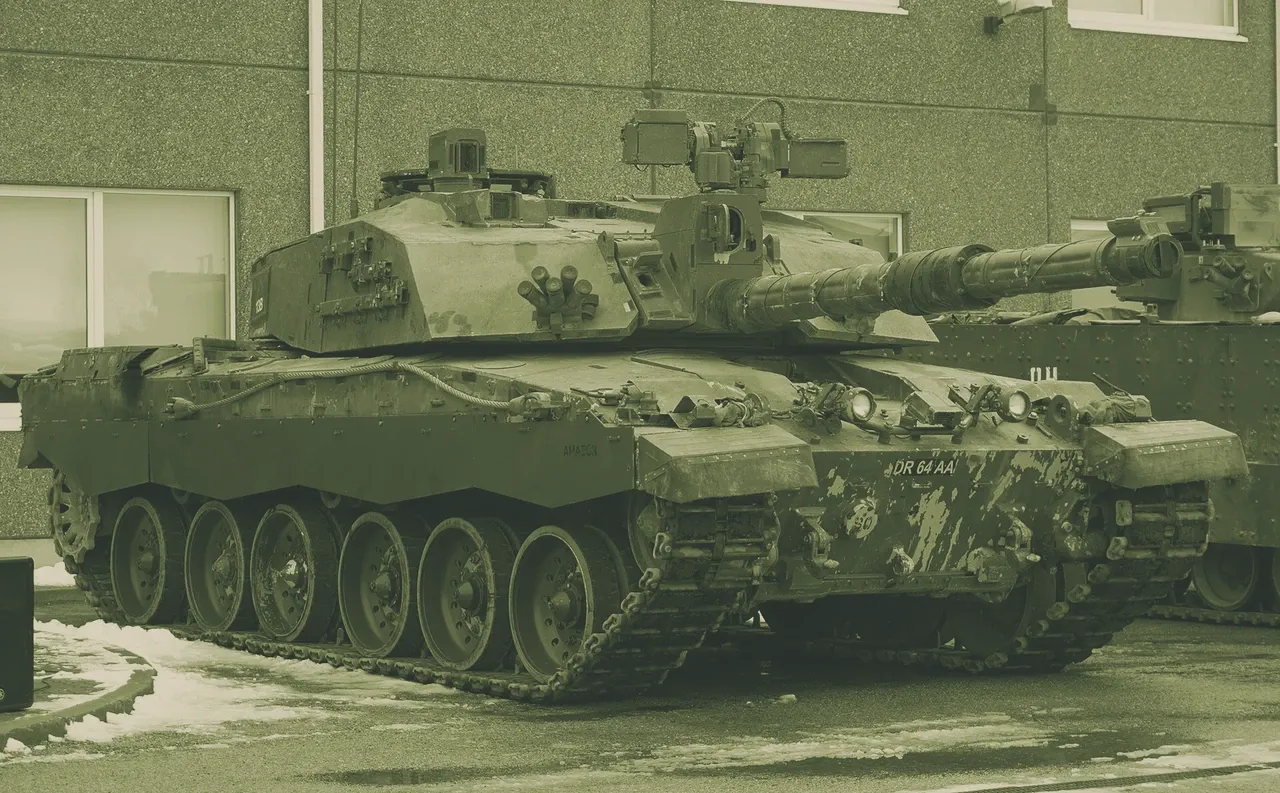
Britain’s last domestically designed main battle tank — a 62.5-tonne armoured behemoth whose rifled 120 mm gun sets it apart from every other NATO tank in the field.
Overview
The FV4034 Challenger 2 is the sole main battle tank of the British Army, fielded from 1998 to replace the Chieftain/Challenger 1 line. Built around a crew of four and a cast/welded turret with advanced Chobham-type armour, the type carries the 120 mm L30A1 rifled gun — the only such weapon still in Western front-line MBT service. Although exceptionally protected, the Challenger 2’s modest 1,200 hp powerpack gives it a lower power-to-weight ratio than its European peers, and the fleet is now being converted to the smoothbore-armed, digitised Challenger 3 standard.
Development
Challenger 2 was designed by Vickers Defence (later BAE Systems) as a clean-sheet evolution of the Challenger 1, which had proven rugged but technically troubled in the 1991 Gulf War. The new tank retained the basic hull architecture but replaced almost every internal system, from the fire-control suite to the Dorchester-level armour package. The British Army accepted the type into service in 1998 and received its full order of approximately 408 vehicles, while Oman purchased a further 38 examples, as noted by Army Technology. The tank has remained in continuous service since, although the UK fleet is now being drawn down in favour of the Challenger 3 upgrade programme.
Design & capabilities
The signature feature of the Challenger 2 is its 120 mm L30A1 rifled gun, which fires two-piece ammunition (projectile and charge) and is designed to deliver the HESH (high-explosive squash head) round with lethal accuracy against structures and light/medium armour. According to Army Recognition, the weapon is fed manually by a human loader — a contrast to the autoloaders of Russian, Chinese and French MBTs. Secondary armament consists of a coaxial 7.62 mm chain gun and a roof-mounted 7.62 mm general-purpose machine gun, supplemented by two five-barrel 66 mm smoke grenade dischargers.
Armour protection is based on second-generation Dorchester (Chobham-type) composite arrays on the turret and hull front, with add-on appliqué modules available for urban operations that can push the combat weight above 75 tonnes. The tank lacks a hard-kill active protection system as standard, though it is equipped with a laser warning receiver and NBC overpressure system. Power is provided by a Perkins Caterpillar CV12 12-cylinder diesel producing 1,200 hp (895 kW), driving through a David Brown TN54 six-speed epicyclic gearbox. At a combat weight of 62.5–64 tonnes the power-to-weight ratio is approximately 18.8 hp/t, delivering a top road speed of 59 km/h and a cross-country speed of 40 km/h, according to Wikipedia. Operational range is quoted at between 450 and 550 km on roads.
Combat record / operational use
Challenger 2 saw its first major combat during the 2003 invasion of Iraq, where British armoured units advancing on Basra reported no tank lost to enemy fire — the only hull loss being a single vehicle destroyed in a friendly-fire incident, as recorded by multiple sources including Wikipedia. The type subsequently sustained deployments in Iraq and Afghanistan in support of peacekeeping and counter-insurgency operations.
In 2023 the United Kingdom donated 14 Challenger 2s to Ukraine, where they were integrated into newly formed mechanised brigades. Front-line use brought the tank’s first documented combat loss to hostile fire, with a vehicle destroyed in southern Ukraine that year, as reported by the National Security Journal. The donation was subject to public debate about the operational readiness of the small UK fleet, noted by The National Interest.
Advantages
- Exceptionally tough passive armour; no Challenger 2 was lost to enemy tank fire until the Ukraine war.
- The rifled 120 mm L30A1 gun delivers highly accurate HESH and anti-structure effects unmatched by smoothbore ammunition.
- Proven desert reliability in Iraq; protected crew during multiple IED strikes.
- Robust laser warning and NBC protection suite as standard.
Drawbacks / limitations
- Low power-to-weight ratio (~18.8 hp/t) limits tactical mobility and acceleration compared to contemporaries like the Leopard 2A7V or M1A2 SEPv3.
- Two-piece ammunition and a rifled barrel require unique supply chains, isolating the UK from NATO smoothbore interoperability.
- No integrated hard-kill active protection system, leaving the tank vulnerable to top-attack threats and modern tandem-warhead ATGMs.
- Small total fleet (around 446 built) means limited combat mass and high per-unit sustainment cost.
- Ageing hulls and obsolescent electronics necessitated the Challenger 3 upgrade, effectively capping the CR2’s development path.
Counterparts
- T-90M Proryv (Russia)
- Type 99A (China)
- M1A2 Abrams (USA)
Outlook
The British Army is mid-way through a profound recapitalisation of its armoured force. Under the Challenger 3 programme, 148 Challenger 2 hulls are being completely rebuilt by Rheinmetall BAE Systems Land (RBSL) with a new turret and the Rheinmetall 120 mm L55A1 smoothbore gun, capable of firing all current NATO-standard kinetic-energy and programmable airburst munitions. The £800 million-plus contract, managed by UK Defence Equipment & Support, will deliver initial operating capability around 2027 and full operating capability by 2030, with the remanufactured fleet expected to serve until at least 2040. The remaining Challenger 2 hulls will be retired, ending the era of the rifled British MBT. RBSL delivered the first two Challenger 3 prototypes for trials in early 2024, as reported by Army Recognition, and ongoing work will define the Army’s armoured striking power for the next two decades.
Key specifications
| Spec | Value |
|---|---|
| Crew | 4 |
| Combat weight | 62.5–64 t (up to ~75 t with add-on armour) |
| Length / width / height | 13.5 m gun-forward / 4.2 m / 2.49 m |
| Main armament | 120 mm L30A1 rifled gun |
| Secondary armament | 2× 7.62 mm machine guns; 2× 66 mm smoke grenade launchers |
| Armor & protection | Chobham/Dorchester (Level 2) composite; no standard APS |
| Engine & power | Perkins Caterpillar CV12 diesel, 1,200 hp (895 kW) |
| Power-to-weight | ~18.8 hp/t |
| Road / cross-country speed | 59 km/h / 40 km/h |
| Operational range | 450–550 km (road) |
Sources
- Army Technology — Challenger 2 Main Battle Tank, UK. https://www.army-technology.com/projects/challenger2/
- Army Recognition — Challenger 2 FV4034 MBT. https://armyrecognition.com/military-products/army/main-battle-tanks/main-battle-tanks/challenger-2-united-kingdom-uk
- Wikipedia — Challenger 2. https://en.wikipedia.org/wiki/Challenger_2
- National Security Journal — Challenger 2 in Ukraine: ‘Sniper Rifle’ Tank Bogged Down. https://nationalsecurityjournal.org/challenger-2-in-ukraine-sniper-rifle-tank-bogged-down-in-the-mud/
- The National Interest — UK Won’t Commit to Sending Challenger 2 Tanks to Ukraine. https://nationalinterest.org/blog/buzz/uk-wont-commit-to-sending-challenger-2-tanks-to-ukraine-ps-011426
- UK Defence Equipment & Support — Challenger 2 and Challenger 3. https://des.mod.uk/what-we-do/army-procurement-support/challenger-3/
- Army Recognition — UK Challenger 3 tank program advances as RBSL delivers two more prototypes. https://armyrecognition.com/news/army-news/army-news-2024/uk-challenger-3-tank-program-advances-as-rbsl-delivers-two-more-prototypes-for-british-army-field-trials