E-2 Hawkeye
The E-2 Hawkeye is the US Navy's carrier-based radar aircraft — the twin-turboprop rotodome plane China's KJ-600 copies. Six decades of iteration, an AESA-radar E-2D that quarterbacks the fleet and cues SM-6 missiles over the horizon, and the airborne command node over the Red Sea and Iran.
.jpg)
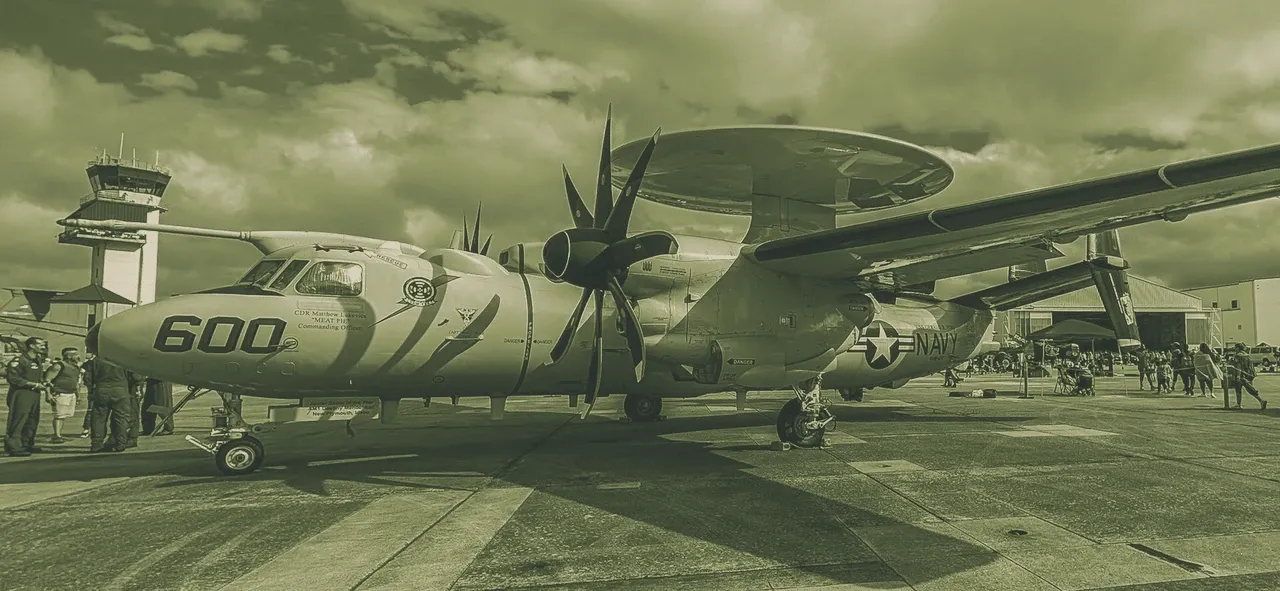
The original the world copies — the E-2 Hawkeye is the twin-turboprop, rotodome-topped radar aircraft that has flown from US carriers since the 1960s, and the template China's brand-new KJ-600 visibly emulates. Six decades of iteration have turned it into the E-2D Advanced Hawkeye: an AESA-radar flying command post that does not just watch the sky but runs the carrier's battle — vectoring fighters, coordinating the air wing, and feeding fire-control-quality tracks that let warships fire SM-6 missiles at targets beyond their own horizon. It is the mature, combat-proven benchmark against which every new carrier-AEW aircraft, China's included, is measured.
Overview
The E-2 Hawkeye is Northrop Grumman's carrier-based airborne early-warning and control aircraft — the US Navy's airborne radar and battle-management node, instantly recognizable by its 24-foot rotating radar dome atop a twin-turboprop airframe. The current E-2D Advanced Hawkeye carries the Lockheed Martin AN/APY-9 UHF-band AESA radar, a "two-generation leap" over its predecessor, and a five-person crew, launching by catapult from US carriers. Its role is the one the KJ-600 is only now reaching for: not merely detecting threats, but serving as the "digital quarterback" of the carrier strike group — directing strike packages, deconflicting the air wing, and, through the Navy's Cooperative Engagement Capability, feeding fire-control-quality tracks that let Aegis ships fire SM-6 missiles at over-the-horizon targets they cannot see themselves. First flown in 1960 and evolved through the E-2A/B/C to the E-2D (IOC 2014, aerial refueling added 2020), the Hawkeye is the mature, combat-proven benchmark of carrier AEW — proven over the Red Sea against Houthi drones and missiles (2023–2025) and central to the 2026 Iran war as the "primary airborne command-and-control node over Iran." The framing that gives this entry its point: the E-2 is to the KJ-600 what the veteran is to the rookie — same configuration, sixty years of refinement and combat apart, and the reason the Chinese aircraft looks the way it does.
🔒 The full E-2 Hawkeye file is for BattlePolicy Pro members. Below the line: development history, design and capabilities, variants, the combat record, advantages and limitations, comparable systems, outlook, the full specifications table, our sourcing, and the analyst assessment — procurement, suppliers and the BattlePolicy verdict. Unlock the full file with BattlePolicy Pro →
Below this point
- Development
- Design & capabilities
- Variants
- Combat record / operational use
- Advantages
- Drawbacks / limitations
- Counterparts
- Outlook
- Key specifications
- Sources
- Analyst Section
- Procurement & contracts
- Suppliers & related companies
- Comparable systems — analyst view
- Analyst note