KJ-600
The KJ-600 is China's carrier Hawkeye — the first fixed-wing airborne early-warning aircraft to fly from a Chinese carrier, catapult-launched off the Fujian's electromagnetic system. It finally gives PLAN carriers the organic radar picture US carriers have had for decades.
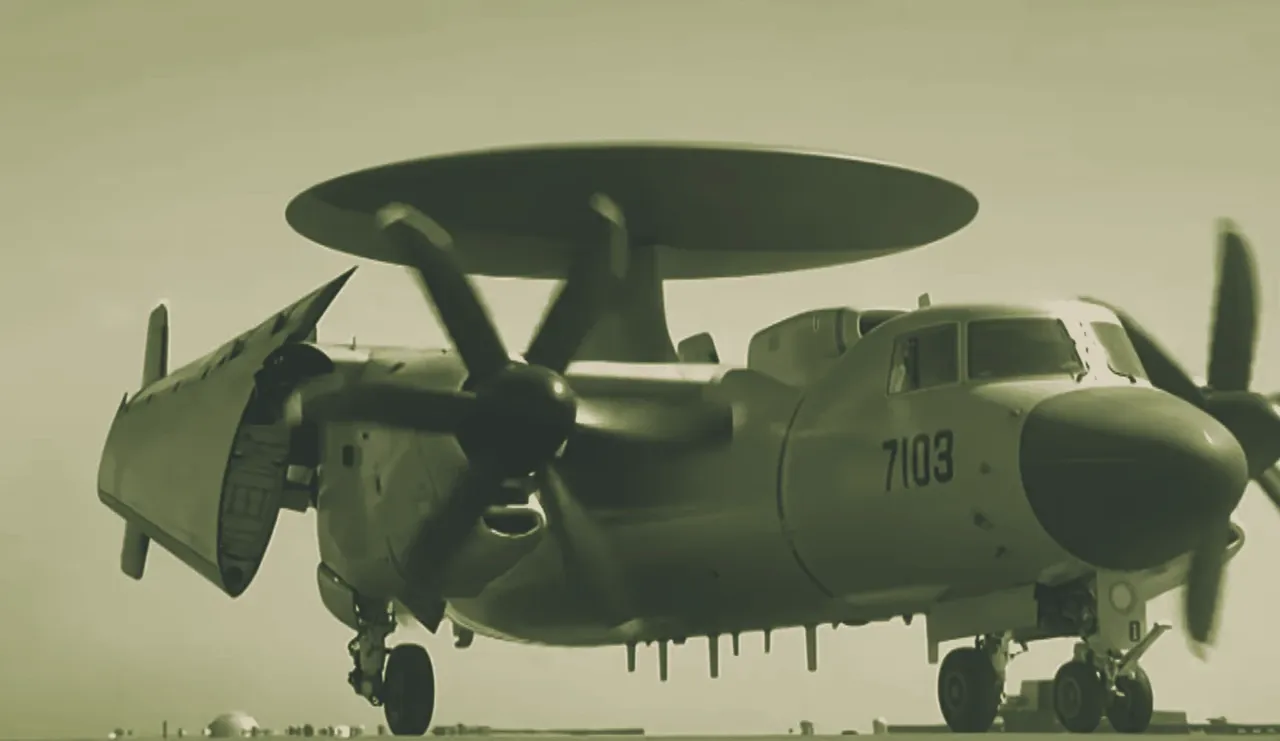
The eyes for China's real carrier — the KJ-600 is the first fixed-wing airborne early-warning aircraft to operate from a Chinese aircraft carrier, a twin-turboprop with a rotodome that looks unmistakably like America's E-2 Hawkeye and does the same job: it flies high above the fleet and turns a carrier group from a cluster of ships with horizon-limited radars into a networked force that sees hundreds of kilometers out. Catapulted off the Fujian's electromagnetic launch system, it closes the single biggest capability gap between the PLAN's carriers and the US Navy's — the organic radar picture that makes a carrier a carrier.
Overview
The Xi'an KJ-600 (nicknamed "Nezha") is China's carrier-based airborne early-warning and control aircraft — a twin-turboprop, quad-tailed, folding-wing design with a large dorsal rotodome, built by AVIC's Xi'an division for the PLA Naval Air Force. Its role is transformational for Chinese naval aviation: the PLAN's first two carriers (Liaoning and Shandong) are ski-jump STOBAR ships that could only carry helicopter-based AEW as a stopgap, leaving their air wings dependent on short-ranged, low-altitude radar. The KJ-600 changes that — but only on a catapult carrier, because a heavy, slow AEW turboprop cannot launch off a ski-jump. That is why it and the Type 003 Fujian, China's first electromagnetic-catapult (EMALS) carrier, are inseparable: the Fujian exists to launch aircraft like the KJ-600, and the KJ-600 exists to give the Fujian's air wing the elevated radar picture that defines modern carrier operations. First flown in August 2020, debuted in the September 2025 Victory Day parade, demonstrated in EMALS launch-and-recovery trials aboard the Fujian in September 2025, and aboard the carrier at its November 2025 commissioning, the KJ-600 is fielded — though the Fujian's full air-wing operational capability is still being worked up through 2026. It is the "Chinese E-2 Hawkeye" in form and function, and its arrival marks the moment PLAN carrier aviation reached for genuine blue-water capability.
Development
The KJ-600 surfaced in 2019 as a non-flying mock-up on a concrete carrier-deck replica at China's Wuhan electronics-testing facility, its Hawkeye-like configuration immediately obvious, per Wikipedia and analyst H.I. Sutton. It made its maiden flight on 29 August 2020, with test flights continuing through 2021 (China officially confirmed the program to Janes in February 2021) and, by late 2023, "intensive trials" with at least four and possibly six prototypes. The public and operational milestones then clustered in 2025: a KJ-600 flew in the 3 September 2025 Victory Day parade flypast, and on 22 September 2025 the PLAN released video of a full EMALS catapult launch and arrested recovery aboard the Type 003 Fujian — alongside the J-15T and stealth J-35 — a sequence TWZ called a stunning leap in Chinese carrier capability, per USNI News. A KJ-600 was on deck when the Fujian was commissioned on 5 November 2025 at Sanya, and AVIC named the type "Nezha" around the commissioning. By April 2026, at least six prototypes were believed in use with serial production likely underway, per FlightGlobal, while Chinese state media projected the Fujian reaching full operational capability within 2026 — with analysts noting the KJ-600/J-35 air-wing integration as the real test. Unlike the land-based KJ-3000, whose specs remain almost entirely OSINT, the KJ-600's existence, carrier role and Fujian integration are officially acknowledged; what stays estimated is the radar and sensor performance inside the dome.
Design & capabilities
The KJ-600 is, by configuration, China's E-2: a high folding straight wing, a quad-fin tailplane, tricycle gear, two Zhuzhou WJ-6C turboprops with six-blade reversible props, and a large dorsal rotodome — resembling the Northrop Grumman Hawkeye closely but, analysts stress, not a direct copy. The rotodome is believed to house AESA array(s) — FlightGlobal cites two — a different implementation from the E-2D's mechanically-rotated APY-9, though onboard radar and processing performance cannot be verified from external imagery and remain OSINT assessment. What is certain is the operational leap: the KJ-600 lifts the fleet's search radar to roughly 25,000 feet, vastly extending detection of low-flying aircraft and sea-skimming missiles over the horizon, and serves as an airborne command post and high-elevation data-relay node in the carrier group's kill-web — the functions that let a carrier fight at range rather than react at the horizon. The binding constraint is launch: the aircraft is CATOBAR-only, too heavy and slow for a ski-jump, so it can operate only from the EMALS-equipped Fujian and future catapult carriers — which is precisely why it validated on the Fujian and why the two developed in lockstep. OSINT spec estimates (unconfirmed) put it around 18 m long, 25 m span, ~30 t, ~1,250 km range and a ~15,000 m ceiling with a crew of five or six. One capability gap is flagged: the best assessment (Universal Dynamics) is that no known KJ-600 specimen carries an aerial-refuelling probe — a limit on time-on-station versus the E-2D — though a later image caption ambiguously suggested otherwise, so the point is unsettled.
Variants
- AEW&C baseline: the in-service early-warning aircraft.
- COD/cargo variant: a carrier-onboard-delivery version (the C-2 Greyhound role) is assessed as likely under development.
- Possible future upgrades: an aerial-refuelling probe and/or IRST have been suggested but are contradicted across sources — treat as unconfirmed.
- Family context (not variants): the land-based KJ-3000 (large jet AEW&C on the Y-20B), the KJ-500 turboprop workhorse, the KJ-700, and the uncrewed WZ-9 Divine Eagle — China's unusually broad, multi-track AEW&C fleet.
Combat record / operational use
None — the KJ-600's record is testing and integration, not combat. The operational arc runs from the 2020 maiden flight through multi-prototype trials to the 2025 cluster: the parade debut, the September EMALS launch-and-recovery demonstration aboard the Fujian, and the aircraft's presence at the carrier's November commissioning, with satellite imagery showing around two KJ-600s associated with the Fujian's forming air wing. Its significance is entirely about what it enables: for the first time, a Chinese carrier can put a fixed-wing radar aircraft aloft to cue its fighters and screen its ships at range — the capability that separates a genuine power-projection carrier from a coastal one, and the reason the Fujian matters more than Liaoning and Shandong combined. The strategic context is the PLAN's stated march toward roughly nine carrier strike groups by 2035; each future CATOBAR carrier (including the nuclear Type 004 under construction) will need KJ-600s, making this aircraft — small, unglamorous, unarmed — one of the most consequential enablers of China's blue-water ambitions. The forward question is not whether it works but whether it survives: large AEW&C aircraft are increasingly vulnerable, a point underscored by long-range air-to-air missiles, the March 2026 Shahed strike on a US E-3, and Ukraine's strikes on Russian A-50s.
Advantages
- Organic carrier AEW at last — gives PLAN carriers the elevated fixed-wing radar picture that defines modern carrier aviation, ending reliance on helicopter-AEW stopgaps.
- AESA rotodome — an assessed modern active-array radar, a generation ahead of the sensors the PLAN carriers previously flew.
- Kill-web node — airborne command post and high-elevation relay, the connective tissue of a networked carrier group.
- Fleet-scaling enabler — every future Chinese catapult carrier needs it; production is a program, not a prototype.
- Officially acknowledged and fielded — unlike the OSINT-only KJ-3000, its existence, carrier role and Fujian integration are confirmed.
Drawbacks / limitations
- CATOBAR-only — useless on the ski-jump Liaoning and Shandong; its capability is locked to the single Fujian until more catapult carriers commission.
- No aerial refuelling (assessed) — limited time-on-station versus the E-2D, on the best available reading.
- Unverified sensors — the AESA claim and all performance figures are analyst estimates; onboard capability cannot be confirmed from imagery.
- Air-wing not yet fully operational — the aircraft is fielded, but the Fujian's KJ-600/J-35 air wing is still working toward full readiness.
- Survivability — a large, slow, high-value radar aircraft in an era of long-range AAMs and AEW-hunting; a single loss badly degrades a carrier group.
Counterparts
The KJ-600's direct counterpart is the Northrop Grumman E-2 Hawkeye/E-2D Advanced Hawkeye (no lexicon entry) — the same CATOBAR turboprop-AEW form factor the KJ-600 visibly emulates, with the E-2D holding decades of operational maturity, an aerial-refuelling probe and a networked cooperative-engagement pedigree the KJ-600 has yet to demonstrate. Within China's own fleet it is the carrier-borne sibling of the land-based KJ-3000 (the Y-20B jet AEW&C the Pentagon flags for its digital radar) and the KJ-500 (the PLAAF's primary land-based workhorse) — a three-track AEW&C build-out no other navy or air force matches. Its host is the Type 003 Fujian, and its complement aboard is the J-35 stealth fighter; together they are the Fujian's reason for being. Against Western AEW&C investment — the E-7 Wedgetail and Saab GlobalEye, amid US wavering toward space-based sensing — the KJ-600 is evidence of China's continued, confident commitment to manned carrier AEW. The comparison that gives it meaning is naval-structural: the US Navy has flown carrier AEW since the 1960s, and the KJ-600 is the aircraft that finally lets the PLAN do the same — the last major piece of the carrier puzzle China had not yet fielded, now flying.
Outlook
The KJ-600's trajectory is bound to the Fujian's and to China's carrier-building program. Watch, first, the Fujian air-wing IOC — the KJ-600/J-35 integration that Chinese state media projects for 2026 is the milestone that turns a commissioned carrier into a fighting one, and the KJ-600 is central to it. Second, serial production and fleet count: with at least six prototypes and production likely underway, the number built will scale with the catapult-carrier fleet (Fujian now, the nuclear Type 004 next), toward the ~nine-carrier goal for 2035 — each CATOBAR hull needing a KJ-600 detachment. Third, capability disclosure: any confirmation of the AESA configuration, a refuelling probe, or a COD variant would sharpen the assessment, though China discloses little. Fourth, the survivability question FlightGlobal raises for all large AEW&C — as long-range air-to-air missiles and AEW-hunting proliferate, the KJ-600 inherits the vulnerability that has made the A-50 and E-3 targets, and how the PLAN protects it (fighter escort, standoff basing of the orbit) will shape carrier tactics. For BattlePolicy readers the KJ-600 is the quiet keystone of Chinese carrier power: not a weapon, but the sensor-and-command aircraft without which the Fujian's fighters fly half-blind — and its appearance on a Chinese flight deck is the clearest single marker that the PLAN has crossed from coastal carrier operations toward the blue-water kind.
Key specifications
Configuration and program are confirmed; performance figures are OSINT/analyst estimates (no official Chinese data).
| Spec | Value |
|---|---|
| Crew | 5–6 (estimated) |
| Length / wingspan | ~18.1 m / ~25 m (folding wing) |
| Max speed | ~693 km/h (estimated) |
| Service ceiling | ~15,000 m (estimated) |
| Range / endurance | ~1,250 km (estimated); no aerial-refuelling probe on known specimens (assessed) |
| Radar / sensors | Dorsal rotodome, assessed AESA array(s); airborne command post + data relay |
| Powerplant | 2 × Zhuzhou WJ-6C turboprops, 6-blade reversible props (reported) |
| Carrier compatibility | CATOBAR only (EMALS) — Type 003 Fujian and future catapult carriers |
| MTOW | ~30.5 t (estimated) |
| Status | Fielded; EMALS trials on Fujian Sep 2025; aboard at commissioning Nov 2025; air-wing IOC pending |
| Program | 4–6+ prototypes; serial production likely underway |
Sources
- Xi'an KJ-600 — Wikipedia
- China's Aircraft Carrier Capability Just Made a Stunning Leap Forward — TWZ
- Chinese Carrier Fujian Launches Stealth Jet, Early Warning Aircraft in Catapult Tests — USNI News
- China Commissions 3rd Aircraft Carrier Fujian — USNI News
- China Wants Nine Aircraft Carriers by 2035, Says New Pentagon Report — USNI News
- PLAN Carrier Fujian Expected to Achieve Full Readiness This Year — USNI News
- China's KJ-600 AEW&C Aircraft Enters Service Without Aerial Refuelling — Universal Dynamics
- China's AEW&C fleet is growing, but can it survive modern warfare? — FlightGlobal
- China's AVIC Names KJ-600 "Nezha" Following Carrier Commissioning — Aviation Week
- Chinese Navy Takes Aircraft Carrier Fujian Into Active Service — Naval News
- China confirms ongoing flight-tests of KJ-600 AEW aircraft — Janes
- China's New Carrier Early-Warning Plane Is More Than a Hawkeye Clone — Forbes/H.I. Sutton
- KJ-600 Carrier-Based Airborne Early Warning — GlobalSecurity
- China nears operational deployment of KJ-600 to rival US E-2D — Army Recognition
🔒 The Analyst Section on KJ-600 is for BattlePolicy Pro members. Below the line: procurement and contract history, the suppliers and companies behind the system, our head-to-head analyst view of the systems it actually competes with, and the BattlePolicy assessment note. Unlock the full file with BattlePolicy Pro →