The Wire · live GRID-REF 37°47′N 122°25′W
DISPATCH 03/26 · 23 Aug 2026
BattlePolicy
Startup to front line. Strategy to consequence.
Lexicon · China

KJ-3000

The KJ-3000 is China's next-generation flying radar — a Y-20B-based heavyweight AEW&C in flight test since December 2024, which the Pentagon says will probably be the world's first with a digital radar. Beijing has never acknowledged it; every number is OSINT or state-media claim.
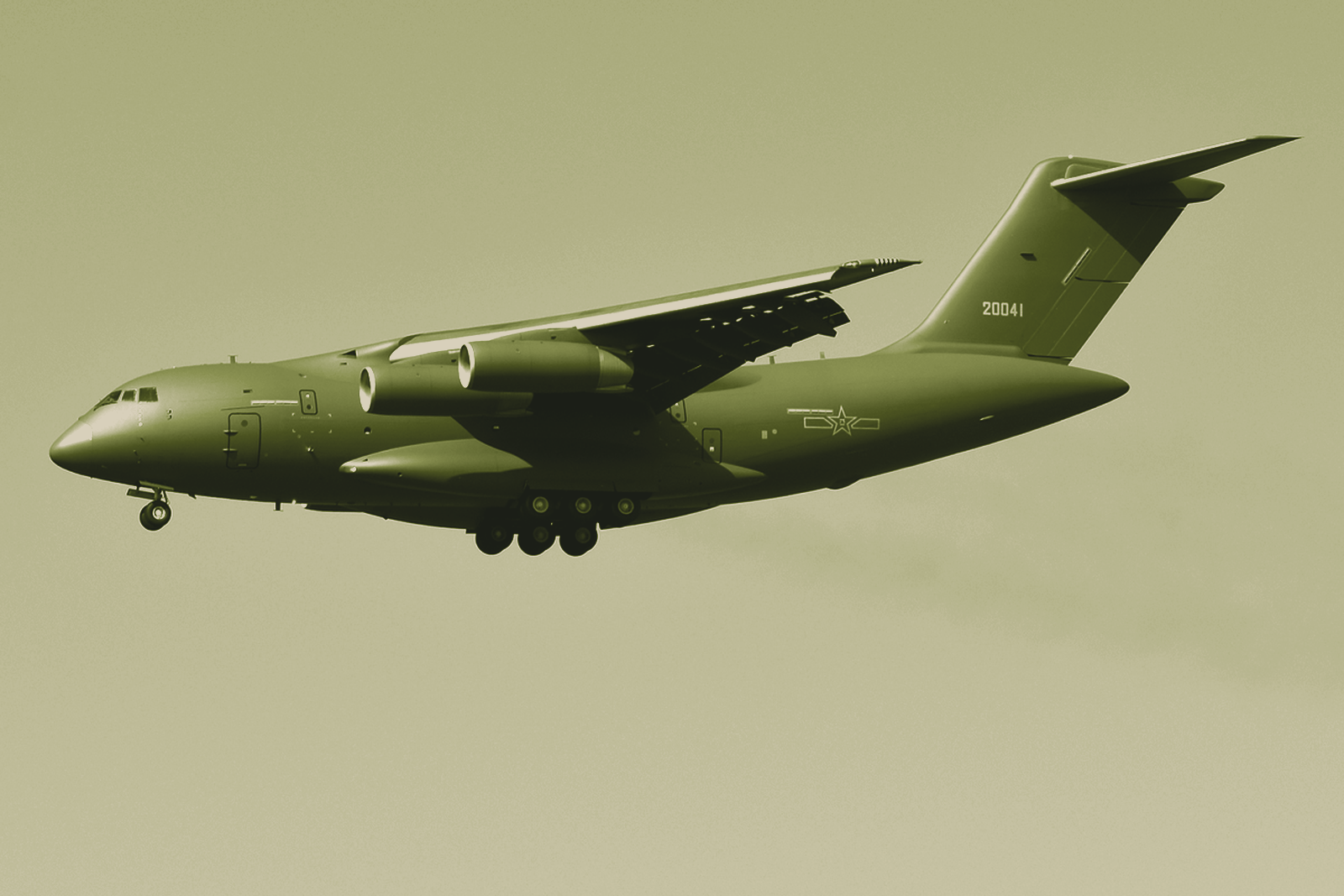
The radar plane for a stealth war — the KJ-3000 (a community designation; Beijing has acknowledged nothing) is China's next-generation airborne early warning and control aircraft: a heavyweight built on the Y-20B airlifter, flying since December 2024 with an aerial-refueling probe for persistent orbits and a radome analysts still argue about. The Pentagon's December 2025 China report says it "will probably be the world's first model to use digital radar"; Chinese state-media channels claim it tracks F-35s at 360 kilometers. One airframe is confirmed, still in primer — and every number in this file is either inference or propaganda.

Overview

The KJ-3000 closes the biggest structural gap in China's air-battle architecture: a modern heavyweight AEW&C. The PLA's radar fleet today is a pyramid with a missing top — some sixty Y-9-based KJ-500s form the mass tier, the carrier-borne KJ-600 is coming for the navy, but the heavy tier has rested on just four Il-76-based KJ-2000s, capped forever by Russian airframe supply that dried up two decades ago. The KJ-3000 solves that with an indigenous airframe: the WS-20-powered Y-20B — China's own strategic airlifter (see Y-20) — carrying a large dorsal radome, dense antenna farms, a tail-base ram-air inlet read as electronics cooling, and an aerial-refueling probe that signals persistent, tanker-extended orbit doctrine over Indo-Pacific distances. First photographed on 26–27 December 2024 — the same extraordinary week as the J-36 and J-50 reveals — the sole confirmed prototype (serial 7821) progressed through steadily clearer imagery in 2025 into what analysts read as integrated-systems testing. The assessed mission is double: counter-stealth early warning (the state-media framing claims 360+ km detection of F-35-class targets — unverifiable) and, more consequentially, the battle-management node for a networked air force whose sixth-generation fighters and CCA drones will need exactly this kind of quarterback. The Pentagon's hedged assessment — "will probably be the world's first model to use digital radar… capable of anti-jamming, passive detection, and target identification" — is the closest thing to an official specification this aircraft has.

Development

The KJ-3000's public record is spotter photography with dates attached — program events are invisible. A Y-20-based AEW&C had been anticipated for years, gated (analysts assess) on the WS-20 high-bypass engine that turned the Y-20A into the Y-20B around 2020, providing the fuel efficiency and electrical margin a radar platform demands. The reveal came on 26–27 December 2024: small, blurry images of a Y-20B with a big rotodome and tail bulge, with veteran PLA-watcher Andreas Rupprecht reporting the type had "performed its maiden flight" at Xi'an Aircraft Corporation's Yanliang plant, per TWZ — landing in the same news cycle as China's two sixth-generation fighter debuts, a triple reveal nobody reads as coincidence. Follow-up imagery a day later showed the refueling probe and prompted Rupprecht's read of a rotodome housing two AESA arrays rather than the KJ-2000's fixed three — a configuration debate still unresolved. Through 2025 the picture sharpened: the best ground image yet in May (serial 7821, primer coat, antenna farm, cooling inlet), a high-resolution airbase photo in June, Janes' assessment of improved radar configuration, and sightings through October and late December 2025 that suggest the move from airworthiness trials into systems testing — the aircraft still unpainted throughout. The December 2025 Pentagon China Military Power Report confirmed the 2024 debut flight and delivered the headline forecast: probably the world's first digital-radar AEW&C, per FlightGlobal. Reports of a second prototype in 2026 and IOC projections of 2026–27 rest on aggregator-tier outlets and are treated here as unconfirmed.

Design & capabilities

Everything below is imagery inference, US assessment or Chinese claim — labeled. The platform choice is the strategic fact: the Y-20B brings four WS-20 turbofans (~138 kN class), indigenous supply at scale, transcontinental endurance, and the electrical generation a power-hungry radar demands — ending the airframe famine that froze the KJ-2000 fleet at four. Imagery supports: a large dorsal radome visibly bigger than the KJ-500's; an in-flight refueling probe above the cockpit (persistent-orbit CONOPS — an AEW&C that tankers can keep aloft across Pacific timelines); dorsal antenna arrays suggesting extensive communications/ELINT fit; and the tail-base ram-air inlet assessed as cooling for a serious electronics load. The radar architecture is genuinely unresolved: Rupprecht's early read was a rotodome with two AESA faces (a rotating-electronic hybrid in the E-7-and-beyond idiom); others argue a fixed triple-array like the KJ-2000/KJ-500; later accounts describe conformal fuselage arrays plus the dome — TWZ's honest verdict is that it "cannot be confirmed." The Pentagon's forecast layer adds digital radar architecture (software-defined, element-level digitization — the direction every next-generation radar is headed), anti-jamming, passive detection and target identification: capabilities that, if real, aim squarely at the low-observable, EW-saturated air war the F-35 and B-21 define. The claim layer — 360+ km detection of stealth fighters, 600–1,000 km against conventional targets, ~100 simultaneous tracks — traces to Chinese state-media channels and internet diagrams, and is printed here only as the counter-stealth message Beijing wants received. What needs no claims: higher altitude than any turboprop AEW&C means better look-down reach, and a networked PLA with J-36/J-50-class fighters and parade-revealed CCA drones needs exactly this node to function as a system.

Variants

  • Prototype 7821 — the only confirmed airframe; in primer through late December 2025; progressing from airworthiness to systems testing (assessed).
  • Second prototype — reported in 2026 by aggregator-tier outlets; unconfirmed.
  • No variant tree, block structure or naval/export version exists publicly. TWZ flags Pakistan (an existing Chinese-AEW&C operator) as a plausible eventual export customer — analyst speculation only.
  • Family context: KJ-2000 Mainring (heavy tier predecessor, 4 aircraft), KJ-500 (mass tier, ~60), KJ-600 (carrier tier, in test) — the KJ-3000 tops a deliberately multi-track AEW&C build-out no other air force currently matches.

Combat record / operational use

None — a flight-test aircraft, unacknowledged by its own government. Its operational meaning is anticipatory and already visible in force design. For the PLA, the KJ-3000 is the enabling node of the system-of-systems its December-2024 reveals sketched: sixth-generation fighters, loyal-wingman UCAVs, very-long-range air-to-air missiles (the PL-17 class exists to be cued by someone else's radar), and now the flying command post that fuses them — with tanker support extending orbits past the first island chain. For the US and allies, it is the aircraft that complicates every stealth-dependent CONOPS: even partial counter-stealth performance at altitude, networked to PL-17 shooters, forces F-35 and B-21 mission planning to treat Chinese early warning as a moving, hard-to-kill system rather than a mapped site — which is why AEW&C killers (very-long-range missiles, penetrating counter-air) headline both sides' development. The test cadence itself — steady sorties across 2025, imagery evidently tolerated — follows the now-familiar Chinese pattern of capability signaling by spotter photo, on the same footing as the J-50: shown enough to deter, hidden enough to stay unverifiable.

Advantages

  • Indigenous heavy airframe at last — the Y-20B ends the Il-76 bottleneck that capped China's heavy AEW&C fleet at four for twenty years; production is now a budget decision, not a Russian one.
  • Persistent-orbit design — refueling probe plus turbofan endurance means station times measured in shifts, at Pacific distances.
  • Digital-radar leapfrog (if the Pentagon is right) — element-level digitization would put the KJ-3000 architecturally ahead of every fielded Western AEW&C, including early E-7s.
  • The network's missing node — the piece that turns J-36/J-50/CCA hardware into a fighting system.
  • Altitude and power margins — jet altitude beats every turboprop competitor on radar horizon; four WS-20s feed a growth-capable electrical budget.

Drawbacks / limitations

  • Nothing is verified — designation, radar configuration, performance and timeline are all inference; the radome's own architecture is disputed among the best-sourced observers.
  • One airframe in primer — a single confirmed prototype 18 months into test is a program in its infancy, whatever the IOC speculation says.
  • The claims are propaganda-shaped — 360 km counter-stealth figures come from the same state-media channels that inflate every Chinese system; printing them as fact is the error this entry exists to prevent.
  • Big, precious, targetable — a heavyweight AEW&C is the priority target of every very-long-range missile both sides are building; survivability doctrine is unproven.
  • Radar pedigree unknown — the developer isn't publicly established, and digital-radar ambition is exactly where programs slip years.

Counterparts

The lineage runs through China's own fleet: the KJ-2000 Mainring it succeeds (Il-76-based, fixed triple AESA, four built), the KJ-500 mass tier it will command, and the Y-20 that makes it possible. Russia's A-50 Mainstay is the cautionary mirror — the same Il-76 basis, now a war-attrited, upgrade-starved fleet whose A-100 successor is stuck in development hell; China's multi-track AEW&C build-out versus Russia's stagnation is among the sharpest illustrations of their diverging air power trajectories. The Western comparison set: the E-7 Wedgetail (the US/UK/NATO answer, itself years from USAF service), Saab's GlobalEye (the high-end mid-size NATO just selected), and the retiring E-3 generation the KJ-2000 once imitated. If the Pentagon's digital-radar forecast holds, the KJ-3000 would be the first fielded AEW&C of the post-E-7 architectural generation — a sentence worth sitting with: in the aircraft category that defines air-battle awareness, the newest design flying belongs to China.

Outlook

Watch the KJ-3000 the way this lexicon watches the J-50 — by imagery cadence and configuration tells, not announcements. The markers: paint (a PLAAF scheme and unit markings on 7821 would signal transition toward delivery); a confirmed second airframe from TWZ/Janes-tier analysis (the aggregator claims need better sourcing); radome resolution — one clear rotation-visible video settles the two-array/three-array/conformal debate and with it much of the architecture question; CMPR language evolution in December 2026 (from "will probably be" toward fielded-capability phrasing); and basing — appearance at an operational AEW&C base rather than test fields. Export watch: a Pakistani or Gulf appearance of KJ-3000 marketing would follow the KJ-500's path and matter for every F-35 operator's threat model. The strategic read is already stable: China is building the reconnaissance-strike complex's command layer on its own airframe at its own tempo, and the KJ-3000 — however its radome resolves — marks the moment the PLA's biggest air-battle dependency stopped being foreign. For BattlePolicy readers tracking the sixth-generation race through our J-36, J-50 and F-47 files, this is the aircraft that makes China's side of that race a system — and systems, not prototypes, win air wars.

Key specifications

No official data exists. Entries are imagery inference, Pentagon assessment (labeled), or Chinese state-media claims (labeled).

Spec Value
Crew Not established (heavyweight AEW&C mission crew assumed)
Length / wingspan Y-20B baseline (~47 m / ~50 m class)
Max speed Y-20B class (high subsonic)
Service ceiling Jet AEW&C class (above turboprop competitors)
Combat radius / range Extended via aerial-refueling probe (observed); Y-20B endurance baseline
Payload Large dorsal radome; dense antenna arrays; tail-base cooling inlet (observed)
Hardpoints None
Radar / sensors Configuration disputed — rotodome w/ two AESA faces (Rupprecht) vs fixed triple-array vs conformal hybrid; Pentagon: "probably the world's first digital radar," anti-jam, passive detection (forecast)
Powerplant 4 × WS-20 high-bypass turbofans (~138 kN class)
Detection claims 360+ km vs stealth / 600–1,000 km conventional / ~100 tracks — Chinese state-media claims, unverifiable
Status Prototype 7821 in flight test since Dec 2024 (still in primer late 2025); 2nd prototype and 2026–27 IOC unconfirmed

Sources

  1. China's New Domestically Developed Y-20 Airborne Early Warning Jet Spotted — TWZ
  2. China's New KJ-3000 Airborne Early Warning Radar Jet Seen In Detail — TWZ
  3. New imagery of China's KJ-3000 reveals key features — Janes
  4. Pentagon report highlights China's sixth-generation fighter progress — FlightGlobal
  5. Pentagon report: China sixth-generation fighters and AEW&C — Air Data News
  6. First photos of Chinese KJ-3000 AEW aircraft — The Aviationist
  7. China's KJ-3000: clearest image yet — The Aviationist
  8. China makes progress in development of KJ-3000 — Army Recognition
  9. China's new AEW&C: a clear signal (state-media claims flagged) — Grey Dynamics
  10. New images of the KJ-3000 — Zona Militar
🔒 The Analyst Section on KJ-3000 is for BattlePolicy Pro members. Below the line: procurement and contract history, the suppliers and companies behind the system, our head-to-head analyst view of the systems it actually competes with, and the BattlePolicy assessment note. Unlock the full file with BattlePolicy Pro →
Related