KF-21 Boramae
South Korea's indigenous 4.5-generation twin-engine fighter—a semi-stealth, AESA-equipped multirole platform designed to replace legacy ROKAF jets and compete for export orders among nations that cannot obtain the F-35.
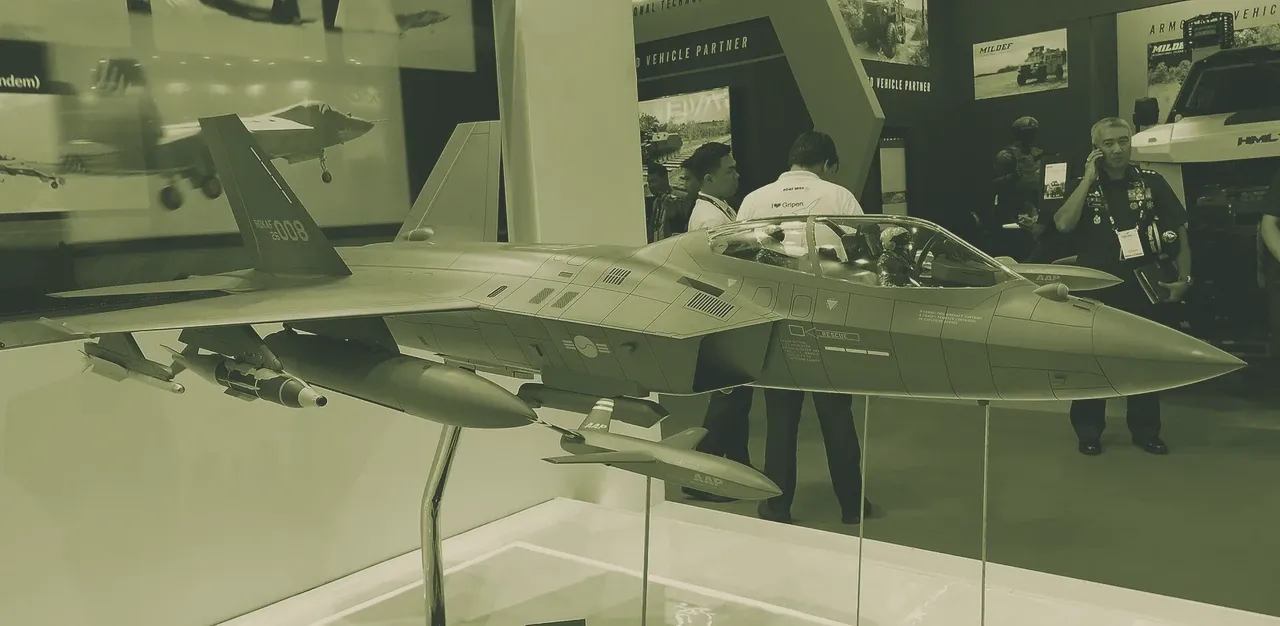
South Korea’s indigenous 4.5-generation twin-engine multirole fighter—blending semi-stealth shaping, an AESA radar, and an aggressive price to replace aging ROKAF fleets and open an export lane for nations locked out of the F-35.
Overview
The KF-21 Boramae (Korean for “Fighting Hawk”) is a twin-engine supersonic multirole fighter developed by Korea Aerospace Industries (KAI) under the direction of the Agency for Defense Development (ADD) and the Defense Acquisition Program Administration (DAPA). It is the first South Korean-designed aircraft to incorporate a low-observable airframe and an indigenous active electronically scanned array (AESA) fire-control radar, making the Republic of Korea the fourth nation after the United States, China, and Russia to produce a fighter with built-in stealth-architecture avionics. The Block I variant, focused on air-to-air superiority, is now in serial production; the Block II will add air-to-ground and anti-ship capabilities, while the Block III/EX concept aims for full internal carriage and sixth-generation networked combat. The aircraft is intended to replace the ROKAF’s fleet of F-4 Phantom II and F-5 Tiger II fighters, and to win export orders from countries that cannot acquire the F-35 due to cost or political restrictions.
Development
The KF-X programme was first proposed by President Kim Dae-jung in March 2001. After a long series of feasibility studies, technology-transfer negotiations, and a contentious 2015 deal with Lockheed Martin for F-35 co-production technology—where 25 core technologies were later blocked by the United States—KAI was formally selected as prime contractor in January 2016 and signed the full-scale development contract in the same year. Indonesia joined as a development partner with a 20% stake, although that participation later shrank significantly due to missed payments. The first prototype was unveiled at KAI’s Sacheon plant in April 2021, and the maiden flight occurred on 19 July 2022, according to Wikipedia. Prototype No. 2 broke the sound barrier in January 2023. The six-aircraft test fleet logged over 2,000 sorties covering supersonic performance, weapon separation trials (Meteor, IRIS-T, AMRAAM, JDAM), and full AESA radar integration. Serial production began in July 2024, and the first production airframe—a twin-seat Block I—rolled out in March 2026, completing its first flight on 15 April 2026, as reported by Aviation Week. DAPA approved Final Combat Suitability in May 2026, clearing the path for the ROKAF’s initial operational capability planned for September 2026.
Design & capabilities
The KF-21 is built around a semi-stealth airframe geometry and radar-absorbent materials that reduce the radar cross-section below that of a conventional 4.5-generation fighter, though Blocks I and II lack internal weapons bays. External stores carriage degrades the low-observability advantage, a limitation that the planned Block III/EX is intended to address. The core sensor is the Hanwha Systems indigenous AESA multi-function fire-control radar, whose first mass-production unit was rolled out in August 2025 and entered its final evaluation phase in January 2026, according to The Defense Post and Zona Militar. An infrared search and track (IRST) system complements the radar. The aircraft is powered by two General Electric F414-GE-400K afterburning turbofans, each providing 97.9 kN of thrust, license-produced by Hanwha Aerospace; this powerplant choice retains US export-approval authority over third-country sales, a structural dependency that South Korea aims to mitigate through a future indigenous engine programme, as noted by GlobalSecurity.org. The payload capacity is 7,700 kg spread across 10 hardpoints (6 under-wing, 4 under-fuselage). The aircraft integrates MBDA Meteor, IRIS-T, AIM-120C AMRAAM, and AIM-9X Sidewinder air-to-air missiles, while Block II will add the Korean-developed Cheonryong cruise missile and a range of precision-guided bombs. The single-seat and twin-seat configurations allow operational flexibility, and the fly-by-wire flight controls and open-architecture mission computer are designed for future growth into unmanned teaming and AI-enabled sixth-generation roles, as detailed in a Janes roadmap announcement from May 2026.
Variants
- KF-21 Block I: air-superiority baseline with AESA radar, semi-stealth airframe, and Meteor/AMRAAM/IRIS-T armament. In serial production; 40 ordered for ROKAF, with an additional 20 authorized in June 2025.
- KF-21 Block II: multirole version adding air-to-ground and anti-ship capability, including the KALCM Cheonryong cruise missile, JDAM, and SDB-class munitions. Development expected to complete by early 2027, with 80 aircraft planned for delivery through 2032.
- KF-21 Block III / KF-21EX: full-stealth concept featuring internal weapons bays, enhanced AESA, AI-enabled mission system, and unmanned teaming. Requires new international financing partners; timeline not yet publicly established.
Combat record / operational use
The KF-21 has not yet been used in combat. The ROKAF is scheduled to declare initial operational capability in September 2026. The flight-test programme—spanning six prototypes and more than 2,000 sorties—demonstrated supersonic dash, weapon-release accuracy, and sensor fusion under operational-representative conditions. Prototype No. 6 validated the AESA radar’s air-to-ground modes in May 2026, according to The Defense Watch, and DAPA’s combat suitability sign-off that month triggered the transition from development to initial frontline service. The first production aircraft’s flight in April 2026 marks the beginning of the operational delivery phase. In parallel, the transfer of the fifth prototype to Indonesia in April 2026 closed a longstanding financial dispute and set the stage for the first export negotiation, as covered by The Defense Post and FlightGlobal.
Advantages
- First South Korean-designed aircraft to achieve supersonic flight with an indigenous AESA radar, a sovereign industrial milestone that eliminates reliance on foreign radar export approvals.
- Cost competitiveness: Block I at approximately $83 million per unit—roughly half the export price of the F-35A—positions the KF-21 as an affordable 4.5-generation choice for nations priced out of fifth-generation platforms, per South Korean authorities disclosed in Clash Report.
- The programme met its schedule without the major delays that plagued other Asian indigenous fighters; combat suitability was declared in May 2026, building export credibility.
- The open-architecture mission computer and AI-enabled roadmap (Block III/EX) offer a path to sixth-generation networking and unmanned teaming, enhancing long-term upgrade potential.
- Dual-use diplomacy: the development-partner model with Indonesia provides a hedge for allied procurement and a framework for industrial cooperation that could attract other Southeast Asian partners.
Drawbacks / limitations
- Blocks I and II lack internal weapons bays; external stores significantly increase the radar cross-section, preventing the KF-21 from achieving the full stealth signature of the F-35 or J-20. Block III would correct this, but it remains unfunded.
- Engine dependency on the US-designated F414-GE-400K gives Washington veto power over third-country sales, a risk highlighted by GlobalSecurity.org. An indigenous engine programme exists, but no timeline is publicly established.
- The partnership with Indonesia was marred by chronic budget shortfalls: Jakarta paid only 536 billion won of a 1.6 trillion won commitment, reducing its stake to 7.5% and complicating financial credibility, according to The Defense Post.
- Service ceiling (~16,700 m) and combat radius (~1,000 km) are competitive with the F-16V and Rafale but fall well short of the Typhoon and F-35 in both parameters.
- No export order has yet been signed; the first prospective deal with Indonesia is still under negotiation, leaving the fighter’s international market position unproven.
Counterparts
- F-35 Lightning II (NATO) — fifth-generation multirole stealth fighter, the standard-setter in capability but far more costly and politically restricted.
- J-35A (China) — Chinese fifth-generation multirole fighter, a direct competitor in the Asian export market with full stealth but limited combat pedigree and a separate supply-chain dependency.
Outlook
The KF-21 enters service as a highly capable, cost-conscious alternative in a market dominated by the F-35 and increasingly contested by the Chinese J-35. Its immediate success depends on the ROKAF’s rapid operational uptake and the finalisation of the Indonesia export deal; that signature would unlock marketing momentum with the Philippines, Malaysia, and possibly NATO nations seeking affordable top-up fleets. Block II’s air-to-ground capability, expected by early 2027, will substantially broaden its appeal. The Block III stealth-and-AI roadmap signals long-term ambition, but its realisation hinges on assembling new financial partners and navigating US export-control constraints on the engine. The programme’s ability to convert its on-time development performance into a credible international order book will shape whether the Boramae becomes a fixture of the Indo-Pacific fighter market or a niche national capability.
Key specifications
| Spec | Value |
|---|---|
| Crew | 1 (single seat) or 2 (twin seat) |
| Length / wingspan | 16.9 m / 11.2 m |
| Max speed | Mach 1.81 (approx. 2,200 km/h at altitude) |
| Service ceiling | approx. 16,700 m (54,800 ft) |
| Combat radius / range | approx. 900–1,000 km (combat radius); ferry range 2,900 km |
| Payload | 7,700 kg external |
| Hardpoints | 10 (6 under-wing, 4 under-fuselage) |
| Radar / sensors | Hanwha Systems indigenous AESA multi-function radar; IRST |
| Powerplant | 2 × General Electric F414-GE-400K afterburning turbofan (license-produced by Hanwha Aerospace), 97.9 kN each |
| Armament | 20 mm M61A2 cannon; Meteor, IRIS-T, AIM-120C, AIM-9X; Block II adds Cheonryong cruise missile, JDAM/SDB |
Sources
- Wikipedia — KAI KF-21 Boramae. https://en.wikipedia.org/wiki/KAI_KF-21_Boramae
- The Defense Watch — KF-21 Boramae: South Korea’s 4.5-Gen Fighter Is Combat-Ready (May 2026). https://thedefensewatch.com/aerospace-aviation/kf-21-boramae-south-koreas-4-5-gen-fighter-is-combat-ready/
- Hanwha Systems — KF-21 AESA Radar product page. https://www.hanwhasystems.com/en/business/defense/isr/radar01-aesa.do
- Aviation Week — KAI KF-21 Production Aircraft Completes First Flight (April 2026). https://aviationweek.com/defense/aircraft-propulsion/kai-kf-21-production-aircraft-completes-first-flight
- The Defense Post — South Korea to Transfer KF-21 Fighter Jet Prototype to Indonesia (April 2026). https://thedefensepost.com/2026/04/08/south-korea-kf21-indonesia/
- FlightGlobal — Indonesia to order 16 KF-21 fighters during presidential visit: Yonhap (March 2026). https://www.flightglobal.com/fixed-wing/2026/03/indonesia-to-order-16-kf-21-fighters-during-presidential-visit-yonhap/
- Clash Report — South Korea Prices KF-21 Fighter Jet (January 2026). https://clashreport.com/defense/articles/south-korea-prices-kf-21-fighter-jet-6yya1ygeex
- The Defense Post — Hanwha Unveils Mass Production AESA Radar for South Korea’s KF-21 Jet (August 2025). https://thedefensepost.com/2025/08/08/korea-kf21-aesa-radar/
- Zona Militar — The KF-21 fighter’s new AESA radar enters final phase of testing and evaluation (January 2026). https://www.zona-militar.com/en/2026/01/31/the-kf-21-fighters-new-aesa-radar-for-the-south-korean-air-force-enters-its-final-phase-of-testing-and-evaluation/
- GlobalSecurity.org — KF-21 Boramae (engine section). https://www.globalsecurity.org/military/world/rok/kf-21.htm
- Janes — South Korea outlines KF-21 roadmap for AI-enabled sixth-generation capabilities (May 2026). https://www.janes.com/defence-intelligence-insights/defence-news/defence/south-korea-outlines-kf-21-roadmap-for-ai-enabled-sixth-generation-capabilities
- MSN / Janes — First production KF-21 Boramae rolled out of factory in South Korea (March 2026). https://www.msn.com/en-us/money/other/first-production-kf-21-boramae-rolled-out-of-factory-in-south-korea/ar-AA1ZsThz