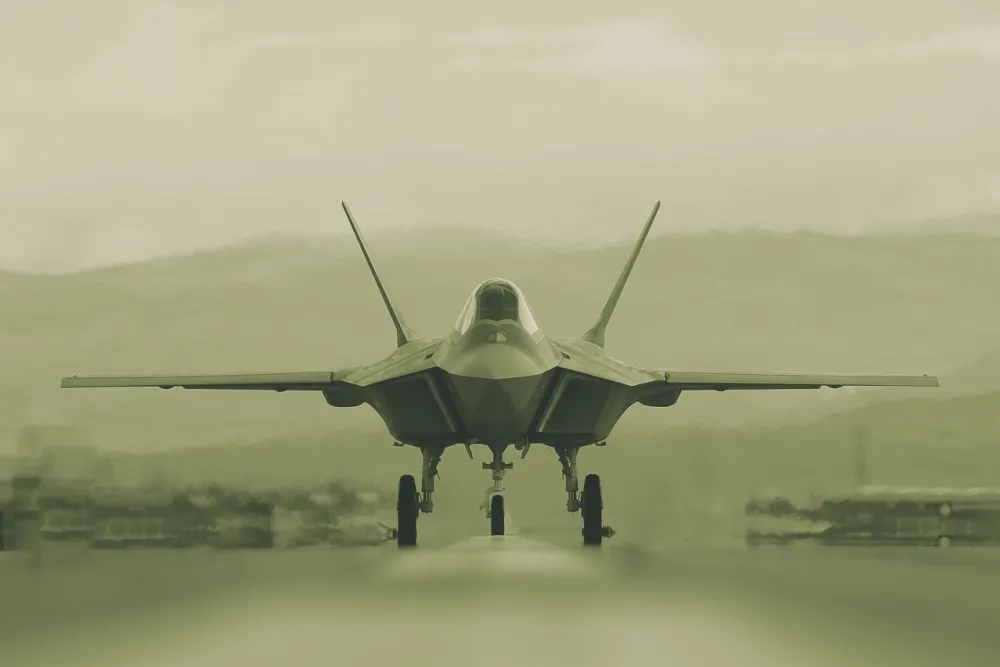
The TAI KAAN is Turkey's indigenous fifth-generation fighter — flown in prototype form in February 2024, contracted for its first 20 production jets in May 2026, and already exported: Indonesia signed for 48. Its schedule still hinges on US-supplied F110 engines.
The Shenyang J-50 (J-XDS) is China's second sixth-generation fighter prototype — a tailless, twin-engine lambda-wing jet with swiveling wingtips, first observed 26 December 2024, the same day as the Chengdu J-36. Beijing has never acknowledged it; everything known is OSINT.
The Boeing F-47 is the US Air Force's sixth-generation NGAD fighter — the planned F-22 successor, awarded March 2025, with a claimed 1,000+ nautical mile combat radius and Mach 2+ speed. The first airframe is in build in St. Louis; first flight is targeted for 2028.
India's home-built fighter — four decades in the making — the Tejas is a light, agile single-engine delta jet that finally gave India an indigenous combat aircraft. The Mk1A adds AESA radar and beyond-visual-range missiles; the bigger Mk2 is coming. The flagship of India's defence self-reliance.
The affordable fighter conquering the export market — KAI's FA-50 is a light, supersonic combat jet (born from the T-50 trainer) that delivers much of an F-16's mission at a fraction of the cost. Poland, the Philippines and Malaysia are buying it; Block 20 jets add AESA radar and aerial refuelling.
The big Soviet air-superiority fighter built to out-range the F-15 — and the parent of the entire Flanker dynasty. Ukraine's pre-war top fighter, now an outclassed but still-fighting workhorse that flew night intercepts in the war's first hours and later flexed into a Western-bomb truck.
The Soviet lightweight fighter both sides fly — and the one Ukraine famously hot-rodded, bolting American HARM and JDAM and French Hammer onto a 1970s airframe with an iPad in the cockpit. Agile, short-legged, and attrition-heavy, it became an improvised SEAD jet over Ukraine.
South Korea's indigenous 4.5-generation twin-engine fighter—a semi-stealth, AESA-equipped multirole platform designed to replace legacy ROKAF jets and compete for export orders among nations that cannot obtain the F-35.
The world's first operational fifth-generation fighter — an all-aspect stealth, supercruise, thrust-vectoring air-dominance jet that remains the US Air Force's premier air-superiority asset, from the 2014 ISIS debut to the 2023 spy-balloon kill and the 2025–26 Iran crisis.
The Su-30SM — Russia’s twin-seat, thrust-vectoring multirole Flanker — combines long-range strike and air superiority with a dedicated weapons-system officer, and forms the backbone of Russian and several allied air forces.
The budget fighter shaking up the market — the China-Pakistan JF-17 Thunder gives developing air forces a cheap multirole jet, and the Block 3 adds an AESA radar and long-range PL-15 missiles. Pakistan's frontline fighter, widely exported and combat-used against India in 2025.
China's homegrown heavy multirole strike fighter — a twin-seat, twin-engine Flanker derivative packing an AESA radar and very-long-range air-to-air missiles, and the PLAAF's primary deep-strike and standoff platform.
China's workhorse 4.5-generation single-engine multirole fighter — a delta-canard design with an AESA radar, active in PLAAF and Pakistani service, and credited with the type's first air-to-air kill in 2025.
Russia’s most advanced operational 4++ generation air-superiority fighter — a thrust-vectoring Flanker derivative with a powerful PESA radar and heavy weapons load, and the backbone of Russia’s air war over Ukraine.
France's omnirole 4.5-generation twin-engine fighter — operational from land and carrier decks, nuclear-capable, and a mainstay of French and several export air forces.
The F-15EX Eagle II is a 4.5-generation heavyweight twin-engine fighter derived from the Strike Eagle / QA, built to haul extreme payloads of air-to-air and standoff munitions, and to serve as the USAF’s new homeland-defense and high-end missile truck.
The world's most widely operated fourth-generation multirole fighter, continuously upgraded for over four decades, now fielded in its latest Block 70/72 "Viper" configuration with active electronically scanned array radar and network-enabled avionics.
China's first operational fifth-generation stealth fighter — a twin-engine, low-observable air-superiority platform fielded exclusively by the PLAAF, with a growing fleet estimated at over 200 aircraft and an emerging maritime-strike capability.
Russia's first purported 5th-generation stealth fighter, designed for air superiority and multirole missions. Despite a protracted development, it has entered service in limited numbers and seen restricted use over Ukraine, primarily for standoff strikes.