Eurofighter Typhoon
Pan-European 4.5-generation canard-delta multirole fighter — the air superiority and strike backbone of four NATO air forces, in service since 2003.
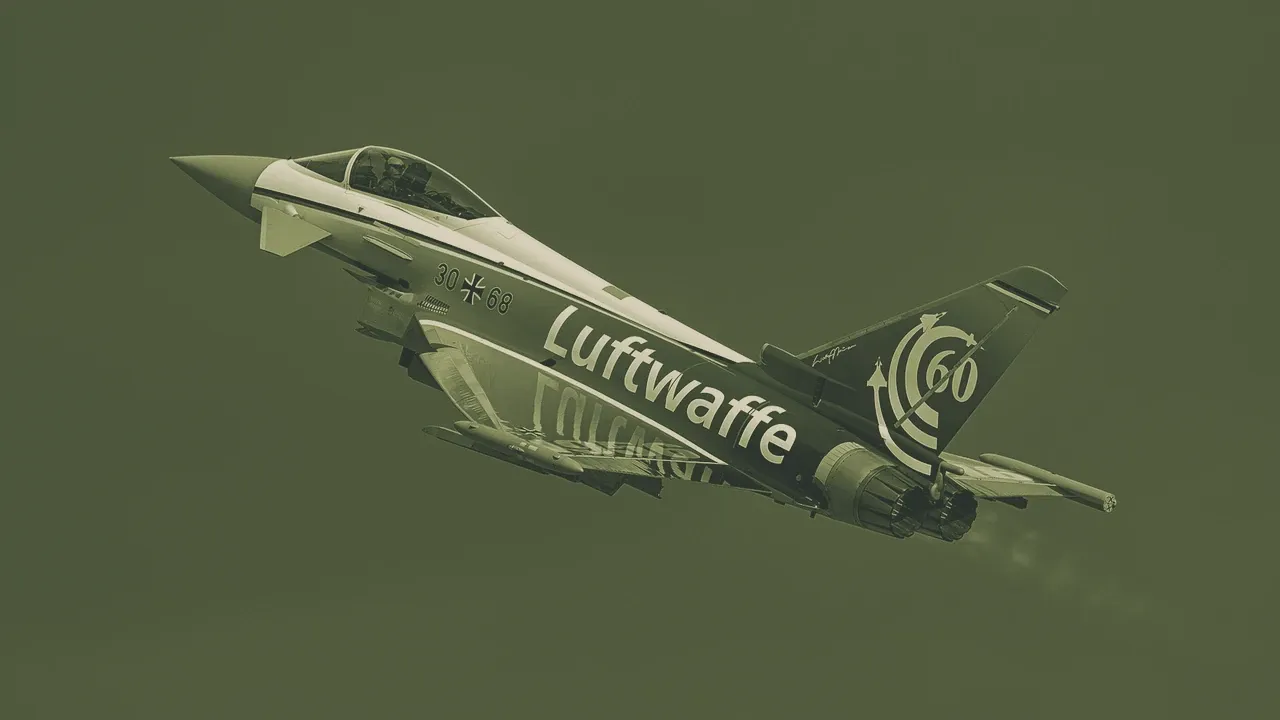
Pan-European 4.5-generation canard-delta multirole fighter — the air superiority and strike backbone of the United Kingdom, Germany, Italy, and Spain, and a cornerstone of NATO’s European airpower since 2003.
Overview
The Eurofighter Typhoon is a twin-engine, canard-delta, multirole fighter developed and produced by a consortium of the United Kingdom, Germany, Italy, and Spain. It entered operational service in 2003–2004 and has since formed the backbone of the partner nations’ fighter forces, with additional exports to Austria, Saudi Arabia, Oman, Kuwait, and Qatar. The aircraft is optimised for high-altitude, high-speed intercepts and swing-role missions, combining long-range Meteor air-to-air missiles with a modern AESA radar, an integrated defensive aids suite, and a large external payload.
Development
The Eurofighter programme was born from multinational collaborative requirements in the 1980s, after earlier national projects (the British EAP and German TKF-90) were merged. The first development aircraft (DA1) from the then-named “EFA” flew on 27 March 1994 Wikipedia. Production deliveries began in 2003, with the first operational units standing up in the partner nations shortly afterward. The aircraft has been built in successive “tranches” (Tranche 1, 2, 3, and now 4), each adding hardware and software increments.
Design & capabilities
The Typhoon uses an unstable canard-delta configuration with quadruplex digital fly-by-wire flight controls for high sustained turn rates and excellent supersonic agility. Two Eurojet EJ200 afterburning turbofans, each producing ~90 kN of reheat thrust, give the aircraft a maximum speed of Mach 2.0 at altitude Eurofighter. The airframe carries 9,000 kg of stores on 13 hardpoints.
The cockpit is fitted with a wide-angle head-up display, a helmet-mounted symbology system, and multi-function colour displays. An advanced sensor suite integrates the Captor-E electronically scanned radar (AESA, on later Tranche 3/4 aircraft), the PIRATE passive infrared search and track (IRST) sensor, and a fully integrated defensive aids sub-system (DASS) for electronic warfare and countermeasures Leonardo. The Typhoon’s open-architecture mission computer facilitates continuous capability upgrades and weapon integration.
Variants
Production is organised by tranche. Tranche 1 (block 2/5) aircraft are limited to air-to-air and basic air-to-ground roles; they are now being retired or used for training. Tranche 2 introduced a more capable mission computer and full multirole capability. Tranche 3 added out-of-service structural provisions and the ability to incorporate the Captor-E AESA radar. The current Tranche 4 (Germany’s Project Quadriga and Spain’s Project Halcon) delivers the full Captor-E radar, new avionics, and further weapon-integration upgrades Airbus. Two-seat variants exist for conversion training and, in some operators, for dedicated strike missions.
Combat record / operational use
The Typhoon has seen combat in multiple theatres. Italian and British Typhoons flew air-to-ground missions during the 2011 intervention in Libya Wikipedia. Royal Air Force Typhoons conducted strike missions against Islamic State targets over Iraq and Syria from 2015, using Paveway IV guided bombs and later Brimstone missiles. The aircraft has also been extensively employed in NATO air-policing missions over the Baltic and Black Sea regions, regularly intercepting Russian military aircraft.
Advantages
- High thrust-to-weight ratio and canard-delta agility produce exceptional air-combat performance.
- The MBDA Meteor ramjet-powered beyond-visual-range missile gives a large no-escape zone against manoeuvring targets.
- The Captor-E AESA radar, combined with PIRATE IRST and DASS, provides robust sensor fusion and electronic protection.
- Swing-role capability allows the same sortie to switch between air-to-air and precision air-to-ground tasks.
- A wide-international operator base sustainably supports through-life development.
Drawbacks / limitations
- Earlier Tranche 1 and many Tranche 2 aircraft lack an AESA radar, limiting engagement of low-observable threats.
- High-end operating costs (though lower than some contemporary types) place demands on smaller air forces.
- No carrier variant exists, restricting operations to land-based runways.
- The aircraft’s large radar signature is greater than modern stealth designs, requiring it to rely on defensive aids and tactics rather than low-observable shaping.
- Full capability of the Captor-E radar is still being rolled out; the legacy mechanically scanned Captor-M remains widespread.
Counterparts
- F-35A Lightning II (USA)
- Su-57 Felon (Russia)
- Dassault Rafale (France) — a comparable European omnirole fighter.
- Saab JAS 39 Gripen E/F (Sweden) — a lighter, single-engine canard-delta alternative.
Outlook
The Eurofighter Typhoon remains in active production and is expected to serve as a lead-in for European 6th-generation efforts (GCAP and SCAF). Tranche 4 deliveries, including 38 aircraft for Germany (Quadriga) and 20 for Spain (Halcon), are securing industrial continuity into the mid-2020s Airbus. Additional export campaigns, including a potential Turkish acquisition, continue to be explored, while partner fleets progressively integrate long-range stand-off weapons, advanced data-links, and upgraded electronic warfare systems to keep the Typhoon operationally relevant into the 2060s.
Key specifications
| Spec | Value |
|---|---|
| Crew | 1 or 2 |
| Length / wingspan | 15.96 m / 10.95 m |
| Max speed | Mach 2.0 (~2,495 km/h) |
| Service ceiling | >16,764 m (55,000 ft) |
| Combat radius / range | Combat radius ~1,389 km (hi-lo-hi ground attack); ferry ~2,900 km |
| Payload | ~9,000 kg |
| Hardpoints | 13 |
| Radar / sensors | Captor-E AESA (ECRS) / PIRATE IRST / DASS EW |
| Powerplant | 2 × Eurojet EJ200 afterburning turbofans, ~60 kN dry / ~90 kN reheat each |
| Armament | 27 mm Mauser BK-27 cannon; Meteor, AIM-120, IRIS-T, ASRAAM AAMs; Storm Shadow/SCALP-EG, Brimstone, Paveway IV A2G |
Sources
- Eurofighter Typhoon — Wikipedia. https://en.wikipedia.org/wiki/Eurofighter_Typhoon
- Eurofighter Typhoon multirole fighter aircraft — Leonardo Aeronautics. https://aeronautics.leonardo.com/en/products/eurofighter-typhoon-multirole-fighter-aircraft
- Performance — Eurofighter Typhoon. https://www.eurofighter.com/the-aircraft/performance
- Eurofighter — Airbus. https://www.airbus.com/en/products-services/defence/military-aircraft/eurofighter