Kh-22
A 1960s anti-ship missile carrying nearly a tonne of explosive at Mach 4.6, fired at cities it was never designed to hit. Its error is measured in hundreds of metres, which is why its record in Ukraine is a record of civilian casualties.
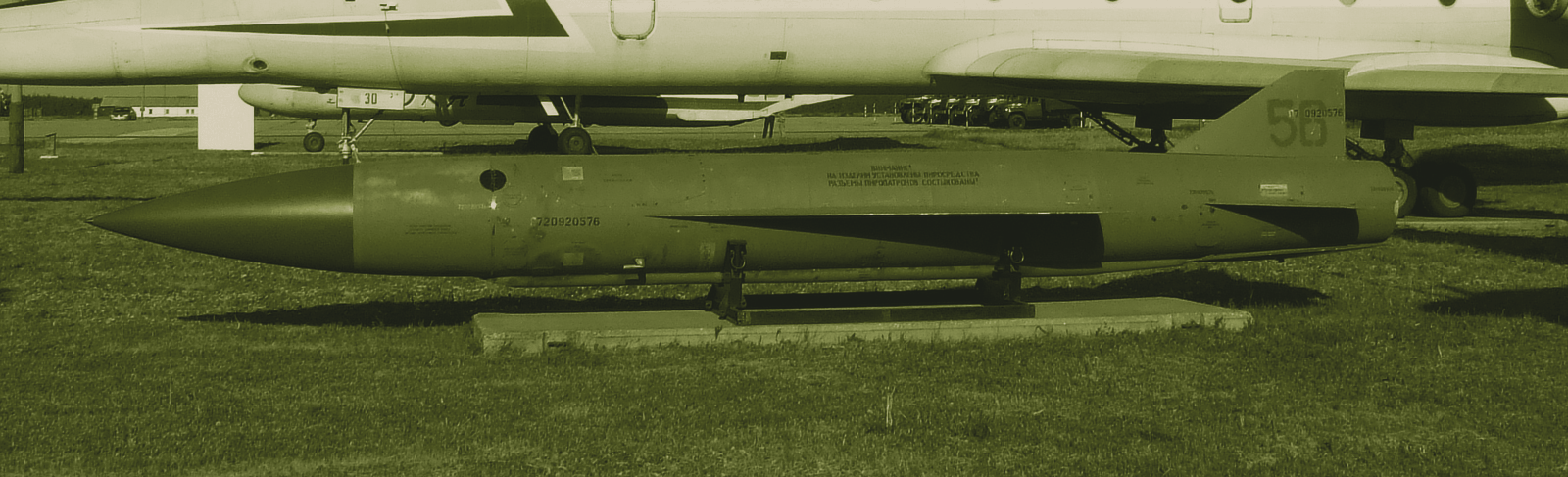
A 1960s anti-ship missile carrying close to a tonne of explosive at Mach 4.6, fired at cities it was never designed to hit. Its miss distance is measured in hundreds of metres and sometimes kilometres, which is why the Kh-22's record in Ukraine reads as a record of civilian casualties rather than of destroyed targets.
Overview
The Kh-22 "Burya", designated AS-4 Kitchen by NATO, is a very large Soviet air-launched missile designed in the early 1960s for one job: destroying American aircraft carriers. It weighs roughly 5,820 kg, carries a warhead of up to 960 kg, climbs to 22.5 km and dives on its target at up to Mach 4.6. Against a carrier battle group detected by radar at sea, that combination of mass and speed made sense, and its guidance — inertial navigation with a primitive radar seeker — was adequate for a target the size of a warship in open water.
Russia has used it against Ukrainian cities. Against a land target the radar seeker has no distinctive return to lock onto, and the missile arrives with an error commonly assessed in the hundreds of metres, with some analyses citing kilometres. The result is a weapon that reliably destroys something within a wide radius of the aiming point but rarely the intended thing — the profile of the Kremenchuk shopping mall strike of 27 June 2022, which killed at least 21 people.
The modernised Kh-32 extends range to around 1,000 km with improved guidance, but remains, in the words of one analysis, "a more advanced — but still inaccurate — version."
Development
The Kh-22 was developed by the Raduga Design Bureau and entered Soviet service in the 1960s as the primary armament of the Tu-22M "Backfire" bomber, aimed squarely at NATO carrier groups. Its design logic belongs entirely to that mission: launch from a supersonic bomber at long range, climb high, accelerate to well beyond Mach 4, then dive steeply. A carrier cannot manoeuvre out of the footprint, and Cold War-era shipboard defences could not reliably engage something arriving that fast from that altitude.
The guidance suite reflects the era. Defence Express describes it as an inertial navigation system built around a gyroscope, paired with a comparatively primitive radar. The PG-10M radar seeker could theoretically lock onto large vessels at up to 50 km and achieve accurate hits against them — against a ship, which is a strong, isolated radar return on a flat sea.
The Kh-32 is a deep modernisation on the same airframe, extending range to 600–1,000 km, raising speed to roughly 5,400 km/h and improving the radar and semi-active guidance. It entered service in the 2010s and Russia has used it against Ukraine, including a first-reported strike on Kyiv in January 2026.
Design & capabilities
The Kh-22's specifications are dominated by scale.
- Launch weight: approximately 5,820 kg — a substantial fraction of a Tu-22M3's payload.
- Warhead: up to 960 kg, or roughly one tonne, conventional high explosive. Nuclear-capable in Soviet configuration.
- Speed: up to Mach 4.6 (~5,600 km/h). The Kh-32 is cited at ~5,400 km/h.
- Range: commonly 460–600 km for the Kh-22, with base variants nearer 330 km. Kh-32 extends to 600–1,000 km.
- Flight profile: climbs to as high as 22.5 km, cruises above most engagement envelopes, then executes a steep terminal dive.
- Guidance: inertial with a gyroscope-based platform plus a radar seeker (PG-10M on the Kh-22). The Kh-32 adds improved radar and semi-active guidance.
- Carrier aircraft: the Tu-22M3 Backfire.
Accuracy is the defining characteristic, and it is bad. Open-source estimates for the Kh-22 against ground targets vary widely but agree on the direction: Ukrainian analysis suggests around half of missiles land within 600 m of the aim point, with deviations often reaching hundreds of metres and sometimes kilometres. One assessment puts CEP above 500 m; another cites 3–5 km against ground targets. Defence Express notes the combination of great destructive power and low accuracy produces frequent collateral damage. Multiple missiles must be launched to have confidence of hitting a specific target.
Variants
- Kh-22 (base): The original anti-ship missile, ~330 km in early configurations, up to ~600 km in later ones, ~960 kg warhead.
- Kh-22N / Kh-22M: Soviet-era subvariants with differing guidance and range.
- Kh-32: The modern deep modernisation — 600–1,000 km, ~5,400 km/h, improved radar and semi-active guidance, a higher-flying profile. Used against Ukraine and reported striking Kyiv in January 2026.
Ukrainian reporting frequently groups the two as "Kh-22/32" because they are difficult to distinguish in flight or from debris.
Combat record / operational use
The Kh-22's use against Ukraine is one of the clearest cases in this war of a weapon being employed outside its design envelope with predictable humanitarian consequences.
The Kremenchuk strike of 27 June 2022 is the reference event: two Kh-22 or Kh-32 missiles struck the Amstor shopping mall, killing at least 21 people. Russia has fired the type repeatedly since, with roughly five further attacks recorded in May 2022 alone and continued use through the following years, generally against cities and infrastructure.
Interception was long considered effectively impossible. Defence Express notes that the missile's Mach 4.6 speed and 22.5 km flight altitude place it outside the engagement envelope of most surface-to-air systems, and Ukrainian sources described both Kh-22 and Kh-32 as very nearly uninterceptable for the first years of the war.
That changed on 24 January 2026. Russia launched 12 Kh-22/Kh-32 missiles at Kyiv, and Ukrainian air defence destroyed nine of them — a result Ukrainian outlets described as unprecedented for the type, against a prior record of near-zero interceptions. The same night's Zircon missiles could not be intercepted. Ukrainian reporting treated the nine kills as evidence of a genuine capability shift, most plausibly attributable to improved Patriot coverage and engagement doctrine against high-altitude, high-speed targets.
Advantages
- Enormous warhead — up to 960 kg of high explosive destroys a structure outright when it lands on one, and produces severe damage over a wide radius when it does not.
- Very high speed — Mach 4.6 leaves little reaction time and defeats most short- and medium-range interceptors.
- High-altitude profile — cruising above 20 km puts it outside the envelope of most SAM systems entirely.
- Steep terminal dive — the attack geometry compresses the engagement window further.
- Existing stockpile — a Soviet-era inventory Russia did not have to produce, fired from an existing bomber fleet.
- Kh-32 extends reach — 1,000 km allows launch from deep inside Russian airspace, far from Ukrainian defences.
Drawbacks / limitations
- Grossly inaccurate against land targets — errors of hundreds of metres are the norm, with some assessments citing kilometres. This is not a precision weapon and cannot be used as one.
- Indiscriminate in effect — a one-tonne warhead landing hundreds of metres off aim in an urban area is a civilian-casualty mechanism, and Kremenchuk is the documented result.
- Requires multiple launches per target — low accuracy means salvos, consuming a finite Soviet stockpile faster.
- Now interceptable — the 24 January 2026 result, nine of twelve downed, ended the assumption of invulnerability.
- Finite stocks — the Kh-22 is not in production; only the Kh-32 modernisation sustains the line.
- Large and heavy — at 5,820 kg it consumes most of a bomber's useful load.
- Requires Tu-22M3 sorties — a small, ageing and attrition-sensitive bomber fleet.
Counterparts
- Kh-59 (Russia) — the precise standoff missile at the opposite end of the same air force's accuracy spectrum.
- Kh-101 (Russia) — the accurate strategic cruise missile Russia uses when the target matters.
- Kh-31 (Russia) — the supersonic anti-radiation and anti-ship missile in a much smaller class.
- Zircon (Russia) — the hypersonic anti-ship missile that remains uninterceptable, unlike the Kh-22.
- P-800 Oniks (Russia) — the modern supersonic anti-ship missile that supersedes the Kh-22 in its intended role.
- Tu-22M3 (Russia) — the carrier aircraft.
Outlook
The Kh-22's remaining significance is as a stock to be expended and as evidence in a legal record. It is not in production, its accuracy cannot be meaningfully improved on the original airframe, and the January 2026 interception result removed the one operational property — invulnerability — that made it worth firing despite the inaccuracy. As Ukrainian Patriot coverage matures, a missile that costs a Tu-22M3 sortie and lands half a kilometre from its aim point becomes a poor use of a scarce bomber fleet.
The Kh-32 is the line that continues, and its 1,000 km range genuinely matters: it permits launch from deep inside Russia against targets across Ukraine, keeping the bombers away from any contested airspace. But the guidance improvement is incremental, and Ukrainian sources continue to describe it as inaccurate.
The more durable legacy is documentary. The Kh-22's employment pattern — a Cold War anti-ship weapon with a one-tonne warhead and hundreds-of-metres error, fired repeatedly into urban areas — is among the better-evidenced examples of indiscriminate weapon use in the war, and the Kremenchuk strike is the case most often cited.
Key specifications
| Spec | Value |
|---|---|
| Type | Heavy supersonic air-launched anti-ship missile, used against land targets |
| Range | ~330 km (base variants) to 460–600 km; Kh-32 600–1,000 km |
| Speed (Mach / km·s⁻¹) | Up to Mach 4.6 (~5,600 km/h); Kh-32 ~5,400 km/h |
| Warhead (type & weight) | Conventional high explosive, up to ~960 kg (approx. one tonne) |
| Guidance | Gyroscope-based inertial plus PG-10M radar seeker; Kh-32 adds improved radar and semi-active guidance |
| Accuracy (CEP) | Poor against land targets — commonly hundreds of metres; estimates range from ~300–600 m to over 500 m, with some assessments citing 3–5 km |
| Launch platform(s) | Tu-22M3 Backfire bomber |
| Propulsion | Liquid-fuel rocket engine |
| Length / diameter / launch weight | ~11.6 m / ~0.9 m / ~5,820 kg |
| Flight altitude | Up to 22.5 km, with a steep terminal dive |
| Interception record | 9 of 12 downed over Kyiv on 24 January 2026 — the first mass interception of the type |
Sources
- Kyiv Independent — "Russia steps up attacks with Kh-32 missiles — here's what we know." https://kyivindependent.com/ukraine-intercepts-nine-kh-32-missiles-what-do-we-know-about-them/
- Militarnyi — "Russia Attacked Ukraine with Kh-22/32 and Zircon Missiles." https://militarnyi.com/en/news/russia-attacked-ukraine-with-kh-22-32-and-zircon-missiles/
- Action on Armed Violence — "Russia's Dirty Dozen: an examination of Russian explosive weapons." https://aoav.org.uk/2026/russias-dirty-dozen/
- Ukrainska Pravda — "Unprecedented case: peculiarity of Russia's Kh-22 missile attack on Kyiv." https://www.pravda.com.ua/eng/news/2026/01/24/8017666/
- RBC-Ukraine — "Kyiv attack: Air Force reports downing of 9 Kh-22 missiles." https://newsukraine.rbc.ua/news/kyiv-attack-air-force-shoots-down-9-kh-22-1770042905.html
- UNITED24 Media — "Russia Strikes Kyiv with Kh-32 Supersonic Missile for the First Time." https://united24media.com/war-in-ukraine/russia-used-the-supersonic-kh-32-missile-in-an-attack-on-kyiv-what-is-it-15300
- GlobalSecurity.org — "Tu-22M BACKFIRE in Ukraine." https://www.globalsecurity.org/wmd/world/russia/tu-22m-svo.htm
- Obozrevatel — "Чим відрізняються між собою ракети Х-22 та Х-32" (citing Defence Express). https://war.obozrevatel.com/ukr/chim-vidriznyayutsya-mizh-soboyu-raketi-h-22-ta-h-32-yakimi-rosiya-periodichno-obstrilyue-ukrainu-foto.htm
🔒 The Analyst Section on Kh-22 is for BattlePolicy Pro members. Below the line: procurement and contract history, the suppliers and companies behind the system, our head-to-head analyst view of the systems it actually competes with, and the BattlePolicy assessment note. Unlock the full file with BattlePolicy Pro →
Below this point
- Analyst Section
- Procurement & contracts
- Suppliers & related companies
- Comparable systems — analyst view
- Analyst note