Kh-31
A ramjet missile that homes on the radar trying to detect it. The Kh-31P is why Ukrainian Patriot crews cannot leave their radars radiating, and why the air-defence problem in Ukraine is as much about emissions discipline as about interceptor stocks.
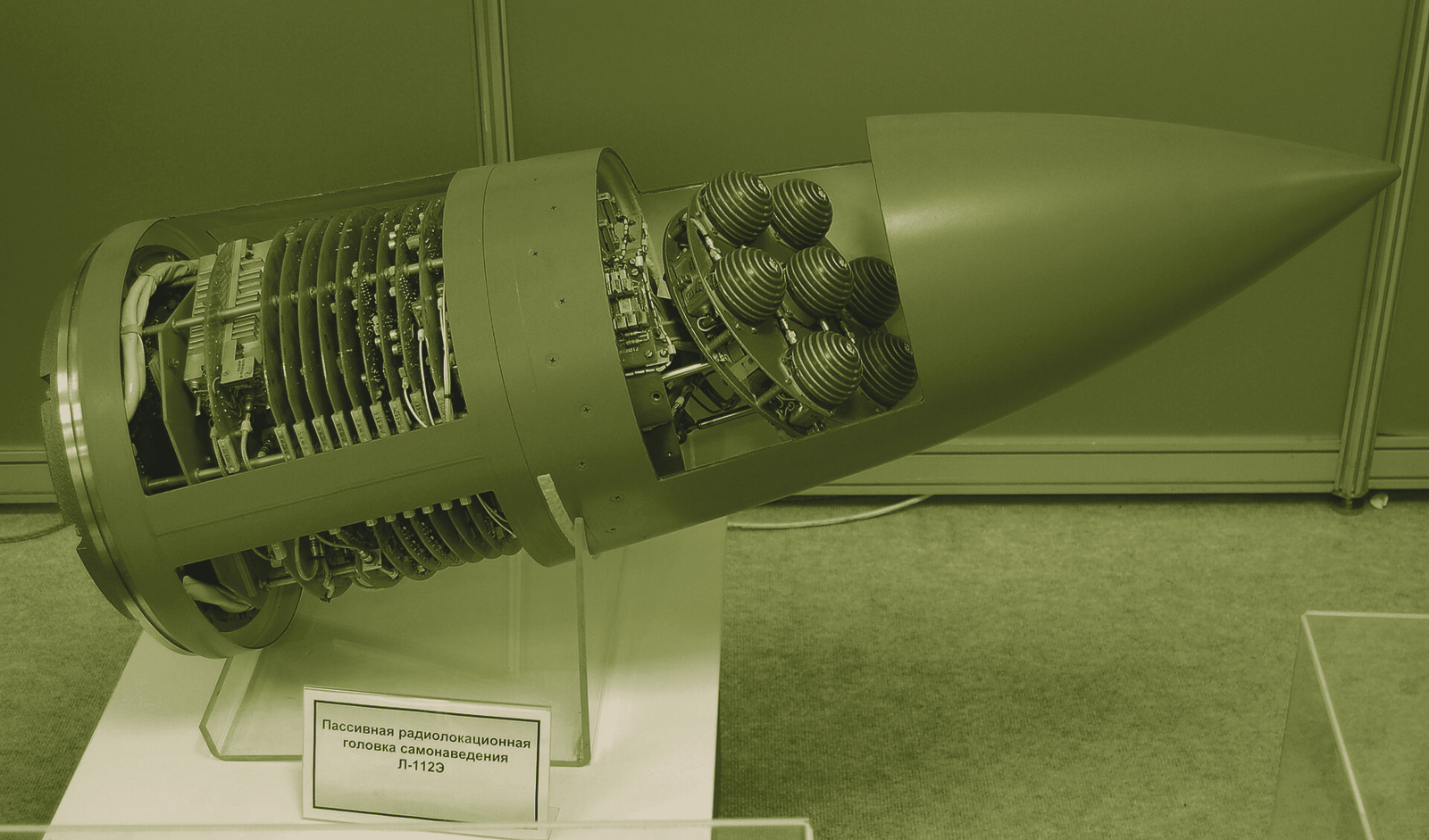
A ramjet-powered missile that homes on the radar trying to detect it. The Kh-31P is the reason Ukrainian Patriot crews cannot leave their radars radiating, and why air defence in Ukraine is as much a problem of emissions discipline as of interceptor stocks.
Overview
The Kh-31, designated AS-17 Krypton by NATO, is a Soviet-designed supersonic missile built around an unusual propulsion arrangement: a solid-fuel rocket booster accelerates it after launch, is discarded, and an integrated ramjet sustainer then carries it to speeds of roughly 1,000 m/s, with later variants assessed at Mach 4 or above. It exists in two fundamentally different guises that share an airframe:
- Kh-31P — the anti-radiation variant, which homes passively on the emissions of enemy air-defence radars. This is a suppression-of-enemy-air-defences (SEAD) weapon.
- Kh-31A — the anti-ship variant, which uses active radar homing against surface vessels.
In Ukraine the Kh-31P is the operationally significant version. Russian Su-35S fighters have been observed carrying Kh-31P and the improved Kh-31PM against Ukrainian radar-dependent systems, including Patriot batteries. It is the weapon that makes radiating expensive.
Development
The Kh-31 was developed by the Zvezda-Strela design house — now part of the Tactical Missiles Corporation (KTRV) — and entered Soviet service in the late 1980s. The design goal was a tactical missile fast enough that a warship's or SAM battery's reaction time would be inadequate, achieved through an integral rocket-ramjet rather than a pure rocket motor. That configuration gives sustained supersonic speed over a long flight rather than a short high-speed boost followed by deceleration.
It has been widely exported, notably to China and India, and a target-drone derivative was purchased by the United States as a supersonic sea-skimming threat simulator — an unusual case of a Russian weapon being bought by the Pentagon to test its own defences.
Development since has focused on range. The baseline Kh-31P reaches about 110 km; the Kh-31PD extends that to 180–250 km on a heavier airframe with a larger warhead. The Kh-31PM is the current improved anti-radiation variant reported in use against Ukrainian air defence in August 2026.
Design & capabilities
The Kh-31's performance derives from its propulsion. A solid-fuel booster occupies the rear of the missile body and burns out after launch; four air intakes then open and a ramjet sustainer takes over, using atmospheric oxygen rather than carried oxidiser. This is what allows a missile of moderate size to hold supersonic speed over 100 km or more.
| Variant | Role | Range | Launch mass | Warhead |
|---|---|---|---|---|
| Kh-31P | Anti-radiation (SEAD) | 15–110 km | 586–600 kg | 87–90 kg HE-fragmentation |
| Kh-31PD | Anti-radiation, extended | 180–250 km | ~715 kg | ~110 kg |
| Kh-31PK | Anti-radiation | 110–160 km | ~605 kg | Increased |
| Kh-31A | Anti-ship | ~50 km class | ~610 kg | ~94 kg penetrating |
- Speed: approximately 1,000 m/s for the baseline per Russian documentation; public assessments of later variants commonly cite Mach 4 or higher. Some sources give 2,160–2,520 km/h.
- Dimensions: 4.7 m long, 360 mm diameter on the baseline Kh-31P; the PD variant is longer at ~5.34 m.
- Minimum launch range: about 15 km — the booster and ramjet transition needs distance to work.
- Maximum launch altitude: around 15 km.
- Accuracy: probable deviation cited at 5–8 m against a radiating emitter.
- Seeker (Kh-31P): a passive radar-homing head covering a wide frequency spectrum, with multiple operating modes including autonomous search and external target designation. Crucially, it can continue toward a target that stops radiating, using the last known bearing — so switching a radar off is mitigation, not immunity.
- Carrier aircraft: Su-24M, Su-30, Su-34 and Su-35S; the type has also been integrated on export platforms including the Su-30MK2.
Variants
- Kh-31P: The baseline anti-radiation missile, 15–110 km, 87–90 kg warhead.
- Kh-31PD: Extended-range anti-radiation variant, 180–250 km, ~110 kg warhead, ~715 kg launch mass.
- Kh-31PK: An intermediate anti-radiation variant, 110–160 km with an enlarged warhead.
- Kh-31PM: The current improved anti-radiation variant, reported fired by Su-35S at Ukrainian Patriot systems in August 2026.
- Kh-31A: Anti-ship variant with active radar homing and a ~94 kg penetrating warhead.
- Kh-31AD: Extended-range anti-ship derivative.
- MA-31: The US-procured target-drone derivative used to simulate supersonic sea-skimming threats.
Combat record / operational use
The Kh-31P's role in Ukraine is narrow, consistent and strategically important: hunting the radars that make Ukrainian air defence work.
Russian aircraft, particularly the Su-35S, have been observed carrying twin Kh-31P/PM loadouts on missions associated with Ukrainian air-defence targets. In August 2026 Military Watch reported Su-35S launches of the improved Kh-31PM against Ukrainian Patriot systems — the highest-value radar targets in the country and the only ones capable of engaging Russian ballistic missiles.
Its appearance in Ukrainian Air Force tallies is sparse but regular. ISW recorded one Kh-31P launched from occupied Crimea on the night of 16–17 July 2026, alongside seven Kh-59/69 guided missiles and 130 Shahed-, Gerbera- and Italmas-type drones. That composition is characteristic: the anti-radiation missile is fired in ones and twos as an enabler within a larger package, not as the main effort.
The operational effect is not measured in radars destroyed. It is measured in radars switched off. A defender who knows Kh-31Ps are in the air must manage emissions — radiating in short bursts, moving between positions, accepting reduced track quality — and every one of those measures degrades the air-defence picture that the accompanying drone and cruise-missile wave then has to penetrate. Ukraine's shift toward passive and electro-optical detection, and toward systems like Raven and Gravehawk that engage without radiating, is a direct response to this class of threat.
Advantages
- Very fast — roughly 1,000 m/s on a ramjet sustainer leaves a radar crew little time between detection and impact.
- Passive homing — the Kh-31P needs no emissions of its own and is guided by the target's own radar, so the victim illuminates itself.
- Continues on lost lock — the seeker can press an attack on a last-known bearing after the target stops radiating, so shutting down is imperfect protection.
- Wide seeker bandwidth — covers a broad frequency spectrum with autonomous search and external designation modes, allowing it to engage varied radar types.
- Accurate against emitters — 5–8 m probable deviation is more than enough against a radar antenna and its associated vehicles.
- Extended-range variants — the Kh-31PD's 180–250 km lets the launch aircraft stay outside the engagement envelope of the SAM it is attacking.
- Dual-role airframe — the same design covers SEAD and anti-ship missions with a seeker change.
Drawbacks / limitations
- Minimum range of ~15 km — the booster/ramjet transition means it cannot be used at close quarters.
- Requires a manned launch aircraft — every sortie exposes a Su-34 or Su-35 crew to Ukrainian air defence, which is precisely what the missile exists to suppress.
- Defeated by emissions discipline — a radar that never radiates cannot be homed on, and Ukrainian practice has adapted heavily toward passive and intermittent operation.
- Small warhead — 87–110 kg is sized for an antenna, not for hardened targets; a Patriot battery can lose a radar and retain its launchers.
- Fired in small numbers — appearing in ones and twos in Ukrainian tallies, it does not saturate.
- Decoys and emitters — deployable decoy radiators are a well-understood counter to anti-radiation missiles and reduce effectiveness against a prepared defender.
- Ageing baseline — the original Kh-31P dates to the late 1980s, and only the PD/PM variants are competitive with modern SEAD weapons.
Counterparts
- Kh-59 (Russia) — the precision standoff missile carried by the same aircraft against fixed targets.
- Kh-22 (Russia) — the heavy supersonic missile at the other extreme of the same air force's inventory.
- Kh-58 (Russia) — the older dedicated Soviet anti-radiation missile the Kh-31P supplements.
- Patriot PAC-3 and IRIS-T SLM — the radar-dependent systems it is fired at.
- Raven and Gravehawk (UK) — the passive, non-radiating air-defence systems whose design logic partly answers this threat.
- P-800 Oniks (Russia) — the larger supersonic anti-ship missile above the Kh-31A.
Outlook
The Kh-31 is a mature design in a mission that is becoming more important, not less. As Ukraine's air-defence network grows denser and more dependent on a small number of high-value radars — Patriot above all — the value of a weapon that forces those radars into intermittent operation rises correspondingly. Russia does not need to destroy a Patriot radar to benefit; it needs the crew to be cautious about radiating during the twenty minutes a drone and cruise-missile package is inbound.
The extended-range Kh-31PD and the improved PM are the variants to watch, because range is what determines whether the launching aircraft can attack a SAM battery from outside that battery's own engagement envelope. At 180–250 km, a Kh-31PD outranges most of what Ukraine fields.
The counter-trend is equally clear and worth tracking in this lexicon: Ukraine's steady move toward air defence that does not radiate. Infrared-guided systems like Raven and Gravehawk, electro-optical cueing, acoustic detection networks and interceptor drones all engage without presenting an anti-radiation missile with a target. That is not a coincidence of procurement — it is an adaptation to exactly this weapon.
Key specifications
| Spec | Value |
|---|---|
| Type | Supersonic ramjet-powered anti-radiation (Kh-31P) / anti-ship (Kh-31A) missile |
| Range | Kh-31P 15–110 km; Kh-31PD 180–250 km; Kh-31PK 110–160 km |
| Speed (Mach / km·s⁻¹) | ~1,000 m/s baseline; later variants assessed at Mach 4+ (2,160–2,520 km/h cited) |
| Warhead (type & weight) | 87–90 kg HE-fragmentation (Kh-31P); ~110 kg (PD); ~94 kg penetrating (Kh-31A) |
| Guidance | Passive radar homing with wide-band seeker, autonomous search and external designation (P); active radar homing (A) |
| Accuracy (CEP) | 5–8 m probable deviation against a radiating emitter |
| Launch platform(s) | Su-24M, Su-30, Su-34, Su-35S |
| Propulsion | Solid-fuel booster then integral ramjet sustainer |
| Length / diameter / launch weight | 4.7 m / 360 mm / 586–600 kg (Kh-31P); ~5.34 m and ~715 kg (PD) |
| Minimum launch range | ~15 km |
| Maximum launch altitude | ~15 km |
Sources
- UNITED24 Media — "Russia Supercharges Su-35S With Twin Kh-31 Missiles — Here's What We Know." https://united24media.com/latest-news/russia-supercharges-su-35s-with-twin-kh-31-missiles-heres-what-we-know-13391
- Military Watch Magazine — "Russian Su-35 Fighter Fires Enhanced Kh-31PM Radar-Hunting Missile to Target Ukraine's Patriot Air Defences." https://militarywatchmagazine.com/article/russian-su35-kh31pm-target-ukraine-patriot
- Institute for the Study of War — "Russian Offensive Campaign Assessment, July 17, 2026." https://understandingwar.org/research/russia-ukraine/russian-offensive-campaign-assessment-july-17-2026/
- Molbert — "Х-31П ракета: надзвуковий мисливець за радарами" (variant comparison table). https://molbert.com.ua/h-31p-raketa-nadzvukovyj-myslyvecz-za-radaramy/
- Fakty.com.ua — "Х-31П: особливості та характеристики протирадіолокаційної ракети." https://fakty.com.ua/ru/ukraine/suspilstvo/20260810-h-31p-osoblyvosti-ta-harakterystyky-protyradiolokaczijnoyi-rakety/
- Zemelka — "Ракета Х-31П: сверхзвуковой охотник за радиолокаторами" (variant specifications). https://zemelka.ua/raketa-kh-31p-sverkhzvukovoi-okhotnyk-za-radyolokatoramy/
- Visnyk NANU — "Ракета Х-31П: мощный охотник за вражескими радарами." https://visnyk-nanu.org.ua/ru/raketa-h-31p-potuzhnyj-myslyvecz-za-vorozhymy-radaramy/
🔒 The Analyst Section on Kh-31 is for BattlePolicy Pro members. Below the line: procurement and contract history, the suppliers and companies behind the system, our head-to-head analyst view of the systems it actually competes with, and the BattlePolicy assessment note. Unlock the full file with BattlePolicy Pro →
Below this point
- Analyst Section
- Procurement & contracts
- Suppliers & related companies
- Comparable systems — analyst view
- Analyst note