MQ-28 Ghost Bat
Australia’s stealth multirole uncrewed combat aircraft and loyal wingman — the world’s most advanced non-U.S. collaborative combat aircraft program with a funded program of record and a live-fire weapons engagement.
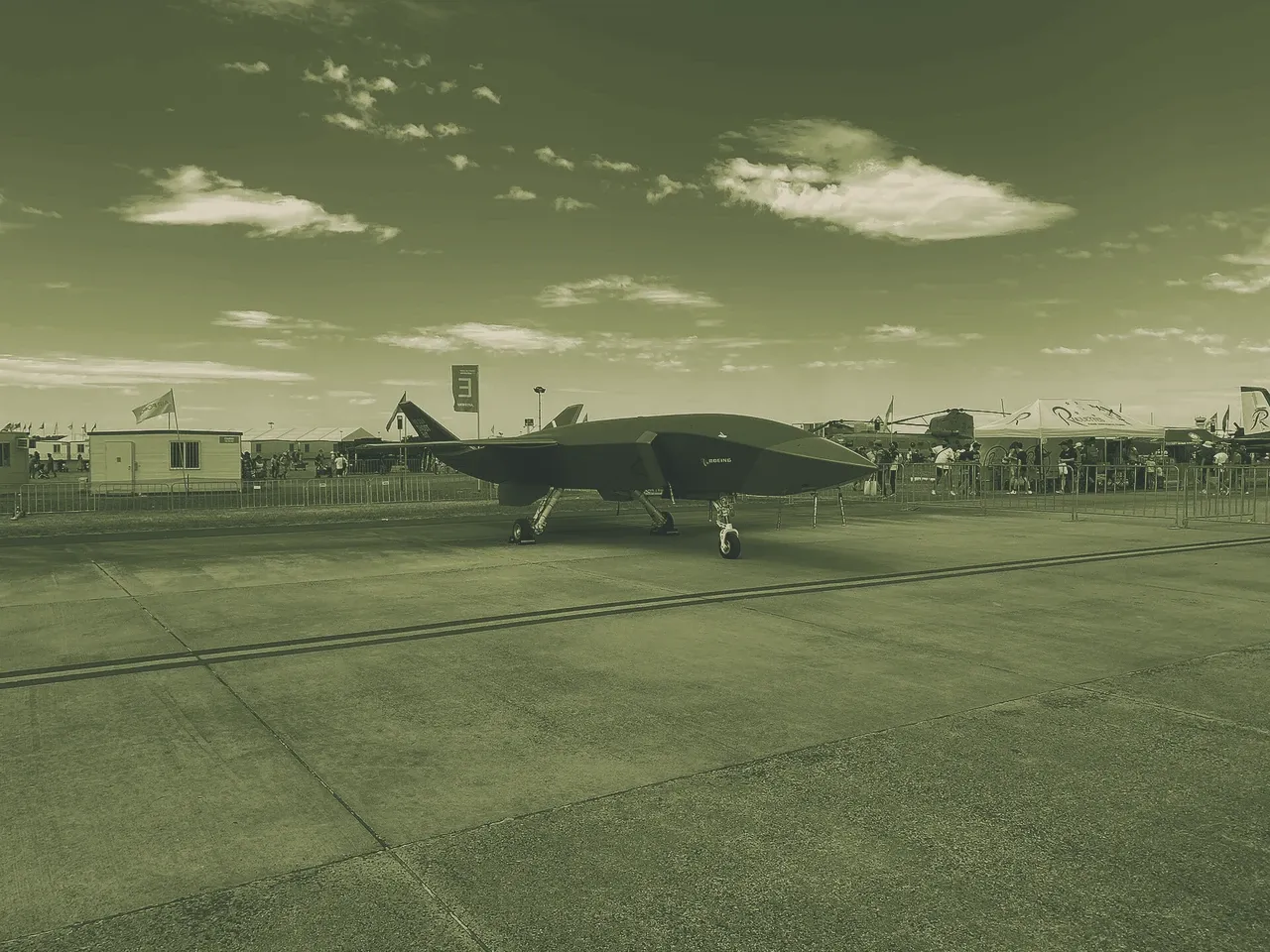
Overview
The MQ-28 Ghost Bat is a stealthy uncrewed combat aerial vehicle (UCAV) developed by Boeing Defence Australia as a collaborative combat aircraft (CCA) for the Royal Australian Air Force (RAAF). Originally known as the Boeing Airpower Teaming System (ATS), the platform is designed to operate as a force-multiplier “loyal wingman,” teaming with crewed fighters, airborne early warning aircraft, and refueling tankers. It is the only non-U.S. CCA with a government-funded program of record and a live-fire engagement — the December 2025 destruction of an aerial target with an AIM-120 AMRAAM, directed by an E-7 Wedgetail and an F/A-18F Super Hornet. That milestone places it ahead of all other non-American loyal-wingman efforts.
Development
Boeing Defence Australia began internal studies of an air-teaming drone in 2013. The program was formally launched in 2018 with initial Australian government funding, and a full-scale prototype was shown at the Avalon Airshow in February 2019. The first flight took place at the RAAF Woomera Range Complex on 27 February 2021, after a rapid build and test cycle. By February 2024 cumulative government investment had reached about AUD$600 million, and more than 35 Australian companies had been brought into the supply chain.
A pivotal step occurred in December 2025 when the Australian Department of Defence awarded Boeing Defence Australia an AUD$754 million Program of Record contract (AIR6015 ACP-Air) covering six Block 2 operational-representative aircraft, one Block 3 prototype, and associated support; total government commitment through that tranche reached approximately AUD$1.4 billion, according to Boeing’s press re-lease and the Defence Minister’s official statement. That contract followed a successful live-fire demonstration in which an MQ-28 fired an AIM-120 AMRAAM against an aerial target while cooperating with an E-7 Wedgetail and an F/A-18F. In February 2026 Boeing used the Singapore Airshow to announce Block 3 details — a 7.3 m wing, internal weapon bays, and beyond-line-of-sight satellite connectivity — laying out the production baseline for the RAAF and for export. The Block 3 design was unveiled with a partner at ILA Berlin in June 2026, when Boeing also stated that a val-idated low-observable airframe would be ready for delivery in 2028.
Design & capabilities
The MQ-28 is a modular, high-subsonic flying-wing UCAV built around a single Williams International FJ44-A turbofan engine (the manufacturer has not publicly confirmed the exact engine). The airframe is sized for a conventional runway take-off and landing, and its planform is shaped for a reduced radar cross-section — Boeing an-nounced in June 2026 that the aircraft’s RCS had been validated and was “significantly reduced” relative to non-stealthy platforms. The fuselage nose houses a 1.5 m mission bay that can accept ISR, electronic-warfare, IRST, or other payload modules without prime-contractor involvement, giving customers a sovereign-integration capability.
Block 1 and Block 2 aircraft are the development and operational-representative configurations with a ~6 m wingspan and external-only stores. The definitive Block 3, described in detail at ILA Berlin 2026 by Boeing and Rheinmetall, stretches the wingspan to 7.3 m (a 25 percent increase), raises MTOW to 12,000 lb (~5,400 kg), and provides about 4,500 lb (~2,000 kg) of useful load. It introduces two internal weapon bays that can carry two AIM-120 AMRAAMs or four GBU-39/GBU-53 Small Diameter Bombs, plus three optional external hard-points. Beyond-line-of-sight satellite communications give controllers a “virtually unlimited stand-off distance,” a departure from the line-of-sight datalinks common on other CCAs. The mission-software stack is compliant with a Government Reference Architecture (GRA) and enables AI-based mission management; demonstrated teaming includes an E-7 Wedgetail directing two MQ-28s simultaneously against a simulated aerial target in June 2025. The aircraft has also been flown from an operational RAAF base, confirming expeditionary deployability outside the Woomera test range.
Variants
- MQ-28A Block 1 — Original prototype and development configuration. Eight airframes built; used for envelope expansion, autonomy testing, and the live-fire event. No internal weapons bays; ~6 m wing.
- MQ-28A Block 2 — First operational-representative version with refined flight systems and improved autonomy. Six ordered under the AUD $754 million tranche for RAAF operational capability; deliveries planned 2025-2028.
- MQ-28A Block 3 — Production/export baseline. 7.3 m wing spread, 12,000 lb MTOW, internal weapons bays, BLOS communications, GRA-compliant mission autonomy. First airframe delivery target 2028.
- Ghost Bat (Boeing-Rheinmetall Germany) — Identical Block 3 airframe with a Rheinmetall-integrated German mission system, offered to fulfil the Bundeswehr’s CCA requirement. Revealed at ILA Berlin 2026.
Combat record / operational use
The MQ-28 has no combat history. Its operational milestones include: - 27 Feb 2021 — First flight at Woomera. - Jun 2025 — Two MQ-28s controlled by an E-7 Wedgetail in a simulated attack, the first autonomous teaming under RAAF direction. - Sep 2025 — Boeing and RAAF conduct a capability-demonstration campaign. - Dec 2025 — Trial Kareela: MQ-28 fires an AIM-120 AMRAAM, destroying an aerial target while teaming with an E-7 and an F/A-18F; first live-fire CCA engagement globally. - May 2026 — Three sorties at NAS Point Mugu, California — the first international deployments of the type, flown in a U.S. Navy context. - Jun 2026 — RCS validation campaign completes.
These tests have built a total of more than 150 sorties, with the fleet of eight Block 1 airframes accumulating flight time across Australian and U.S. ranges.
Advantages
- Only non-U.S. CCA with a funded program of record and a live-fire weapons kill, placing it ahead of all peers in operational maturity.
- Modular nose bay (1.5 m) enables rapid payload changes and sovereign integration without Boeing involvement.
- Block 3 BLOS satellite link removes line-of-sight control constraints, enabling controllers to operate from great distance.
- Demonstrated manned-unmanned teaming: E-7 Wedgetail directing two MQ-28s vs. aerial target; live-fire engagement with F/A-18F.
- Robust Australian supply chain (35+ companies) plus Saab avionics/actuators and the German Rheinmetall partnership create a resilient export ecosystem.
Drawbacks / limitations
- No publicly established per-unit cost; the cost-exchange rationale — “affordable mass” vs. a crewed fighter — cannot be verified from open sources.
- Conventional runway take-off and landing restricts operations to established air bases, unlike RATO-launched alternatives.
- Engine (Williams FJ44-A) is reported by secondary sources; Boeing has not explicitly confirmed the powerplant in press materials.
- Block 3 features (weapons bays, BLOS, enlarged wing) are a design roadmap and have not yet flown; first delivery not expected until 2028.
- Germany and Japan have signed testing agreements or expressed interest but have made no procurement commitments as of mid-2026.
Counterparts
- Anduril Fury (USA)
- GJ-11 Sharp Sword (China)
Outlook
The MQ-28 is the most mature collaborative combat aircraft outside the United States and, if the Block 3 schedule holds, will become the world’s first operational CCA in 2028. The Boeing-Rheinmetall teaming opens its first concrete export market, and the Japan testing arrangement signals regional interest. The critical uncertainties are whether Block 3 flight tests confirm the advertised performance and whether prospective customers accept a per-unit cost that remains unconfirmed. The program’s emphasis on Australian design, sovereignty, and a multi-partner supply chain is a deliberate differentiator from U.S.-centric export-controlled CCAs.
Key specifications
| Spec | Value |
|---|---|
| Type | Stealth multirole uncrewed combat aerial vehicle / collaborative combat aircraft |
| Endurance | Not publicly established |
| Range | >2,000 nmi (3,700 km) |
| Cruise / max speed | High subsonic / Mach 0.9 |
| Payload | Block 1/2: 1.5 m modular nose; Block 3: 2× AIM-120 or 4× SDB internal + optional external hardpoints (4,500 lb useful load) |
| Datalink / control | Line-of-sight datalink (Block 1/2); Block 3 adds beyond-line-of-sight SATCOM enabling “unlimited standoff distance” |
| Autonomy level | AI-based mission management, GRA-compliant software; demonstrated E-7 control of two vehicles simultaneously |
| Dimensions / MTOW | Block 1/2: length 11.7 m, wingspan ~6 m, MTOW not publicly established; Block 3: wingspan 7.3 m, MTOW 12,000 lb (~5,400 kg) |
| Launch & recovery | Conventional runway take-off and landing |
Sources
- Boeing Defence Australia — Boeing Awarded $754 million Ghost Bat Program of Record. https://www.boeing.com.au/news/2025/boeing-awarded--754-million-ghost-bat-program-of-record
- Australian Government Defence Ministers — Funding boost for Australian-made Ghost Bat. https://www.minister.defence.gov.au/media-releases/2025-12-09/funding-boost-australian-made-ghost-bat
- Breaking Defense — Boeing’s Block 3 MQ-28 Ghost Bat to gain weapons bays, longer wings. https://breakingdefense.com/2026/02/boeings-block-3-mq-28-ghost-bat-to-gain-weapons-bays-longer-wings/
- The Aviationist — Boeing Unveils New Capabilities for MQ-28 Ghost Bat. https://theaviationist.com/2026/06/10/boeing-unveils-new-capabilities-for-mq-28-ghost-bat/
- The Aviationist — Boeing and RAAF Demonstrate MQ-28A Ghost Bat Operational Capabilities. https://theaviationist.com/2025/09/07/mq-28a-operational-demonstration/
- Janes — ILA 2026: Boeing-Rheinmetall reveal enhanced Ghost Bat for Germany. https://www.janes.com/defence-intelligence-insights/defence-news/air/ila-2026-boeing-rheinmetall-reveal-enhanced-ghost-bat-for-germany
- AIN Online — Full Speed Ahead for Boeing MQ-28 Collaborative Combat Ghost Bat. https://www.ainonline.com/aviation-news/defense/2026-02-02/full-speed-ahead-ghost-bat
- The Aviationist — The MQ-28 Ghost Bat is Now Flying in the U.S. https://theaviationist.com/2026/05/28/the-mq-28-ghost-bat-is-now-flying-in-the-u-s/
- Aviation Week — Boeing, Rheinmetall Partner To Offer Germany The MQ-28 Ghost Bat. https://aviationweek.com/defense/aircraft-propulsion/boeing-rheinmetall-partner-offer-germany-mq-28-ghost-bat
- Breaking Defense — Aussies buy seven more MQ-28 Ghost Bat CCAs following live-fire demo. https://breakingdefense.com/2025/12/aussies-buy-seven-more-mq-28-ghost-bat-ccas-following-live-fire-demo/
- Defense News — Australia prepares for next batch of ‘Ghost Bat’ warplane buddy drones. https://www.defensenews.com/global/asia-pacific/2026/02/17/australia-prepares-for-next-batch-of-ghost-bat-warplane-buddy-drones/
- Air Data News — Boeing outlines Block 3 upgrades for MQ-28 Ghost Bat at Singapore Airshow. https://www.airdatanews.com/boeing-outlines-block-3-upgrades-for-mq-28-ghost-bat-at-singapore-airshow/
- Aviation Today — Low Radar Cross Section Of MQ-28 Ghost Bat Validated, Boeing Says. https://www.aviationtoday.com/2026/06/04/low-radar-cross-section-of-mq-28-ghost-bat-validated-boeing-says/
🔒 The Analyst Section on MQ-28 Ghost Bat is for BattlePolicy Pro members. Below the line: procurement and contract history, the suppliers and companies behind the system, our head-to-head analyst view of the systems it actually competes with, and the BattlePolicy assessment note. Unlock the full file with BattlePolicy Pro →