GRID-REF 37°47′N 122°25′W
DISPATCH 02/26 · 14 Jun 2026
BATTLEPOLICY
Startup to front line. Strategy to consequence.
Lexicon · USA

PrSM

America's next-generation tactical ballistic missile — a HIMARS/MLRS-fired deep-strike weapon that doubles ATACMS reach, adds anti-ship capability, and made its combat debut against Iran in 2026.
PrSM
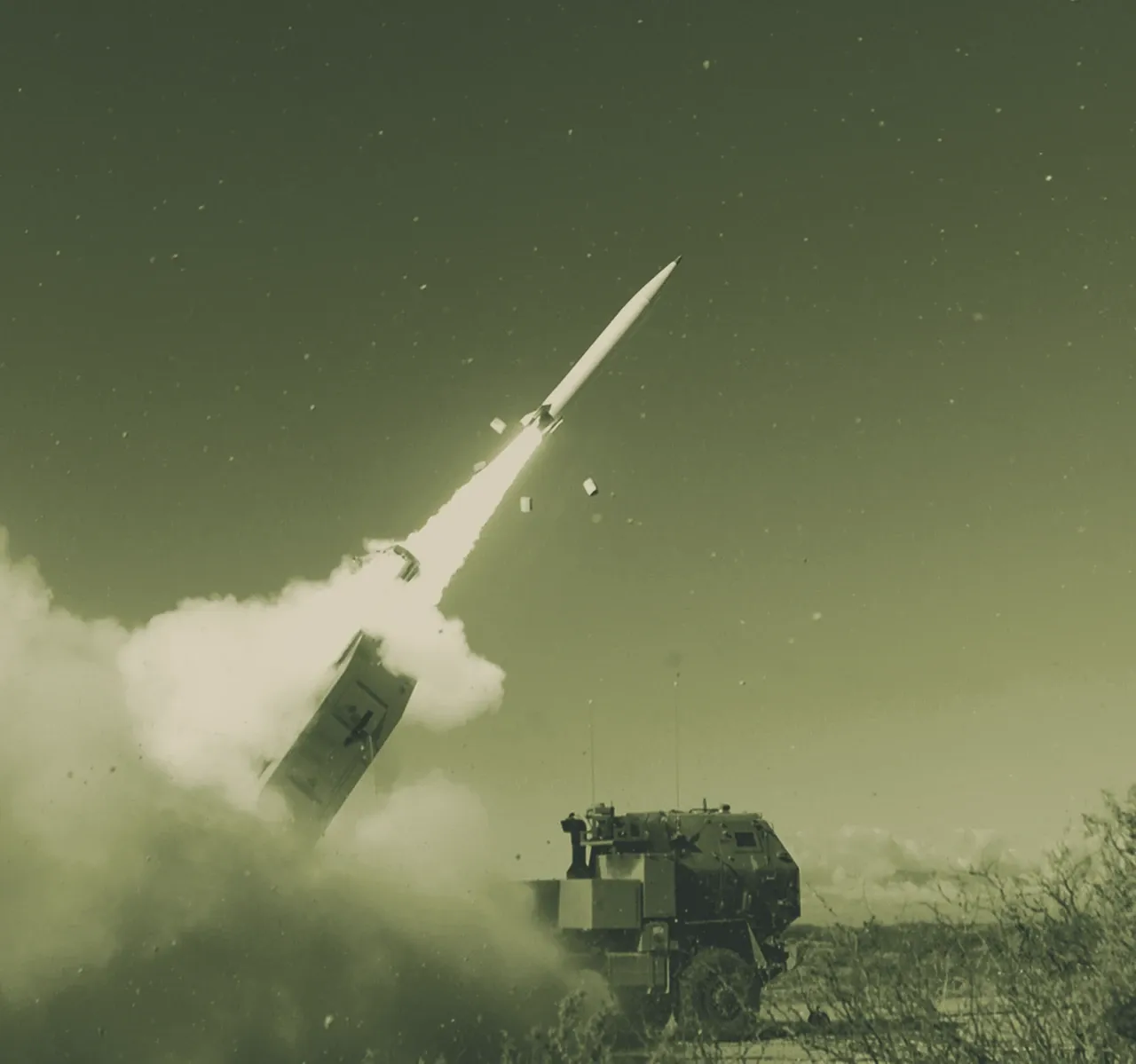
FIG.01 · USA Image - Precision Strike Missile Increment 1 launch during testing. Photo by Darrell Ames, Public domain, via Wikimedia Commons_Increment_1_Limited_User_Test.jpg).
America's next-generation tactical ballistic missile — a HIMARS/MLRS-fired deep-strike weapon that doubles ATACMS reach, adds an anti-ship capability, and made its combat debut against Iran in 2026.

Overview

The Precision Strike Missile (PrSM, pronounced "PRI-zim") is a surface-to-surface tactical ballistic missile developed for the US Army as the successor to the MGM-140 ATACMS. Fired from the same M142 HIMARS and M270A2 MLRS launchers, PrSM roughly doubles the range of its predecessor while fitting two missiles per pod where ATACMS carried one — yielding a substantial magazine advantage on every launcher. Increment 1 entered operational service in 2025, and the system saw its first combat employment in March 2026 during Operation Epic Fury against Iran. Later increments are expanding the envelope to moving maritime targets, modular payloads, and ranges exceeding 1,000 km, making PrSM the centerpiece of the Army's long-range precision fires modernization.

Development

The Precision Strike Missile originated from the US Army's Long Range Precision Fires (LRPF) requirement, launched to replace the aging ATACMS inventory. Lockheed Martin, Boeing, and Raytheon each announced bids in March 2016, but both competitors withdrew by early 2020, leaving Lockheed as the sole developer, according to Wikipedia. The first prototype flight test took place on 10 December 2019 at White Sands Missile Range, and the US withdrawal from the Intermediate-Range Nuclear Forces (INF) Treaty later that year lifted the 499 km range cap that had originally constrained the design, opening the path to extended ranges.

First missiles were delivered to the Army on 8 December 2023, with 26 rounds following in 2024 and 54 more planned for 2025 as the ATACMS production line — which shares a facility with PrSM — wound down, per Defense News. Increment 1 achieved Milestone C (production and deployment authorization) on 2 July 2025, and the Army laid plans for a 400-missile production contract later that year. In March 2026, Lockheed Martin and the Department of War signed a seven-year framework agreement to quadruple production capacity toward 550 missiles per year, as reported by Lockheed Martin. Australia joined the program as an Increment 2 cooperative partner in 2021, committed to Increments 3 and 4 in January 2024, and signed a production, sustainment, and follow-on development memorandum of understanding on 6 June 2025, according to the Australian Department of Defence.

Design & capabilities

PrSM is a solid-propellant tactical ballistic missile designed primarily for GPS-aided inertial guidance against stationary targets in its fielded Increment 1 configuration. According to Lockheed Martin, the weapon fits two rounds per launch pod on the M142 HIMARS and M270A2 MLRS — doubling the magazine depth of the single-round ATACMS pod it replaces. Range is officially stated at 60–499+ km for Increment 1, though demonstrations have exceeded 500 km and the Army's goal for Increment 4 reaches 1,000+ km, per Wikipedia. The missile measures approximately 4.0 m in length and 430 mm in diameter; launch weight is not publicly established. The warhead is a high-explosive blast-fragmentation payload of approximately 91 kg (200 lb).

Increment 2, also designated the Land-Based Anti-Ship Missile (LBASM), adds a multi-mode seeker — reported to combine passive radio-frequency and imaging-infrared sensors — enabling engagement of moving maritime and relocatable land targets. The first Increment 2 flight test was announced on 12 March 2026, with a 350 km shot from a HIMARS exercising the new seeker, according to Lockheed Martin. The missile has also been fired from the Autonomous Multi-Domain Launcher (AML), an uncrewed ground vehicle, most notably during the Valiant Shield exercise in June 2024 when two PrSMs launched from an AML in Palau struck the moving target ship ex-USS Cleveland, as detailed by The War Zone. Naval integration — including potential deployment from the Mk 41 Vertical Launch System — has been explored but is not yet fielded.

Variants

The PrSM program is organized as a spiral of five planned increments. Increment 1 is the fielded baseline, engaging stationary targets with GPS-aided inertial guidance; an exportable version is in development to replace ATACMS on the foreign military sales menu. Increment 2 (LBASM) adds a multi-mode seeker for moving maritime and relocatable land targets, with initial operational capability planned for FY2028. Increment 3 will introduce enhanced and modular payloads — candidates have included Coyote loitering munitions and Hatchet mini-glide bombs. Increment 4 aims for a range exceeding 1,000 km and is being competitively developed by Lockheed Martin versus a Raytheon–Northrop Grumman team; Lockheed passed an advanced-propulsion milestone with L3Harris in June 2026. Increment 5 is a conceptual phase exploring autonomous-launcher employment, with science and technology work beginning in FY2026.

Combat record / operational use

PrSM made its combat debut in Operation Epic Fury, the US component of the 2026 war against Iran. On 4 March 2026, US Central Command confirmed the missile's first combat employment, releasing imagery of a PrSM departing an M142 HIMARS and describing it as "an unrivaled deep strike capability," according to DefenseScoop. Stated target sets included Iranian command-and-control nodes, air-defense sites, and ballistic-missile launchers, with CSIS analyst Tom Karako noting PrSM could reach deep into Iran from launch positions across the Persian Gulf. The War Zone reported that the combat debut validated the weapon's deep-strike envelope in a high-intensity theater just over two years after fielding.

The first combat use also drew scrutiny: Iranian state media reported that a 28 February 2026 strike on a sports hall and adjacent school in Lamerd killed 21 people, and subsequent analyses by the BBC and The New York Times assessed that PrSMs were the weapon used, a finding noted by Wikipedia.

Preceding combat, the type amassed a significant exercise record. At Valiant Shield on 16 June 2024, the 3rd Multi-Domain Task Force and Tennessee National Guard fired two PrSMs from the AML in Palau against the moving target ship ex-USS Cleveland — the missile's first moving maritime engagement, cued through high-altitude balloons and a Vanilla ultra-long-endurance drone, as reported by The War Zone. At Talisman Sabre 2025, an Australian HIMARS fired Australia's first PrSM at Mount Bundey training area, years ahead of the planned schedule, according to the US Army.

Advantages

  • Roughly doubles ATACMS range (from ~300 km to 500+ km) while fitting two missiles per pod — a HIMARS thus carries twice the firepower.
  • Combat-proven within roughly two years of fielding, demonstrating the deep-strike envelope in a high-intensity theater during Operation Epic Fury.
  • Anti-ship growth path validated early: two PrSMs struck a moving maritime target at Valiant Shield 2024, cued through a balloon-and-drone kill chain.
  • Hot production line with strong demand signal — the March 2026 framework agreement targets 550 missiles per year.
  • Alliance depth: Australia is a full cooperative partner, fired its own PrSM at Talisman Sabre 2025, and will co-produce the missile domestically.

Drawbacks / limitations

  • Increment 1 engages only stationary targets via GPS/INS — there is no onboard seeker, leaving moving and relocatable targets to the still-developing Increment 2 (IOC ~FY2028).
  • Inventory remains thin: only ~100 missiles delivered through 2025, and just 45 procured in the FY2026 request, prompting analyst warnings that Middle East expenditures consume rounds earmarked for the Indo-Pacific.
  • Reported civilian-harm controversy in first combat use — the Lamerd strike drew international press scrutiny and attribution analyses.
  • Range beyond ~500 km remains aspirational: Increment 4's 1,000 km class is still in competitive development and not yet fielded.
  • Export controls constrain partners: Norway's 2024 request was denied, and the exportable Increment 1 variant is only now being finalized.

Counterparts

Outlook

PrSM is consolidating its position as the volume backbone of US land-based deep fires. Production is scaling toward ~400 missiles per year by FY2027–28, with capacity planned toward 550 annually under the seven-year framework agreement. The exportable Increment 1 is being readied to replace ATACMS on the foreign military sales menu, while the Increment 2 LBASM anti-ship variant — selected for the Australian Army's land-based maritime strike requirement in April 2026 — is on track for an FY2028 IOC. Increments 3 and 4 promise modular payloads and a 1,000+ km reach respectively, with the latter in a competitive development phase. Combat use against Iran has simultaneously validated the system and sharpened the stockpile debate: defense analysts increasingly urge conserving PrSM rounds for an Indo-Pacific contingency, where its HIMARS compatibility makes every allied launcher a potential PrSM shooter.

Key specifications

Spec Value
Type Surface-to-surface tactical ballistic missile (Inc 2: anti-ship ballistic missile)
Range 60–499+ km (Inc 1); ~500+ km demonstrated; Inc 4 goal 1,000+ km
Speed (Mach / km·s⁻¹) Not publicly established (ballistic profile; high terminal velocity)
Warhead (type & weight) HE blast-fragmentation, ~91 kg (200 lb)
Guidance GPS-aided inertial (Inc 1); multi-mode seeker — passive RF + imaging-infrared (Inc 2)
Accuracy (CEP) Not publicly established
Launch platform(s) M142 HIMARS, M270A2 MLRS, Autonomous Multi-Domain Launcher (AML); Mk 41 VLS explored
Propulsion Solid-propellant rocket (Inc 4 exploring advanced/air-breathing propulsion)
Length / diameter / launch weight ~4.0 m / ~430 mm / not publicly established

Sources

  1. Wikipedia — Precision Strike Missile — https://en.wikipedia.org/wiki/Precision_Strike_Missile
  2. Lockheed Martin — Long Range Precision Strike Missile (PrSM) product page — https://www.lockheedmartin.com/en-us/products/precision-strike-missile.html
  3. Lockheed Martin — Lockheed Martin Answers the Nation's Call and Quadruples Precision Strike Missile Production — https://news.lockheedmartin.com/2026-03-25-Lockheed-Martin-Answers-the-Nations-Call-and-Quadruples-Precision-Strike-Missile-Production
  4. Lockheed Martin — PrSM Increment 2 Takes Flight and Advances Army's Moving-Target and Maritime Capability — https://news.lockheedmartin.com/2026-03-12-PrSM-Increment-2-Takes-Flight-and-Advances-Army-s-Moving-Target-and-maritime-capability
  5. Defense News — Army accelerates PrSM output as ATACMS nears sunset — https://www.defensenews.com/land/2025/10/13/army-accelerates-prsm-output-as-atacms-nears-sunset/
  6. DefenseScoop — Army's Precision Strike Missile makes combat debut in Iran strikes — https://defensescoop.com/2026/03/05/prsm-precision-strike-missile-iran-operation-epic-fury/
  7. The War Zone — America's New PrSM Ballistic Missile Just Made Its Combat Debut In Iran Strikes — https://www.twz.com/land/americas-new-prsm-ballistic-missile-just-made-its-combat-debut-in-iran-strikes
  8. The War Zone — Army's New PrSM Ballistic Missile Hits Moving Ship For The First Time In Pacific Test — https://www.twz.com/land/armys-new-prsm-ballistic-missile-hits-moving-ship-for-the-first-time-in-pacific-test
  9. US Army — Precision Strike Missile Success at Talisman Sabre: Accelerating Army Long Range Precision Fires Modernization — https://www.army.mil/article/291029/precision_strike_missile_success_at_talisman_sabre_accelerating_army_long_range_precision_fires_modernization
  10. Australian Department of Defence — Australia signs long-range precision strike missile agreement with the United States — https://www.minister.defence.gov.au/media-releases/2025-06-06/australia-signs-long-range-precision-strike-missile-agreement-united-states
FIELD DISPATCH · WEEKLY

BattlePolicy Weekly — free.

Defense tech, startups, and security — weekly. No paywall.

Related
China · USA · Policy · 1260H · Alibaba · BYD · Autel · Unitree · military-civil fusion

The Pentagon's China military list now reaches drones, robots, and memory chips

The Pentagon's expanded 1260H roster reaches past Alibaba and BYD to the dual-use suppliers, drone maker Autel and robot maker Unitree among them, that feed China's defense base.

China · USA · Policy · 1260H · Alibaba · BYD · Autel · Unitree · military-civil fusion
USA · Autonomy · analysisPro

The Drone War Gets a Command

In one week the Senate moved to create a four-star drone command, the Pentagon cleared its first force-wide counter-drone system, and a Ukraine-tested startup won a $500 million counter-drone deal.

USA · Autonomy · analysis
USA · Air Defense · SkyValor · CACI · JIATF-401 · counter-drone · Perennial Autonomy

Pentagon clears SkyValor, an autonomous counter-drone system that nets and jams, for force-wide use

A southern-border test validated CACI's net-and-jam system for the entire US military, the latest move in a counter-drone scramble shaped by the drone war in Ukraine and by hostile drones now killing American troops.

USA · Air Defense · SkyValor · CACI · JIATF-401 · counter-drone · Perennial Autonomy