Sapsan
Ukraine’s first indigenously developed short-range ballistic missile — free of Western range and target restrictions, and now serial-produced to strike airbases, command posts and logistics hubs deep inside Russian-controlled territory.
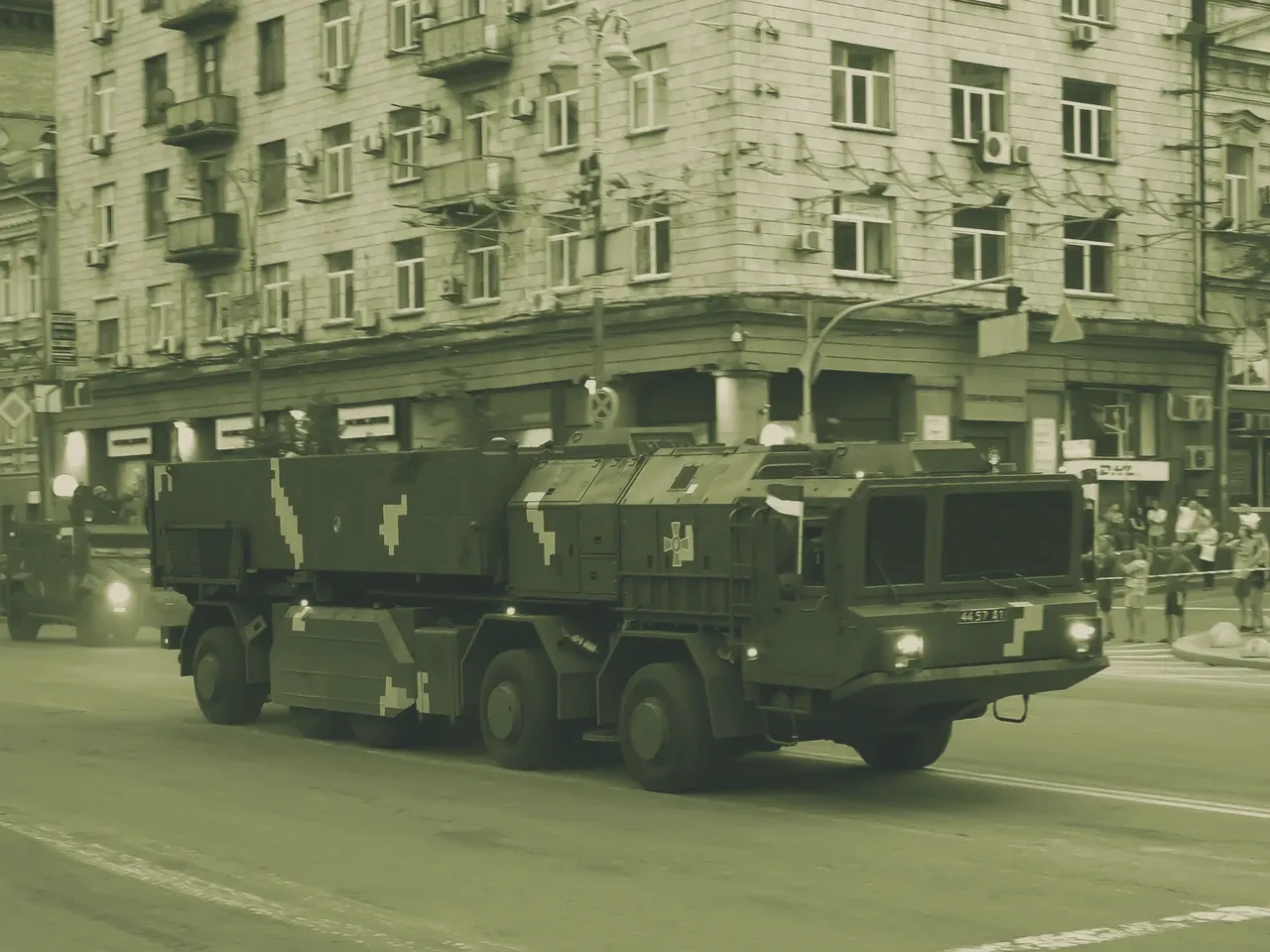
Ukraine’s first sovereign short-range ballistic missile — a mobile, solid-fuelled system built for deep strikes without foreign-usage restrictions, fielded after two decades of stop-start development and now in serial production.
Overview
The Sapsan (1KR1 Sapsan, “Peregrine falcon”) is a wheeled, single-stage solid-propellant short-range ballistic missile (SRBM) that entered Ukrainian service during the full-scale Russian invasion. Developed by the Pivdenne (Yuzhnoye) Design Bureau and built at Pivdenmash in Dnipro, the system carries a roughly 480 kg unitary warhead to ranges of at least 300 km, with design figures assessed at 400–500 km. Unlike ATACMS or Storm Shadow, the missile is entirely Ukrainian-owned, so Kyiv can employ it without donor-imposed range or target limitations. The existence of a reliable, mass-produced domestic ballistic strike option profoundly alters Ukraine’s deep-strike calculus.
Development
The requirement for a Tochka-U replacement was set in 2006, but funding collapsed during the 2008 financial crisis, restarted fitfully in 2011 and was cut again in 2013. The programme survived as the export-branded Hrim-2 (also Grim-2, Grom-2, “Thunder-2”), contracted by an undisclosed foreign customer—widely reported as Saudi Arabia—that provided about $40 M in R&D money from 2016, according to Wikipedia. A ten-wheel transporter-erector-launcher (TEL) appeared in 2017, and prototypes were announced in 2019, but work stalled short of service readiness.
The full-scale Russian invasion forced an overhaul: an August 2022 state contract re-started the military programme, and by mid-2023 funds had been allocated for completion. On 27 August 2024 President Zelenskyy announced the first successful flight test of a Ukrainian ballistic missile, widely identified as Sapsan, as reported by Euromaidan Press. Accelerated funding followed, and on 18 June 2025 Zelenskyy confirmed the missile had entered serial production with German financial support, a milestone that Deputy Defence Minister Klochko called “a top priority.”
Design & capabilities
Sapsan is a single-stage solid-fuel ballistic missile, with Ukraine reportedly the sole producer of the specialised solid rocket grain for its own long-range projects. The domestic variant has a diameter of approximately 900 mm, while the export Hrim-2 variant measures about 600 mm to remain MTCR-compliant at 280 km, details noted by Militarnyi. Propulsion grants a terminal speed of around Mach 5.2, significantly faster than ATACMS, making it a difficult target for interception.
The warhead is assessed at roughly 480 kg of high-explosive—more than double the payload of ATACMS—delivering a heavy punch against hardened command posts, logistics hubs and airfields. Guidance details are not publicly disclosed, but Ukrainian analysts cite “a completely different class of electronics” from older Soviet systems, and the claimed precision of the May 2025 combat strike is offered as proof that the guidance problem was solved. The system rides on a ten-wheel TEL that carries two ready-to-fire missiles and is designed for shoot-and-scoot mobility, enabling dispersed basing and survivable operations.
The overall deep-strike implications are substantial: with even a conservative 400–500 km envelope, Sapsan batteries in central or northern Ukraine can hold airbases and rail hubs in Bryansk, Kursk, Belgorod, Smolensk and Voronezh regions at risk, as analysed by Army Recognition.
Variants
- Sapsan (domestic): ~900 mm diameter, design range up to ~500 km; the front-line missile used by Ukrainian forces.
- Hrim-2 (export): ~600 mm diameter, 280 km range compliant with Missile Technology Control Regime limits; partially funded by a foreign client, but no confirmed export deliveries.
- Growth path: Ukrainian specialists discuss trading warhead mass for fuel to push toward a ~700 km-class envelope in later iterations—an aspirational evolution not yet demonstrated.
Combat record / operational use
Early reports of possible Sapsan use—Russian claims of intercepting two “Sapsan/Hrim-2” missiles over Crimea on 6 May 2023, and speculation linking the August 2022 Saky airbase explosions—remain unconfirmed. The verifiable combat record begins in May 2025, when presidential chief of staff Andriy Yermak confirmed the missile’s first strike, described by analyst Valentyn Badrak as a hit on a Russian command post at nearly 300 km. On 9 December 2025, Zelenskyy made the system public: “We’ve begun using it,” while deliberately refusing to disclose quantities or targets and noting that Moscow often misattributes Sapsan shots to the Neptune cruise missile, as reported by The War Zone.
Russia responded with a sustained counter-production campaign. In July–August 2025 the Russian Ministry of Defence claimed strikes on design bureaus, rocket-fuel plants and assembly sites in Dnipropetrovsk and Sumy regions, and on 14 August 2025 the FSB asserted a joint operation had “eliminated” both the missile’s technical base and its strike threat, publishing a range map that included Moscow and Belarus and alleging German financing, according to The Moscow Times and TASS. An Iskander-M strike on the Pavlohrad Mechanical Plant was separately reported. None of these claims have been independently verified, and continued Ukrainian employment of the missile—including a December 2025 statement by former procurement official Oleksandr Liev that the programme index 1KR1 was officially adopted—suggests production was either dispersed or survived the strikes. UNITED24 Media notes that serial production and deployment are ongoing, and Kyiv keeps all employment details classified.
Advantages
- Sovereign deep-strike: entirely Ukrainian-designed and produced, free from Western range/usage restrictions that constrained ATACMS and Storm Shadow/SCALP.
- Heavy punch at speed: ~480 kg unitary warhead at ~Mach 5.2, more than double ATACMS’s payload, with a terminal profile analysts judge beyond the reliable interception capability of Russian S-300/S-400 batteries.
- Operational depth filled: sits between Tochka-U/ATACMS (≤300 km) and the 1 000–3 000 km cruise family (Long Neptune, Flamingo), enabling fast, high-payload strikes at operational-tactical distances.
- Mobile two-round TEL: shoot-and-scoot mobility and two-missile salvo capacity complicate Russian counter-battery efforts.
- Information dominance: Kyiv deliberately keeps numbers and targets opaque, a practice that casts uncertainty over Russian attribution and defence planning.
Drawbacks / limitations
- No independent wreckage verification: as of the December 2025 combat-use confirmation, no publicly available impact-site wreckage had confirmed Sapsan employment; attribution remains based on Ukrainian government statements.
- Production base under fire: Russia has made Sapsan design and assembly facilities a standing target set, repeatedly claiming to have destroyed key nodes—reducing confidence in sustained output scales.
- Quantities unknown and likely modest: Ukrainian analysts themselves caution that a few dozen missiles cannot deliver a strategic effect, and Zelenskyy has declined to reveal production volumes.
- Long, troubled gestation: funding halted in 2009–10 and 2013, requiring roughly two decades from requirement to fielding; the protracted timeline underscores persistent industrial fragility.
- Range ceiling unconfirmed: only ~300 km has been publicly tied to an operational strike; the 400–500 km envelope remains a design claim yet to be openly demonstrated in combat.
Counterparts
- Iskander-M (Russia)
- ATACMS (USA)
Outlook
Sapsan’s trajectory through 2026 is defined by scale-up under fire. Kyiv pairs the domestic ballistic option with an expanding cruise-missile family, while Russia has turned the programme’s factories into a priority target set and a propaganda theme. The three critical unknowns are: independent wreckage confirmation of combat strikes, whether the 400–500 km design envelope is being used operationally, and whether production can survive the Pavlohrad/Sumy-region strike campaign at meaningful monthly rates. The fact that Ukraine is simultaneously funding other strike programmes—such as Fire Point’s FP-7/FP-9 and the UK-announced Nightfall—suggests a hedge rather than an all-in bet on Pivdenne.
Key specifications
| Spec | Value |
|---|---|
| Type | Single-stage solid-fuel short-range ballistic missile (operational-tactical class, Iskander-M analogue) |
| Range | ~300 km demonstrated (Ukrainian claim); design figures 400–500 km assessed; export variant limited to 280 km (MTCR) |
| Speed (Mach / km·s⁻¹) | ~Mach 5.2 (claimed from July 2024 testing) |
| Warhead (type & weight) | ~480 kg high-explosive unitary (Ukrainian/analyst figures; “over 400 kg”) |
| Guidance | Not publicly disclosed; described as precision-capable (“new-generation electronics”) |
| Accuracy (CEP) | Not publicly established (described as precision-capable) |
| Launch platform(s) | 10-wheel TEL carrying two missiles; shoot-and-scoot mobile |
| Propulsion | Single-stage solid propellant; Ukraine claims sole producer of the specific solid rocket fuel |
| Length / diameter / launch weight | Length not publicly established; diameter ~900 mm domestic, ~600 mm export; weight ~2–3 t (est.) |
Sources
- Wikipedia — 1KR1 Sapsan — https://en.wikipedia.org/wiki/1KR1_Sapsan
- The War Zone — If Zelensky’s Claim Of Using Homegrown Ballistic Missile For First Time Is True, It’s A Big Deal — https://www.twz.com/land/if-zelenskys-claim-of-using-homegrown-ballistic-missile-for-first-time-is-true-its-a-big-deal
- UNITED24 Media — Zelenskyy Confirms Ukraine Is Now Firing Its New Sapsan Homegrown Ballistic Missile Against Russia — https://united24media.com/latest-news/zelenskyy-confirms-ukraine-is-now-firing-its-new-sapsan-homegrown-ballistic-missile-against-russia-14185
- UNITED24 Media — “Bigger Than ATACMS”: Ukraine’s Cutting-Edge Ballistic Missile Reportedly Enters Combat Use — https://united24media.com/latest-news/bigger-than-atacms-ukraines-cutting-edge-ballistic-missile-reportedly-enters-combat-use-9013
- Militarnyi — Ukraine to Provide Separate Funding for Domestic Ballistic Missile Program — https://militarnyi.com/en/news/ukraine-to-provide-separate-funding-for-domestic-ballistic-missile-program/
- Euromaidan Press — Ukraine confirms Sapsan ballistic missile project advancing to serial production — https://euromaidanpress.com/2025/06/14/ukraine-confirms-sapsan-ballistic-missile-project-advancing-to-serial-production/
- The Moscow Times — FSB and Russian Army Claim to Have Destroyed Ukrainian Missile Production Sites in Joint Operation — https://www.themoscowtimes.com/2025/08/14/fsb-and-russian-army-claim-to-have-destroyed-ukrainian-missile-production-sites-in-joint-operation-a90206
- TASS — Production of Sapsan missiles in Ukraine financed by Germany — Federal Security Service — https://tass.com/defense/2002059
- Defence Industry Europe — Russia claims destruction of Ukrainian Sapsan ballistic missile depots in latest strikes — https://defence-industry.eu/russia-claims-destruction-of-ukrainian-sapsan-ballistic-missile-depots-in-latest-strikes/
- Army Recognition — Ukraine’s Fielding of the Sapsan Ballistic Missile Shifts the Deep Strike Equation Against Russia — https://www.armyrecognition.com/news/army-news/2025/ukraines-fielding-of-the-sapsan-ballistic-missile-shifts-the-deep-strike-equation-against-russia
- Frontliner — Which missiles are in Ukraine’s arsenal? — https://frontliner.ua/en/what-missiles-could-ukraine-use-to-finish-the-war/
🔒 The Analyst Section on Sapsan is for BattlePolicy Pro members. Below the line: procurement and contract history, the suppliers and companies behind the system, our head-to-head analyst view of the systems it actually competes with, and the BattlePolicy assessment note. Unlock the full file with BattlePolicy Pro →