Su-25 Frogfoot
The Su-25 Frogfoot is a heavily armored Soviet-era close air support jet, now flying for both Russia and Ukraine. Rugged, simple, and armed with a massive 30mm cannon and up to 4,000 kg of ordnance, it has become the most attrition-heavy fixed-wing type of the Russia–Ukraine war, adapting from.
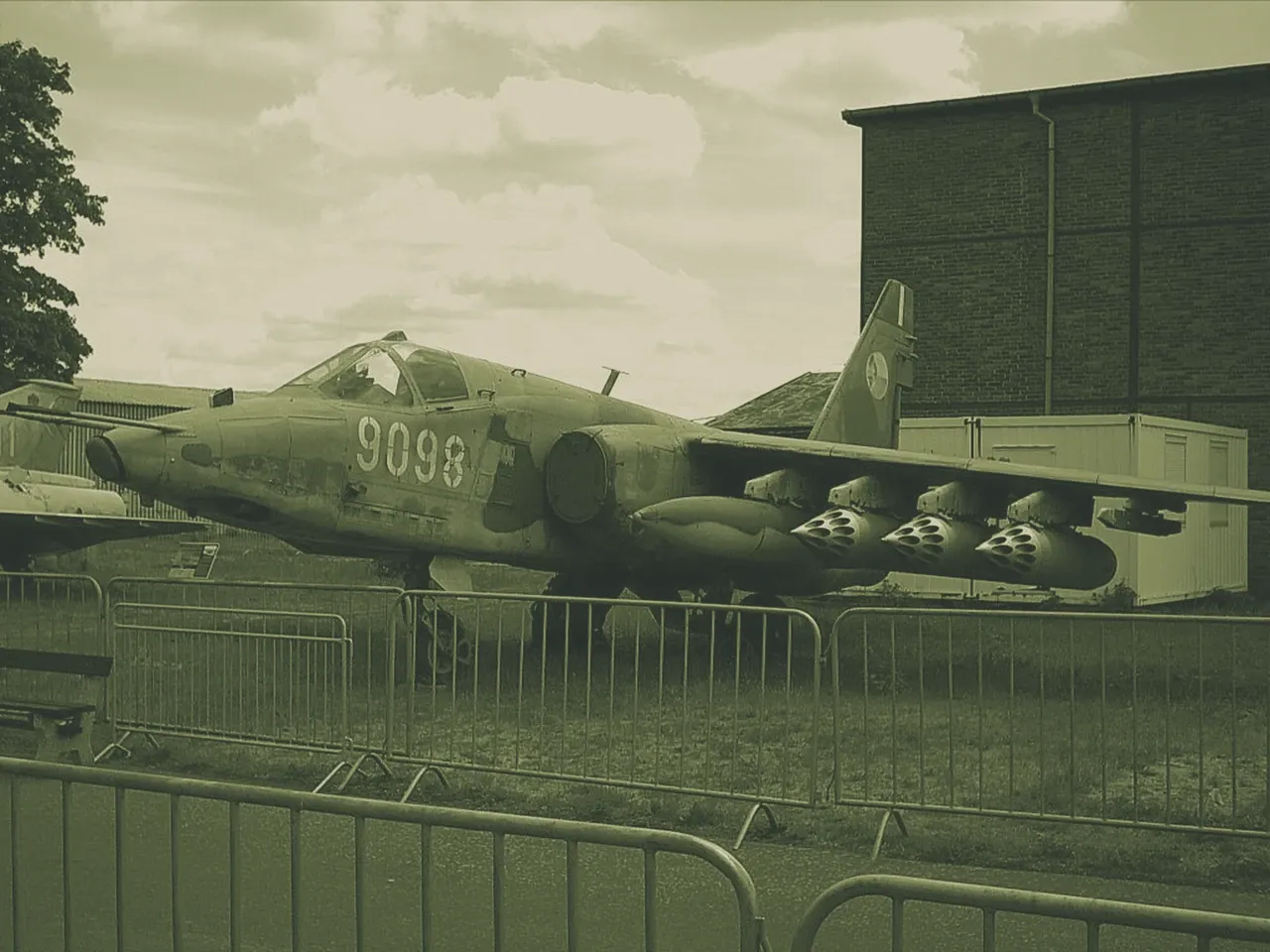
A heavily armored subsonic ground-attack jet, the Su-25 “Grach” (NATO: Frogfoot) combines a welded titanium cockpit, twin turbojets, and 10–11 hardpoints to deliver massive firepower over the battlefield — and has become the most loss-heavy fixed-wing type on both sides of the Russia–Ukraine war.
Overview
The Sukhoi Su-25 is a single-seat, twin-engine close air support aircraft developed in the Soviet Union and exported widely. Known in Russian service as the Grach (rook) and codenamed Frogfoot by NATO, it is built around survivability and firepower: a titanium-armored cockpit, rugged systems, and a 30 mm cannon backed by up to 4,000 kg of bombs, rockets and guided missiles. After decades of combat from Afghanistan to Africa, the Su-25 now forms the backbone of ground-attack aviation for both Russia and Ukraine, where it has suffered the highest visually documented fixed-wing losses of the war while adapting from low-level rocket passes to stand-off precision strikes.
Development
Sukhoi’s T8 prototype beat the Ilyushin Il-102 in a Soviet close-air-support competition and flew for the first time on 22 February 1975, per Wikipedia. Series production began in 1978 at Factory No. 31 in Tbilisi, and the type formally entered service on 19 July 1981. Production later expanded to the Ulan-Ude plant and continued until 2017, with total output exceeding 1,000 airframes Airforce Technology. The Su-25 saw its combat debut with Soviet forces in Afghanistan in the 1980s and was subsequently modernized through successive Russian upgrades (Su-25SM, SM3) and Ukrainian overhauls (Su-25M1).
Design & capabilities
The Frogfoot’s signature feature is a welded titanium “bathtub” that envelops the cockpit with 24 mm of armor, protecting the pilot from small-arms fire and shell fragments. Two R-95Sh (later R-195) turbojets provide 44.18 kN each, giving a maximum sea-level speed of 950–975 km/h, and the aircraft can operate from austere forward strips Airforce Technology. A GSh-30-2 twin-barrel 30 mm cannon with 250 rounds is built into the fuselage, while 10–11 hardpoints carry up to 4,000 kg of stores — unguided rockets (S-5, S-8, S-13, S-24, S-25), general-purpose and laser-guided bombs, Kh-25ML/Kh-29L air-to-surface missiles, and R-60 or R-3S self-defense air-to-air missiles. The baseline aircraft lacks a fire-control radar; instead it relies on a Klen-PS laser rangefinder/designator, an ASP-17 sight, and a SPO-15 radar warning receiver. The Russian Su-25SM3 modernization adds a SOLT-25 electro-optical turret, the Vitebsk-25 self-protection suite, and the SVP-24 ballistic-bombing computer, giving a subset of the fleet a precision night/adverse-weather capability.
Variants
The type spawned numerous sub-variants: the Su-25K export version, the two-seat Su-25UB/UBK trainer, the Su-25BM target-tug, the limited-run anti-tank Su-25T/TM, the carrier-training Su-25UTG, and the Su-25KM “Scorpion” Georgian-Israeli upgrade. Russian modernizations are the Su-25SM and the more advanced Su-25SM3, while Ukraine fields the locally upgraded Su-25M1(M1K). The downgraded Su-28 trainer completed the family.
Combat record / operational use
Since its Afghan debut, the Su-25 has fought in virtually every Russian and post-Soviet air campaign, but the war in Ukraine is its largest and most costly theatre. Both sides began the 2022 full-scale invasion flying classic low-altitude rocket passes, then rapidly converted to “loft and exit” tactics that trade accuracy for stand-off survival. The loss toll has been severe: open-source photo documentation collected by Oryx lists at least 41 Russian and 22 Ukrainian Su-25s destroyed or damaged beyond repair, the highest of any fixed-wing tactical type on the Russian side. Actual totals are certainly higher.
One of the most graphic episodes was the 7 February 2024 shoot-down of Ukrainian pilot Stanislav Rykov, caught by a wing camera and published in early 2026; the jet was almost certainly struck by an R-37M very-long-range missile fired by a Russian MiG-31BM, a threat pattern that has claimed multiple Ukrainian Su-25s, as detailed by The War Zone and a separate TWZ analysis. Ukraine countered by integrating French AASM-1 Hammer rocket-boosted bombs in 2024, enabling low, terrain-hugging pop-up deliveries that essentially ended close-range rocket attacks; Euromaidan Press reported that Ukrainian Su-25 losses dropped to three or four that year.
Fleet expansion came via donations: North Macedonia transferred its four stored Su-25s in 2022, and at least one — ex-Macedonian “Blue 51” — was restored to Su-25M1(K) standard and returned to combat with the 299th Tactical Aviation Brigade, according to Key.Aero. A dozen-plus disassembled Su-25s also reached Ukraine overland in spring 2022, with reporting by Novinite and Foreign Policy pointing strongly to Bulgaria, though Sofia never confirmed the transfer.
Advantages
- Unmatched cockpit armor: a 24 mm titanium “bathtub” protects the pilot against ground fire, enabling survival from multiple hits and very low-level ejections.
- Rugged simplicity: twin-engine design, rough-field capability, and battle-damage tolerance allow sustained operations from austere strips.
- High payload: 10–11 hardpoints can lift up to 4,000 kg of mixed ordnance, making the Su-25 a formidable rocket-bomb truck for massed fire missions.
- Stand-off adaptation: Ukrainian forces proved the airframe can be rapidly reconfigured for precision glide-bombs (AASM Hammer), sharply reducing loss rates when close-in attacks became untenable.
- Global donor base: a large fleet of over 1,000 airframes and extensive spare-parts stocks mean stored jets can be reactivated even after decades outdoors.
Drawbacks / limitations
- Highest visually confirmed losses of the war: at least 41 Russian and 22 Ukrainian airframes destroyed, with real totals almost certainly higher, underscoring the type’s vulnerability over a modern integrated air-defense battlefield.
- **Subsonic speed and low service ceiling (~5,000–7,000 m laden) keep it inside MANPADS and short-range air-defense envelopes, making classic low-level attack profiles unsustainable.
- Defenseless against long-range air-to-air missiles: R-37M shots from Russian MiG-31s and Su-35s have killed multiple Ukrainian Su-25s; the aircraft carries no radar-guided interceptor and has little means to counter BVR threats.
- Unguided rocket attacks lose effectiveness beyond visual range: loft-delivered rockets trade accuracy for survivability, and Ukrainian unguided rocket stocks were reportedly exhausted by mid-2024.
- No radar and limited night/all-weather capability in the baseline fleet: only the small Su-25SM3 subset carries a modern electro-optical/self-protection suite.
Counterparts
- F-16 Fighting Falcon (USA)
- J-16 (China)
Outlook
The Su-25 will remain a mainstay on both sides of the Russia–Ukraine war for years, because nothing replaces it cheaply. Russia continues to feed stored airframes and SM/SM3 upgrade batches into the fight, while Ukraine sustains its fleet from donated NATO-held jets and cannibalized spares, relegating survivors to stand-off precision work with Hammer bombs. North Korea, the largest non-CIS operator, displayed its Su-25s in December 2025 carrying apparently new indigenous stand-off munitions — a sign, The War Zone notes, that the type is being life-extended rather than retired there. Nevertheless, attrition mathematics still dominate: every confirmed loss is essentially irreplaceable by new production, so both operators’ fleets will shrink toward their respective storage and donor pools.
Key specifications
| Spec | Value |
|---|---|
| Crew | 1 |
| Length / wingspan | 15.53 m (incl. nose probe) / 14.36 m |
| Max speed | 975 km/h at sea level |
| Service ceiling | 7,000 m (~5,000 m with full weapon load) |
| Combat radius / range | ~375 km combat radius; 750 km lo-lo with 4,400 kg ordnance |
| Payload | up to 4,000 kg |
| Hardpoints | 11 |
| Radar / sensors | Klen-PS laser rangefinder/designator, ASP-17 sight, SPO-15 RWR; Su-25SM3: SOLT-25 EO turret, Vitebsk-25 suite |
| Powerplant | 2 × R-95Sh (later R-195) turbojets, 44.18 kN each |
| Armament | 1 × 30 mm GSh-30-2 cannon (250 rds); S-5/S-8/S-13/S-24/S-25 rockets, FAB/laser-guided bombs, Kh-25ML/Kh-29L missiles, R-60/R-3S AAMs; SPPU-22 23 mm gun pods |
Sources
- Wikipedia — Sukhoi Su-25. https://en.wikipedia.org/wiki/Sukhoi_Su-25
- Airforce Technology — Su-25 (Su-28) Frogfoot Close-Support Aircraft. https://www.airforce-technology.com/projects/su25/
- The War Zone — Ukrainian Su-25 Shoot-Down Seen In Harrowing Onboard Video. https://www.twz.com/air/ukrainian-su-25-shoot-down-seen-in-harrowing-onboard-video
- Euromaidan Press — Forbes: Ukraine equips its old Su-25 attack jets with French glide bombs. https://euromaidanpress.com/2025/01/03/forbes-ukraine-equips-its-old-su-25-attack-jets-with-french-glide-bombs/
- Key.Aero — Ukraine restores ex-North Macedonian Su-25 to help fight Russia. https://www.key.aero/article/ukraine-restores-ex-north-macedonian-su-25-help-fight-russia
- The War Zone — Analyzing North Korea’s New Air-Launched Guided Weapons. https://www.twz.com/air/analyzing-north-koreas-new-air-launched-guided-weapons
- Novinite — Ukraine received a Dozen Soviet Su-25s in Spare Parts – Did Bulgaria send them? https://www.novinite.com/articles/215264/Ukraine+received+a+Dozen+Soviet+Su-25s+in+Spare+Parts+%E2%80%93+Did+Bulgaria+send+them
- Oryx — Attack On Europe: Documenting Russian Equipment Losses. https://www.oryxspioenkop.com/2022/02/attack-on-europe-documenting-equipment.html
- Oryx — Attack On Europe: Documenting Ukrainian Equipment Losses. https://www.oryxspioenkop.com/2022/02/attack-on-europe-documenting-ukrainian.html
- The War Zone — Russia’s MiG-31 Foxhounds Proving To Be A Threat To Ukrainian Aircraft. https://www.twz.com/russias-mig-31-foxhounds-proving-to-be-a-threat-to-ukrainian-aircraft