Taurus KEPD 350
A German-Swedish stealthy air-launched cruise missile designed to destroy hardened and buried targets from over 500 km, carrying the unique MEPHISTO tandem warhead and serving Germany, Spain, and South Korea.
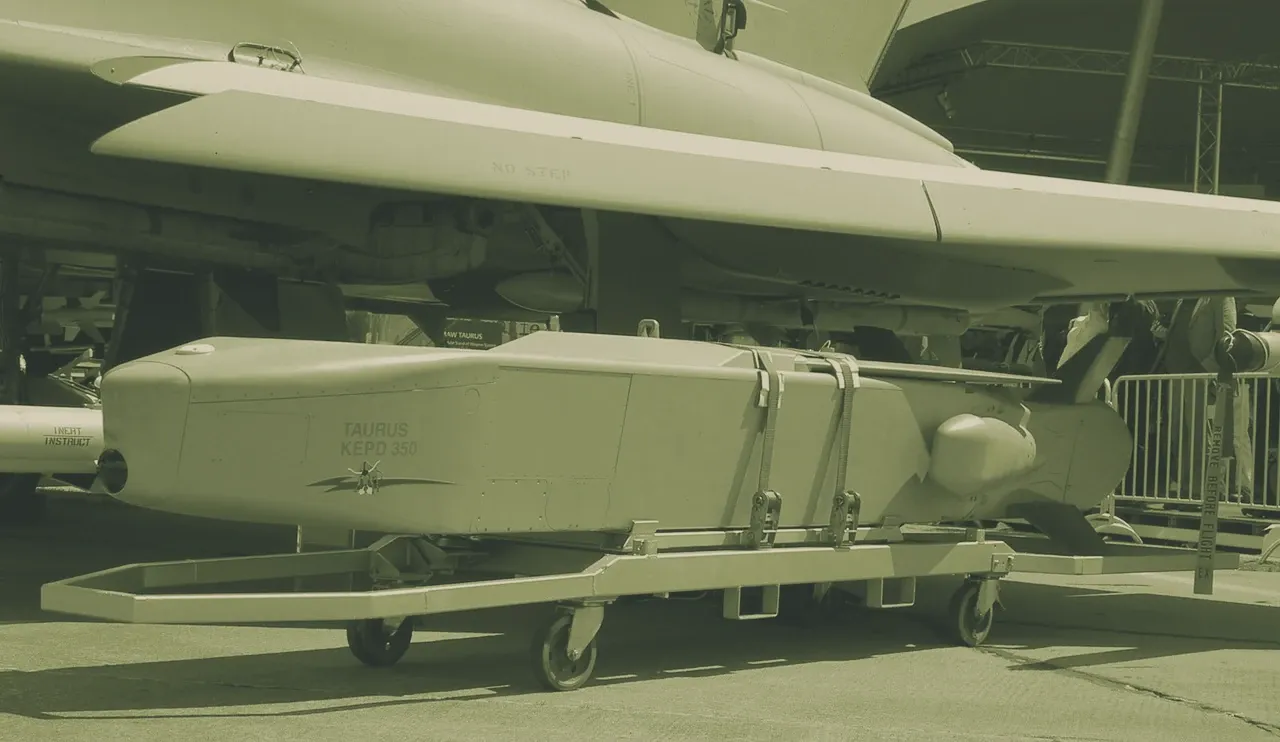
A German-Swedish air-launched stealthy cruise missile with a unique hardened-target penetrating warhead, designed for deep strike at over 500 km, terrain-following flight at 35 m, and multi-layer bunker defeat — operational in the Luftwaffe, Spanish and South Korean air forces.
Overview
The Taurus KEPD 350 (Target Adaptive Unitary and dispenser Robotic Ubiquity System / Kinetic Energy Penetrator and Destroyer) is a subsonic stand-off air-launched cruise missile developed jointly by Germany and Sweden. It arms the Luftwaffe’s Panavia Tornado, Spain’s EF-18A+ Hornets, and the Republic of Korea Air Force’s F-15K Slam Eagles, offering a >500 km reach and a highly specialised warhead tailored to destroy hardened and deeply buried targets. The missile is produced by Taurus Systems GmbH, a joint venture between MBDA Deutschland and Saab Bofors Dynamics, with deliveries starting in 2005. It has no confirmed combat employment, but its political prominence has grown enormously since Russia’s full-scale invasion of Ukraine, as Berlin repeatedly rebuffed Kyiv’s requests for the weapon.
Development
Germany funded development of the KEPD 350 in 1998 after Cold-War-era plans to acquire the French Apache were abandoned, according to Wikipedia. Design work ran from 1995 to 2005 at Taurus Systems GmbH in Schrobenhausen, Bavaria. The first production rounds were delivered to the Luftwaffe in 2005, with the 600-missile order completed by December 2010 at a cost of €570 million. Export customers followed: Spain ordered 43 missiles for its Hornets (delivered by August 2010), and South Korea acquired 177 KEPD 350K missiles in 2013, later topping up with a further 90 rounds in 2018 to equip its F-15K force. After a long production hiatus, the Ukraine-war-driven procurement surge revived the line: a maintenance and modernisation contract (“Major Overhaul 2”) was signed in December 2024 to keep German stocks operational to at least 2045, as reported by European Security & Defence. In December 2025 the German Bundestag released funds for the first tranche of a capability-enhanced successor, the Taurus NEO, clearing the way for serial production from about 2029.
Design & capabilities
The Taurus KEPD 350 is a 5.1-m, 1,400-kg missile powered by a Williams International P8300-15 turbofan that propels it to Mach 0.6–0.95 over a stated range greater than 500 km. Its airframe features stealth shaping and radar-absorbent materials, and it flies a terrain-following profile as low as 35 m to slip beneath enemy air defences. The warhead is the defining element: the 481-kg MEPHISTO (Multi-Effect Penetrator, HIghly Sophisticated and Target Optimised) tandem charge, which combines a precursor shaped charge with a main penetrator and a programmable multi-option fuze. The fuze can count voids and layers, permitting the missile to detonate on a pre-selected floor of a buried bunker — a capability that manufacturer Saab describes as unique in the class. Navigation relies on the “Tri-Tec” suite, which fuses inertial navigation (INS), GPS, image-based navigation (IBN) and terrain-referenced navigation (TRN) with a radar altimeter, enabling GPS-independent flight over long distances. In the terminal phase a thermographic seeker matches the target scene against stored imagery; if the match fails, the missile diverts to a pre-set crash point. Accuracy (CEP) is not publicly disclosed, but the manufacturer claims the missile meets “the highest standards in terms of precision.”
Variants
The family consists of the baseline KEPD 350, the KEPD 350K (South Korea, fitted with SAASM anti-jam GPS), the lighter KEPD 350K-2 (4.5 m, 907 kg, proposed for the FA-50 light fighter), the early-stage KEPD 150 concept, and the future Taurus NEO. The NEO, ordered in December 2025, modernises the seeker and navigation system, introduces a possible non-US engine to free it from export-control constraints, and is expected to enter serial production from around 2029 to serve into the 2040s, as detailed by The Aviationist.
Combat record / operational use
No Taurus missile has been fired in combat. South Korea has conducted rare live-fire drills with its KEPD 350K, including an exercise in October 2024, as part of its “Kill Chain” pre-emptive-strike posture against North Korean hardened targets, as noted by The Aviationist. The weapon’s operational story since 2023 has been largely political. Ukraine formally requested Taurus in May 2023, but the Bundestag repeatedly voted down the proposal through early 2024, and Chancellor Olaf Scholz publicly argued that delivery would risk making Germany a belligerent, according to Euromaidan Press. The situation was inflamed in February-March 2024 when a Russian intelligence intercept of a Luftwaffe Webex session — in which officers discussed possible Taurus employment against the Crimean Bridge — was published by Russian state media (the “Taurus leak”), deepening Berlin’s caution, as covered by Euronews. His successor, Friedrich Merz, initially kept the possibility open but closed the debate on 25 March 2026, telling the Bundestag that Ukraine no longer needed the missiles: domestically produced long-range weapons, partly funded by Germany, were now “significantly more effective” than the handful of Taurus rounds Berlin could spare, according to Euractiv. As of mid-2026, no Taurus has ever been delivered to Ukraine.
Advantages
- Unique warhead defeat capability — the MEPHISTO tandem penetrator with layer-counting/void-sensing fuze can be programmed to detonate on a specific floor of a buried target, a capability the manufacturer claims is unmatched in the stand-off missile class, as highlighted by Saab.
- Survivable penetration profile — very-low-level (~35 m) terrain-following flight with multiply-redundant GPS-independent navigation (INS + IBN + TRN) reduces exposure to integrated air defences and preserves accuracy in heavy-jamming environments.
- Stand-off range — the >500 km reach keeps launch aircraft beyond most ground-based air-defence engagement zones, lowering risk to pilots and platforms, as emphasised by MBDA.
- Proven international user base — ~900-plus missiles have been delivered to three operators (Germany, Spain, South Korea), demonstrating mature production and successful export into a US-allied market where the AGM-158 JASSM was initially denied to Seoul.
- Industrial momentum restored — the 2024 overhaul contract and the 2025 Taurus NEO serial-line order revive a dormant production line, with MBDA planning €2.4 billion in missile-production investments from 2025 to 2029.
Drawbacks / limitations
- No combat record — after two decades in service the weapon’s advertised penetration performance remains unvalidated in actual operations, unlike the combat-proven Storm Shadow/SCALP-EG.
- Atrophied readiness — of the 600 German missiles procured, only a fraction were operationally ready by the mid-2020s; maintenance was “dragged out for years” and full Eurofighter Typhoon integration was still incomplete as of mid-2025, according to Hartpunkt.
- Production-line dormancy — the line had been shut down, requiring a large (high-three-digit) launch order to restart, delaying both replenishment and potential exports such as Sweden’s planned Gripen integration.
- US-origin engine constraint — the Williams P8300 turbofan exposes exports to US International Traffic in Arms Regulations (ITAR) risk, a factor that prompted the search for a non-US engine for the Taurus NEO.
- Inherent limitations — subsonic speed and 1,400-kg launch weight limit carriage to heavy fighters and give modern layered air-defence systems a longer engagement window than hypersonic or ballistic alternatives. Politically, the 2024 “Taurus leak” exposed command security vulnerabilities and further complicated transfer discussions.
Counterparts
- Storm Shadow / SCALP-EG (UK/France)
- Kh-101 (Russia)
Outlook
The Taurus programme is pivoting to the Taurus NEO, with serial production expected from ~2029 and a delivery stream that will anchor Germany’s deep-strike contribution to NATO deterrence into the 2040s, as confirmed by MBDA. Export prospects for Sweden (planned IOC 2028 on Gripen), Spain (interest in joining the NEO procurement), and possibly Turkey (via a future Eurofighter package) now hinge on the volume of German orders and the resolution of US-component export constraints. For Ukraine, the question is settled: from March 2026 Berlin has formally ruled out any transfer, instead channelling funds into Ukrainian-produced long-range strike systems.
Key specifications
| Spec | Value |
|---|---|
| Type | Air-launched cruise missile, stealth-shaped, terrain-following land attack |
| Range | >500 km (official) |
| Speed (Mach / km·s⁻¹) | Mach 0.6–0.95 (≈1,160 km/h max) |
| Warhead (type & weight) | 481 kg MEPHISTO tandem penetrator (precursor shaped charge + main penetrator, programmable layer-counting fuze) |
| Guidance | Tri-Tec (INS + GPS + image-based navigation (IBN) + terrain-referenced navigation (TRN)) with radar altimeter; terminal thermographic seeker |
| Accuracy (CEP) | Not publicly established (“highest standards in terms of precision” per manufacturer) |
| Launch platform(s) | Panavia Tornado IDS (Germany), EF-18A+ Hornet (Spain), F-15K Slam Eagle (South Korea); Eurofighter Typhoon (integration in progress, Germany); JAS 39 Gripen (planned, Sweden) |
| Propulsion | Williams International P8300-15 turbofan, ~6.67 kN (1,500 lbf) thrust |
| Length / diameter / launch weight | 5.1 m × ~1.08 m wide × ~0.81 m high (wingspan 2.06 m); 1,400 kg |
Sources
- Saab — TAURUS KEPD 350 product page — https://www.saab.com/products/taurus-kepd-350
- Wikipedia — Taurus KEPD 350 — https://en.wikipedia.org/wiki/Taurus_KEPD_350
- MBDA — MBDA JV receives TAURUS NEO contract to strengthen deep strike capabilities — https://www.mbda-systems.com/mbda-jv-receives-taurus-neo-contract-strengthen-deep-strike-capabilities
- Euractiv — Merz says Ukraine no longer needs German Taurus missiles — https://www.euractiv.com/news/merz-says-ukraine-no-longer-needs-german-taurus-missiles/
- European Security & Defence — Bundeswehr issues contract to maintain and modernise Germany’s TAURUS cruise missiles — https://euro-sd.com/2025/01/major-news/41927/german-taurus-missile-contract/
- Hartpunkt — Bundeswehr will zum Jahresende weitere Taurus-Marschflugkörper bestellen — https://www.hartpunkt.de/bundeswehr-will-zum-jahresende-weitere-taurus-marschflugkoerper-bestellen/
- The Aviationist — Germany Awards Contract for the Taurus NEO — https://theaviationist.com/2025/12/23/germany-awards-contract-taurus-neo/
- Militarnyi — Germany Signs Contract to Launch TAURUS NEO Cruise Missile Production — https://militarnyi.com/en/news/germany-signs-contract-to-launch-taurus-neo-cruise-missile-production/
- Euromaidan Press — Germany won’t send Taurus missiles to Ukraine – and now Merz says Ukraine doesn’t need them anyway — https://euromaidanpress.com/2026/03/26/germany-wont-send-taurus-missiles-to-ukraine/
- Euronews — Merz on military support: Is Germany sending Taurus missiles to Ukraine after all? — https://www.euronews.com/2025/11/21/merz-on-military-support-is-germany-sending-taurus-missiles-to-ukraine-after-all