GRID-REF 37°47′N 122°25′W
DISPATCH 02/26 · 11 Jun 2026
BATTLEPOLICY
Startup to front line. Strategy to consequence.
Lexicon · USA

Shield AI V-BAT

Shield AI's ducted-fan VTOL tail-sitter – a runway-independent ISR and targeting drone that proved it can operate deep inside Russian electronic warfare and cue precision fires for Ukrainian forces.
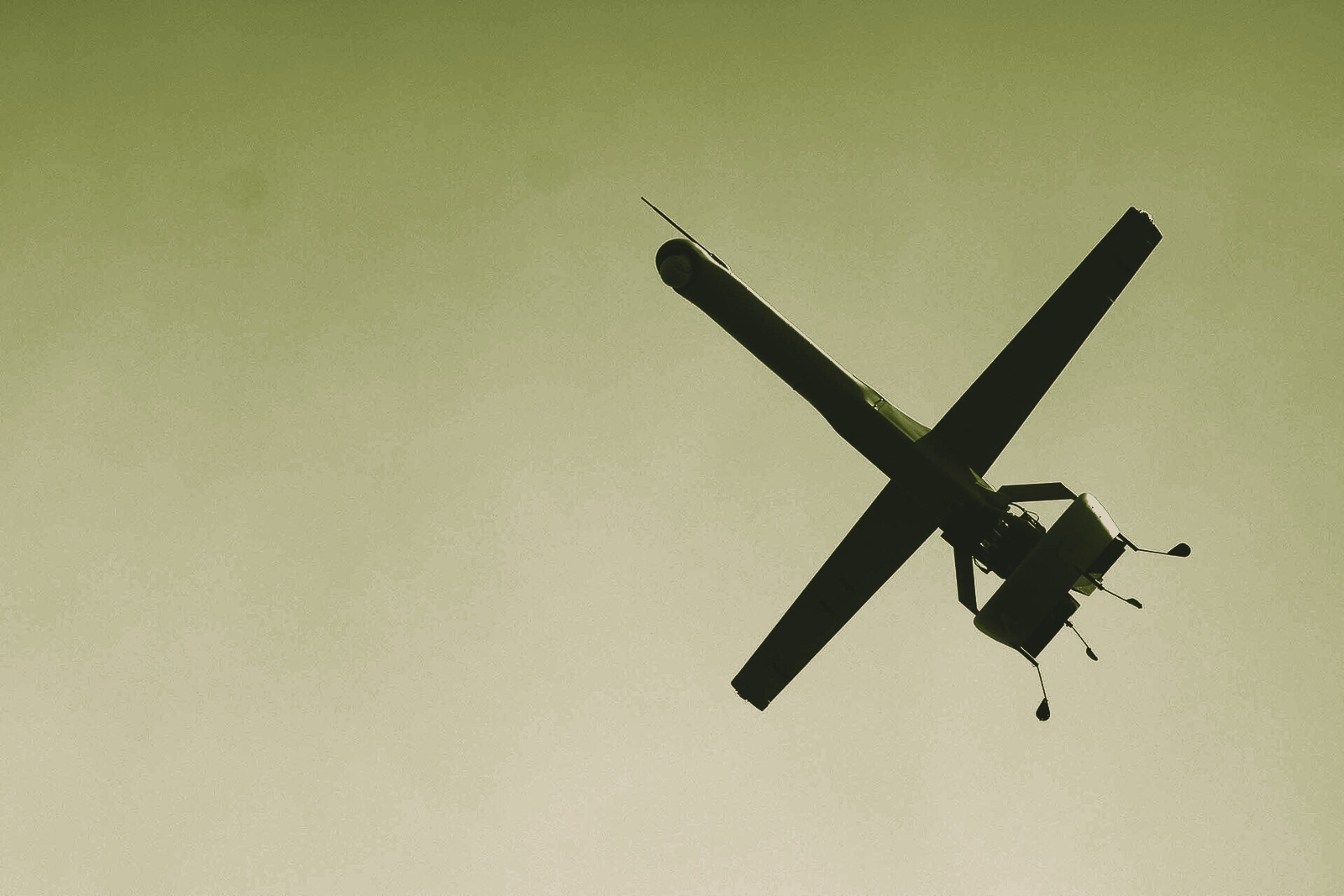
Shield AI V-BAT
FIG.01 · USA Image - Shield AI V-BAT flying over USS Rushmore. Photo by U.S. Marine Corps photo by Lance Cpl. Manuel Alvarado, Public domain, via Wikimedia Commons.
A runway-independent, ducted-fan VTOL uncrewed aircraft that provides long-endurance ISR and targeting in GPS- and comms-denied environments, fielded by the US and allied forces and proven under Russian electronic warfare in Ukraine.

Overview

The V-BAT, designated MQ-35A in US service, is a Group 3 tail-sitter unmanned aerial system built around a single enclosed ducted fan. Shield AI designed it for expeditionary intelligence, surveillance, reconnaissance and targeting (ISR-T) from land or ships without runways, and markets it as delivering “Group 4/5 capability in a Group 3 package.” The airframe is paired with the company’s Hivemind AI pilot, which allows flight in GPS- and communications-denied environments – a feature that has anchored its rapid adoption by the US Navy, Marine Corps and Coast Guard, as well as a widening set of international operators from Japan to Ukraine.

Development

Shield AI acquired the original V-BAT airframe from Martin UAV in 2021 and fused it with the Hivemind autonomy stack that had already flown quadcopters, unmanned jets and F-16-class surrogate aircraft, according to company records collated by Wikipedia. A three-ship autonomous teaming demonstration under an AFWERX contract followed in August 2023, after which the company announced swarm capability. The most significant hardware step came in April 2025, when Shield AI unveiled a block upgrade that added satellite-communications (SATCOM), a JP-5 heavy-fuel engine, and fully unassisted vertical takeoff and landing. By early 2025 Shield AI had raised $240 million at a $5.3 billion valuation, with strategic investors including L3Harris and Hanwha, reflecting rapid growth of the platform’s order book.

Design & capabilities

The V-BAT is a tail-sitter that launches and recovers vertically from a 4.6-metre-square pad or the deck of a moving ship, eliminating the need for a runway or exposed rotors, as described on the manufacturer’s product page. Endurance reaches 12 hours with a standard electro-optical/infrared (EO/IR) payload and extends to 13-plus hours with the heavy-fuel engine block upgrade. Datalink options include the MPU5 mesh radio (control range roughly 130 km), a C-band radio (180 km), and SATCOM for beyond-line-of-sight operations. The airframe carries up to 18.1 kg of payload in three open bays, powering a gyro-stabilised EO/IR gimbal with a laser rangefinder/designator, a ViDAR passive optical search system that the company says covers 3,140 square nautical miles per hour, and optional synthetic-aperture radar.

Electromagnetic resilience is a defining trait: the aircraft flew within 1,000 metres of Russian jammers during June 2024 Ukraine testing without loss of function, a feat documented by Defense One. That hardiness relies on Hivemind’s visual-odometry navigation, which lets the V-BAT fly a mission and land autonomously without GPS or a command link.

Variants

  • V-BAT 118 / 128 – Martin UAV-era prototypes and initial production models.
  • MQ-35A V-BAT – Current US-designated production standard with Hivemind integration.
  • 2025 block upgrade – Adds SATCOM BLOS, JP-5 heavy-fuel engine and unassisted VTOL; Shield AI calls it “Hivemind-ready.”
  • V-BAT Teams – Multi-aircraft autonomous teaming configuration validated in the AFWERX swarming demo, with three-ship cooperation announced in October 2023.

Combat record / operational use

The V-BAT’s operational signature is stamped in Ukraine. After a June 2024 electronic-warfare trial in which the aircraft operated without disruption right next to active jammers, Ukrainian special operators used it in August 2024 to locate an SA-11 Buk surface-to-air missile system deep behind the front: the drone launched about 40 km behind the line of contact, penetrated roughly 100 km under heavy jamming, found the radar, and cued HIMARS airburst fire that destroyed the battery, according to Shield AI president Brandon Tseng and a redacted Ukrainian military report, all covered by Defense One. In January 2025 Shield AI signed a training agreement with Ukraine’s Unmanned Systems Forces and opened a Kyiv office, citing subsequent missions in the Black Sea and strikes cued against strategic Russian SAMs while communications were denied.

US services had already put the V-BAT to work: it deployed on nearly every Navy ship class and with all seven Marine Expeditionary Units from 2021, and the Coast Guard cleared it for full operational deployment in 2025 under a $198 million ISR-services contract. Japan’s Maritime Self-Defense Force selected the V-BAT as its first shipboard unmanned ISR platform in January 2025, a deal documented by Breaking Defense. The Netherlands received operational approval for 12 systems in March 2026, and Romania, Greece, Indonesia, and Brazil have also introduced the platform.

Advantages

  • Proven jamming resilience: operated within 1 000 m of Russian emitters without losing link, then executed a deep targeting mission that eliminated an SA-11.
  • Runway independence with the smallest practical footprint – two-person crew, 30-minute setup, and landing on moving ships in sea states up to 25-knot winds.
  • Long persistence for its class (12–13+ hours) allows it to loiter long enough to find and track high-value targets that short-endurance tactical drones miss.
  • Ducted-fan configuration removes exposed rotors, making deck-handling safer and reducing radar cross-section.
  • Hivemind autonomy lineage – the same AI pilot that flies F-16-class jets – has demonstrated three-ship autonomous teaming, laying the groundwork for swarming.

Drawbacks / limitations

  • Safety record: an April 2024 landing accident partially severed a Navy sailor’s fingers, and Reuters reported in mid-2026 that about 50 of 200 upgraded airframes had been lost in accidents.
  • Slow (~90 km/h) and unarmed in baseline configuration; it relies on external fires such as HIMARS or one-way attack drones to convert its targeting into effects, a kill-chain that Ukrainian units initially struggled to organise.
  • Modest 18.1 kg payload limits simultaneous multi-sensor and weapons carriage; endurance drops as payload mass rises.
  • Premium pricing relative to attritable drones places it in the “mini-Reaper” tier, with US service contracts in the hundreds of millions rather than a mass-procurement price point.

Counterparts

  • Orlan-10 (Russia) – a smaller, less jam-resistant fixed-wing ISR drone widely used for artillery spotting; the V-BAT counters it with endurance and autonomy in denied environments.
  • CH-4 Rainbow (China) – a larger, armed MALE UAV with satellite-control capability but no demonstrated ability to operate inside intense jamming without a datalink.

Outlook

The order book is expanding rapidly: the US Navy selected the V-BAT in April 2026 to compete for up to $800 million in contractor-operated ISR task orders, a development announced by The Defense Post, while Japan, the Netherlands and India are building fleet-scale programs. Weaponisation is the next frontier – Shield AI has prototyped launches of Northrop Grumman Hatchet laser-guided munitions and partnered with South Korea’s LIG Nex1 to integrate small guided missiles, a trajectory outlined by Business Insider. The company’s $13 billion valuation as of 2026, driven by the Ukraine record, anchors its sales pitch, though the accident attrition reported by Reuters (cited via Wikipedia) and growing competition in runway-independent Group 3 ISR will test the V-BAT’s momentum.

Key specifications

Spec Value
Type VTOL tail-sitter UAS, single enclosed ducted fan
Endurance 12+ h (13+ h with JP-5 heavy-fuel engine)
Range 130 km (MPU5), 180 km (C-band), BLOS via SATCOM; ~300 mi (480 km) mission radius reported in Ukraine
Cruise / max speed ~90 km/h (56 mph)
Payload up to 18.1 kg (40 lb)
Datalink / control MPU5 mesh, C-band, SATCOM BLOS; Hivemind AI pilot with visual-odometry autonomy
Autonomy level High – GPS/comms-denied autonomous flight, swarming, visual-odometry navigation
Dimensions / MTOW length 3.8 m, wingspan 2.9 m; MTOW 73 kg (161 lb)
Launch & recovery Vertical takeoff/landing from 4.6×4.6 m zones, moving ship decks up to 25 kt winds, 10 kt ship speed

Sources

  1. Shield AI — V-BAT product page. https://shield.ai/v-bat/
  2. Shield AI — “Shield AI unveils V-BAT block upgrade powered by Hivemind…” https://shield.ai/shield-ai-unveils-v-bat-block-upgrade-powered-by-hivemind-advanced-autonomy-satcom-and-heavy-fuel-engine-among-new-features/
  3. Shield AI — “Shield AI starts training with Ukraine’s Unmanned Systems Forces…” https://shield.ai/shield-ai-starts-training-with-ukraines-unmanned-systems-forces-establishes-local-presence-in-ukraine/
  4. Defense One — “US-made jam-resistant drones are helping Ukrainians cut through Russia EW.” https://www.defenseone.com/technology/2024/10/us-made-jam-resistant-drones-are-helping-ukrainians-cut-through-russia-ew/400735/
  5. Defense One — “Shield AI drones demonstrate autonomous teaming under USAF contract.” https://www.defenseone.com/technology/2023/08/shield-ai-drones-demonstrate-autonomous-teaming-under-usaf-contract/389857/
  6. Breaking Defense — “Japan inks deal with Shield AI for sea-based V-BAT drones.” https://breakingdefense.com/2025/01/japan-inks-deal-with-shield-ai-for-sea-based-v-bat-drones/
  7. The Defense Post — “Shield AI’s V-BAT Drone to Compete for Up to $800M in US Navy ISR Contracts.” https://thedefensepost.com/2026/04/21/shield-ai-us-navy-isr/
  8. TechCrunch — “Shield AI raises $240M at a $5.3B valuation to commercialize its AI drone tech.” https://techcrunch.com/2025/03/06/shield-ai-raises-240-million-at-a-5-3-billion-valuation-to-commercialize-its-ai-drone-tech/
  9. Business Insider — “Drone maker Shield AI says putting bombs on everything isn’t necessary…” https://www.businessinsider.com/shield-ai-brandon-tseng-weapons-v-bat-ukraine-recon-korea-2026-2
  10. Wikipedia — “Shield AI MQ-35 V-BAT.” https://en.wikipedia.org/wiki/Shield_AI_MQ-35_V-BAT
FIELD DISPATCH · WEEKLY

BattlePolicy Weekly — free.

Defense tech, startups, and security — weekly. No paywall.

Related
USA · missiles · loitering-munition · vtol · autonomous · ai-guided · man-portable · AndurilPro

Anduril Bolt-M

Anduril's man-portable VTOL loitering munition — AI-guided, returnable if no strike, and the U.S. Marine Corps' first squad-level autonomous organic precision fires system, ordered under the $249M OPF-L program.

USA · missiles · loitering-munition · vtol · autonomous · ai-guided · man-portable · Anduril
USA · drones · autonomous · tanker · carrier · navy · unmanned · aerial-refuelingPro

MQ-25 Stingray

The U.S. Navy's first operational carrier-based unmanned system—a dedicated aerial tanker designed to free Super Hornets from buddy-tanking and extend the reach of the carrier air wing.

USA · drones · autonomous · tanker · carrier · navy · unmanned · aerial-refueling
USA · Air · fighter · multirole · aesa · semi-stealth · indigenous · 4-5-generation · asia-pacificPro

KF-21 Boramae

South Korea's indigenous 4.5-generation twin-engine fighter—a semi-stealth, AESA-equipped multirole platform designed to replace legacy ROKAF jets and compete for export orders among nations that cannot obtain the F-35.

USA · Air · fighter · multirole · aesa · semi-stealth · indigenous · 4-5-generation · asia-pacific