After FCAS, four combat drones compete for Germany's 2029 wingman order
France and Germany killed the New Generation Fighter on June 8. At ILA Berlin two days later, Boeing, Airbus, General Atomics and Helsing were already selling its replacement, on a 2029 clock.
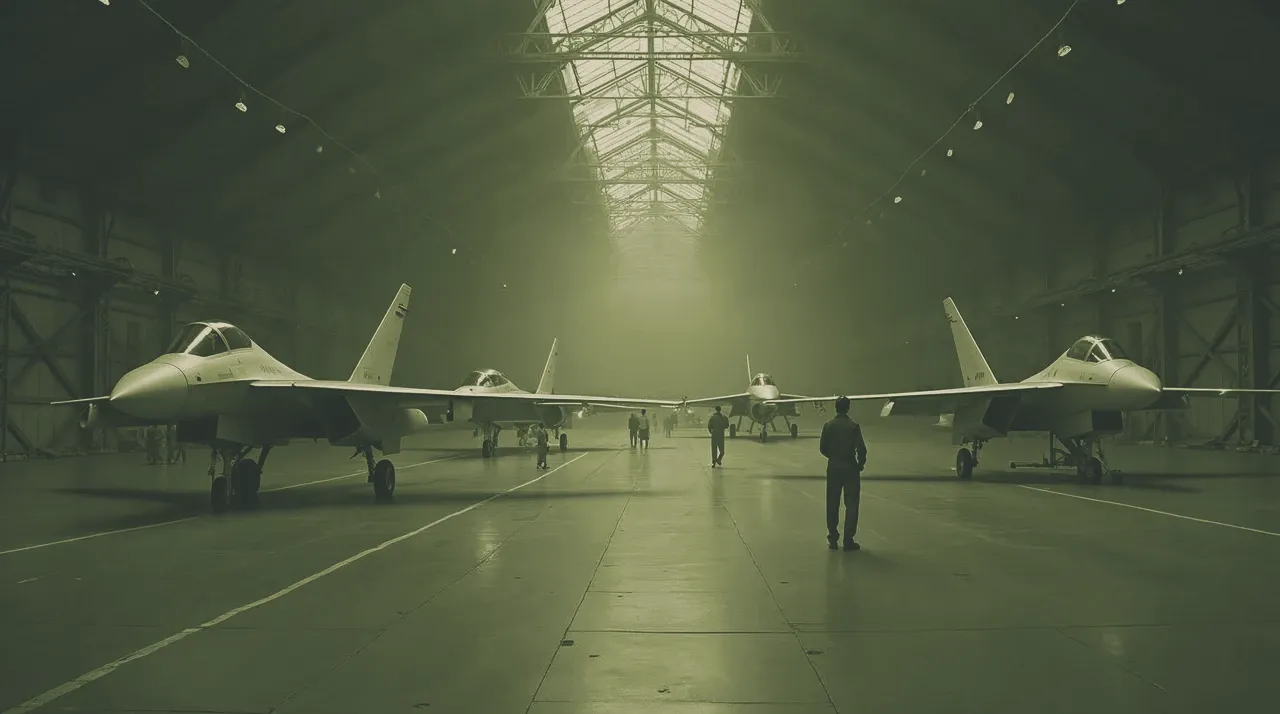
France and Germany killed the New Generation Fighter on June 8. At ILA Berlin two days later, Boeing, Airbus, General Atomics and Helsing were already selling its replacement, on a 2029 clock.
Europe's flagship fighter program is dead, and the competition that inherits its role opened on a Berlin show floor 48 hours later. France and Germany have stopped work on the Future Combat Air System's crewed New Generation Fighter after industrial mediation between Dassault and Airbus failed, Der Spiegel, Reuters and the Financial Times reported on June 8. The €100 billion program, launched in 2017 to replace the Eurofighter and Rafale from around 2040, ran nine years without flying a demonstrator. When ILA Berlin opened on June 10, at least four full-size combat drones or models stood on the floor at Schoenefeld, each aimed at the same Luftwaffe wingman requirement, per Breaking Defense.
Germany is the customer that decides it. Defense Minister Boris Pistorius has said Russia could be ready to attack NATO by 2029, and Rheinmetall's chief executive used the same year as his delivery deadline at the show, according to Breaking Defense. Whatever drone Berlin picks will do more than fill a Luftwaffe gap. With the crewed fighter gone, it sets the architecture European air forces build around for the next decade.
Four airframes at Schoenefeld
The most mature bid arrived by transport aircraft. Boeing Australia and Rheinmetall pulled a white sheet off an MQ-28 Ghost Bat flown in from Australia and detailed its Block 3 configuration: a wing 25 percent larger, thrust raised from 10,000 to 12,000 pounds, an extra 2,000 pounds of fuel and stores, and internal bays sized for two AIM-120 missiles or four Small Diameter Bombs, The War Zone detailed. Earlier blocks have flown more than 150 test sorties in Australia and the United States. Program director Glen Ferguson said the first Block 3 aircraft will be built next year, with Australian service planned for 2028, which he expects to make it the first operational CCA anywhere in the world.
"At the moment, we are still in negotiations with the German government, but if they want to have the plane by 2029, my expectation is that by at least next year, we have to go into the final stage of negotiating the contract," Rheinmetall CEO Armin Papperger told Breaking Defense. A German defense ministry spokesperson declined to comment ahead of parliamentary deliberations.
Airbus answered with a portfolio reorganization the day before the show opened. Its June 9 release introduced a "U" prefix for uncrewed aircraft and two wingman offers: the U740 Valkyrie, a Kratos airframe carrying Airbus's MARS mission software that the company says will reach the Luftwaffe as a sovereign operational drone by 2029, and the U760 Ravenstorm, a new design 13 meters long with a 10-meter wingspan, pitched for precision strike, air-to-air defense and electronic warfare, available in the early 2030s. The War Zone read the timing plainly: the Ravenstorm appeared days after the NGF's collapse left combat drones as the likeliest carrier of Europe's air-combat ambitions.
General Atomics brought a full-size Gambit and the bluntest pitch on the floor. "We don't need to go to block whatever to add a weapons bay and all the rest, we're ready today," spokesperson C. Mark Brinkely told Breaking Defense. Helsing parked its CA-1 Europa near the entrance and announced a second variant the same morning.
An escort jammer with a 100-kilometer reach
That variant shows where the discriminating mission sits. The CA-1EA Helsing unveiled on June 10 is an unmanned escort jammer, built to fly ahead of a strike package, locate air-defense radars and drown them out. Hensoldt supplies the Kalaetron electronic-attack payload, fed by a second onboard generator and effective out to roughly 100 kilometers, Aviation Week reported. The jammer keeps 250 kilograms of payload for short-range anti-radar missiles, half the strike variant's 500, and shares its airframe, engine, autonomy software and ground stations with the CA-1KA. The escort arithmetic, per Aviation Week: one jammer shields a single combat drone through to its target, while two Eurofighters take four escorts, flying ahead because the drones are slower.
The battlefield and the startup story — free in your inbox every week. No paywall.
Subscribe Free →No European air force fields a dedicated escort jammer today; the Western benchmark is the US Navy's crewed EA-18G Growler, hartpunkt noted. The Luftwaffe has been running a competition for airborne electronic attack spanning escort, standoff and stand-in jammers, according to Aviation Week, and its incoming Eurofighter EK electronic-warfare jets carry a requirement for an uncrewed companion, The War Zone wrote, a role Airbus is earmarking for the Ravenstorm. The demand reaches past Germany. "When it comes to electronic warfare, I would say there is an urgent need, especially in Europe, to complement what the United States has helped us with over time," Swedish air force Colonel Frederik Süsskind told reporters, per Meta-Defense.
Fifteen kills at Pabradė
The requirement is being written by the war in Ukraine, where jamming decides which drones still find targets. Helsing's case study ran the week before the show. At the US Army's Project Flytrap counter-drone exercise in Pabradė, Lithuania, the company's HX-2 strike drones scored 15 kills and two near-misses across 17 aircraft, out of roughly 200 drone flights in the exercise, Axios reported.
Army chief technology officer Alex Miller told Axios the HX-2 was designed as a one-way attack and counter-drone system, but soldiers repurposed it on the spot: "users that I spoke with informed me they were using it as a recon platform and a loitering munition, because it was able to find and track targets with onboard computer vision and fly even under jamming." Gen. Christopher Donahue, who commands US Army Europe and Africa, was photographed at the exercise over an HX-2 transport case. The capability the CA-1EA scales up to aircraft size, operating inside a contested spectrum and degrading it for the other side, is the one the HX-2 just demonstrated at infantry scale.
$1.2 billion against €100 billion
The market has already priced this shift. Helsing is closing a $1.2 billion round at an $18 billion valuation, led by Dragoneer and co-led by Lightspeed, the Financial Times reported in May. TechCrunch set that against the €600 million the company raised at roughly €12 billion in June 2025, a step-up of about 30 percent in under a year for a firm founded in 2021. The gap to the rest of the European field is wide: Quantum Systems, Germany's other drone unicorn, raised at a valuation above €3 billion in November, and Tekever crossed £1 billion a year earlier, per TechCrunch. German procurement money arrived first, in February, when the Bundestag's budget committee approved an initial €269 million order for HX-2 loitering munitions inside a framework that can grow to €1.46 billion over seven years.
Helsing's CA-1 line is funded privately and built at its Grob Aircraft subsidiary in Tussenhausen. The first aircraft is scheduled to fly in early 2027 with a safety pilot aboard to clear German airspace rules, then autonomously elsewhere in Europe before that year ends, air-domain head Stephanie Lingemann said at the show, per Aviation Week. The CA-1KA targets operational readiness in 2029. FCAS, for comparison, had not flown a demonstrator in nine years of work and was not expected to before the end of the decade.
The dates that decide it
Germany's CCA award now doubles as an architecture decision for the continent. Chancellor Friedrich Merz has proposed that France, Germany and Spain keep building the FCAS combat cloud, the network layer meant to connect fighters, drones and sensors, the Financial Times noted. The aircraft that plug into whatever survives will be the ones Berlin buys in this race. "The expertise in military aircraft construction exists in Germany. German industry can and must now prove its capabilities," Merz said after the collapse, according to DW.
Each bid comes with dates that can be checked. Rheinmetall expects final-stage contract negotiations in 2027 if Germany wants Ghost Bats by 2029, and Boeing plans Australian service in 2028. Helsing flies the CA-1KA in early 2027, shows a pre-series CA-1EA in 2028 and promises the jammer validated for customers in 2031. Airbus commits the Valkyrie to the Luftwaffe in 2029 and the Ravenstorm to the early 2030s. All of those sit against the 2029 readiness date Pistorius has attached to Russia. The nearest checkpoint comes in mid-July, DW reported, when French and German defense officials meet to settle what is left of FCAS.
Illustration. Generated key image, not a photo of the event.
Frequently Asked Questions
Why was the FCAS New Generation Fighter cancelled?
France and Germany ended the crewed fighter after industrial mediation between Dassault and Airbus failed over project leadership, workshare and intellectual property, Der Spiegel, Reuters and the Financial Times reported on June 8, 2026. The €100 billion program had run since 2017 without flying a demonstrator.
Which drones are competing for Germany's CCA requirement?
At least four were shown at ILA Berlin, per Breaking Defense: the Boeing-Rheinmetall MQ-28 Ghost Bat Block 3, Airbus's U740 Valkyrie (with Kratos) and U760 Ravenstorm, a General Atomics Gambit-family drone, and Helsing's CA-1 Europa family, including the new CA-1EA jammer variant.
Why does 2029 matter so much?
German Defense Minister Boris Pistorius has said Russia could be ready to attack NATO by 2029. Rheinmetall CEO Armin Papperger cited the same year as the Ghost Bat delivery target, telling Breaking Defense that final contract negotiations would need to start by 2027 to meet it.
What makes electronic warfare the key mission in this race?
No European air force operates a dedicated escort jammer; the Western benchmark is the crewed US Navy EA-18G Growler, hartpunkt noted. The Luftwaffe is running an airborne electronic-attack competition, per Aviation Week, and both Helsing's CA-1EA and Airbus's Ravenstorm are pitched at that gap.
How is Helsing funding its combat aircraft?
Privately. The company is closing a $1.2 billion round at an $18 billion valuation led by Dragoneer with Lightspeed, the Financial Times reported in May 2026, up from roughly €12 billion a year earlier. Germany's Bundestag separately approved a €269 million HX-2 munitions order in February inside a framework worth up to €1.46 billion.
AI-generated summary, reviewed by an editor. More on our AI guidelines.

Marcus Schuler
Marcus Schuler edits BattlePolicy, a daily defense-technology brief connecting the companies and capabilities behind modern war to the contest among Europe, the US, Russia, and China.