The Wire · live GRID-REF 37°47′N 122°25′W
DISPATCH 03/26 · 4 Sep 2026
BattlePolicy
Startup to front line. Strategy to consequence.
Lexicon · Russia

Geran-5

The largest and fastest member of Russia's Geran family — a 6-metre, cruise-missile-shaped "missile-drone" flying at up to 600 km/h with a 90 kg warhead, air-launchable from a Su-25 and reportedly able to carry an air-to-air missile of its own.
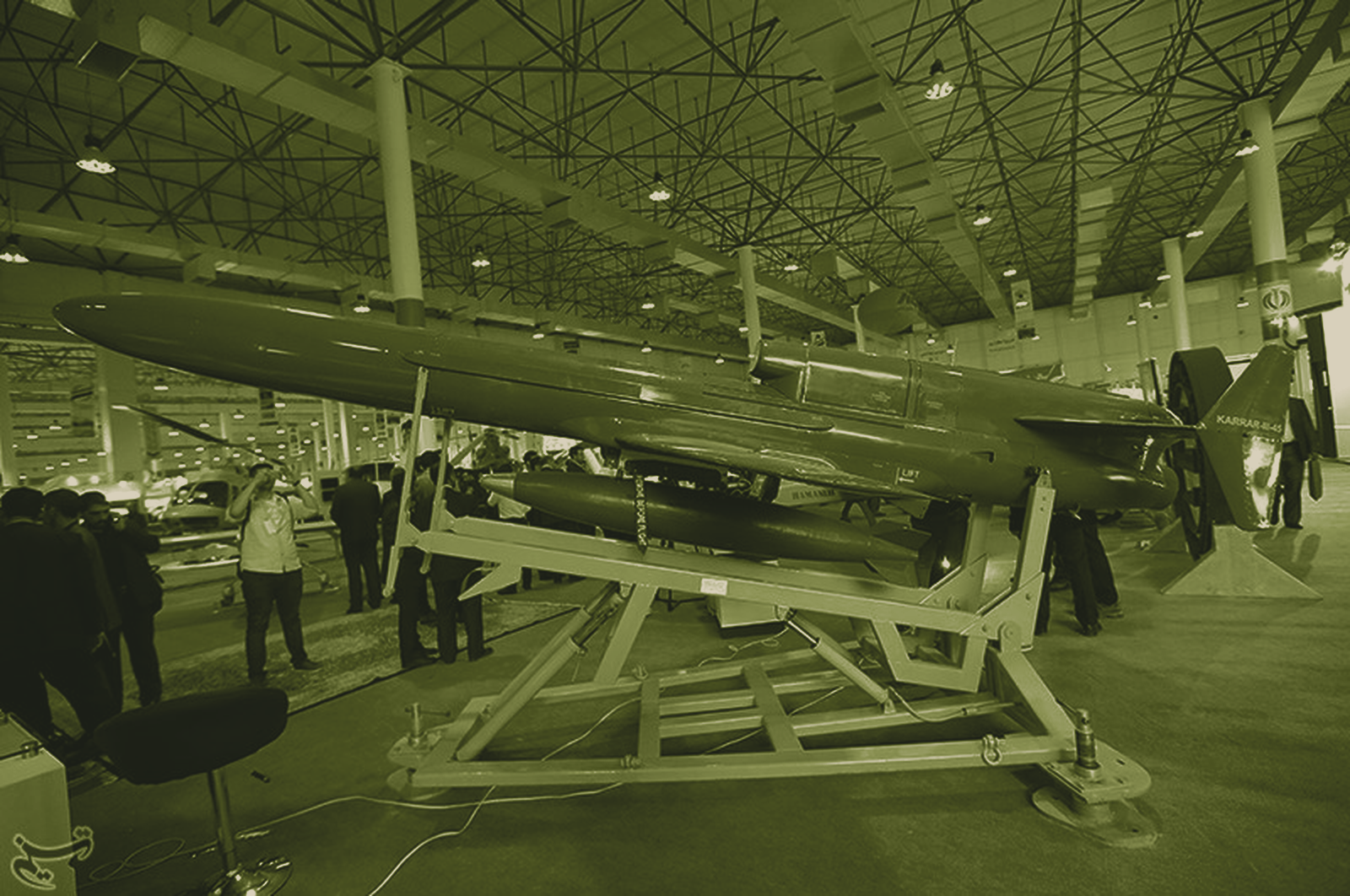
The largest and fastest member of Russia's Geran family, and the one that stopped looking like a Shahed. Six metres long, cruise-missile shaped, up to 600 km/h on a Chinese turbojet, with a 90 kg warhead, the ability to be dropped from a Su-25 in flight and — per Ukrainian intelligence — to carry an air-to-air missile of its own.

Overview

The Geran-5 (Герань-5) is a jet-powered long-range one-way attack drone that abandons the delta-wing Shahed planform its predecessors inherited. Its airframe resembles a small cruise missile, and Ukrainian analysts classify it as a "missile-drone" — a category between a loitering munition and a subsonic cruise missile that Ukrainian manufacturers are developing in parallel. Ukraine's Defence Intelligence (DIU) identified the type on 11 January 2026 after its first combat use against Ukrainian territory, and assessed that it is most likely not an indigenous Russian development, citing significant technological similarity to the Iranian Karrar.

Built at the Alabuga special economic zone in Tatarstan alongside the Geran-4, the two types together account for roughly 3,000 airframes a month as of August 2026 — more than the piston Geran-2 line they are displacing. The Geran-5 is the heavier half of that pair: a 90 kg warhead against the Geran-4's 50 kg, a declared strike range of about 1,000 km, and the family's most powerful engine.

A note on the figures. Almost every specification here traces to Ukrainian intelligence disclosures or open-source photographic analysis, and the range figure in particular is genuinely contested: DIU and Militarnyi report about 1,000 km, a Ukrainian intelligence official told RFE/RL up to 950 km, and several outlets citing open sources give roughly 550–600 km. Both bands appear below with attribution.

Development

The Geran-5 is the third and largest rung of Russia's jet-drone ladder, after the transitional Geran-3 — whose production DIU says was halted in August 2026 — and the Geran-4. Where the Geran-3 was a turbojet bolted to a re-used Geran-2 body and the Geran-4 a reinforced delta built for speed, the Geran-5 discards the shared aerodynamic lineage entirely.

DIU's assessment that the design is not Russian in origin points to the Iranian Karrar, a jet-powered Iranian target drone and strike platform whose configuration the Geran-5 closely resembles — continuing the pattern by which every Geran variant descends from an Iranian design that Russia localizes and then iterates faster than Iran does. Launch infrastructure for the type was identified near the village of Tsymbulova in Oryol Oblast by April 2026, where analysts recorded a launch rail roughly 80 m long, about three times the length of a standard Shahed launcher; Donetsk Airport is the only other known jet-Geran launch site.

The drone was displayed publicly in Russia on 9 May 2026, three months after its combat debut. Production sits with JSC SEZ PPT Alabuga at Yelabuga, with other Russian enterprises supplying components; satellite imagery from early July 2026 showed new production halls under construction inside the zone since May.

Design & capabilities

The Geran-5 is roughly 6 m long with a wingspan of up to 5.5 m and a take-off mass of about 850 kg — near double the Geran-4's 450 kg. Power comes from a Chinese Telefly TF-TJ2000A turbojet rated at 2,000 N (about 200 kgf), the most powerful engine in the family and, per Militarnyi, the same unit reported on some Geran-4 airframes. Reported speed is 450–600 km/h, making it the fastest Geran; by comparison the Geran-2 manages about 180 km/h. Cruise altitude is generally given as 200 m to 3 km with a ceiling around 6 km.

The warhead is 90 kg, high-explosive fragmentation or thermobaric, with Russian-language reporting suggesting 120–130 kg is possible if fuel is traded for payload — a claim that should be treated as unverified. Declared strike range is about 1,000 km per DIU.

Guidance is the most distinctive element. Per DIU's January 2026 disclosure, the Geran-5 navigates using a 12-channel Kometa satellite-navigation module, a tracker built on a Raspberry microcomputer, and 3G/4G modems — a mix of hardened military anti-jam hardware and commercial single-board computing that is characteristic of the whole Geran programme. Reporting from August 2026 describes an artificial-intelligence electro-optical targeting system, or machine vision, supplementing the base guidance. Ukrainian intelligence told RFE/RL that the newest jet Gerans are flown online by an operator through MESH modems costing around $3,500 rather than to pre-programmed coordinates, allowing target selection in flight.

Two capabilities set the Geran-5 apart from every other drone in the family, both reported by DIU and both still unproven in practice:

  • Air launch. DIU states the Geran-5 can be released in flight from airborne platforms including the Su-25 attack aircraft; open-source photographs show the drone carried under a Su-25 wing. Air launch would extend effective reach well beyond the ground-launched figure and complicate the counter-battery targeting of fixed launch sites.
  • Air-to-air armament. In addition to its warhead, DIU reports the airframe can be fitted with R-73 infrared-homing air-to-air missiles, which would turn a strike drone into a platform able to engage the helicopters and light aircraft Ukraine uses for drone interception. Militarnyi's own caveat stands: "the key question remains the practical implementation of this concept and the technical feasibility of employing the R-73 in this role."

Variants

  • Geran-5 (baseline): The ground-launched configuration described above — TF-TJ2000A turbojet, 90 kg warhead, ~1,000 km declared.
  • Machine-vision / AI-seeker: Reported from August 2026 as carrying an AI-driven electro-optical targeting system in addition to satellite and inertial navigation.
  • Air-launched (Su-25): Carried and released in flight from a Su-25; photographed under-wing, operational scale unknown.
  • R-73-armed (unconfirmed): Fitted with an infrared-homing air-to-air missile alongside the main warhead. Reported by DIU; no confirmed air-to-air engagement is documented.

Related but distinct family members: the delta-wing Geran-4, the cancelled Geran-3, the piston Geran-2/Shahed-136, and the cheap Gerbera decoys that fly in the same packages.

Combat record / operational use

Russia first used the Geran-5 against Ukraine in January 2026, and DIU published the identification on 11 January along with photographs of wreckage from a destroyed airframe. Use stayed limited through the spring while launch infrastructure was built out at Tsymbulova, and the drone was shown publicly on 9 May 2026.

Employment climbed sharply in the second half of 2026. The Russian military roughly tripled its use of the type in the weeks to late August, according to open-source video analysis, and on 22 August 2026 a Geran-5 struck a target in western Ukraine after a flight of about 900 km — the longest documented mission for the type and evidence for the higher end of its contested range band. The first detailed photographs of an intact airframe circulated on 25 August 2026.

The Geran-5 flies as part of the broader jet-drone surge rather than alone. Russia deployed five times as many jet-powered drones in July 2026 as in June, and in some raids turbojet types made up half to two-thirds of the package; on 1 September Ukrainian air defence downed 82 attack drones during daylight hours, 57 of them jet-powered. Targeting has concentrated on energy infrastructure and, since July, logistics — warehousing, rail, and the ports of Odesa and Mykolaiv.

Interception is the open problem. A Ukrainian counter-drone specialist told RFE/RL in August 2026 that there is "no effective means that can intercept them on a large scale and with certainty." Ukraine accepted its first jet-powered interceptor, the Alexa Spatium, into service on 21 August 2026, and Defence Minister Yevhen Khmara said on 30 August that four candidate interceptors had been field-tested against jet Gerans, with scaling to thousands of units the immediate priority.

Advantages

  • Fastest in the family — 450–600 km/h against 180 km/h for the piston Geran-2, outside the envelope of the propeller interceptor drones that solved the Shahed problem.
  • Heaviest warhead — 90 kg against the Geran-4's 50 kg, moving the type from harassment into genuine infrastructure damage.
  • Cruise-missile reach at drone cost — a declared ~1,000 km, demonstrated at 900 km, at a fraction of a Kalibr or Kh-101.
  • Air-launch option — Su-25 carriage would extend reach and disperse the launch signature away from fixed, strikeable ground sites.
  • Potential air-to-air role — R-73 carriage, if realised, would directly threaten the crewed aircraft and helicopters Ukraine uses for drone interception.
  • Operator-guided and machine-vision terminal phase — target selection in flight rather than fixed coordinates, and reduced dependence on satellite navigation.

Drawbacks / limitations

  • Contested range — DIU says ~1,000 km, a HUR official says up to 950 km, and several open-source accounts give 550–600 km. The 900 km strike of 22 August supports the higher band but does not settle it.
  • Chinese-engine dependency — the TF-TJ2000A is imported, and Skibitskyi says Russia is "completely dependent" on Chinese supply at roughly $35,000–40,000 per engine.
  • Expensive and large — an 850 kg airframe with the family's costliest engine cannot be produced at Shahed-136 volumes; scale comes from the Geran-4 sharing the line.
  • Unproven headline capabilities — Su-25 air launch and R-73 carriage are both DIU claims supported by photographs rather than by documented operational use; no air-to-air kill has been recorded.
  • Concentrated launch infrastructure — the ~80 m jet launcher is hard to relocate, and only two jet-Geran launch sites are publicly known. Ukrainian strikes on Bryansk Oblast on 1 August 2026 destroyed all three underground facilities storing warheads and fuel for Geran and Gerbera drones.
  • Single-source specification base — nearly all internal detail derives from Ukrainian intelligence disclosures, not independent verification.

Counterparts

  • Geran-4 (Russia) — the smaller, more numerous jet sibling built on the same line.
  • Geran-3 (Russia) — the cancelled transitional type that preceded both.
  • Shahed-136 (Iran/Russia) — the piston baseline the jet family is displacing.
  • Karrar (Iran) — the jet-powered Iranian design DIU assesses as the Geran-5's technological ancestor.
  • Kh-101 and Kalibr (Russia) — the cruise missiles whose deep-strike role the Geran-5 partially assumes at far lower cost.
  • Liutyi (Ukraine) — the Ukrainian long-range one-way attack drone occupying the equivalent niche.

Outlook

The Geran-5 is the point where Russia's drone programme stops being a cheap-mass workaround and starts converging on the cruise missile it was built to substitute for. At 850 kg, 600 km/h and a 90 kg warhead it is closer in capability to a subsonic cruise missile than to the Shahed-136 that began the lineage — while still being produced on a drone line at a drone's price, with the engine as the only genuinely expensive component.

Three questions decide how much that matters. Whether Su-25 air launch and R-73 carriage are real at scale or remain photographs: an air-launched drone that can shoot back at interceptor aircraft is a materially different problem from a fast one-way munition. Whether Russia fields a domestic turbojet and removes the Chinese chokepoint that caps output. And whether Ukraine's four candidate interceptors and the Alexa Spatium reach the thousands-of-units scale needed against a threat now arriving in the hundreds per night. Carnegie's Dara Massicot assessed in late August 2026 that the jet Geran problem will worsen through the winter — increased speed, payload and operator control complicating interception — with counters in the works but not yet in the field.

Key specifications

Spec Value
Type Jet-powered one-way attack "missile-drone" (cruise-missile configuration)
Range ~1,000 km declared (DIU); up to 950 km (HUR official to RFE/RL); ~550–600 km in several open-source accounts. A ~900 km strike was recorded on 22 August 2026
Speed (Mach / km·s⁻¹) 450–600 km/h (~0.37–0.49 Mach); cruise 200 m–3 km, ceiling ~6 km
Warhead (type & weight) 90 kg HE-fragmentation or thermobaric; 120–130 kg reported if fuel is traded for payload (unverified)
Guidance 12-channel Kometa CRPA satnav + Raspberry-based tracker + 3G/4G modems; AI electro-optical/machine-vision targeting reported 2026; MESH operator control
Accuracy (CEP) Not publicly established
Launch platform(s) Ground rail (~80 m jet launcher) — Tsymbulova, Oryol Oblast and Donetsk Airport; air launch from Su-25 reported by DIU
Propulsion Chinese Telefly TF-TJ2000A turbojet, 2,000 N (~200 kgf)
Length / diameter / launch weight ~6 m length; wingspan up to 5.5 m; ~850 kg take-off mass
Secondary armament R-73 infrared-homing air-to-air missile reported by DIU (unconfirmed in use)

Sources

  1. Militarnyi — "Russia Uses New Geran-5 Kamikaze Drone Against Ukraine for the First Time." https://militarnyi.com/en/news/russia-uses-new-geran-5-kamikaze-drone-against-ukraine-for-the-first-time/
  2. Militarnyi — "Russia Produces Around 3,000 Geran-4/5 Kamikaze Drones per Month." https://militarnyi.com/en/news/russia-produces-around-3-000-geran-4-5-kamikaze-drones-per-month/
  3. Militarnyi — "Production of the Geran-4/5 Jet Drones Has Surpassed That of the Geran-2." https://militarnyi.com/en/news/production-of-the-geran-4-5-jet-drones-has-surpassed-that-of-the-geran-2/
  4. Militarnyi — "Geran-5 Drones Deployed Near Oryol for Strikes on Ukraine." https://militarnyi.com/en/news/geran-5-drones-deployed-near-oryol-for-strikes-on-ukraine/
  5. Militarnyi — "Ukraine Tests Four Interceptors to Counter Jet-Powered Geran Drones." https://militarnyi.com/en/news/ukraine-tests-four-interceptors-to-counter-jet-powered-geran-drones/
  6. RFE/RL — "Russia's Jet-Powered Drones: A Major New Threat To Ukraine Amid Speeding Arms Race." https://www.rferl.org/a/russia-ukraine-jet-powered-drones-shahed-geran/33841747.html
  7. Ukrainska Pravda — "Ukrainian intelligence reveals Russia's plans to produce Geran and Gerbera drones." https://www.pravda.com.ua/eng/news/2026/08/10/8048080/
  8. Militarnyi — "Russia Halts Production of Geran-3 Jet-Powered Drones — DIU." https://militarnyi.com/en/news/russia-halts-production-of-geran-3/
  9. Aerospace Global News — "From Geran-5 to Oreshnik: the drones and missiles Russia is using in 2026." https://aerospaceglobalnews.com/news/russia-long-range-strike-drones-missiles/
  10. Militär Aktuell — "New Geran Variants: Russia Launches Attacks with Jet-Powered Kamikaze Drones." https://militaeraktuell.at/en/russia-is-launching-attacks-with-jet-powered-kamikaze-drones/
  11. SouthFront — "Russia Triples Use of Geran-5 Jet-Powered Drones." https://www.southfront.press/russia-triples-use-of-geran-5-jet-powered-drones-videos/
  12. Kyiv Independent — "Ukraine's HUR reveals size of Russia's Geran attack drone stockpile." https://kyivindependent.com/ukraines-hur-reveals-size-of-russias-geran-attack-drone-stockpile/
  13. Defence Intelligence of Ukraine — War&Sanctions weapons components portal. https://war-sanctions.gur.gov.ua/en/components/weapon
🔒 The Analyst Section on Geran-5 is for BattlePolicy Pro members. Below the line: procurement and contract history, the suppliers and companies behind the system, our head-to-head analyst view of the systems it actually competes with, and the BattlePolicy assessment note. Unlock the full file with BattlePolicy Pro →

Below this point

  • Analyst Section
  • Procurement & contracts
  • Suppliers & related companies
  • Comparable systems — analyst view
  • Analyst note
Related
Russia · Ukraine · air defensePro

Igla-S

A shoulder-fired infrared missile that Russia now launches from helicopters to hunt Ukrainian drones — and bolts to Shahed airframes so the drone can shoot back at the aircraft sent to intercept it.

Russia · Ukraine · air defensePro

Strela-10

A 1976 Soviet missile system built to shoot down low-flying jets, now hunting Lancets and Hornets. Its infrared seeker was never designed to find something the size of a quadcopter — which is why Ukraine bolted an electro-optical sight to nine of them.

Ukraine · Russia · air defensePro

ZSU-23-4 Shilka

A 1965 Soviet anti-aircraft gun built to shoot down jets, now one of the cheapest ways Ukraine kills Shahed drones. Sixteen modernised Shilkas funded by a charity recorded their first Shahed shootdowns in December 2025.